
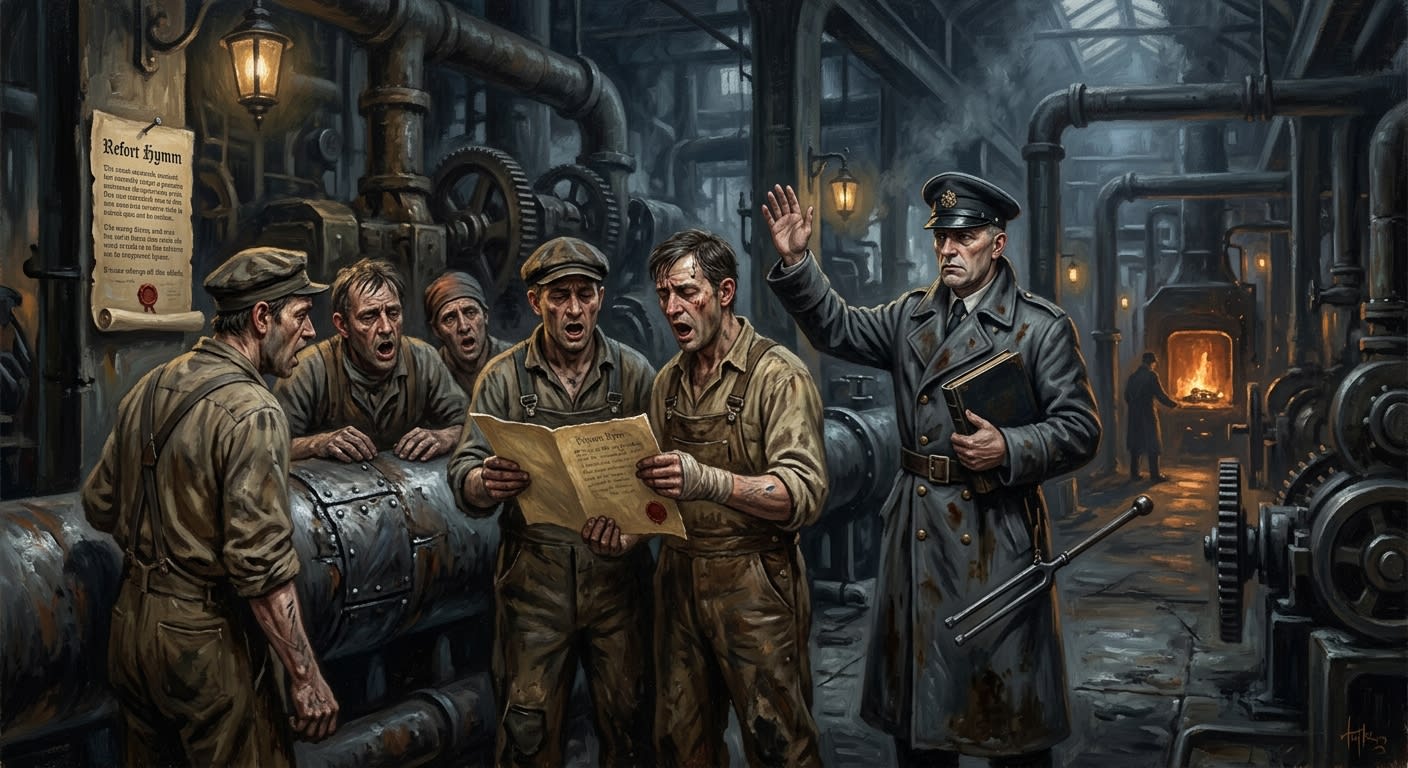
#On the Catastrophe That Taught the Bureau to Sing at Holes
The Gasket Hymn Reform of A.S. 152 was the Synod’s answer to the Furrow of Pest, a wound-site rupture in the southern extraction corridor that killed thirty-seven workers and produced three weeks of wrong flame from every refinery chapel foolish enough to accept its yield. The official description is “joint procedural revision.” This is tidy, accurate, and bloodless, which is to say it belongs in a drawer, not in history.
The truth has heat on it. A seam opened, a hymn failed, a gasket split, thirty-seven men died in positions the Bureau of Records later described as “occupationally consistent,” and the southern fuel line burned green-blue until even the accountants learned to be afraid of colour.
Before the Reform, extraction crews sealed drums by local habit: a muttered closing verse in one corridor, three hammer taps in another, a bell-scrap tied to the clamp in a third, an old prospector’s spit in places whose names the Bureau of Purity would prefer not to know. Some crews used chapel sleds. Some used a portable relic. Some used nothing but speed. The drums still moved. The furnaces still ate. Strasbourg, seeing fuel arrive, performed its usual miracle of not asking.
#On the Furrow of Pest
The Furrow lay in the southern corridor, beyond the comfortable geography of maps and just west enough of the Line for the Synod to call it “licensed ground.” It had been listed as low-yield, low-risk, intermittently sour, and commercially unattractive. These classifications possess the spiritual value of umbrellas in artillery weather.

A charter crew entered after first bell carrying standard stakes, chalk salt, three gasket drums, a hand-pump, a chapel sled with cracked runners, and a hymn singer whose name survives in two spellings and, by Records doctrine, may have been two people. The seam responded to the tap with a pressure pitch below middle bell-toll, steady at first, then falling in small steps. The survey scribe marked the fall. The foreman ordered the draw continued. Quota is the oldest demon with a ledger.
At fourth bell the first drum began to tremble. At fifth the singer changed cadence, either by training, terror, or improvisation. Witnesses disagreed. The pump crew tried to slow the draw. The seam answered on the same pitch as the singer’s throat. Then the gasket failed.
A proper failure is loud. This one was courteous. The clamps opened without shattering. The wax lifted clean from the drum-mouth. The vapour rose in a column the colour of bruised brass, paused above the chapel sled, and entered the singers’ mouths before the men had time to flee. Those nearest the drum died standing. Those farther off ran burning without visible fire. The thirty-seventh man reached the second shrine-stake and wrote the first two letters of his mother’s name in chalk salt before his hand turned black.
FURROW OF PEST — MERCY FIELD DIGEST, SEALED ANNEX Bodies recovered: ██ complete, ███ partial, █ respirating without thoracic integrity. Observed flame: green-blue, cold to exposed metal, scalding to skin, responsive to spoken cadence. Disposition of hymn singer: █████████████████████. Recommendation: do not cremate in ordinary furnace.
The wrong flame travelled with the yield. Refineries at three nodes reported clean ignition followed by impossible colour. Boiler rooms smelled of wet soil. Bell plates rang in response to no strike. A kitchen furnace in a pilgrim hospice burned soup to ash while leaving the iron pot rimed with frost. Engines called it contaminated fuel. Bells called it cadence failure. Doctrine called it a lesson because Doctrine had not yet decided who was at fault.
#On the Joint Initiative
The joint commission assembled in Strasbourg with admirable speed, by which I mean after the dead were buried, the fuel was spent, and the charter house had filed for loss relief. Engines & Furnaces arrived with pressure charts, clamp fragments, wax samples, drum measurements, and three technicians who had slept badly enough to tell the truth. The Bureau of Bells arrived with pitch tables, tremor notations, seven revised cadences, and a senior cantor who regarded every engineer as an under-baptised kettle.
The Bureau of Rites was consulted. It declined.
The Reform’s genius lay in refusing to settle the question. Did the gasket fail because the clamp was poorly seated, because the cadence broke, because the seam answered, because quota pressure forced the draw, because the chapel stood on ground that was not consecrated until after the second stake, or because Hell enjoys paperwork? Yes. The commission placed every cause in sequence and made the sequence mandatory.
Survey. Stake. Chapel placement. Tap. Pressure pitch. Draw. Seal. Closing verse. Transport. Each stage received a cadence, a witness mark, a clamp tolerance, a wax requirement, and a filing destination. The gasket hymn singer ceased to be an ornament dragged along by superstitious crews. He became a licensed instrument. The chapel sled ceased to be pious clutter. It became the minimum sanctified footing beneath the singer’s feet. The old rule, “sing low, pump slow,” became policy, which is what happens when common sense survives long enough to be ruined by forms.
#On the New Hymn
The revised gasket hymn is ugly. This is not criticism. Beauty distracts. The hymn was built to seat drums, pace pumps, steady hands, and deny hostile cadence a place to enter. Its first movement holds the crew at survey pitch. Its second fixes the pump rhythm. Its third forces the singer’s breath down until the throat vibrates through the chapel boards. Its fourth is spoken directly over the gasket wax while the clamps bite. Its fifth, the closing verse, is never printed in public copies because public copies are read by citizens, and citizens should not know how much of their warmth depends on a man singing to a barrel full of wound.
Bells wanted the hymn longer. Engines wanted it shorter. Tithes wanted it cheaper. Records wanted it numbered. Doctrine wanted it phrased in a manner that did not imply the wound was being negotiated with. The final version satisfied no one, a sign of procedural holiness.
Early commentary assigned the Reform to the Bureau of Rites, citing its liturgical character.
Corrected. The Gasket Hymn Reform was a joint act of the Bureau of Bells and the Bureau of Engines & Furnaces. Rites was asked whether sealing demon-seep drums by song possessed precedent. Rites answered with absence, which is the most elegant no in the Synod’s cabinet.
The hymn’s meter was calibrated against pump strokes. Every third syllable marks a hand-motion. Every seventh marks a clamp check. The singer is forbidden to ornament the line. Ornament permits ego; ego permits variation; variation permits a seam to answer in the gap. A cracked voice must stop. A coughing singer must signal. A foreman who orders the draw continued after a cracked signal commits Category Two operational blasphemy, unless yield demand has been issued under War priority, in which case the same act becomes zeal and the dead are praised for efficiency.
#On Enforcement and the New Profession
The Reform gave birth to inspectors before it saved workers. This is the natural order of governance. First the seal, then the hand, then the corpse.
Within six months, every licensed wound-site extraction house was required to carry approved hymn sheets, registered chapel sleds, tuned pitch pipes, clamp-witness cards, and a certified singer whose throat had been examined by Bells and whose payroll had been approved by Engines. A crew without a singer could not draw legal yield. A singer without a chapel could not seal legal drums. A drum without the closing cadence did not exist, except physically, dangerously, and at black-market prices.
The Wound-Site Prospectors hated the Reform, then survived because of it, then hated it with greater sophistication. Vapor deaths dropped. Rupture rates fell. Crews learned to hear pressure before pressure became appetite. Charter houses complained of delay, fees, singer scarcity, chapel maintenance costs, wax spoilage, and the insult of being saved by people with tuning forks.
Black drill crews developed their own answer: cork-and-prayer gasket protocol, cheaper, faster, and survivable often enough to be tempting. The Bureau calls them criminals. The furnace districts call them suppliers when winter runs ahead of doctrine. A black drum bears no hymn mark, no wax stamp, no closing verse. It may burn hot. It may breathe. It may remember the Furrow more vividly than any approved fuel.
#On the Reform’s Present Use
As of A.S. 201 the Gasket Hymn Reform governs every lawful wound-site drum fed to bastion furnaces, refinery chapels, hospital boilers, resonance thumpers, and the private warm rooms of officials who would faint before admitting their comfort depends upon scar-diggers. The Reform has been amended after the Charter Wars, after the Quiet Basin Incident, after counterfeit wax scares, after the Unhymn Infiltration of A.S. 163, and after several incidents whose files carry more black ink than words. Its core remains: the seal must be sung.
The Reform did not make extraction safe. Safety is a nursery word. It made extraction legible. A death after the Reform has a form, a sequence, a failed clause, a witness line, a Bureau to blame, a family to disappoint, and a drum to route. This is progress by Synodic measure.
The Furrow of Pest remains marked in private prospector maps with three short strokes and a hooked line, meaning: seam answers singers; do not trust low pitch; do not camp near old wax. Public maps show nothing unusual. Public maps have delicate nerves.
The Reform ended wrong flame incidents in the southern corridor.
Withdrawn. It ended the first pattern. Other flames have since shown better education.
A singer stands on the chapel sled. A pump crew lowers its hands to the cadence. The seam hums under the pitch. The gasket wax softens. The foreman watches the quota slate. Somewhere in Strasbourg a clerk waits to learn whether the drum exists. The singer opens his mouth and tells the wound what shape obedience will take today.