
#On the Quarter That Heard Nothing
Silence, if neglected, acquires tenants. — Bureau of Orison field note, lower Kanzleiburg, A.S. 149
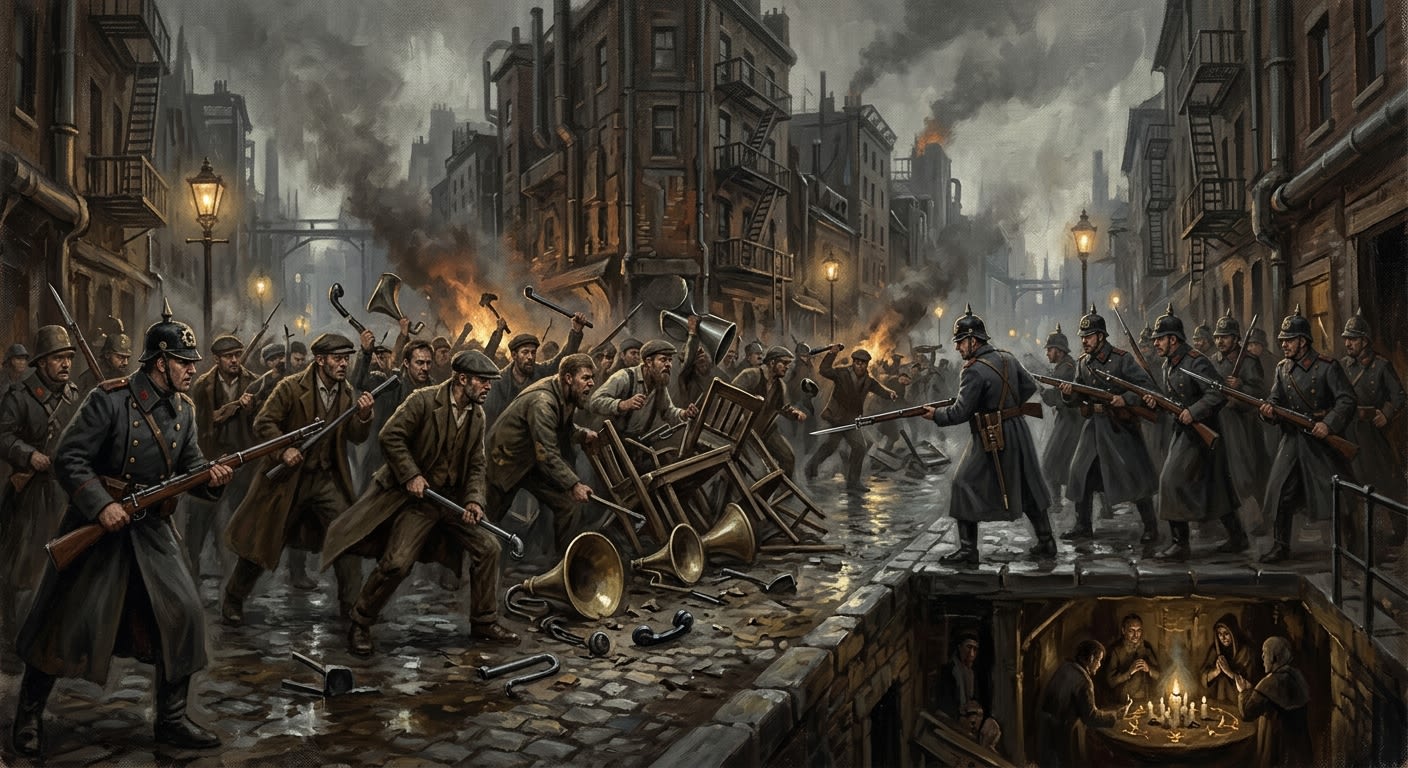
The Quiet Quarter Revolt was the A.S. 149 deadzone rising in the lower wards of Kanzleiburg, where broken receivers, inaudible horns, and storm-wrecked speaker shrines made a hole in the Synod’s voice large enough for pamphlets, prayer circles, cellcraft, and something less easy to file. The district did not begin by rebelling. It began by missing the sermon. The Synod forgave this for three weeks because the maintenance office had better fires to ignore. By the sixth week, sermon tokens returned unstamped. By the ninth, the stairwell chalk disappeared. By the twelfth, the Silent Godless had found the basements.
The Bureau of Purity later called the affair a revolt. Orison called it a coverage failure exploited by subversive elements. Engineering called it a weather casualty. Records filed it under civic disturbance, infrastructure anomaly, and proscribed congregation. All four were correct, which is how one recognises a proper administrative disaster.
#On the Lower Wards
Kanzleiburg is geometry with hunger inside it: broad avenues, numbered districts, lettered sub-districts, Prussian drains, Synodical signs, and three million souls counted downward by Records because a smaller city eats less on paper. The lower wards sit below the confident map, pressed between service canals, rail sidings, old cellar churches, workers’ lodging blocks, and utility corridors whose plans disagree with themselves in three archives. The city above routes grain, coal, orders, soldiers. The city below routes rumours.
The Saint Verena storm tore three rooftop speaker shrines from their housings and cracked the old hornline mast above Unter-Vierundzwanzig, a district whose Prussian number the Synod had officially replaced with “Lower Chapel Sector Twelve” and which no citizen used even at confession. The receivers had already been failing. Their coils spat static. Their casings sweated. Their devotional indicator lamps glowed during silence and went dark during sermon. The Orison Signal Engineers logged the fault, requested copper, received a reprimand for wasteful requisition language, and logged the fault again with better adjectives.
The local Auditors marked the sector Heresy-Adjacent twice, then withdrew the label after complaints from the ward supply office, whose ration queues could not tolerate another branded district that winter. The first mercy was bureaucratic. The second was tactical. The third was cowardice with a stamp.
#On What Silence Fed
At first, the residents improvised. Families gathered beside functioning receivers in neighbouring blocks. Token runners carried slips across sector lines. Old women opened windows toward streets where the horn could faintly be heard, then argued that intention should count. Intention, I regret to report, has never survived contact with a compliance board.
The Silent Godless arrived with the good manners of rats near grain. They did not announce themselves. They asked whether a sermon unheard could bind a conscience. They asked whether the Creator who required tower-horns had misplaced His omnipresence. They asked whether obedience still existed when no one was listening. The questions moved through ration queues, laundry rooms, cellar steps, factory breaks, and the little beer rooms where men speak softly because the ceiling has ears when the walls do not.
Unlicensed prayer circles appeared beside them, which offended the Godless almost as much as it offended Orison. The old cellar piety of the Cellar Saints had never entirely left Kanzleiburg; remove the hornline, and the buried forms wake hungry. Women lit votive stubs beneath water pipes. Men recited chaplets without stamped text. Children learned melodies their schoolmasters could not identify. The district became an argument conducted in whispers: no the Creator, private the Creator, old the Creator, wrong the Creator, no sermon, better sermon, no Bureau.
RECOVERED PURITY TRANSCRIPT — CELLAR 9, LOWER WARD, A.S. 149 Question: Identify the language used in the service. Witness: I do not know. Question: Did it resemble Polish, Prussian, Latin, Dutch, or Old Church tongues? Witness: No. Question: Did you understand any word? Witness: Only my name. Question: Your name was spoken? Witness: Not spoken. Counted. [remaining testimony sealed under Orison-Purity joint restriction]
#On the Clearing
Purity entered at dawn because dawn makes authority look more inevitable than it is. White mantles sealed the stairwells. Brand Authority Officers marked the district boards bruised purple before the first arrests, a procedural inversion later justified as “anticipatory accuracy.” Orison cut the broken horn mast from the roof and installed a relay wagon in the square, where it broadcast the Litany of Correct Reception for seven hours into streets full of people being searched for pamphlets.
The first violence came from a token runner who struck an Auditor with a slate. The second came from a Purity escort who mistook a laundry pulley for a signal cord and shot the man holding it. The third, fourth, and fifth were entered as “crowd correction.” By evening the district had acquired the shape of a lesson: doors chalked, windows open, residents kneeling in courtyards while portable horns shouted over the sobbing. The Choir Rate for the day was recorded at 98.6 percent. Splendid. A neighbourhood surrounded by rifles is almost always devout.
An early Orison circular described the Quiet Quarter as “reconsecrated without fatalities.”
Corrected after Purity objected that the word “without” conflicted with sealed transport records, compensation denials, and the sudden need for thirty-seven replacement household heads. Current phrase: “reconsecrated with acceptable civic loss.”
In Cellar 9, Purity found the service that made the file grow black wax. No licensed priest stood there. No Godless organiser admitted ownership. The walls had been chalked with sermon marks that were correct in form and impossible in sequence, as if an Auditor had inspected the cellar every hour for nineteen days. On a crate sat three piles: Silent Godless microprint, hand-copied prayers, and blank sermon tokens. The blank tokens were warm.
#On the Reforms That Followed
The Synod’s response was swift once blame could be placed where it would not bite upward. The Hornline Reforms required rooftop speaker shrines in every district, published coverage standards, relay wagons for temporary deadzones, calibrated receiver testing, sector maps tied to household rolls, and an Auditor corps whose purpose was to prove that the Word had landed. If the sermon failed to arrive, a ledger would say so. If the ledger said so, a penalty would follow. If the penalty caused unrest, the unrest would prove the district had needed the sermon all along.
This is called policy. Admire the hinge.
The Metric Sanctification Edict of A.S. 158 later gave these reforms their theology. A compliance score became spiritual health. Adjustment became blasphemy. The Sky-Sermon Attendance Auditor became a statutory profession with a stamp heavy enough to dent a household. The Quiet Quarter was cited in the footnotes, then in the training manuals, then in lectures, then in warnings painted above receiver-test benches: If the radio fails, the body answers.
#On the Present File
As of A.S. 201, the Quiet Quarter no longer appears on public maps of Kanzleiburg. Lower Chapel Sector Twelve appears instead, cleanly renamed, thoroughly audited, and equipped with seven rooftop shrines, two relay masts, one permanent Orison office, and a Purity substation whose windows face inward. The old district population was redistributed after the clearing. Their descendants file petitions to return. The petitions are routed, acknowledged, delayed, and placed in a cabinet whose lock has not been opened since A.S. 164.
The Hornline works there now. Too well. Every sermon arrives with bell-perfect force. Every receiver hums. Every window opens on schedule. The Choir Rate has not fallen below ninety-four percent in twelve years, which proves either successful correction or continuing terror. The Bureau records no distinction.
The district listens. The Ledger is satisfied. The basements remain.