

#On the Committee, So Far as the Ledger Knows It
"Geometrically impressive but theologically indefensible."
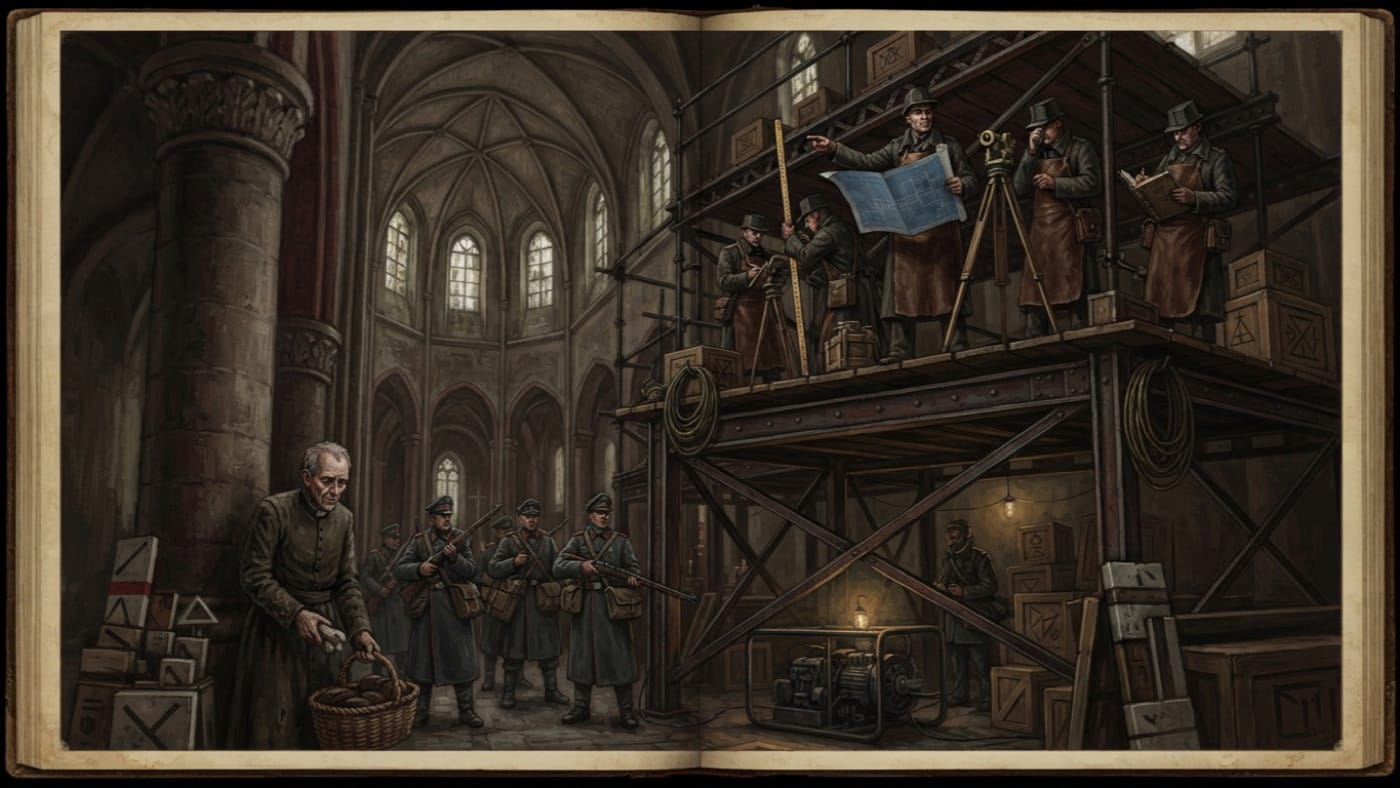
The Rationalist Architecture Committee enters the Ledger through one sentence, and the sentence is a compliment with a knife in it. In the year the Church now reckons as A.S. 31, the Committee surveyed Saint Gereon in Cologne. Saint Gereon was an old Rhineland church on Roman foundations, crowned with a nave of ten sides. The life of Saint Ignatius the Carrier preserves the Committee's finding: the building was "geometrically impressive but theologically indefensible." The Committee then recommended demolition.
That is all the Ledger has of the Committee. It holds no chair, no roll of members, no seat, no founding instrument, no second survey and no date of dissolution. It holds one verdict and what followed from it. Read closely, that verdict tells a Warden more than most institutions confess in a century of minutes.
The setting, at least, is fixed. The Treaty of Regensburg was concluded in A.S. 30 and the Rationalist Republic formally proclaimed. Rationalist administration had been stripping the Rhineland's sacred furniture for years before anyone wrote a treaty to excuse it. The Edict of Ironmouth was in force. Faith was treason. Into that order came a body that worked with the measuring rod instead of the iron wire, and it reached the wrecking crew all the same. The survey suggests the Committee held some general authority over church buildings. If a statute granted that authority, no copy of it has reached the Ledger.
Certain arrangements of the Lore Book place the persecution of the faithful under headings that date the Sundering to A.S. 51–100 and the Atheist Wars to A.S. 101–200.
Those headings are obsolete and are withdrawn. The Treaty of Regensburg and the formal Republic belong to A.S. 30. The Committee's survey of Saint Gereon belongs to A.S. 31. The Sundering fell on the first of November, A.S. 45. A reader who finds the Committee measuring naves in the Church's second century has been reading the wrong folio, and should report to the Bureau of Records so that their habits can be corrected.
#On the Decagon
Ten walls. One conjunction.
The surveyors looked at Saint Gereon and saw what any honest eye sees. Ten walls enclosed the nave, a roof spanned them, and the whole stood on footings that Rome had laid and the Rhineland had kept. The pamphleteers of the age called every chapel they could reach a heap of superstition with a bell on top. The surveyors wrote impressive instead, and they put the word in the file.
Then they wrote but.
Everything the Committee was lives in that conjunction. Before it stands a building judged by the rule and the plumb-line and found admirable. After it stands the same building judged by its use and found guilty. The geometry was acquitted. The liturgy was convicted. No surveyor can lay a measuring rod against a liturgy, so the sentence passed on the purpose had to be carried out on the stones.
A cruder persecutor would have called the church ugly and spared himself the contradiction. The Committee was too scrupulous for that. It knew the walls had done nothing wrong, said so in writing, and recommended their destruction anyway. It understood, more clearly than many of my own colleagues, that a church is the use a building is put to. It could think of no way to abolish the use that left the building standing.
Ten sides of honest Rhenish masonry, and a man with a ruler calls them indefensible. The walls had been defending themselves since before his Republic had a name.
#On the Eleven Days
Survey. Recommendation. Filing. Schedule.
The account gives the sequence in order, and it is short. The Committee surveyed. The Committee recommended demolition. The recommendation was filed. The demolition was scheduled. Eleven days separated the filing from the expected arrival of the wrecking crew.
The Ledger knows nothing of what the Committee did with those eleven days. It records no hearing, no appeal, no petition from the parish and no second inspection. It does not say whether the surveyors ever went down into the crypt, whether they knew what lay there, or whether they would have cared. Their verdict concerns the nave. A church can be condemned without anyone asking what is buried beneath it, and the record gives no sign that anyone asked.
One man did know. Ignatius Brenner was the parish clerk of Saint Gereon, and he had catalogued the crypt himself. A scheduled demolition sentences everything under the roof along with the roof: vestments, registers, reliquaries, and whatever the reliquaries hold. Under a falling vault, sacred bone is buried in rubble, carted away with it, or found by the crew and handed to whichever office of the Republic took an interest. The Republic's usual interest in relics was the purification fire.
Brenner did not wait for the crew. He entered the sacristy, went down to the crypt he had listed in his own ledger, and took three apostolic phalanges from their reliquary. He laid them beneath black bread in a wicker basket.
When the Committee scheduled a demolition, it also scheduled, without the least intention, eleven days in which a parish clerk could act before the roof came down. An office that destroyed on the spot, with no file and no interval, would have left him nothing. The Committee's sin, if one may speak of administrative sin, was procedure.
#On What the Filing Purchased
He walked. The Committee had given him somewhere to walk from.
The rest belongs to the Carrier and is told at length in his own entry. Here it is enough to follow the consequence. Brenner crossed the Rhine to Deutz through Rationalist checkpoints, past a Philosophical Prefect and Republican Guards who looked at bread and saw bread. Those men belonged to other offices of the Republic. The record does not place them under the Committee, and I will not invent the chain of command. The Republic had more offices than coordination, and the clerk walked through the gaps between them.
At Deutz he delivered the bones to the brewer Aldric Hartmann. They stayed in the brewery's keeping for fourteen years, from A.S. 31 to A.S. 45, while the faithful of the Rhine endured underground with the Cellar Saints. After the Sundering the phalanges passed through other hands toward Kalnik Ridge, where they manifested in A.S. 48 among the relics raised against the host. Brenner was not there. He was canonized in A.S. 104. The bones now rest in the Relics Archive under the authentication of the Bureau of Relics.
Trace the chain backward and every link holds. No Kalnik without the bones; no bones without the basket; no basket without the eleven days. And there were no eleven days without a recommendation properly filed by men who thought the nave impressive and the faith indefensible.
#On the Limits of the File
What was scheduled. What is known.
The account describes no demolition. Saint Gereon was recommended for destruction, the destruction was scheduled, and a wrecking crew was expected when the eleven days ran out. Whether the crew came, whether the hammer fell, and whether the nave survived or was later raised again on its Roman footings, this entry leaves undecided. Any copy that has the stones falling on schedule has borrowed its certainty from a better story.
The Committee's own end is written nowhere either. It has no recorded dissolution, no successor office, and no known fate at the Sundering. The obvious guess is that it went down with the Republic it served. A guess is not a Ledger entry.
The Ledger keeps its one act. By my reckoning that makes the Committee the only Rationalist body ever to serve the Church exactly as faithfully as it served the Republic: with a clean survey, a correct filing, and eleven days of procedure.