
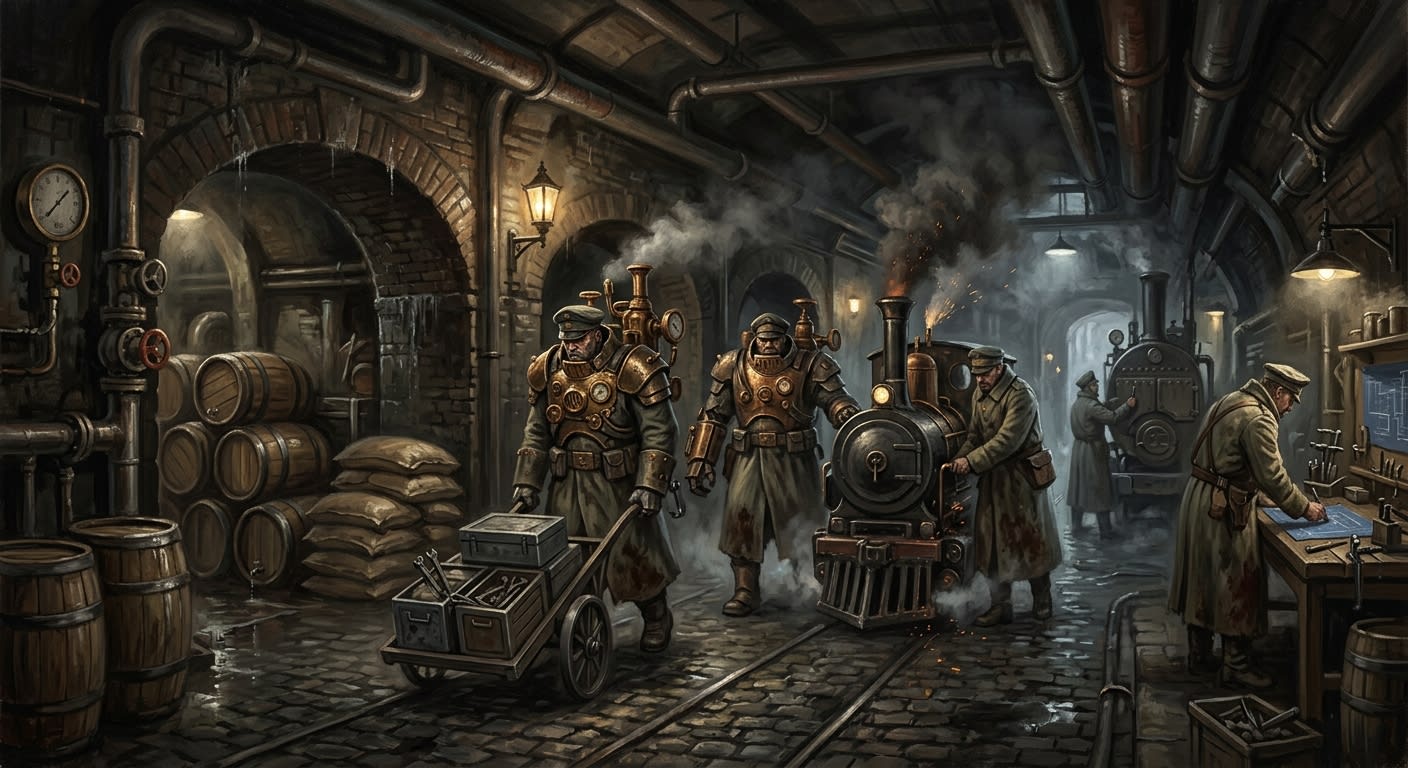
#On the East Bank That Kept Its Mouth Shut
Deutz sits on the east bank of the Rhine opposite Cologne, close enough to smell the cathedral politics and far enough to know when to pretend deafness. It is not, by size or vanity, among the great cities of the Synod. It has warehouses, breweries, ferry steps, damp cellars, customs sheds, brick alleys, old smoke, river mould, and that stubborn Rhineland talent for surviving inspection by becoming too useful to demolish and too plain to praise.
Its glory came from concealment. This offends civic committees, which prefer glory to arrive on a plinth with a subscription plaque. Deutz received three apostolic phalanges in A.S. 31, accepted them beneath beer, kept them through fourteen years of Rationalist occupation, and released them in A.S. 45 when the Sundering made hidden bones into battlefield fire. That is the city's charter in Doctrine, whatever municipal surveyors mutter about Roman roads, bridgeheads, ferry tolls, and commercial privilege.
The official map calls Deutz a Cologne adjunct, a right-bank district, a river service quarter, a Third-Tier Pilgrimage Site host, and a customs hinge. All true. All insufficient. Deutz is where sacred cargo learned the virtue of smelling like fermentation.
#On the Crossing of A.S. 31
In A.S. 31, Ignatius Brenner crossed the Rhine with three apostolic finger bones under black rye in a breadbasket. The Rationalist Republic had made possession of relics a crime of superstition with the penalty schedule of treason. Guards watched the Cologne bridgehead. A Philosophical Prefect asked questions trained by pamphlets and sharpened by vanity. Brenner said he was bringing bread to his sister in Deutz.
He had no sister in Deutz. He had Aldric Hartmann. This was better for Europe and worse for Hartmann's sleep.
The first checkpoint saw a clerk with bread. The second saw a loaf under a checked cloth. One guard lifted the corner, beheld the Republic's intellectual triumph over superstition in the form of rye, and put the cloth down. Deutz received what Cologne could no longer safely keep.
The route now has markers in places where the actual crossing has shifted, washed out, been rebuilt, or been too lucrative to leave unadorned. The river moves. Pilgrimage hates that. It prefers the holy to stand still beneath ticketed awnings. The Rhine, like most old powers, accepts devotion and continues taking its own road.
#On Hartmann's Cellar
Hartmann's brewery stood in Deutz with the useful ugliness common to working buildings: vats, drains, patched stone, sweating foundation walls, malt sacks, ledger shelves, and enough sour breath in the air to discourage delicate inspectors from spiritual curiosity. Under the fermentation vats lay the crypt. Into that crypt went Relic 31-C(α–γ), wrapped in oilcloth, recorded in a ledger hidden inside a hollowed copy of the Rationalist Principia Rationis. Providence has, on occasion, a comic timing so vulgar one suspects Doctrine's involvement.
The cellar was perfect because it was unromantic. A sealed recess beneath an altar invites martyrdom, betrayal, and eventually a painting. A sealed recess beneath beer invites complaints about damp and a tasting cup. Rationalist inspectors searched sacristies, ossuaries, reliquary cupboards, monastery shelves, bishop's houses, and anywhere else their manuals told them superstition might skulk. They came late to beer. A civilisation that misunderstands beer deserves philosophers.
Older pilgrimage cards describe Hartmann's cellar as a “sanctuary chamber maintained for secret worship.”
Corrected. It was a brewery cellar. Secret worship would have endangered the relics, the custodians, the customers, and the beer. The bones were not adored there. They were hidden. The difference is the difference between survival and a trial exhibit.
Between A.S. 31 and A.S. 45, the bones waited. Hartmann died of lung fever in A.S. 38. Custody passed through a son, an apprentice, and Klara, whose surname the Bureau of Records has failed to recover with an incompetence so precise it resembles policy. The crypt remained closed. The vats continued. Deutz smelled of yeast, wet oak, river fog, fear, and civic ordinariness. Sacred history often smells worse than incense.
#On Klara and the Discipline of No Gesture
Deutz's holiest civic act was restraint. Klara did not open the crypt. She did not sell the bones, display them, whisper of them to a pious friend, bargain them for safety, embroider them into family legend, or improve her own soul by making the apostles available for one night of trembling devotion. She left them under beer and kept her mouth shut.
This is difficult for pilgrims to admire because nothing happened. Pilgrims adore happening. Bells, light, blood, swords, a saint crying vinegar, a demon recoiling from a shinbone: give them incident and they will buy candles by the armful. Seven years of not touching a trap seam gives them nothing to purchase except humility, and humility has dreadful margins.
The Bureau has no surname for her. Deutz has many, all invented by families eager to attach themselves to her silence like burs to a cloak. Hartmann's widow, brewer's niece, apprentice's sister, ferry wife, cellar girl, holy maid, unnamed guardian, city mother: each title claims more than the record permits. Doctrine permits Klara. One name. One custodial interval. One successful concealment. Ornament would be theft.
COLOGNE ANNEX — SEALED MORTAR NOTE At A.S. 45 opening, crypt seal showed no fresh knife work. Mortar beside seam bore three old fingernail marks, shallow, human, unbloodied. No explanation entered. No explanation required.
#On the Thread Beneath the City
Deutz was one knot in the Thread, the Cellar Saint network by which relics, wafers, letters, baptismal oil, names of safe houses, and hunted priests moved through Church lands under occupation. The Thread was not a road. Roads are for soldiers and tax men. The Thread was a remembered sequence of cellars, invoices, chalk marks, ferry errands, coded quantities, reliable silences, and the particular glance by which a frightened believer asked whether a floor could keep a secret.
Cologne supplied danger and cargo. Deutz supplied cover. The breweries mattered because commerce is the oldest mask still in regular use. Men carrying sacks at odd hours draw fewer questions when a vat is sour. A wet cellar excuses foot traffic. A delivery ledger can hide route intelligence among hops and barrel hoops. A false prayer meeting is suspicious. A late beer cart is Thursday.
The Deutz knot did not know every other knot. That was wisdom. Each carrier knew a sender and a receiver. Each refuge knew its feeder and next silence. No brave fool was allowed enough knowledge to make torture efficient. This offended the heroic temperament. Good. Heroic temperaments have ruined more underground networks than informers.
By A.S. 45, when the Sundering broke the Republic's certainties, the Thread became a road of recovery. Brenner returned through it to Deutz, opened what Klara had preserved, and set the phalanges toward Koblenz, the 7th Rearguard Column, Brother Tomislav, and Kalnik Ridge. The bones burned demons in A.S. 48 because Deutz had been boring for fourteen years.
#On Pilgrimage, Plaques, and Managed Damp
After Saint Ignatius the Carrier was canonised in A.S. 104, the Hartmann cellar became a Third-Tier Pilgrimage Site. The upper brewery had already failed structurally in A.S. 78, which local guides describe as a sorrow and Engineers describe as predictable. The cellar survived beneath the foundation. Bureau of Pilgrimage sealed it, posted it, tariffed it, and discovered that holiness below street level requires railings, appointment schedules, and more vinegar than projected.
Pilgrims descend in groups of twelve. They see the vat scars, the sealed niche, the trap seam, a replica of the hollowed Rationalist book, the drainage run, and the plaque: HERE RESTED WHAT LATER BURNED. Some touch the lintel for Ignatius. Brewers leave hops for Hartmann. Women leave blank paper for Klara. Smugglers leave nothing, being professionals with superior devotional discretion.
A.S. 112 route sheets advertised the Deutz cellar as “the birthplace of Saint Ignatius's miracle.”
Corrected. Ignatius performed no personal miracle in Deutz. He delivered bones. Hartmann hid them. Klara kept them hidden. The miracle manifested at Kalnik Ridge. Pilgrimage is advised that geography may be profitable without becoming fraudulent.
The cellar's damp is now managed by a three-office agreement between Pilgrimage, Records, and a municipal works committee whose minutes smell faintly of beer. Too much damp threatens masonry. Too little damp offends visitors who expect sanctity to feel like a lung condition. The current compromise is called preservation humidity. I call it licensed mould.
#On the Candle Riot and the Price of Too Much Meaning
Deutz acquired a second lesson in A.S. 151, during the Candle Riot that later hardened the authority of the Shrine-Assessors. A local shrine committee treated an advisory downgrade as a suggestion and continued selling silver-token access beside a candle rack already marked unsafe, overcrowded, and doctrinally over-described. Thirty-seven pilgrims were injured in the crush. The candle rack, by witness accounts unhelpfully consistent, achieved independent motion.
This incident matters because Deutz had forgotten its own genius. The town that once saved relics through plainness had allowed shrine commerce to breed theatre. Silver tokens. Special queues. Touching privileges. A rack of devotional candles taller than several inspectors and less stable than their moral vocabulary. The crowd pressed. The rack moved. The Assessor's downgrade became binding law after the blood was mopped, because the Bureau learns mercy most quickly when liability has already knocked out teeth.
The Deutz Candle Riot did not destroy the cellar's status. It disciplined it. Assessment became binding at utterance for shrine classification. Silver-token access was curtailed. Candle height was regulated. Local committees learned that advisory meant advisory only until enough pilgrims were injured to improve the definition. Deutz returned, with bruises, to its older sacrament: less display, more custody.
#On River Work and Present Uses
Modern Deutz is a right-bank service quarter with a relic under its feet and Cologne breathing over its shoulder. Ferries, warehouses, repair sheds, brewery remnants, pilgrim hostels, customs counters, and small devotional shops share streets too narrow for their ambitions. The Rhine brings cargo, fog, tax disputes, smugglers, legitimate traders who behave worse than smugglers, and pilgrims who arrive believing a cellar will simplify faith. It rarely does. Cellars complicate everything by reminding the proud that salvation once depended on a trap seam and an honest brewer's cough.
Records maintains a small annex near the pilgrimage stair, chiefly to count visitors, authenticate offerings, discourage invented surnames for Klara, and prevent local guides from upgrading Hartmann by rhetoric. Pilgrimage sells approved route cards. Tithes audits shrine boxes with the affection of a butcher weighing veal. Purity watches for Rationalist antiquarian clubs, relic counterfeiters, and those tiresome aesthetes who think the hollowed Principia proves the Republic was secretly sacred rather than merely useful as storage.
As of A.S. 201, Deutz remains useful. Its warehouses feed Cologne's river arithmetic. Its pilgrimage site draws modest footfall and immodest commentary. Brewers still claim Hartmann's yeast survived, though three laboratory reviews and one tasting have failed to support anything except local confidence. Porters touch the lintel before hard crossings. Smugglers invoke Saint Ignatius with professional brevity. Blank papers for Klara multiply whenever Records complains.
Deutz's civic virtue is unchanged. It holds what Cologne cannot display, hides what Strasbourg would prefer to classify, profits in small coins, and survives beneath larger shadows without mistaking shadow for insignificance.
At the cellar threshold the air cools. Stone sweats. The old niche remains sealed behind glass and wire. The plaque says what it can. The rest smells of beer.