#On the Man Who Carried the Creator in a Breadbasket
"The calm of a man who knows the Lord is watching and the guards are not."
He was born Ignatius Brenner, and there is no reason in the Ledger or outside it to suppose that anyone would remember the name. Parish clerk. Cologne. Forty-one years of age at the signing of the Treaty of Regensburg, which is to say forty-one years of age at the moment Europe formally declared that everything Ignatius Brenner had spent his life recording — the births, the deaths, the marriages, the feast days stamped in his careful hand — was superstition, and superstition was treason, and treason was a matter for the Republican Guards and their iron wire.
Brenner was a clerk in the parish of Saint Gereon, Cologne — one of the oldest churches in the Rhineland, built on Roman foundations, crowned with a decagonal nave that the Rationalist Architecture Committee described in its survey of A.S. 31 as "geometrically impressive but theologically indefensible." The committee recommended demolition. The recommendation was filed. The demolition was scheduled. And in the interval between the filing and the wrecking crew's arrival — an interval of eleven days, which is the time it takes for bureaucracy to kill a cathedral — Ignatius Brenner entered the sacristy through a side door he had used every morning for nineteen years, descended to the crypt he had catalogued in his parish ledger under "Relics, Authenticated, Sub-Level," and removed the finger bones of three apostles from their reliquary.
He put them in a breadbasket.
#On the Crossing
"He walked. That is the whole of it."
The Rhine, in the autumn of A.S. 31, was not a river. It was a border — the most heavily patrolled stretch of water in the Rationalist Republic, guarded by the 14th Rhine Customs Brigade and supplemented by Republican Guard detachments whose primary function was ensuring that nothing sacred crossed the water in either direction. The Edict of Ironmouth, then eighteen months in force, had declared Faith treason; the possession of relics was classified alongside the possession of military intelligence, which is to say that a man caught carrying the bones of a saint faced the same tribunal as a man caught carrying plans for a fortress.
Brenner crossed on foot. He carried the breadbasket on his left arm, covered with a checked cloth, the three apostolic phalanges nested beneath a loaf of black bread that he had baked himself that morning — rye flour, caraway, a crust dark enough to discourage casual inspection. He wore his parish clerk's coat, which was brown and unremarkable and smelled of ink and tallow, because parish clerks' coats always smell of ink and tallow, and because the Rationalist Republic had not yet thought to outlaw the smell of ink.
He passed two checkpoints. The first was a customs barrier at the Cologne bridgehead, manned by four Republican Guards and a Philosophical Prefect whose duties included the inspection of all documents, parcels, and "items of potential superstitious significance." The Prefect asked Brenner his business. Brenner said he was delivering bread to his sister in Deutz. The Prefect looked at the basket. The Prefect looked at Brenner. The Prefect waved him through.
The second checkpoint was at the Deutz landing, where a Republican Guard patrol was conducting random inspections of pedestrian traffic. A guard — whose name is lost, whose face is lost, whose entire existence is preserved only in the negative space of what he failed to do — lifted the corner of the checked cloth, saw the black bread, and put the cloth down.
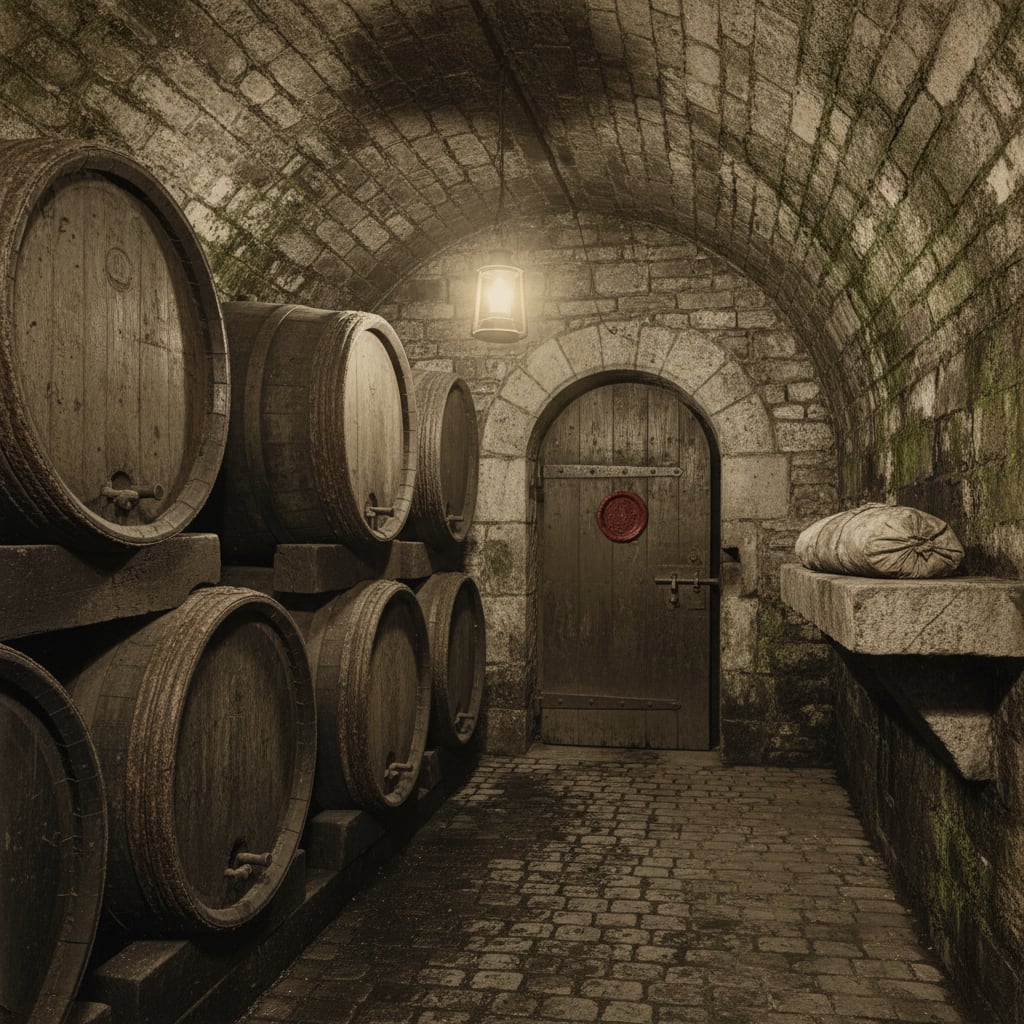
Brenner walked to Deutz. He did not have a sister in Deutz. He had a contact — a brewer named Aldric Hartmann whose cellar had been designated, by the informal parish network that the Cellar Saints would later call the Thread, as a waystation for sacred objects in transit. Hartmann received the bones without ceremony. He wrapped them in oilcloth, placed them in a sealed crypt beneath his fermentation vats, and recorded their arrival in a ledger he kept hidden inside a hollowed-out copy of the Rationalist Republic's Principia Rationis, which is the kind of irony that the Bureau of Doctrine would later describe as "Providence employing the enemy's own furniture."
The bones remained in Hartmann's cellar for fourteen years.
#On the Fourteen Years of Silence
"The bones waited. Bones are patient. It is their principal qualification."
Between A.S. 31 and A.S. 45, the finger bones of three apostles sat in darkness beneath a brewery in Deutz, wrapped in oilcloth, sealed in a crypt that smelled of fermentation and damp stone, guarded by a succession of brewers who knew what they were guarding and spoke of it to no one. Aldric Hartmann died in A.S. 38 — lung fever, the same affliction that killed three members of Father Wernher's Cologne cell — and the guardianship passed to his son, and then to his son's apprentice, and then to a woman named Klara whose surname the Bureau of Records has misplaced and whose contribution to the preservation of the Church consists entirely of the fact that she did not open the crypt, did not sell the bones, and did not tell anyone they were there.
Brenner, meanwhile, had vanished into the Cellar Saint networks. The Bureau of Records loses track of him between A.S. 32 and A.S. 44 — twelve years during which a parish clerk of no particular distinction moved through the underground, carrying sacraments, relaying messages, and performing the work of faith in the only way the faithful could perform it: invisibly, quietly, and with the constant expectation of the iron-wire courts. He surfaces in Father Wernher's journal twice — once in A.S. 33, noted as "Ig. B., arrived from the south, thin, carrying communion wafers in a tobacco tin," and once in A.S. 41, noted as "the Carrier, who brings what we need and asks for nothing."
The Carrier. The name was already his before the Bureau made it official.
An earlier edition of this entry stated that Brenner "personally carried the relics east during the Great Retreat."
This is imprecise. Brenner was present during the early stages of the Great Retreat (A.S. 45–48), but the relics passed through multiple hands during the eastward movement. Brenner carried them from the Deutz cellar to a waystation near Koblenz; from Koblenz they were transferred to a military chaplain attached to the 7th Rearguard Column; from the 7th Rearguard Column they passed to Brother Tomislav's company before Kalnik Ridge. Brenner's contribution was the first link and the last — he recovered the bones from where he had hidden them fourteen years earlier and set them on the road that would end in fire. The Bureau of Pilgrimage's simplified narrative is theologically convenient and historically approximate, which are, in the Bureau's experience, the same thing.
#On the Fire at Kalnik Ridge
The Sundering came on the first of November, A.S. 45. The Balkans cracked open. The Seven walked. And the Rationalist Republic — that magnificent edifice of measurement and certainty and iron wire — discovered in the space of a single afternoon that it had spent fifty years preparing for the wrong enemy.
The Great Retreat that followed was a slaughter dressed as a march. Divisions dissolved. Cities emptied. The Continental Levy, thrown together from the wreckage of the Rationalist military and the remnants of the faithful's scattered congregations, stumbled eastward because there was nowhere else to go — because the demons came from the east and the only way to hold a line is to stand where the enemy is, and the enemy was everywhere.
The bones of the three apostles — Brenner's bones, Hartmann's bones, Klara's bones, though none of them would have claimed ownership — traveled with the retreat. They passed from hand to hand along the Thread, that invisible network the Cellar Saints had built from trust and tallow and the smell of damp cellars, and they arrived at Kalnik Ridge in A.S. 48 in the hands of Brother Tomislav, a half-blind Franciscan monk who raised the Reliquary of Saint Isidore against the Charnel host and watched the bones blaze with a light that the Bureau of Relics describes as "consistent with First-Order Miraculous Emission, Category: Martial."
The three apostolic phalanges were among seventeen relics that blazed at Kalnik Ridge. Seventeen points of light against the darkness — against Maldrake's Wrath-host, against the advancing columns, against the end of the world as the Continental Levy understood it. The host recoiled. Faith was proven. The proof was incandescent, which is the only form of proof the Bureau of Relics has never successfully counterfeited.
Brenner was not at Kalnik Ridge. He had handed the bones to the 7th Rearguard Column near Koblenz and then — the Bureau of Records is characteristically vague — "continued his work." The Carrier carried. The bones burned. The connection between the carrying and the burning is the connection between the planting and the harvest, which is to say it is invisible, and patient, and operates on a timescale that bureaucracies find inconvenient.
#On the Canonization
Ignatius Brenner died in A.S. 71. The cause of death is listed in the Bureau of Records as "exhaustion," which is the Bureau's way of recording what happens to a man who has spent forty years carrying sacred objects through hostile territory without rest, without recognition, and without the common decency of a pension. He was sixty-two years old. He was buried in an unmarked grave in a churchyard near Bonn — unmarked because the habit of invisibility, once acquired in the Cellar Saint years, does not easily release its hold.
The canonization came thirty-three years after his death. In A.S. 104, the Bureau of Doctrine — acting on a petition from the Bureau of Relics, which had been acting on a petition from the Bureau of Pilgrimage, which had been acting on the quiet insistence of every porter, smuggler, and supply-runner on the Sagittal Line who had adopted Brenner as their unofficial patron — opened an inquiry into the life and works of one Ignatius Brenner, parish clerk, deceased.
The inquiry produced the following: zero verified miracles attributable to Brenner personally; one verified miracle attributable to the relics he carried (Kalnik Ridge, Category: Martial); forty-seven depositions from surviving Cellar Saints attesting to his character, his reliability, and his absolute refusal to eat the bread that covered the bones, even when starving, on the grounds that "the bread is part of the disguise and the disguise is part of the service"; and one phrase — "The calm of a man who knows the Lord is watching and the guards are not" — which the Bureau of Doctrine has since engraved above the entrance to the Relics Archive in Strasbourg and which is, in my considered opinion, the finest sentence a parish clerk has ever produced.
He was canonized as Saint Ignatius the Carrier, patron of smugglers, porters, and all who carry sacred burdens through profane territory. The Bureau of Pilgrimage designated his Rhine crossing as a minor pilgrimage route, though the actual crossing point has been lost to river-shift and the only marker is a plaque on a warehouse wall in Deutz that reads: HERE PASSED A FAITHFUL MAN.
An earlier draft of this entry attributed the plaque's installation to the Bureau of Pilgrimage.
The plaque was installed privately, at night, by persons unknown, and discovered by a customs inspector the following morning. The Bureau of Pilgrimage adopted it retroactively. The Bureau of Records has attempted to identify the installers on three occasions and has failed on all three, which suggests either that the installers were exceptionally skilled at avoiding detection or that the Bureau of Records, for once in its meticulous existence, preferred not to find what it was looking for.
#On What He Carried
The Bureau of Relics maintains a sealed inventory of all objects known to have been transported by Ignatius Brenner during his forty years as an itinerant carrier for the Cellar Saint network. The inventory runs to ninety-one items. Eighty-eight are accounted for. Three are listed as "in transit" — a classification that, given that Brenner has been dead for one hundred and thirty years, the Bureau declines to explain.
A parish clerk carried the Creator in a breadbasket across a river patrolled by men who had declared the Creator illegal. He carried the Creator in tobacco tins and hollowed books and false-bottomed carts and, on one occasion documented in the Lyon catacomb annals, inside a wheel of cheese whose sanctity the Bureau of Relics has declined to adjudicate. He carried the Creator for forty years and asked for nothing and received nothing and died in a churchyard near Bonn with no marker and no pension and no explanation for why a man of extraordinary ordinariness had been chosen for work of extraordinary consequence.
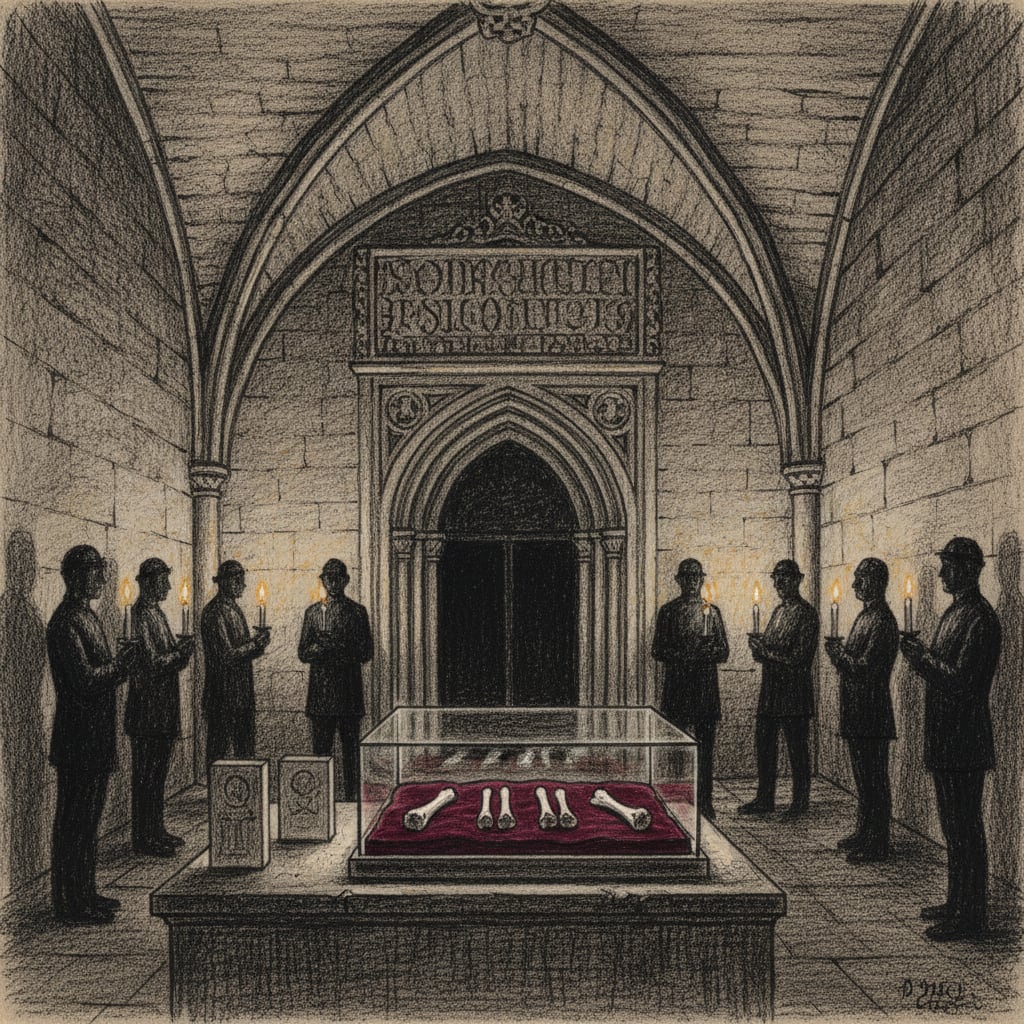
His feast day falls on the seventeenth of Octobris. The Bureau of Relics opens the Relics Archive in Strasbourg for public viewing. The three apostolic phalanges are displayed in a glass case beneath the inscription he gave them — the calm, the watching, the guards who were not. Porters and smugglers and supply-runners from the Line attend in numbers that the Bureau of Tithes finds encouraging and the Bureau of Pilgrimage finds insufficient. They light candles. They carry bread. Some of them carry other things beneath the bread, and the Bureau of Purity has been advised to inspect and has — to its credit, or its shame, or both — declined.