
#On the Room Before the Vault
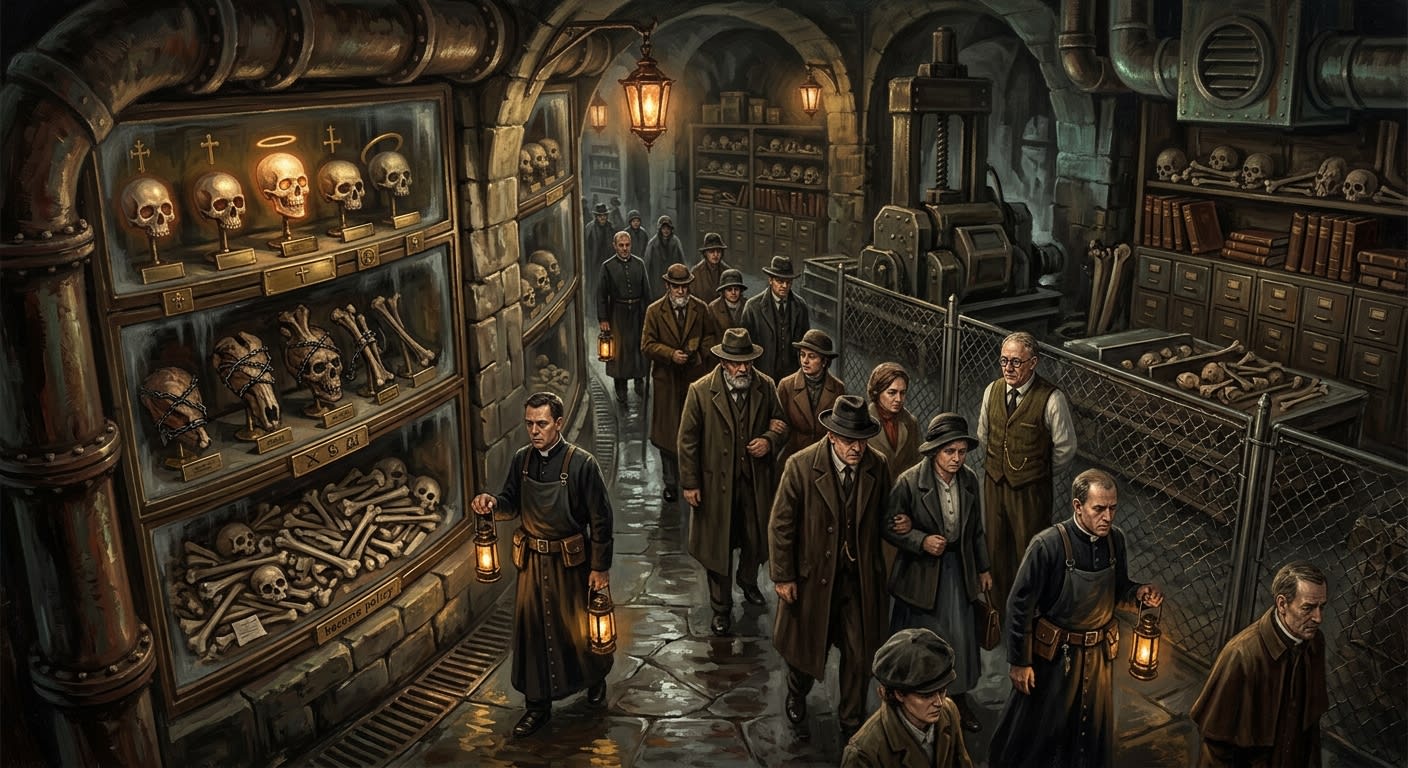
The Relics Archive in Strasbourg is the public face of the Bureau of Relics, which is to say it is the least honest room in a very honest depth. It lies beneath the Cathedral of Strasbourg, below the pilgrim polish and above the true iron gut of the Vault of Sacred Custody, where the bones cease being educational and become operational. The Archive is where saints are shown to citizens in glass, where porters kneel, where inspectors pretend the labels settle the matter, and where I once watched a child try to wave at an apostolic finger-bone.
The child was removed gently. The bone did not wave back. The file remains open.
The phrase above the entrance belongs to Saint Ignatius the Carrier, born Ignatius Brenner of Cologne, carrier of three apostolic phalanges beneath black rye in A.S. 31: The calm of a man who knows the Lord is watching and the guards are not. The letters are brass, polished daily by a lay brother with hands like tongs. Pilgrims touch the last word until it shines brighter than the rest. The guards notice. This is permitted. The irony has been authenticated.
#On the Descent and the Filing Hand
Seventeen steps take the visitor below the cathedral's polite floor. The first six smell of wax. The next four smell of camphor. The last seven smell of metal, old linen, cold stone, and that special clerical fear produced when a man knows the object in the next cabinet may have been dead longer than his nation and better treated than his mother.
The Reception Hall receives the public. The Relics Archive begins beyond a grille of black iron inscribed with the four verbs of the Bureau: Custody, Authentication, Classification, Distribution. The verbs are carved in that order because the Bureau would rather guard first and understand later, a policy so successful that the Synod has imitated it in war, marriage, taxation, and education.
The Archive's present filing method descends from a cellar habit. Father Wernher's grandson, Clerk-Notary Wernher the Younger, served the Bureau of Records from A.S. 94 to A.S. 131 and helped design the Archive's classification tables using the very habits by which his grandfather catalogued bones, wafers, parish names, and tolerable lies in the damp beneath Cologne. This is officially called continuity. It is also proof that the Synod was built by people who learned to organise in bad air and never fully trusted daylight again.
The cabinets stand in ranks: First-Class bodily remains in lead-lined drawers; Second-Class objects touched by saints in velvet cradles; Third-Class earth, ash, oil, water, battlefield grit, and substances whose names have been softened for public catechism. Each drawer carries a label, a provenance strip, an authentication mark, a handling colour, and a small brass aperture through which a clerk may inspect without opening. A relic displayed to the public is a relic selected, framed, captioned, and deprived of several dangerous facts. This is not fraud. This is pedagogy with locks.
Older guide cards described the Relics Archive as “a devotional museum.”
Corrected in internal use. A museum stores the past for viewing. The Relics Archive stores weapons, debts, legal identities, failed miracles, mobile morale, and bones that may object if mislabeled. Public guide cards retain museum because children and donors require soft nouns.
#On the Apostolic Phalanges
The most beloved case holds Relic 31-C(α–γ): the three apostolic phalanges Brenner carried across the Rhine in A.S. 31, hid by way of Aldric Hartmann's Deutz brewery cellar, recovered during the Great Retreat, transferred through Koblenz to the 7th Rearguard Column, and manifested at Kalnik Ridge in A.S. 48 when Brother Tomislav raised the reliquary and Maldrake's host recoiled. Zero personal miracles belong to Brenner. One martial miracle belongs to the bones he saved. The Bureau debated the distinction until the porters grew impatient.
On the seventeenth of Octobris, the case is opened for public viewing. Opened is a technical word. The glass is lifted three finger-widths behind a secondary screen; the velvet tray remains sealed; the attending Examiner breathes through a gauze strip steeped in vinegar and prayer; two porters selected by lot carry ceremonial bread along the aisle and place it beneath the inscription. The bread is counted before and after. In A.S. 188 one loaf vanished. The Bureau of Purity questioned seventeen men and found nothing. Saint Ignatius, patron of smugglers, had excellent manners.
Porters kneel first. Supply-runners kneel next. Smugglers kneel last, when the guards are tired and the Bureau of Tithes has already counted the largest donations. They pray for safe passage, loose straps, sleepy guards, honest mud, and the mercy of a cloth that stays unlifted. The prayers are irregular. The Archive records them anyway. A prayer becomes respectable once copied in triplicate.
FEAST OF SAINT IGNATIUS — ARCHIVE OBSERVATION, A.S. 196 Declared bread loaves: ██. Undeclared objects detected beneath loaves: ███. Objects confiscated: █. Objects allowed onward under “devotional concealment tolerance”: ██. One sealed packet addressed to the Archive itself arrived without carrier. Contents remain in transit.
The phalanges rest in a shallow case lit from below. Their colour is neither white nor yellow but that deep old ivory which suggests time has been boiled down and poured into bone. Children expect glow. The bones do not glow for children. They already burned demons. They need not perform for infants.
#On the Bell and the Pen-Stopping Rule
The Bell of Saint Isidore does not reside in the Archive. It travels by black-silk gun-carriage under Relics custody, Bells objection, Festivals appetite, and military longing. Yet the Archive keeps the Bell's fused ridge-glass sketches, axle seals, handling writs, failed recasting sample, and the Debrecen lifespan debit copy whose ink has faded around the numbers but not the names. This is proper. A mobile relic requires a still paper-body. The Archive supplies it.
During the Feast of the Cracked Bell, when the Bell is struck once in public, clerks in the Relics Archive pause their pens until the sound has gone. This is not superstition. It is procedure born from unpleasant evidence: ink laid during the peal has formed names absent from any registry, some belonging to the living, some to the dead, and some to persons whose files later appeared in the wrong century. Records calls this a transient inscription hazard. Relics calls it a courtesy to the Bell. Doctrine calls both phrases sufficient.
The failed recasting sample is kept in a nested crucible no wider than a child's cup. A shaving from the Bell once rang by itself for nine minutes in a sealed vessel and caused two technicians to remember dying at Kalnik Ridge, though neither had been born. The sample is displayed only to Examiners undergoing advanced acoustic caution. They emerge pale. Some request transfers to bone work, which is how one knows the lesson has taken.
Public captions once stated that the Bell's Archive holdings are commemorative.
Amended. Commemoration is the varnish. The holdings are legal, acoustic, forensic, and defensive. The Bell moves; its paperwork anchors it. Without the Archive, the gun-carriage would be a miracle wandering loose through the calendar, and even Festivals has not yet fallen that far.
#On the Cellar Saint Holdings
The Cellar Saint cases occupy the north ambulatory, where the light is low and the labels grow more tender than strict accuracy recommends. There are bread cloths, tobacco tins, false-bottom slats, oilcloth packets, hollowed books, chimney hooks, patched aprons, cellar keys, and forty-one rescued volumes from the Lyon catacombs copied into safer bindings because the originals smell of old damp and tribunal smoke. The faithful stand longest before these cases. Grand reliquaries awe them. Cellar objects accuse them.
The Bureau of Relics has authenticated 1,247 objects attributed to Cellar Saint rescue operations: roughly 340 judged genuine in the vulgar sense, 500 administratively genuine, and 407 objects of authenticated devotion, which means nobody knows what they are but somebody prayed hard enough over them to make disposal politically expensive. The Archive arranges them by rescue cell: Cologne, Lyon, Innsbruck, Bavaria, Palatinate, Swiss valleys, Unknown. Unknown is the largest cabinet. History is mostly Unknown with better wax.
Father Wernher's journal is kept under glass near the Cologne cases, forty-seven pages written on the backs of enemy census forms. The ink has browned. The hand remains disciplined. The final entry is reproduced in every schoolbook: “The bells. At last.” The original page is smaller than the legend, as originals usually are. Legends require elbow room.
Klara's label is worse. “Klara, surname unrecorded; Deutz custody, c. A.S. 38–45.” Seven words and a range. She guarded three apostles beneath beer barrels after Aldric Hartmann died and received no surname from Records. The Archive keeps a blank strip below her name. Visitors sometimes ask why. The guide says the strip represents lost history. I say it represents our incompetence, framed in brass.
#On Authentication as Theatre and Knife
Every relic admitted to the Archive passes through examination, but examination is not a single act. It is theatre performed with knives hidden in the sleeves. The Examiner weighs, measures, smells, listens, prays, burns a test taper, watches flame lean or withdraw, checks provenance against Records copy, inspects seal descent, cross-matches old hands, confirms no Velmoran taint, and decides whether the object before him is saint, fraud, debt, weapon, consolation, nuisance, or all of these wearing linen.
The public sees the successful cases. It does not see the Retired Cabinet.
The Retired Cabinet is a polite name for the west sub-room where failed relics wait before disposal, interment, reconsideration, or translation into architectural usefulness under Saint-Bone Melting precedent. I have seen a parish tibia there with three village ribbons tied to its box and a rejection slip reading DOCTRINALLY INSUFFICIENT. A widow outside the grille asked whether insufficient bones could still hear prayers. The attending clerk said no. The widow prayed anyway. The clerk did not stop her. Occasionally bureaucracy mislays its cruelty and behaves.
The Archive also holds counterfeit teaching sets from Velmoran operations: bones that make candle flames recoil, chalice stems that sweat green oil, saint-cloth that turns devotional ink into promissory debt, and one beautiful little reliquary hinge that whispers the price of every person who touches it. Students learn from them behind screens. The Bureau says knowledge prevents contamination. The screens say the Bureau is lying with partial competence.
#On the Present Condition
As of A.S. 201, the Relics Archive is open by licence, crowded on feast days, undercounted on ordinary days, and deeper than public charity admits. The three apostolic phalanges remain displayed on Ignatius' feast. The Bell files continue to require pen-stopping discipline. The Cellar Saint holdings attract more tears than the Bureau budgeted for cleaning. The Retired Cabinet is full. The Unknown cabinet grows.
Below the Archive, the Vault of Sacred Custody continues for one and a half miles in three directions. The fourth direction remains sealed. Engineering instruments declined it in A.S. 178. Relics accepted the refusal as reverence. I have no quarrel with either cowardice. Some doors exist so that wise men may praise the lock and go upstairs.
At closing, the clerks cover the apostolic case, extinguish seven lamps, count the bread crumbs beneath Ignatius' inscription, seal the Bell sample crucible, copy the day's donation ledger, and listen for drawers that answer after dark. Drawers that answer are marked for morning. Morning, being properly supervised, usually behaves.