
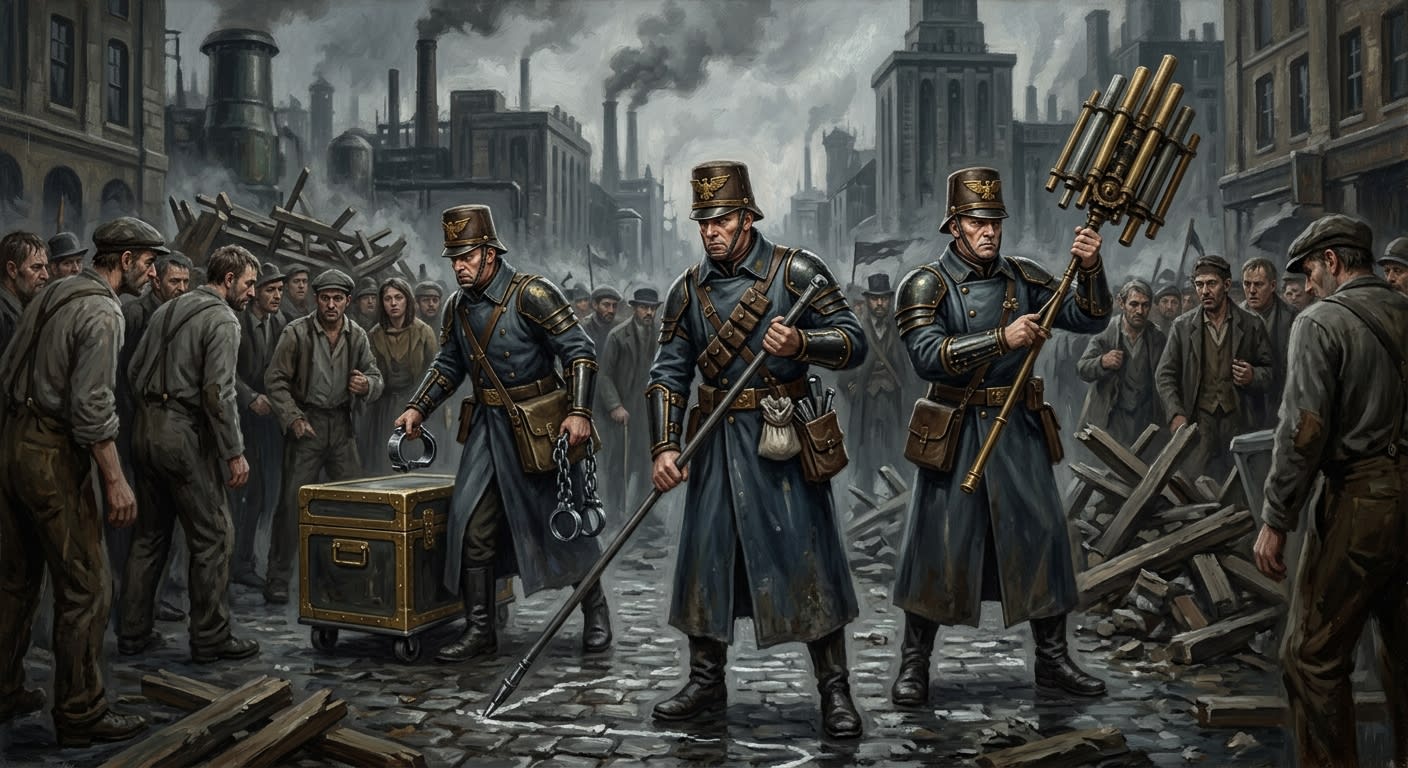
#On the Specialist Who Makes the Crowd Obey Itself
The Riot-Quiet Specialist is an elite Roving Judge’s Bailiff trained to dismantle a crowd without firing, without shouting, and without granting the crowd the courtesy of believing it has become important. He is the Hymn-Length Reforms brought to their final insult: violence arranged so clearly, so patiently, so mathematically that actual violence becomes surplus inventory.
The ordinary Circuit Bailiff controls a court. The Riot-Quiet controls the moment before a court becomes impossible. His trade is timing, placement, breath, chalk, chime, silence, sightline, and that little civic terror by which one man at the front of a crowd realizes he is alone because the men behind him have decided, privately and at once, to remain alive.
The specialty descends from the Road Riots of A.S. 140 and the Hymn-Length Reforms that followed. The Road taught the Bureau that delay breeds sympathy, sympathy breeds hands, and hands overturn wagons. Circular 4.12 taught the bailiff corps to kill the interval. The Riot-Quiet Specialist learned to kill the interval before anyone noticed it had been born.
#On the Method of Position
The Specialist begins before the Judge arrives. That is the first doctrine. A Judge creates attention; attention creates appetite; appetite must find its dish already empty. The Specialist walks the square while it is still pretending to be a square. He reads stall gaps, cart axles, rooflines, alley throats, window ledges, rain channels, loose stones, lamp hooks, shrine steps, and every raised place from which a brave idiot may acquire an audience.
Then he chooses where the crowd will fail.
He does this with chalk. A court perimeter is a line, but a Riot-Quiet chalking is a trap drawn in public. The Judge’s table is placed where sightlines divide the crowd into sections that cannot see themselves as one body. The witness pen is set just off centre, irritating the eye. The seal chest sits high enough to be visible and too far back to be rushed. Court Ropes stand at angles that suggest escape routes while blocking the routes that matter. Riflemen appear fewer than they are. The chime hangs where sound strikes stone and returns with a second, ghostly count.
At Bastion-Brest, Sable Rook placed his chime so it struck the quay wall and came back doubled. The port crowd believed two bailiffs were marking time. They were wrong. They behaved as if they were right, which is the only truth crowd-control requires.
Early academy copies described Rook’s Brest action as “spontaneous tactical genius.”
Corrected: Rook had studied quay echo geometry for three nights before convening the property hearing. Spontaneity is what instructors call preparation when they wish to sound inspired.
#On the Hymn-Chime as Weapon
The hymn-chime is not loud. That is why it works. A trumpet challenges. A gunshot declares failure. The chime counts. Counting insults panic by refusing to share its hurry.
The Riot-Quiet Specialist uses the chime before the first ring. He lets the crowd see his hand near the striker. He waits through one breath too many. Men at the front begin measuring themselves against that pause. A shout loses rhythm. A chant comes apart between syllables. The Specialist rings once. Opening. The crowd’s noise becomes exterior to procedure. The second ring admits proof. The third buries rebuttal. The fourth makes consequence portable.
A crowd wants crescendo. The chime gives it accounting.
The Specialist watches for the count-break: the instant when collective sound stops rising and begins checking itself. Shoulders turn. Feet test mud. Men glance sideways to discover whether they are still numerous. Once a crowd begins counting its own exits, the riot has entered audit.
#On the Body in the Chalk
Riot-Quiet work is choreography performed by men who would be offended by the word. The Specialist stands neither too close to the Judge nor too far. Too close announces fear. Too far invites heroics. He places one Court Rope where mothers will curse him, another where young men will imagine rushing, and a third where old men can retreat without feeling they have retreated. Pride needs a door. Give it a narrow one.
He moves accused persons with equal calculation. A prisoner displayed too long becomes a saint. A prisoner hidden too well becomes a rumour. The Specialist shows the accused at the mark, removes him at the mark, and prevents grief from acquiring continuity. Tears are permitted in fragments. Fragments do not overturn wagons.
TRAINING YARD OBSERVATION — STRASBOURG CIRCUIT SCHOOL Exercise: maternal breach at chalk line. Recruit response: verbal appeal, delayed arm block. Crowd model response: forward surge. Instructor note: recruit allowed grief to become sequence. Correction: █████████████. Recruit retained for Docket Runner work only.
The Specialist must know how bodies lie. A crowd leaning back may be preparing to run or to throw. A silent front rank may indicate obedience, shock, or the presence of a speaker being passed forward. Children at the edge mean either innocence or stones hidden in bread baskets. Priests are worse than children. Children at least throw straight.
#On the Doctrine of Unfired Violence
The Bureau loves the phrase “without firing.” It polishes the phrase and displays it on instruction slates as if restraint were the same thing as mercy. Riot-Quiet doctrine does not reduce violence. It relocates violence into expectation. The crowd sees where rifles would fire, where cuffs would close, where the Judge’s seal would turn hesitation into sentence. The Specialist arranges consequence so legibly that consequence may remain implied.
This is civilized, says the Bureau. It is also cheaper.
Public commendations credit Riot-Quiet Specialists with “bloodless order.”
Amended for internal circulation: bloodless order includes crushed feet, broken fingers, hunger seizures, post-court arrests, and every punishment delayed until the crowd has dispersed beyond the artist’s frame.
The first shot is a confession. It says the chalk failed, the chime failed, the sightline failed, the Specialist lost the interval. Some failures are survivable. A shot before the fourth mark is not. Inquiry follows. Inquiry has bright gloves and no sense of humour.
#On Selection and Temperament
Riot-Quiet candidates are chosen from Circuit Bailiffs who have completed at least six crowd courts without seal loss, prisoner disappearance, or premature discharge. They are tested in market squares filled with paid insult-men, grieving actors, false clerics, loose dogs, and children instructed to cry at procedural marks. The dogs are easiest. The clerics are hardest. The children ruin more candidates than doctrine admits.
The required temperament is unpleasant: calm without softness, attention without curiosity, cruelty without heat. Hot men shoot. Soft men listen. Curious men turn their heads at the wrong shout and die with an incomplete custody log. A Riot-Quiet Specialist must hear every voice and answer none until the chime permits him.
They acquire habits. Counting exits in dining halls. Sitting where backs face walls. Interrupting songs at the measure. Correcting children’s games when a mock trial exceeds its hymn. Their spouses learn not to stand in doorways. Their friends, if they had any, learn to stop using the word “just” before requests.
#On the Sable Rook Lesson
Rook remains their patron in practice, though no office says patron. The Brest port seizure is recited as the cleanest example of Riot-Quiet logic: meet uprising with hearing, hearing with hymn, hymn with seizure, seizure with public counting. The dock gangs expected martyrdom and received inventory. The treasury became a list. The list became property. The property became silence.
Young Specialists adore this story because it offers a lie with good posture: perfect timing cleanses force. The restricted Rook files offer the necessary bruise. Fourteen names entered his next custody chain. Eleven discharged. Three bracket marks. No academy circulation.
The Riot-Quiet cadre knows the cupboard exists. They do not open it during lectures. Opening cupboards lengthens classes, and lengthened classes breed questions, and questions are little riots with ink instead of stones.
#On Present Use
As of A.S. 201, Riot-Quiet Specialists are assigned to volatile circuits, port seizures, ration courts, pilgrimage crossings, tax readings, and any proceeding where the Bureau expects spectators to discover their conscience in groups. They travel ahead of Judges when possible and behind them when punishment is intended to look reactive. Their reports are short. The best ones read like weather entries: crowd gathered, mark struck, dispersal achieved, no discharge.
The road knows them by stance. A standard bailiff looks at the accused. A Riot-Quiet Specialist looks at the third row. Men who have seen one at work tell their sons to leave before the chalk goes down. Women tell each other which alley he left open. Children imitate the chime and scatter laughing, which is nearly treason and perfectly accurate.
The Bureau calls this public confidence. The road calls it knowing when to go home.