
#On the Road Before It Broke
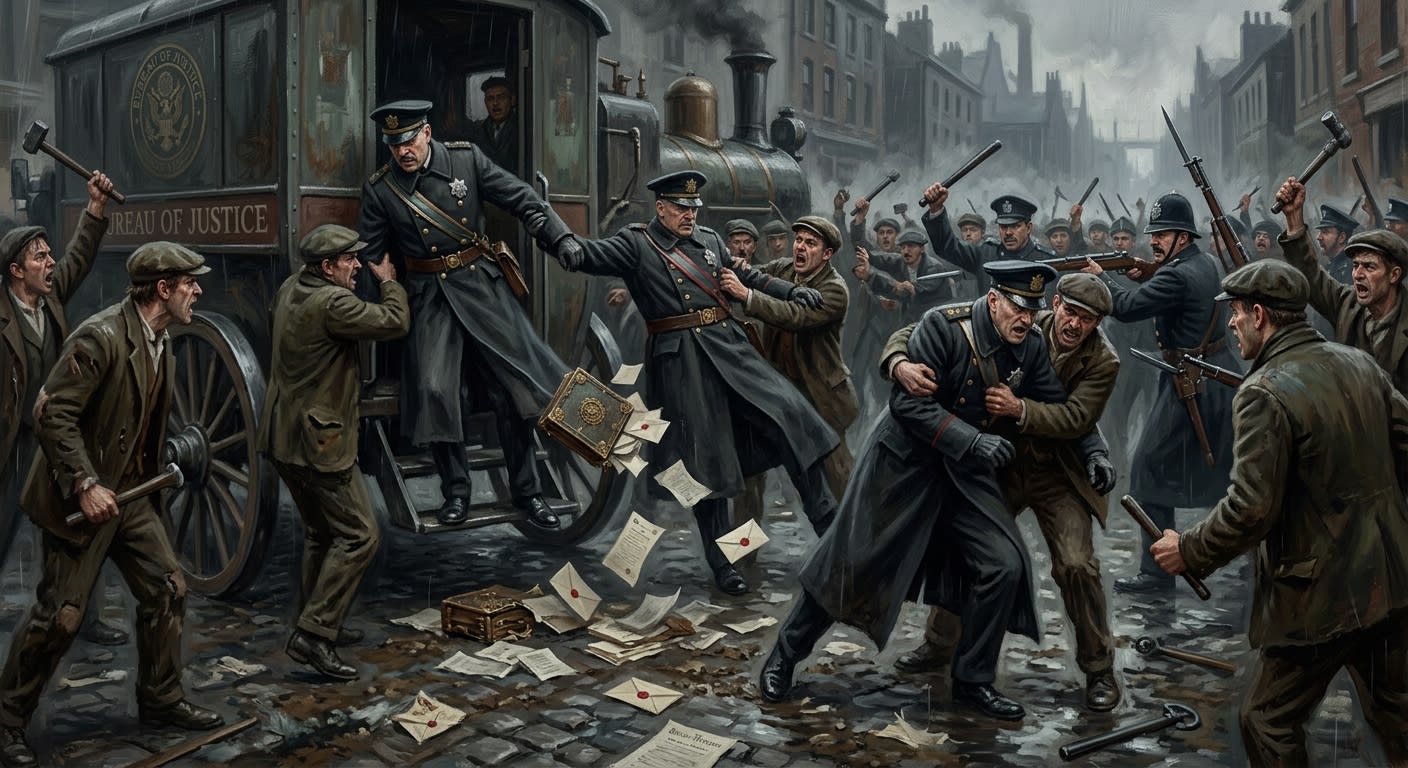
The Road Riots of A.S. 140 were the necessary disgrace from which the Hymn-Length Reforms later pretended to descend by reasoned statute. The official language calls them “circuit violence.” This is an admirably small phrase for wagons overturned in ditch-mud, seals passed through bloody hands, three Roving Judges dragged from their seats, and several districts discovering, for one afternoon, that justice can be made to scream if enough men pull at the same time.
The circuit courts before A.S. 140 were slower beasts. A Roving Judge’s Bailiff still chalked the perimeter, guarded the seal, and kept prisoners chained close enough for the crowd to smell fear. Yet trials could stretch: a witness permitted extra breath, a guild advocate permitted rhetoric, a vicar permitted objection, a widow permitted grief. The road learned to use delay as a weapon. A case stalled long enough became a gathering. A gathering given grievance became a mob. A mob hearing law hesitate began to suspect that law possessed a throat.
A.S. 140 already carried too many live coals: condemned carriers muttering after the Cart-Saint disturbances, pilgrim-token disputes, tithe arrears in the Rhineland, old resentment along the postal roads, and the usual appetite of poor men for any institution rich enough to own wheels. Three circuits moved through this weather. They did not return intact.
#On the Pulling Down of Judges
The first Judge was taken near a market ford whose name was later removed from road guides. The crowd began with testimony, as crowds prefer to do when still pretending innocence. A miller’s son had been condemned for tithe evasion on evidence supplied by a creditor who owed the same tithe twice over. The Judge allowed the creditor to speak at length. The son’s mother stepped past the chalk. A bailiff struck her. The crowd found its arithmetic.
The Judge’s wagon rocked once, twice, and went over into the ditch. The seal chest broke its hinge against a stone. I have read the repair bill. The hinge receives more descriptive attention than the Judge.
The second Judge fell on the pilgrim road north of Warsaw, where a delayed custody transfer had left eight accused men chained in public rain for six hours while two clerks argued over whose receipt bore senior ink. The crowd had time to read the chains, count the bruises, invent family relations, and choose its heroes. When the Judge opened court, the crowd had already reached verdict. His bailiff rang the chime. Someone rang the bailiff with a paving stone.
The third Judge was pulled from a wagon at dusk on a grain road west of Brest. This incident became the one the Bureau hates most because the mob behaved with administrative talent. They seized the seal, pressed it into wax, stamped the Judge’s own travel writ, and distributed impressions among themselves like festival tokens. One impression appeared weeks later on a seizure notice for a cooper’s shop. Another authenticated a marriage objection. The third condemned a goat. The goat, by all accounts, accepted sentence with better composure than several magistrates I know.
RECOVERED SEAL IMPRESSION — THIRD ROAD INCIDENT Wax source: tallow admixture, local. Seal pressure: authentic enough to pass parish inspection. Text beneath impression: “THE ROAD HAS JUDGED.” Attached names: ███████, ███████, ███████. Disposition: erased from parish roll; copy retained for training; original sealed.
#On the Mob’s Theology
The road did not hate justice. It hated waiting for justice to reveal its price. This distinction matters to no one dead, yet it matters to the Bureau, and so it matters to me, which is an indecent tax upon a man of taste. The rioters shouted doctrine as often as obscenity. They cried “No seal, no law” while stealing seals. They sang snatches of creed while breaking wagon wheels. They held up custody chains as proof that the Judge had already decided before testimony began.
The Bureau later described this as doctrinal confusion. It was doctrinal fluency turned against its owners. The people had listened. That was the trouble.
Early memoranda blamed the Road Riots on foreign agitators, ale-house Rationalists, and itinerant heresy vendors.
Revised: local grievance supplied adequate fuel. Foreign influence remains useful for sermons and may be invoked on feast days.
The Bureau of Records listed the casualty figures as administrative. The road listed them as three less Judges. Neither number is neutral. Records counts missing authority as damage to office. The road counts dead authority as weather clearing. Doctrine counts both, then chooses the column that flatters tomorrow’s decree.
#On the Reform That Followed
A.S. 141 produced Judicial Circular 4.12, with that beautiful bureaucratic modesty by which catastrophe becomes paragraph. Circuit trials were compressed to one standard creed-hymn: opening, testimony, rebuttal, ruling, each phase closed by chime. A trial exceeding the hymn became null. The presiding Judge faced inquiry. The attending Bailiff faced discipline. The crowd faced whatever remained of patience and powder.
The reform’s genius lay in its insult. It did not make justice fairer. It made justice faster than a mob could organize itself around. It took the Road Riots’ lesson seriously: time breeds witness, witness breeds sympathy, sympathy breeds hands on wagon wheels. The new system killed the interval.
The bailiff corps changed overnight and then claimed it had always been changing. Chalk perimeters became stricter. Custody chains acquired new receipt points. Hymn-chimes were standardized. Bailiffs learned crowd-body placement as carefully as scripture. Seal chests gained triple locks and ugly little bells that shrieked when opened out of order. Road courts became portable rituals with a blade hidden under the altar cloth.
#On the Present Teaching
The academy teaches the Road Riots as the founding wound of modern circuit order. The diagrams are clean. Wagons are boxes, crowds are shaded masses, Judges are circles, seals are stars, and death appears only as instructional pressure. Cadets recite the maxim: a trial that runs long becomes a riot. They are correct. They are also being trained to fear listening.
A training slate once stated that the Road Riots “proved the people’s hatred of law.”
Corrected: the Road Riots proved the people’s intimate familiarity with law’s weak joints. Hatred came later, after tuition.
The recovered seal impressions remain in a restricted drawer beneath Strasbourg’s Judicial Enforcement archive. I have seen the goat warrant. It bears an authentic pressure variance, a crude hand, and a moral clarity unavailable to most tribunals.