

#On His Attested Station
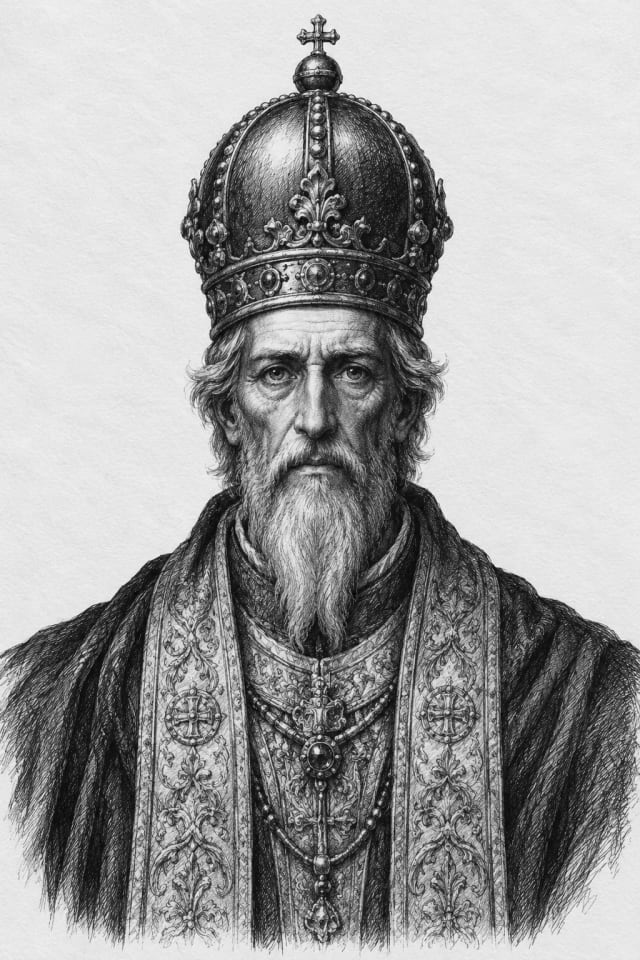
Saint Leopold enters the Sacred Ledger wearing a crown that a costumier made for him.
His only documented appearance is that effigy, and I set it down first so the reader stops looking for a cradle. On the fourteenth of Novembris, A.S. 30 (1740 CE), three days after the Treaty of Regensburg, his figure rode the Ringstrasse among the forty-seven saints of the Black Procession. Saint Rupert carried his salt-cellar. The Blessed Adalheid carried her crozier. Leopold wore the ducal crown. Academy students walked behind him carrying a printed programme that named his incorrupt body as a superstition and supplied the correction.
The Ledger builds his entry from those two facts: a crown, and a corpse the Rationalists felt obliged to explain away. They did not waste plaster on obscure saints. The method depended on an audience that would know the saint on sight and know the claim attached to him, so that the correction would strike a familiar face. Vienna recognised Leopold in A.S. 30. The Prefecture used that recognition to humiliate him, and the Ledger now uses it to open his file.
#On the Incorrupt Body
The programme's sentence survives whole: "naturally occurring adipocere formation in alkaline soil."
Read it as a confession. Nobody prints a correction for a belief that nobody holds. The Republic's instructors set Leopold's preservation in type because the tradition was still alive in Vienna's parishes in A.S. 30, alive enough to need a counter-catechism and a column of black-gowned youths to carry it. The programme never disputed that the tradition existed. It disputed the cause. A physician's word was put where a sacristan would have said mercy, and a Latinate noun was expected to do what forty-seven bonfires were about to attempt.
Look at what the programme leaves out. It cites no exhumation and names no examiner. It records no measurement, no witness at an opened coffin and no place of burial. It supplies a soil for a grave it never locates. The alkaline soil belongs to the Prefecture, and the Prefecture inferred it from the conclusion it wanted, the way a lecturer chooses an example to suit his thesis. I will not move that soil into the Church's account of the saint. The Rationalists dug it, and it goes in the Ledger under their name.
The Church has always held that incorruption is a sign. Signs are read; they are not assayed. The Ledger therefore records the tradition as attested and the body as unexamined, and it refuses to let a hostile handbill pass as an autopsy.
#On the Ducal Image
The figure was straw and plaster on a wooden frame. Like its forty-six companions it was dressed in vestments confiscated from Vienna's churches and draped in black mourning cloth. The theatrical costumiers who built it had previously dressed opera singers and painted scenery for the Imperial Theatre. They were good at their trade. Witnesses who were sympathetic to the Republic still found the effigies disturbing to look at.
The crown was what identified him. Rupert could be known by his salt and Adalheid by her staff, and Leopold could be known only by what sat on his brow. The Ledger records that it was ducal. Its metal, workmanship and design are not recorded, and I will not supply them. A crown on an effigy shows what a costumier believed a crowd expected to see. It does not prove which duchy, if any, the man governed, and the Ledger enters no territory against his name.
The Klemm dossier remembers him waiting before the pyres "in plaster and ducal mockery." That is my own Bureau's phrase, and a fair one. The mockery came in layers. Real vestments were put on a false body, a false crown was set over a real devotion, and behind the platform walked students who had been taught that reciting a chemical cause was the same as understanding one. No surviving record names the author of Leopold's paragraph in the programme. It came out of the apparatus of Public Instruction, and the Ledger attributes it there rather than to any one hand.
Before the Rationalists came, the Ringstrasse carried the true relics of Rupert and Adalheid on feast-days. The Ledger has no record that Leopold's remains ever travelled that route, and I will not borrow Rupert's salt or Adalheid's healings to fill out a thinner file. In A.S. 30 he went down the boulevard as a likeness on a wheeled platform behind draught-horses. His body was not on it.
#On the Fire and the Finding
The platforms ended in the Heldenplatz at seven pyres stacked with timber and soaked in pitch. Dr. Klemm gave fourteen pages of address and never once used the Creator's name. At the fourth bell the torches went in.
For roughly ninety seconds the fires behaved as the lecture required. Then the heat stopped. The flames kept rising and kept giving light. The straw, plaster and stolen silk blackened and fell apart on schedule. But the air around seven burning pyres went cold. Frost formed on coat-buttons. A laundress in the front rank collapsed with blackened fingertips. Three citizens died of exposure within sight of the flames.
Leopold burned in one of those seven fires. The Ledger does not say which. Pilgrims would like a crowned saint who struck back, a gesture from the plaster or an answer from the grave. The record does not give them one. The warmth was withdrawn from the whole desecration together, from all forty-seven effigies at once, and no account singles out Leopold as its cause. A Warden who added a personal miracle to the file because the file looked thin would deserve the cold.
The Prefecture classified the event as an atmospheric anomaly, blamed Alpine wind-currents, and cancelled the second day of celebrations without giving a reason. Klemm went privately to the nearest pyre, held out his hand, and wrote the one honest sentence of his career. In public he called it a chemical marvel.
The Bureau of Doctrine reached its finding sixty-two years after the event, as it reaches most of its best findings, looking back. The finding holds that the Creator permitted the fire and withheld its sustaining warmth from the act. I keep that finding the way it was given: as Doctrine's reading of a sign. It does not certify what took place inside the flame. The Bureau of Engineering still lists the mechanism as unknown. Two years after the burning, in A.S. 32, came the Year Without Dawn. The Sundering followed on 1 November A.S. 45. The saints' effigies had been ash for fifteen years by then.
An older compiled digest of Vienna's portents dates the Black Procession, and with it the only documented appearance of Saint Leopold's crowned effigy, to A.S. 124.
Corrected to the fourteenth of Novembris, A.S. 30 / 1740 CE, three days after Regensburg. The earlier figure would have the Rationalists staging a state festival seventy-nine years after the Sundering and twenty-nine years after the Synod reconsecrated the square. The compiler has been reassigned to bell inventories, where a wrong number only rings.
#On the Later Memorial
After the Synod reconsecrated the Heldenplatz in A.S. 95, seven columns of black basalt were raised over the seven pyre-sites. The columns hold a steady thirty-seven degrees in every season, the temperature of living blood. Each carries the name of a saint whose effigy burned there.
Seven columns cannot name forty-seven saints. The Ledger does not show whether Leopold's name is among the seven cut into the stone, and it places nothing of his inside any column: no crown, no bone, no relic. I have read the inscription lists I am permitted to read, and I enter no finding on his name. A Warden who finds a convenient name in an inscription has usually carved it there himself.
Pilgrims come through the Bureau of Records' permit-houses in their thousands and lay bare hands on the basalt in winter. That is the pilgrimage of the Black Procession, the warmth returned to the square where the warmth was refused. Some among them surely come for the crowned saint. Others come because their district chaplain told them to, or because it was cold. The Ledger records no rite of Leopold at the columns and no cure in his name, and none will be entered on hearsay.
What remains is a name, a crown and a body that both the faithful and the Rationalists believed had refused to rot. The Republic set the full machinery of public instruction against him and still had to admit that it was arguing with a corpse.