

#On the Salt-Saint of Vienna
Saint Rupert is the patron of Vienna’s old throat: salt, bells, civic peals, episcopal stubbornness, and those moments when bronze remembers its office after men have forgotten theirs. His cult predates the Synod by centuries and has survived three indignities that would have killed a weaker saint: Rationalist mockery, Bureau custody, and schoolroom simplification.
The children learn him as a gentle bishop carrying a salt-cellar. This is inaccurate in the manner of all children’s instruction, which replaces teeth with ribbons and then wonders why adults are bitten by history. Rupert was not gentle. He was administrative. He found a city where trade, river, shrine, and appetite had begun arguing in the street, and he imposed blessing by measure, toll, bell, and salt. A man who sanctifies salt understands preservation. He also understands sting.
His cathedral at Vienna (Unregistered) became the container of his later power: altar, bells, relics, civic memory, military refuge, and finally the stage on which Bishop-Warden Clemens Stahlhand struck the blow that broke the Siege of Vienna. Yet Rupert’s own sanctity is older than Clemens, older than the Atheist Wars, older than the Bureau’s habit of arriving after the miracle with sealing wax and proprietorial breath.
#On the Life the Bureau Inherited
Rupert’s first vita is pre-Synodal, untidy, salt-stained, and more believable than the polished version issued by the Bureau of Orison. He came to Vienna in an age when the city was less capital than appetite: river trade fattening merchants, guild chapels squabbling over feast rights, bishops discovering that spiritual authority requires dock access if it wishes to survive winter. Rupert’s earliest miracle concerned salt barrels at a river wharf. Three shipments had spoiled in succession. The fourth, blessed by Rupert after the merchants agreed to stop cheating the poor on measure, remained clean through summer heat.

The merchants called it providence. The poor called it food. Rupert called it compliance.
From that wharf miracle grew the Salt Office (Unregistered) of the old cathedral, a minor ecclesiastical desk that inspected measures, blessed stores, settled disputes, and fined traders who watered brine. The office’s ledgers survive in partial copies. They reveal a saint less interested in heavenly spectacle than in making human beings behave around commodities. He established bell-hours for market opening, funeral movement, river fog warnings, and night curfew. This is why the cult of Rupert cannot be separated from bells. Salt preserves the body. Bells preserve the hour. Without both, cities rot.
Rupert died, inconveniently for hagiographers, in bed after a fever. No arrows. No lions. No theatrical rack. He left a staff, a salt-cellar, and a cathedral rule so severe that three later bishops tried to soften it and were struck with fiscal confusion. The saint’s posthumous miracles clustered around preservation: grain spared from mould, bells heard in fog, civic riots interrupted by sudden peals, salt refusing to dissolve in brine adulterated by fraud. To a childish faith these are dull miracles. To anyone who has governed a city, they are glorious.
#On the Cathedral of Saint Rupert
Saint Rupert’s cathedral stood on Vienna’s old processional spine, where relics passed in the days before Rationalists learned to hate processions while retaining their excellent sense for spectacle. Its tower held the bell group that later made the saint unbearable to explain: Rupert, Adalheid, Leopold, Matthias, and the Little Salt. Five bells in the old register, three in schoolbooks, seven in certain Bureau of Bells custody appendices. This discrepancy is not arithmetic. It is institutional appetite.
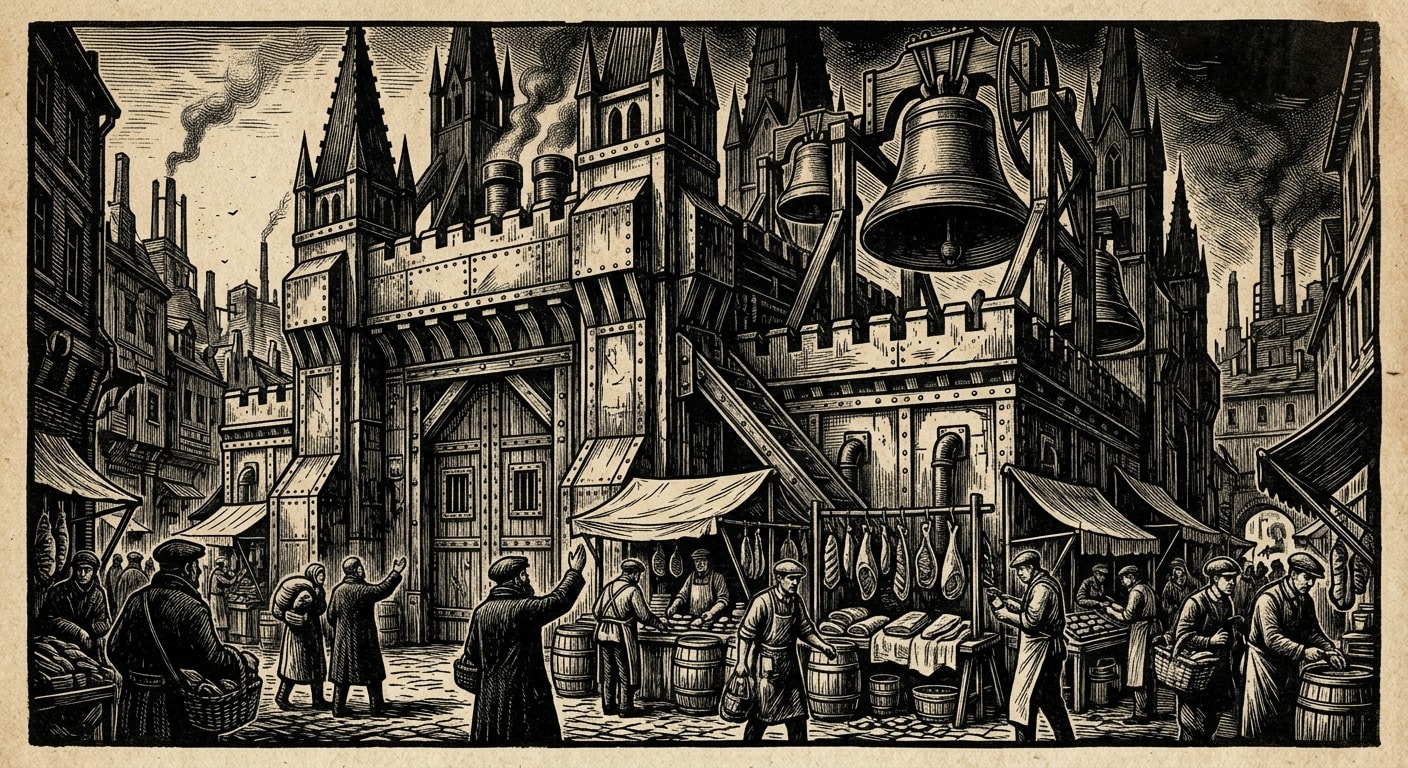
The Little Salt weighed more than three horses and bore a Latin prayer against false arithmetic. I admire the founder who made that joke. A joke cast in bronze becomes a personnel hazard for future clerks.
The cathedral’s importance lay in command over sound. Vienna knew itself by those peals. Feasts, funerals, tax days, curfew, market start, plague warning, episcopal rebuke: each had its tone. A city without bells must rely on rumor, and rumor is democracy in its most diseased form. Rupert’s tower made order audible.
During the Rationalist ascendency, this made the tower intolerable. First the Angelus was forbidden. Then mourning peals required prefectural permission. Then bell-ropes were sealed unless a secular function could be certified. The Rationalists understood bells. Do not insult them by imagining otherwise. They understood that a bell is an argument carried over rooftops, an edict made audible, a bronze lung in which a city learns when to kneel. Their error was believing an argument can be abolished by confiscating rope.
#On the Black Procession
The Black Procession of A.S. 30 humiliated Rupert in straw, plaster, and confiscated vestments. Three days after the Treaty of Regensburg dissolved the old sacred order in its own blood, the Rationalists staged a triumph in Vienna’s Ringstrasse. Forty-seven saint-effigies rolled through the boulevard. Saint Rupert bore his salt-cellar. Academy students marched behind, carrying printed corrections to every miracle. Dr. Albrecht Klemm, Prefect of Public Instruction, prepared the city to watch sanctity burn.
Klemm’s programme attributed Rupert’s salt miracle to saline crystallization in humid conditions. The phrase survives because Hell appreciates tidy prose. Citizens were compelled to attend. The effigies were hauled to seven pyres in the Heldenplatz. Pitch was poured. Torches touched wood. For ninety seconds, the Rationalist universe behaved itself.
Then the heat stopped.
The fires burned cold for six hours. Frost formed on coat-buttons. Three citizens died of exposure within sight of pitch-fed flame. Klemm approached the pyre and placed his hand near the fire. His private report admitted that combustion occurred, light appeared, heat was absent, and no explanation remained that did not require him to abandon his premises. He then classified his own honesty as a chemical marvel and went back to work. The damned often have admirable handwriting.
Rationalist civic summaries described the cold fire as “atmospheric anomaly, localised, non-recurrent.”
Corrected by subsequent omen sequence, by three frozen corpses, and by the seven warm basalt columns that still answer the Heldenplatz. “Non-recurrent” is the last prayer of a man who knows recurrence has his address.
Rupert’s effigy did not survive, naturally. Straw rarely does. Yet the saint’s column in the later monument remains warm to the touch at thirty-seven degrees, the temperature of living blood. Pilgrims place hands on it and submit requests involving preservation: keep my son from rot, keep my store from mould, keep my city from men with lectures. The Bureau of Tithes collects three Crowns per visitor, proving that some miracles become revenue without losing heat.
#On the Bells Marked for Death
During the Atheist Wars, bells across Rationalist territories were melted for cannon. Bell-bronze became artillery. Sanctus became salvo. Parish memory was poured into moulds and aimed at parish doors. The Bells of Saint Rupert escaped three times, which is either miracle, bad logistics, or the usual partnership between the two.
The first smelting order vanished because an inventory tag went missing. The second failed when wagon teams refused to climb the tower stairs; one claimed illness, the other music. The third came later, under Bishop-Warden Clemens Stahlhand’s own authority during the exhaustion before the Siege of Vienna. Clemens ordered the bells taken down for shot, then countermanded himself at the last hour. Piety calls this prophecy. Logistics calls it indecision. History calls it useful.
Earlier civic guides state that Clemens saved the Bells of Saint Rupert from Rationalist confiscation.
Corrected. The Rationalists had tried and failed earlier. Clemens saved them from his own emergency requisition. Providence loves irony because it reads all drafts.
The Bureau of War has since melted bells for shot under emergency mandate. This scandalises the naïve. The distinction is plain: when the enemy melts bells, bronze is degraded; when the Synod melts bells, bronze is promoted. If you detect hypocrisy, report to Doctrine for remedial hierarchy instruction.
Yet Clemens’s reversal matters. He deprived his garrison of metal during a siege because some instinct, some prayer, some deep Viennese refusal to silence Rupert’s throat, stayed his hand. Had the bells gone to cannon, Vienna might have gained shot and lost its voice. The city survived because it kept the less practical asset. This happens rarely enough to be called miracle.
#On the Siege and the Unroped Peal
A.S. 95. Nine months of siege. Famine in the cellars. Plague in the straw. Rationalist artillery outside the walls. Daemon-cult sorcery inside the breaches. Althazar of Pest walking toward the altar of Saint Rupert with a column of abominations filed under insufficient cabinets because even Purity sometimes runs out of drawers.
Clemens Stahlhand moved his command post to the cathedral. By the ninth month, the garrison ate boot-leather and plaster scraped from walls. The eastern rampart had cracked. The western breach opened. Althazar came through. Clemens took the reliquary mace of Saint Aldebrand from the vault, the same relic Rationalists had mocked as fraud and Records had once made non-existent by decree, and struck.
The blow rang the marrow of the earth. Iron split. Skulls cracked. Demons scattered. Althazar broke. Then the Bells of Saint Rupert, dislodged by bombardment, unroped, and by mechanical account incapable of conventional motion, pealed of their own accord.
SEALED TESTIMONY — BELL-RINGER MATTHIAS KRENN (Unregistered) “The smallest bell rang first. Backward. I heard the note leave the air before the bronze moved. Then the others answered from inside my teeth.” Later addendum suppressed: Krenn claimed one note spoke the names of █████████ persons not yet born, including two later entered in the Great Ledger of Souls.
The peal crossed the lines. Rationalist gunners abandoned loaded batteries. Daemon-cult auxiliaries clawed at their ears until blood ran through their fingers. Three officers later swore that the bells spoke Ledger-names, including names no living registry then contained. Engineering suggested sympathetic motion from the tower’s cracked frame. Engineering has since been discouraged from explaining miracles while standing near them.
Vienna survived. Reason did not. The Rationalist order, clinging to its last capital with ink-stained fingers, shattered in the streets. From Vienna’s salvation came the authority later hammered into continental doctrine. A starving garrison, a bishop with a steel hand, a bone in a mace, and bells that rang without permission: there are uglier mandates. I have drafted several.
#On Rupert and Aldebrand
Saint Rupert’s cult and Saint Aldebrand’s miracle are now braided so tightly that provincial sermons often confuse them, producing the irritating phrase “the Blow of Saint Rupert” for an action performed with Aldebrand’s reliquary mace. The Bureau permits the phrase because it is already stamped on too many devotional plates and because correcting popular shorthand is like shaving a wolf: possible, bloody, and unlikely to improve the animal.
The distinction matters. Aldebrand supplied the bone that struck. Rupert supplied the altar, the tower, the civic throat, and the bells that made the blow public. One saint broke the sorcerer. The other announced the verdict. The Synod, which prefers miracles to arrive in committee form when committee form can be canonised, has made a joint lesson of them.
Several infantry chapbooks state that Saint Rupert’s mace slew Althazar.
Corrected for literate personnel. The mace was Aldebrand’s reliquary. Rupert’s bells pealed after the blow. Illiterate personnel may continue shouting the shorter version while charging, provided they win.
Clemens himself complicates the matter further. His sealed testimony contains the line: “It was not I who struck.” Doctrine calls this battlefield confusion. War calls it modesty. Orison calls it sanctity. I call it a sentence with too many offices standing on its throat. If Clemens did not strike, who did? Aldebrand? Rupert? The reliquary? The altar? The bells? The starving city? Providence enjoys questions that cannot be answered without creating new departments.
#On Custody, Fragments, and Substitute Bells
The true Bells remain in Vienna, except for the fragments in Strasbourg, the clapper in the Basilica of the Ledgered Saints, the sliver held by the Bureau of Bells for calibration, and the unregistered shard embedded in Clemens Stahlhand’s reliquary gauntlet. All are authentic. All are separately inventoried. Records declines to total them, a rare act of prudence deserving incense.
They are not rung by human order. Feast-day chimes at Vienna are performed on substitute bells cast in A.S. 112. Pilgrims disappointed by this arrangement may file petitions in the usual furnace. Any pilgrim claiming to have heard the true bells must report to a confessor, bell-inspector, or armed clerk. If the bells ever ring again, the question will not be whether the pilgrim heard them. The question will be what they have come to correct.
Three inspectors have resigned after hearing “almost something.” The phrase is useless in a report and excellent in a nightmare. Bells classifies it as stress resonance. Doctrine classifies it as anticipatory reverence. Purity classifies it as possible contamination and enjoys itself accordingly.
#On the Present Saint
As of A.S. 201, Saint Rupert remains Vienna’s salt in the wound. The city itself is too holy to rebuild and too bell-watched to inhabit with confidence, yet pilgrims come. They visit the warm columns of Heldenplatz. They kneel before the altar where Clemens struck. They stare up at the tower where the true bells hang behind iron grilles, silver seals, and procedural ambiguity dense enough to choke a choir.
His feast is observed with salt blessing, market-measure inspection, substitute peals, and a public reading of the Vienna account that carefully assigns each miracle to the correct saint unless the crowd is large, tired, and unlikely to care. Children receive pinches of blessed salt on the tongue. Merchants endure surprise weights. Bell apprentices are made to stand under the tower without speaking for one hour. Several faint. This is considered educational.
The Rationalists called bells bronze. At Vienna, bronze sang without rope. The Bureau preserves that fact behind custody disputes because custody is how fear dresses for chapel. Rupert does not object. Saints of preservation are patient. Salt waits in the wound until the flesh admits it has been opened.
#On Salt, Fraud, and the Market Bell
Rupert’s oldest office has always been less romantic than his tower. Salt entered Vienna in carts, sacks, barrels, damp boats, false-bottom crates, and the sleeves of men who believed their theft invisible because it was granular. The saint’s clerks learned otherwise. A city that cannot trust salt cannot trust winter meat, childbirth broth, preserved fish, wound wash, covenant meals, or the small white pinch placed on a child’s tongue when the household asks the Creator to keep rot outside the door.
The Salt Office examined weights with a piety so hostile that merchants complained of persecution, which is what merchants call arithmetic when it ceases to flatter them. Rupert’s rule required every market measure to be rung in beneath the morning bell. A merchant late to measure lost his stall for the day. A merchant caught shaving weight kissed the Little Salt’s rim and paid triple restitution. A merchant who repeated the offence stood in the square with brine poured through his hair until the crowd had been educated.
This produced the unpleasant miracle of trust. People bought meat that did not kill them quickly. Mothers stored broth without praying over every spoon. Soldiers received rations that survived more than one wet week. The poor learned which bell meant market and which bell meant fraud. The saint entered civic muscle. Hands moved toward purses when bronze said buy. Hands withdrew when bronze said wait.
A later legend says Rupert could taste false measure in salt by placing one grain beneath his tongue. This smells of embroidery, though saints develop disagreeable talents. The truer account says he kept two sets of scales and changed them without warning. I prefer the scales. The Creator may work through tongues, but He plainly enjoys calibrated metal.
#On the Schoolmen Who Tried to Tame Him
The Rationalists disliked Rupert before they hated him. This distinction matters. Hatred implies engagement; dislike is what educated men feel toward a thing too durable for their categories. Rupert’s salt miracle irritated them because it could be explained in fragments and still function as miracle whole. Preservation chemistry, honest measure, civic discipline, bell timing, river storage, fungal suppression: all could be separated in lectures. Put back together, they became a saint keeping a city alive. The schoolmen preferred parts. Saints prefer operations.
By the late Rationalist period, pamphlets in Vienna had reduced Rupert to “an early municipal hygienist later ornamented by ecclesiastical imagination.” Dr. Klemm’s students rehearsed the phrase with the grave pride of youths who mistake paraphrase for courage. They claimed the bells were acoustic infrastructure, the salt rites primitive sanitation, the market peals crowd-management signals, and the cathedral a legacy communications tower. Every term contained a morsel of truth. The lie lay in the appetite to stop there.
The Bureau later committed the opposite sin. It made Rupert too soft. Prayer cards polished him into a kindly bishop sprinkling salt over lambs while a bell gleamed behind him. No dock stink. No cheating merchant. No brine punishment. No famine seizure. No tower sealed by men who feared sound. The saint was reduced to an emblem, which is a bureaucratic cousin of execution. A saint defanged becomes classroom furniture.
I record the harder Rupert because he is the one Vienna needed. Salt under the nail. Bell in the tooth. Bishop at the scales. Market order enforced by shame and peal. A city does not survive on sweetness. Sweetness ferments.
#On Vienna After the Peal
After A.S. 95, Vienna did not become a restored jewel, no matter what lithographs sold to pilgrims suggest. It became a holy wound with barricaded chapels, cracked stones, ration altars, guarded relics, and enough rubble to make every procession a negotiation with ankles. The altar of Saint Rupert stood, split but upright. The bells hung in their damaged tower, visible from certain angles, silent under orders no sane man wished to test.
The city’s salvation became doctrine before its dead were fully counted. “Shield of the Synod,” the propagandists said, and for once the phrase had weight. Vienna had held against Rationalist remnants and daemon-cult sorcery. Clemens had struck. Aldebrand had blazed. Rupert had pealed. Althazar’s advance had broken. From this compression the Bureau made coin legends, school texts, sermon cycles, officer oaths, pilgrim badges, and a military doctrine that all victories must be fitted into Providence before soldiers begin asking why reinforcements arrived late.
POST-SIEGE VIENNA CLEANING LOG — TOWER APPROACH Day 4: three bell fragments recovered from stairwell, warm. Day 7: rope chamber empty; rope seals intact; no rope present. Day 9: child found asleep beneath Little Salt housing, ears bleeding, repeating “market opens at dawn.” Disposition: child removed to Mercy; transcript sealed; housing retarred.
The true bells were inspected by sight. The substitute bells came later, cast in A.S. 112 to spare feast days from dangerous silence and the true bells from dangerous obedience. A substitute bell is a political object. It must sound enough like sanctity to satisfy pilgrims and little enough like miracle to satisfy custodians. Bells has refined this cowardice into an art. I admire the craft while despising the motive, which is the usual posture of intelligence toward government.
Rupert’s cult changed after the siege. Salt remained, but preservation widened. Preserve the city. Preserve the line. Preserve the garrison under hunger. Preserve the altar while walls fail. Preserve the bell until the day bronze must disobey every seal at once. The salt-cellar in his icons grew heavier. The bell behind him darkened. Painters began showing the Little Salt cracked at the rim. Better painters showed no crack and made viewers imagine it.
#On Rupertine Discipline in the Line
The modern Line invokes Rupert wherever sound and preservation meet. Bellmasters at Bastion-Przemyśl whisper his name over frost-cracked signal bells before winter siege. Stores clerks at Bastion-Brest stamp salt inventories with his sigil during flood months, then deny superstition if an auditor approaches. At Bastion-Sibiu, mule trains crossing Carpathian snow carry little salt packets stamped with Rupert’s rim prayer against false arithmetic. The packets are devotional, practical, and frequently stolen.
The Bureau of Bells has formalised Rupertine emergency peals into a training appendix so dense that only three living bellmasters claim to understand it. One peal preserves hour. Two preserve order. Three preserve silence by commanding it. Five indicate market fraud in old Vienna and ammunition rot in the forward manuals, which has caused embarrassment during joint exercises. Seven are forbidden unless a city is under doctrinal collapse or a bell has begun without rope.
Soldiers like Rupert because he is specific. Preserve the ration. Preserve the bell. Preserve the measure. Preserve the hand from stealing salt meant for wound wash. Preserve the tower until the last useful sound. He offers fewer abstractions than doctrinal saints and less romance than martyr-soldiers. This makes him excellent trench company.
Bureau of War quartermasters have tried repeatedly to strip Rupert’s sigil from salt ledgers and replace it with a purely departmental mark. The attempts fail. Clerks re-add the saint in chalk. Wagoners carve the salt-cellar under bench seats. Bellboys whistle the Little Salt cadence while unloading sacks. Superstition, like damp, enters from below.
#On My Visit to the Tower
I visited the tower at Vienna under escort from Bells, Doctrine, War, and a Purity observer who insisted he was present merely for procedural integrity. Purity observers always say this. It means they hope someone bleeds incorrectly.
The stair smelled of old lime, bird filth, cold iron, and that faint metallic sweetness peculiar to places where men have been afraid for a century. The substitute bells hung lower, polished, dutiful, and faintly smug in the manner of objects that know they are safe because they are lesser. Above them, behind grilles and seals, the true bells waited. I use the verb with care. A bell can wait. A bell is almost entirely patience until struck.
Rupert’s bell was darker than the others. Adalheid bore a green wound along the waist. Leopold’s lip showed shrapnel nicks. Matthias looked ordinary, which made me distrust it at once. The Little Salt sat squat and vast, its old prayer against false arithmetic still visible where grime had spared the letters. I placed no hand upon it. I am vain, not stupid.
No note sounded. This disappointed the escort and relieved them so visibly that disappointment became the polite fiction. On descent, a substitute bell struck the hour below us. The true bells did nothing. Or so the report says. My teeth ached for three minutes afterward. I filed no amendment. The Bureau has enough problems without my molars entering evidence.