

#On the Old Route
The Ringstrasse is Vienna's great boulevard. That is the first line in its file. For longer than I like, it is nearly the only line. No surviving register names who laid the street out or who paid for it. None gives the year its first stone went down, or its length in any unit the Bureau of Engineering would sign for. The archives of Vienna have been seized, burned, reclaimed and reshelved by successive authorities. They hand the street to us already built and already named, as if it had never needed a surveyor.
What the record keeps is the street's use. Before the Rationalists, the Ringstrasse carried the city's feast-day processions, and among the things those processions carried were the relics of Saint Rupert and the Blessed Adalheid. No schedule of those feasts survives, and neither does an inventory of the reliquaries. Nobody wrote down the bearers' names or the order of march. Only the fact remains. Two of Vienna's holy dead went along this boulevard on their days, in view of the city, and the city learned which of its roads was for carrying the sacred.
A boulevard is a road. A processional route is a road a city has agreed to read like a sentence: a subject goes forward, the faithful stand at the kerb, and everyone knows how the sentence ends. Vienna had read the Ringstrasse that way for longer than anyone bothered to record. That was its whole ceremonial standing, and it was enough to get the street chosen.
#On Public Instruction
The Treaty of Regensburg gave the Rationalist Republic its formal settlement in A.S. 30 (1740 CE). The Rationalists had governed Vienna before that, and the treaty gave them the paperwork. Three days later, on the fourteenth of Novembris in the published account, they wanted a triumph, and the Prefecture of Public Instruction was told to stage one.
The Prefecture assigned three places. The Academy already sat in the Cathedral of Saint Stephen. The burning went to the Heldenplatz. The procession itself went down the old relic route. I read that choice the way I read any confession. A man who truly believed processions were empty would have marched his carts down the most convenient street. The Prefecture picked the one street every grandmother in Vienna knew as the road of the saints. They said the old rites meant nothing, and then they took the old rites' road for their own rite.
Attendance was compulsory for citizens of the First Prefectural District, during working hours. The record says that much and stops. It does not say where the District's lines ran, whether the boulevard lay inside them, what other districts were required to do that afternoon, or what happened to a man who stayed at his bench. I will not invent a fine to make the obligation vivid. It is vivid enough already. A government that had just freed the European mind ordered that mind into the street on a weekday to watch the freeing go past on carts.
The figures were made by craftsmen who had once dressed opera singers and built sets for the Imperial Theatre. It was the craftsmen who were hired, not the house. The theatre itself appears in no surviving document as sponsor, workshop or starting-post for the day. Its old employees did the work.
#On the Forty-Seven
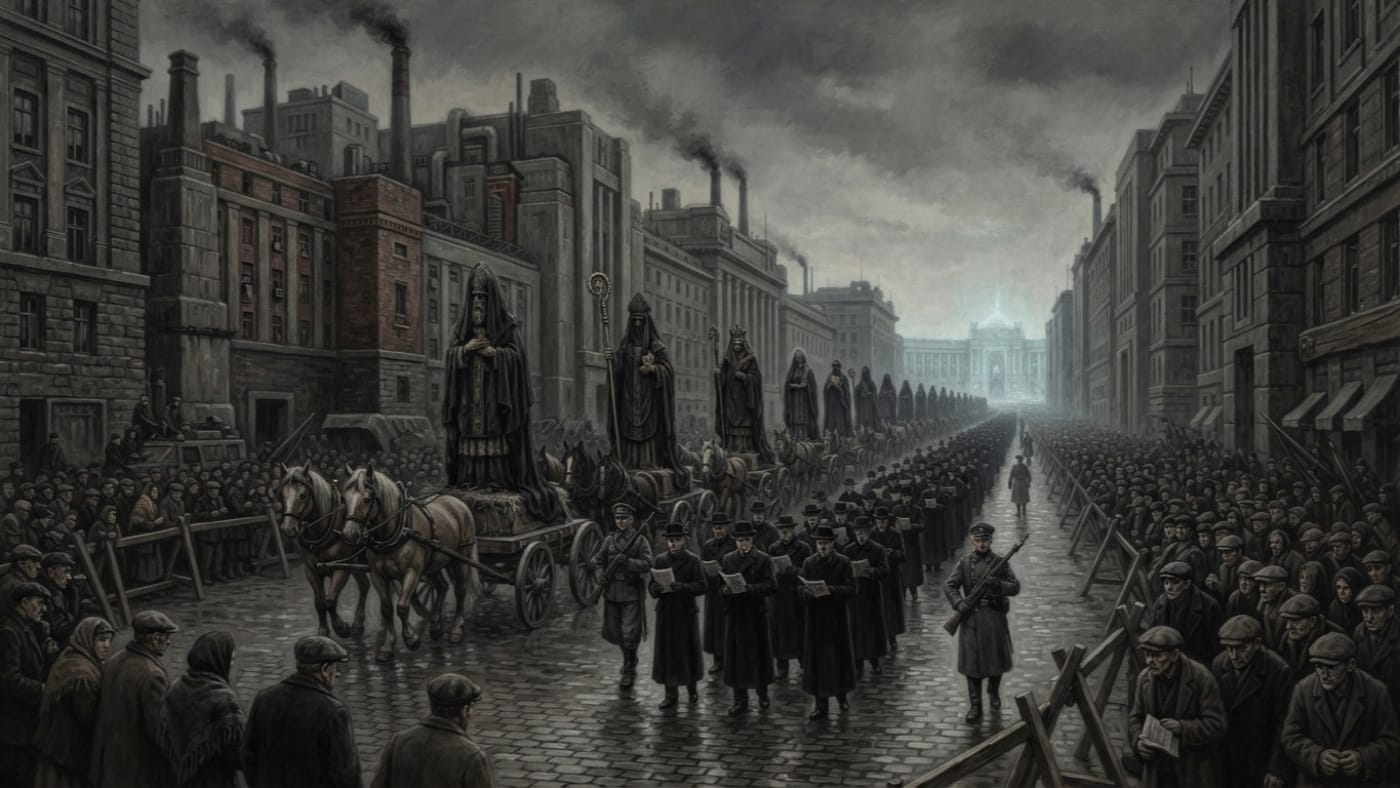
Forty-seven effigies went down the Ringstrasse. Each was straw and plaster on a wooden frame. Each wore vestments confiscated from the churches of Vienna, and over the vestments hung black mourning cloth. Each rode a wheeled platform, and draught-horses drew the platforms along the boulevard in file, the way relics had once gone, behind the horses instead of on the shoulders of the faithful.
The organizers gave a reason for the number: one effigy for each year of what they called the Superstitious Epoch. The Ledger records the claim as theirs. It does not adopt their arithmetic, and it takes from that number no date for anything older than their own impatience.
Three of the forty-seven are identified in the record. Saint Rupert carried his salt-cellar. The Blessed Adalheid carried a crozier. Saint Leopold wore the ducal crown. The other forty-four went by unnamed in any surviving page, and I will not fill the column with guesses. Whoever they were, they were built to be recognized. Attributes have no other purpose. An effigy nobody knew would have been straw on its way to a bonfire. An effigy everybody knew was an insult delivered in procession, at walking pace, in front of the whole street.
Behind the platforms marched columns of Academy students in black gowns, carrying printed programmes. Each programme named the saint, listed the miracles attributed to him or her, and set the Prefecture's "rational correction" beneath. Rupert's salt became saline crystallization. Adalheid's healing of the blind became optic-nerve inflammation. Every miracle was corrected in a paragraph and printed before the saint had reached the fire.
The difference between the two kinds of procession is the whole matter of this file, so I set it down plainly. On the feast days the Ringstrasse carried relics, whatever the reliquaries held: the remains and memorials of the holy dead, brought out on their days. On the fourteenth of Novembris it carried plaster in borrowed cloth. The form of the procession survived. There were platforms and draught-animals, bearers and followers, vestments, mourning colour, and a crowd lining the route. The Rationalists kept all of it and changed only the thing at the centre. They could not invent a ceremony of their own. They borrowed the Church's and put a dummy where the relic had been.
One more point. The only things on those platforms that had ever served at an altar were the vestments, and they had been taken by order. The theatre men supplied straw, plaster, frames and skill. The Prefecture supplied the sacred cloth, out of sacristies. Somewhere in the city a clerk signed for it.
#On the Fire Beyond the Route
The procession left the Ringstrasse's account where the boulevard's record ends, at the Heldenplatz. No document gives the junction, the turning or the street in between. In the square, Dr. Albrecht Klemm gave the principal address. Then the effigies were given to the fire.
The fires burned, consumed what was fed to them, and gave light without heat. Witnesses suffered frostbite. Three died of exposure. The second day of celebrations was cancelled. The full dossier lies with the Black Procession, and I will not copy it out here to make this file look fuller.
None of this belongs to the boulevard. No register records frost on the Ringstrasse, cold in its paving, or any anomaly along its length. The street carried the saints to the fire. The fire did its work elsewhere.
In A.S. 92 the Bureau of Doctrine classified the event as a First-Order Portent: Providential Warning, Category: Elemental Rebuke. The observation was fire without heat. The judgment is Doctrine's: the Creator withheld His warmth from the desecration. I hold that judgment as a Warden holds it, entirely. The Ledger still keeps observation and judgment in separate columns, so that a heretic who attacks the second finds the first untouched behind it. The Year Without Dawn followed in A.S. 32, then the Red Flood in 34 and the Eastern Silence in 38, and the Sundering on the first of November, A.S. 45. The Rationalists filed the first warning under weather.
Stamped Erratum — Sacred Ledger: Inherited chronologies that place the Black Procession in A.S. 124 are struck. The Procession, and with it this boulevard's documented attestation, belongs to A.S. 30 (1740 CE), three days after the Treaty of Regensburg. Any era-heading built on the older figure is withdrawn with it. The Ringstrasse did not wait ninety-four years for its saints to pass.
#On the Surviving Record
Vienna was reclaimed in A.S. 95, and the Heldenplatz was reconsecrated that year. Seven black basalt columns stand there and hold a steady thirty-seven degrees in every season. They stand in the square. Nothing in their record ties a column to a particular effigy, and they were never set on the boulevard.
The city today is an inhabited shrine-ruin and a supply hub of the Central Corridor, in Zone 3, with about ninety thousand souls entered in the registry. The ruins have their own file. The registry counts residents, not kerbstones. It does not record whether the Ringstrasse is paved or broken, busy or empty, prayed along or simply walked. I have no survey of its present stones, and I will not write one from a window I have never looked through.
So the boulevard's file holds two things. There are the undated feast days, when relics went along it and the city knew what it was seeing. There is one afternoon in Novembris of A.S. 30, when plaster went along it in stolen vestments and the city was told by printed programme what it was seeing. Of the street between those two entries, and since, the Ledger holds nothing. It will not write in what it does not have.