
#On the Square That Learned Temperature
The Heldenplatz lies in Vienna, before the dead dignity of the Hofburg and within the wider custody of a city that has been capital, carcass, shrine, tourist trap, and administrative inconvenience, in that order of holiness. The square was once imperial theatre: parade ground, balcony stage, cavalry floor, the stone plate upon which rulers presented themselves to the obedient and the ambitious. Then the Rationalists took it and discovered, as all atheistical regimes eventually discover, that old stone remembers old gestures better than new slogans.
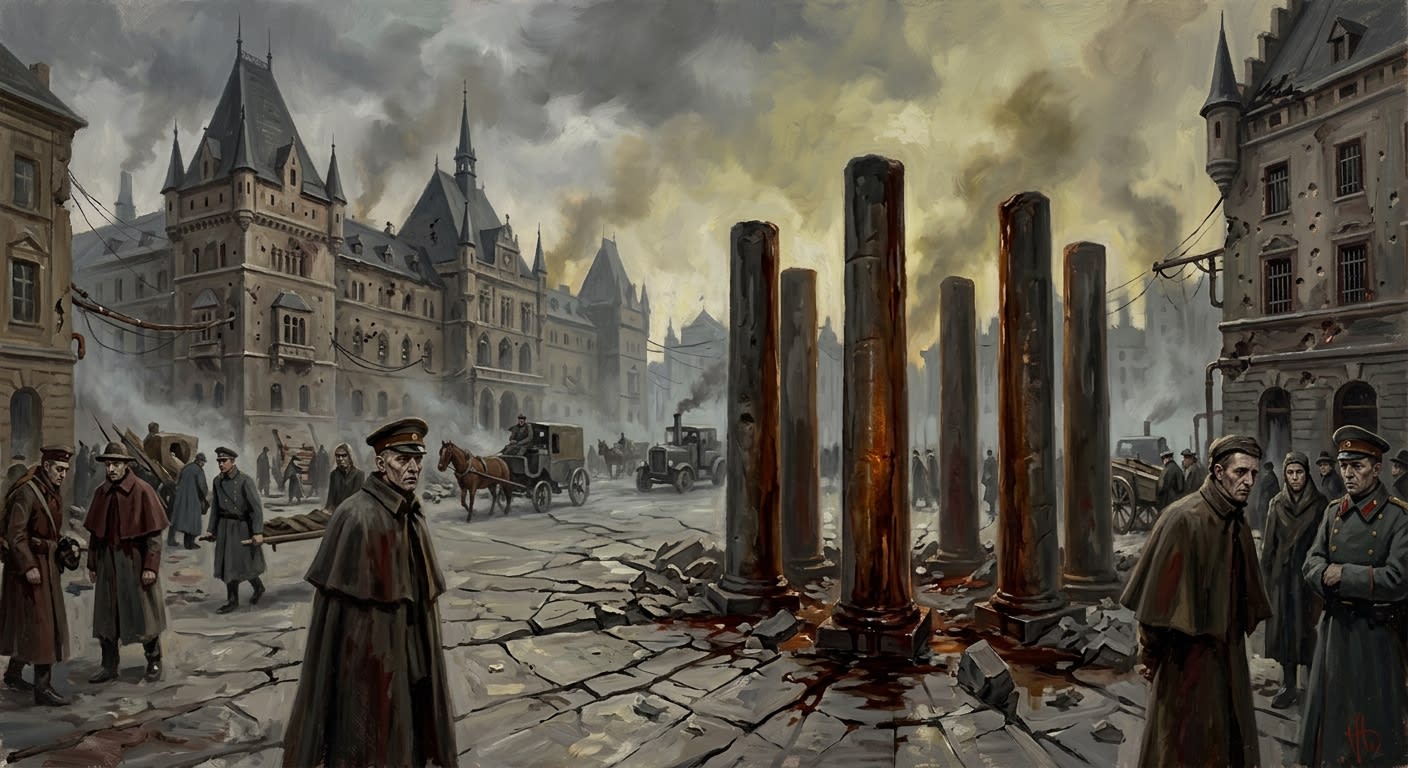
Its present surface is cracked in a radial pattern still visible beneath pilgrim knees, measuring cords, soot varnish, and the Bureau of Pilgrimage's tasteful little brass arrows. Seven basalt columns stand upon seven former pyre sites, each column warm at thirty-seven degrees, the temperature of living blood. They have radiated that warmth since A.S. 95. The Bureau of Engineering measures them quarterly. The Bureau of Doctrine explains them annually. The explanations are mutually obedient and scientifically useless.
The Heldenplatz is best understood as a square where the Synod defeated vocabulary. The Rationalists named desecration emancipation. They named cold fire atmospheric anomaly. They named retreat public safety. They named defeat civic recalibration. They named the Creator obsolete and stood beneath pyres that refused to behave. Sixty-five years later, Clemens Stahlhand struck Althazar of Pest with Saint Aldebrand's reliquary mace, and the stones answered with cracks. Since then the square has belonged to us, which is to say it has belonged to pilgrims, clerks, guides, relic vendors, penitents, soldiers in transit, widows with exact change, and the particular species of official who can stand beside a miracle and ask whether the queue rope should be moved three inches left.
#On the Black Procession of A.S. 30
The square's first modern wound came three days after the Treaty of Regensburg, when the Rationalist Prefecture of Public Instruction staged what its posters called a civic funeral for superstition. Forty-seven saint-effigies were carried into the Heldenplatz draped in mourning cloth. Academy students in black gowns stood in formation. Republican guards held the approaches. Attendance was compulsory in the usual Rationalist manner, which combined legal command with the insult of calling obedience voluntary.
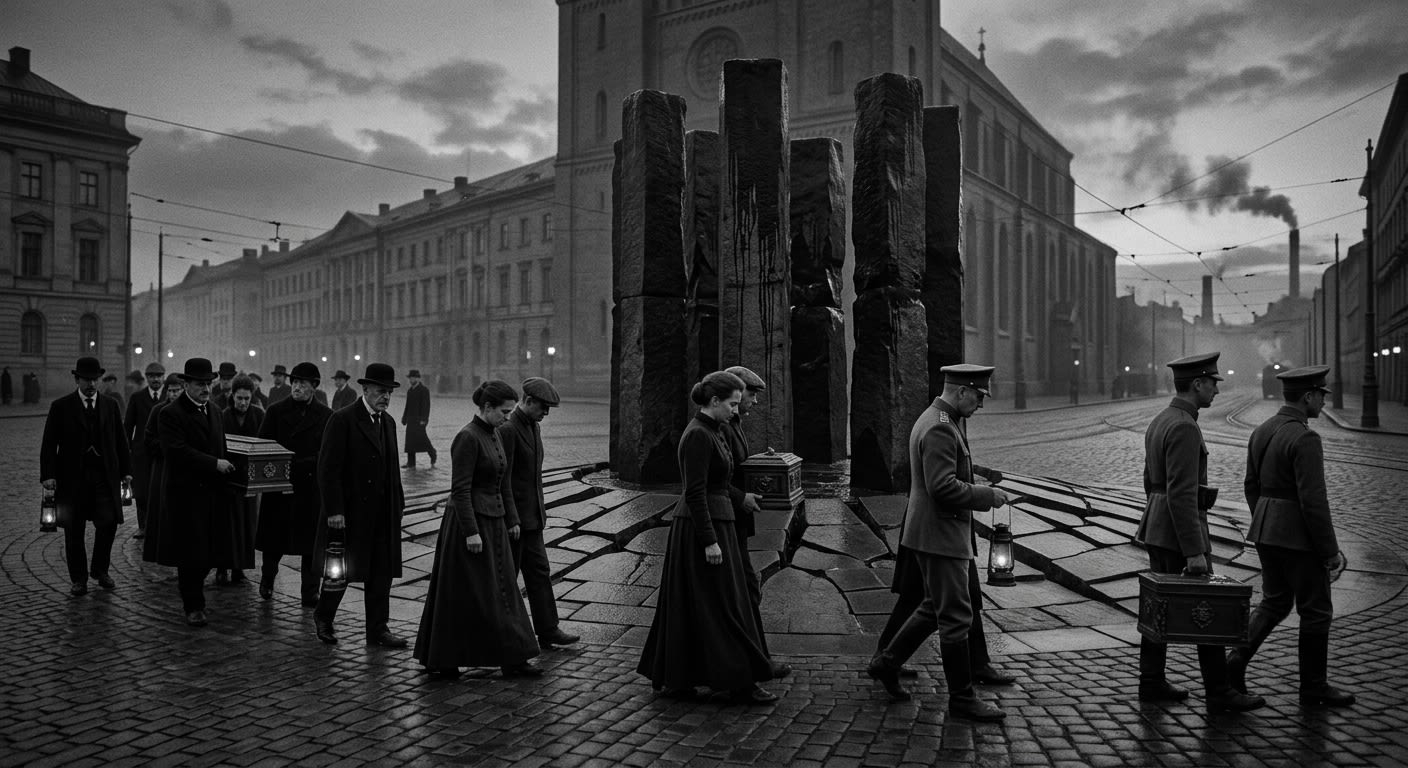
Dr. Albrecht Klemm, Prefect, lecturer, and visible mouth of the Triumvirate of Public Instruction, delivered the address. Fourteen pages survive. I have read them, and I regret to report that the man wrote with discipline. Bad prose comforts the censor. Good prose sharpens him. Klemm used liberation as a knife, reason as a disinfectant, and civic hygiene as the basin in which he intended to wash Europe clean of prayer. He did not use the word the Creator. He had already declared the word linguistically obsolete, a statement so pleased with its own collar-studs that one longs to slap the sentence before the author.
At fourth bell the torches touched the pitch. For ninety seconds the square belonged to the Republic. Flame rose. Smoke moved. The effigies caught. Students smiled with the brave idiocy of young men watching their professors approve them. Then the heat withdrew.
The fires continued to burn. They produced light. They consumed pitch. They blackened cloth. They gave no warmth. Frost formed on coat-buttons within six feet of the pyres. A laundress collapsed in the front rank. A boy lost two fingers to cold while standing close enough to smell burning saint-paint. Three citizens died of exposure in sight of fire. The Republican guards tried to push the crowd back and found the crowd pushing toward the flame, because terror makes fools into investigators.
Klemm did not flee. This deserves record, because even the damned are entitled to accurate rope. He watched the cold fires betray his premises and later classified the event as an atmospheric anomaly, localised, non-recurrent. He changed his terms in later lectures: chemical marvel, thermal displacement, crowd perception residue, superstition's last meteorological argument. The cowardice was flexible. The fear beneath it was not.
The Bureau of Doctrine classified the event retroactively in A.S. 92 as First-Order Portent: Providential Warning, Category: Elemental Rebuke. This is a splendid phrase and almost too merciful. The Heldenplatz did not warn Vienna. It testified against it.
#On the Rationalist Stagecraft
A square does not become blasphemous by accident. Someone must measure the sight-lines, requisition the lumber, hire the plasterers, instruct the guards, print the handbills, arrange the viewing stands, and decide which saint shall be insulted first. The Heldenplatz was desecrated by logistics before it was desecrated by fire.
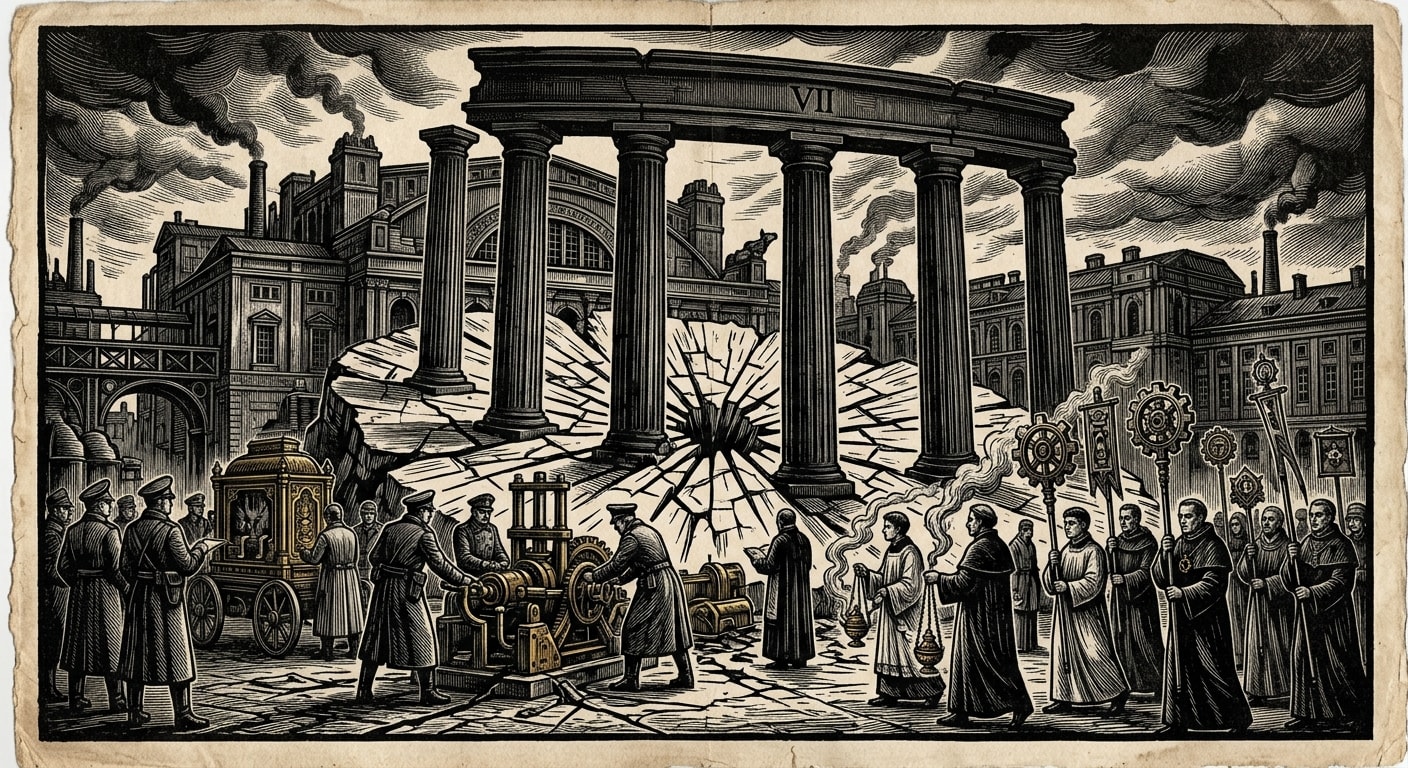
Klemm's office chose the square because the old Holy See of Vienna had just been dissolved at swordpoint and the new Rationalist Republic required an image large enough for illiterate obedience. The Imperial Palace stood at the edge like a captured skull. The boulevards could feed crowds into the plaza under guard. The surrounding offices could be hung with black cloth. The old imperial habit of public acclamation could be turned, with very little carpentry, into public apostasy. Rationalists were skilled at reusing sacred architecture after removing the sacred, as a butcher reuses a church knife to cut sausage.
The forty-seven effigies were not random. Saint Rupert was placed nearest the central pyre because Vienna's bells had once belonged to him. Saint Leopold was given a paper crown and made ridiculous for the benefit of republican students. Lesser local saints were arranged by district so families could watch their own intercessors humiliated in proper civic order. Saint Aldebrand was absent from the procession in name, which proves that even atheists possess instinct. They had mocked his reliquary in Amsterdam nineteen years earlier and still lacked the courage to put him in plaster before the crowd.
The Prefecture of Public Instruction made school attendance compulsory that afternoon. Children were given lesson slips titled The Mind Freed From Ghosts. Surviving copies show eleven blanks to be filled during the ceremony: relic, priestcraft, credulity, emancipation, republic, and so forth. One blank remains unfilled on several recovered slips. The prompt reads: Fire proves that matter obeys ______. I am fond of that blank. It is the most honest Rationalist sentence in the archive.
Academy musicians were positioned near the north approach to play a civic march after the first pyre took. They stopped after the heat failed. Later reports blame condensation in the brass instruments. This is a charmingly technical phrase for panic. The trombonists saw their breath frosting in the mouthpieces and understood more theology in one minute than Klemm had permitted them in three years.
The crowd's behaviour after the cold began is the point the Republic tried hardest to bury. They did not stampede. They did not riot. They leaned forward. Men and women who had been ordered to witness the end of sainthood suddenly behaved like auditors at a suspicious account. They tested distance. They held hands toward flame. They compared the cold line against paving joints. They spoke in whispers because the square had become a chapel without permission. That, more than frostbite, frightened the guards.
#On Cold Fire and Corrected Science
The cold fires lasted into the night. Rationalist reports disagree on duration because men who deny miracles become poor timekeepers in their presence. Some write two hours. Some write until matins. One private memorandum says the pyres continued to glow under frost until the ash had finished spelling names in its own collapse. The memorandum was seized, copied, misfiled, and rediscovered by a clerk whose career briefly improved before Purity noticed his handwriting.
Cold fire is an insult to two kingdoms at once. It insults matter by burning without heat. It insults unbelief by behaving in public. Rationalist science could have survived private impossibility; every academy keeps cabinets for failed instruments, dead rats, and inconvenient measurements. Public impossibility is harder. Citizens had been ordered to watch the death of sainthood and instead watched combustion submit a dissenting report.
The Rationalists scrubbed the stones and failed. They relaid sections of pavement and found the frost line returning through new mortar. They banned private discussion and drove discussion into kitchens, laundries, barracks, fever rooms, university stairwells, and all the other places where truth travels better for being hunted. They assigned scholars to thermal analysis. The scholars produced charts. The charts did not warm the dead.
A citizen who touched one pyre ring three days after the procession reported numbness in the palm until Ascension. A soldier stationed at the Hofburg west gate described the ash as "soft like unspoken confession," which proves that soldiers should not be allowed near similes without chaplain supervision. A student of Klemm's later entered a monastery under a false name and wrote one penitential tract on fire's obedience to Heaven. It is badly argued, badly spelled, and beloved by novices. I have preserved it because the Ledger has room for useful stupidity.
The cold-fire sites remained marked in municipal plans even during the city's later emptiness. Rationalist surveyors marked them as unsafe ground. Military engineers marked them as thermal anomaly. Refugees marked them with chalk saints. Demonic scavengers avoided them, according to two field notes from the Great Retreat whose authors were later eaten, reassigned, or both; the handwriting ends too suddenly for confidence. By A.S. 95 the pyre rings had survived Republic, collapse, silence, plunder, and weather. Then came the Blow.
#On the Blow of A.S. 95
The Siege of Vienna belongs formally to its own article, to Clemens's dossier, to the cult of Saint Aldebrand, to War's founding mythology, to Pilgrimage's income projections, and to every veteran who has ever corrected a schoolchild with a stump. The Heldenplatz claims only the part of the event that reached stone.
By A.S. 95 Vienna had died twice and was preparing, with admirable Viennese formality, to die a third time. The Rationalist Republic had collapsed into remnants, prefectural ghosts, hungry artillery, and officers who continued issuing orders to offices without roofs. Althazar of Pest held the city with deserters, mercenary engineers, cult surgeons, infernal auxiliaries, and men whose souls had signed contracts their bodies could not afford. Clemens Stahlhand advanced through the breach with the reliquary mace of Saint Aldebrand, that famous disputed femur whose absence had already glowed in too many official places.
The testimonies disagree on weather, distance, posture, and the exact placement of Althazar's left hand. They agree on the sound. Seventeen independent witnesses describe a low note sustained for nine seconds, felt in the sternum. The blow killed Althazar and two men beside him. It shattered the Hofburg glass. It cracked the Heldenplatz flagstones outward in a radial wound. The bells of Saint Rupert pealed without rope or hand.
A War digest once described the Heldenplatz fracture as "collateral paving damage consequent to breach engagement."
Corrected. Paving damage is what a wagon does to poor cobble. The Heldenplatz opened under a reliquary note, answered a saint the Republic had mocked, and split along lines still measured by Pilgrimage guides who charge by the group.
The radial crack matters because it joins A.S. 30 to A.S. 95 by stone rather than interpretation. The cold-fire pyres had marked seven sites of blasphemous display. The reliquary blow cracked the square from the direction of Saint Rupert's altar toward those sites, as if the city were drawing a correction line through its own shame. I do not say the square understood. Understanding is for souls, dogs, and competent junior clerks. Stone obeyed. That is enough.
After the blow, the hostile column broke. Althazar's name entered the sanctioned vocabulary of defeat. Clemens entered beatification proceedings with unseemly speed. Saint Aldebrand entered the Bureau's most elegant embarrassment: a miracle performed by a relic Records had previously mishandled into absence. Vienna was reclaimed. The Heldenplatz, having been made witness by cold and answer by fracture, was finally useful to Doctrine in its preferred condition: undeniable.
#On the Seven Basalt Columns
The seven basalt columns were raised in A.S. 95 upon the old cold-fire pyre sites. Each is black, plain, slightly tapered, and offensive to every sculptor who believes miracles require ornament. They stand without figural carving. No saint's face, no heroic relief, no Rationalist body crushed under allegory. Only stone, warmth, and the visitor's hand discovering that doctrine can enter through the palm.
The columns radiate constant warmth at thirty-seven degrees. Not fever. Not forge heat. Blood warmth. A mother recognizes it faster than a scholar. A soldier recognizes it after injury. A clerk recognizes it only after being told by a thermometer, and even then asks for duplicate readings.
Engineering has drilled none of them. This restraint is frequently mistaken for reverence. It is actually fear wearing clean gloves. The Bureau of Engineering knows that some questions, once bored into, answer upward. Surface measurements are permitted. Internal probing is prohibited under joint Doctrine-Relics caution. The prohibition has been violated twice by unauthorised instruments, both times by men who later found their hands too numb to hold spoons. Their reports are excellent reading during cold weather.
Pilgrims press palms to the columns and weep for reasons that do not always match Doctrine's pamphlets. Some weep for Vienna. Some for lost sons. Some for proof. Some for heat, because winter in the ruins is cruel and a miracle does not stop being miraculous when it is also comfortable. The Bureau of Pilgrimage dislikes this last category of use while selling warming tokens from the adjacent kiosk. The token bears the legend THE STONE REMEMBERS and costs more in January.
Children are brought to the columns during anti-Rationalist instruction. They are told to touch the stone and recite the sentence: Reason made a fire that froze; Faith made stone remember blood. It is a good sentence. I did not write it, which proves that even lesser offices sometimes stumble into serviceable phrasing when cornered by a warm rock.
The columns have never cooled. During the Winter Audit of A.S. 147, three official thermometers cracked in sequence while recording identical readings. During the Pilgrim Crush of A.S. 166, twenty-seven people trapped against the third column survived overnight exposure with frostbitten ears and warm hands. During the A.S. 199 Revenue Reform, Tithes proposed charging by duration of touch. The proposal was withdrawn after a veteran of Bastion-Przemyśl broke the assessor's wrist against Column Five and called it liturgy.
#On the Hofburg Face and the Cracked Radius
The Heldenplatz cannot be separated from the Hofburg. The palace watches the square with broken windows, sealed chambers, and the kind of aristocratic injury that outlives every regime that tries to own it. Within that palace the Council of Nine left its last meeting undisturbed: table set, minutes unfinished, pen still wet. Outside, the square carries the fracture from Clemens's blow. Together they form Vienna's most efficient sermon. Inside: Reason stopped mid-sentence. Outside: stone finished the argument.
The radial crack begins in the line of impact reported by the siege testimonies and runs outward in seven principal branches, though Pilgrimage guides prefer to say nine when the tour includes foreign officers, because soldiers respect larger numbers and tip worse than widows. The branches pass near the pyre sites without touching the column foundations. This has produced several theological readings. Doctrine favours correction without erasure: the old sin remains marked, the answer surrounds it, memory is preserved under obedience. Relics favours custody: the saint's force avoided later consecrated stone by anticipation. Engineering favours subsurface stress transmission and is invited to keep favouring it in private.
Records keeps measurement tablets in a locked cabinet beside the west guide-station. The crack widens by less than a fingernail each decade, except in years when Vienna reports major feast overcrowding, unauthorised night vigils, or excessive Rationalist-descendant petitions. The widening is officially thermal expansion. Stone, apparently, expands under bad genealogy.
There is a small brass nail at the intersection of the third fracture line and the processional path. Pilgrims touch it with two fingers after Column Two. Veterans step over it. Guides claim this distinction has no doctrinal meaning, which means a doctrinal meaning is growing nicely and will require a committee soon enough. Children try to pry it loose. No child has succeeded. One child in A.S. 188 reportedly heard a bell through the nail and spent the next week speaking in siege dates. His mother considered this a miracle until the Bureau of Orison and Song charged her for unlicensed recitation.
The Hofburg glass, shattered by the blow, was not swept into ordinary disposal. Fragments were collected, counted, washed, counted again, disputed, and sealed in eleven reliquary packets. Three packets remain in Vienna, two were sent to Strasbourg, one to Cologne for comparison against Aldebrand cult glass, one to the Vault of Silences, and four are missing in the manner of objects too sacred to lose and too profitable to find quickly. Black-market Hofburg splinters circulate through the Central Corridor. Most are bottle shards. Some cut warmly.
#On Pilgrimage, Commerce, and Knees
The Heldenplatz is administered as part of Vienna's shrine-route, bracketed by the Via Stahlhand, the Hofburg sealed chamber, Saint Stephen's ruin precinct, the Hanged Bridge, and several lesser attractions of mixed authenticity. Pilgrims arrive by Central Corridor rail, by penitential caravan, by officer convoy, by family vow, and by the sour little coaches hired by wealthy citizens who prefer their discomfort upholstered.
The official circuit begins at the west approach, where guides instruct visitors to lower their voices before entering the square. This is admirable in theory and profitable in practice, since every whispered question requires a paid guide to repeat it in authorised phrasing. The first stop is the Cold-Fire Line. The second is the Klemm Step, a brass plate marking where the Prefect is believed to have stood. The third is the Fracture Radius. The fourth through tenth are the seven columns, approached in the order of the original pyres. The eleventh is the kiosk, because the Bureau of Tithes has a gift for placing commerce exactly where piety is too softened to resist.
An earlier Pilgrimage brochure described the Heldenplatz circuit as "free to all faithful visitors."
Clarified. Entry is free. Guided silence, column-order instruction, fracture measurement, commemorative ash-paper, certified warmth contact, veteran priority viewing, and weather shelter are assessed separately.
Veterans receive precedence at Column Three and Column Seven. Widows receive precedence when wearing ash-cloth or producing packet proof. Children under seven may touch without fee if accompanied by a paying adult and not sticky. Rationalist descendants may kneel at the Klemm Step under supervision. Foreign diplomats are guided around the columns unless they request contact in writing, at which point the request is forwarded, delayed, annotated, and usually granted after the diplomat has left Vienna. This is called security. It is also comedy.
At dusk the square changes custody. Day belongs to Pilgrimage. Dusk belongs to Orison and Song. Night belongs to guards who do not discuss what the columns do in fog. The heat remains constant, yet fog gathers around the bases as if the stones are breathing through old ash. Guides deny motion. Soldiers refuse the question. Children notice everything and are hushed by adults who have paid too much to be frightened efficiently.
The local economy has grown around knees. Cobblers sell reinforced penitential caps. Washerwomen specialise in pilgrimage trousers. Boys rent cushions until Purity confiscates them, then sell the confiscation story for a smaller fee. Licensed sketch-men draw pilgrims beside columns and improve posture after payment. Unlicensed sketch-men draw the same scene with Klemm's ghost in the background and sell three times as many copies before arrest. Taverns near the west approach serve warm wine called Column Blood, condemned twice by Doctrine and purchased once by a Doctrine secretary whose name I remember with pleasure.
The citizens who live around the square are less impressed than visitors and more dependent than either party admits. They know which guide steals from old women, which column draws veterans at night, which paving seam trips foreigners, which Orison auditor hums before fining children, and which Tithes clerk sells counterfeit warmth certificates from a glove box. Sanctity, when lived beside, becomes neighbourly and irritating. This does not reduce it. It proves it has entered ordinary life deeply enough to annoy.
#On Present Custody and Unsettled Stone
As of A.S. 201, Heldenplatz remains under layered jurisdiction. Pilgrimage manages traffic, Tithes manages offerings, Records manages testimonies, Doctrine manages meaning, Engineering manages measurements, Purity manages speech, and the city magistrates manage nothing except street cleaning after feast days. This is the correct distribution. A site with one master becomes simple. A sacred site must be divided among offices so blame can mature in several jars.
The square has survived Rationalist theatre, demonic pressure, siege fracture, pilgrimage polishing, souvenir scraping, civic petitions, winter ash, and the boots of every official who came to prove he was too sophisticated to tremble. It waits. Squares do that. Men parade over them and call it power. Crowds gather upon them and call it history. Bureau clerks fence them with rope and call it order. Stone receives all these nouns and keeps the older account.
NIGHT WATCH ENTRY — HELDENPLATZ, COLUMN FOUR Fog low. Heat constant. Surface dry. Audible knocking from inside basalt at second hour. Pattern matched seven slow strikes, pause, nine-second hum. Guard Hildebrand answered once before being stopped. He reported smelling pitch and hearing a lecture hall laughing. Column intact. Guard reassigned to silent duty.
No office admits current anomaly beyond warmth. The warmth is enough. A square that made fire cold and stone warm has already exceeded the courtesy owed to administration. The Bureau of Doctrine's present holding is clean: Heldenplatz is a corrected civic theatre where Rationalist desecration was first rebuked in A.S. 30 and finally answered in A.S. 95. Pilgrims may kneel. Citizens may learn. Officials may measure what measurement can survive.
At first bell the guides uncoil rope. At second, children arrive with school cards and red knuckles. At third, veterans take the west approach and pretend their hands are steady. At fourth, the hour of the old torches, the columns hold their blood-warm silence. Somewhere beneath the polished stone, seven cold pyres remember being corrected. The square receives the day's knees.