
#On the Failure Beneath the Quarter
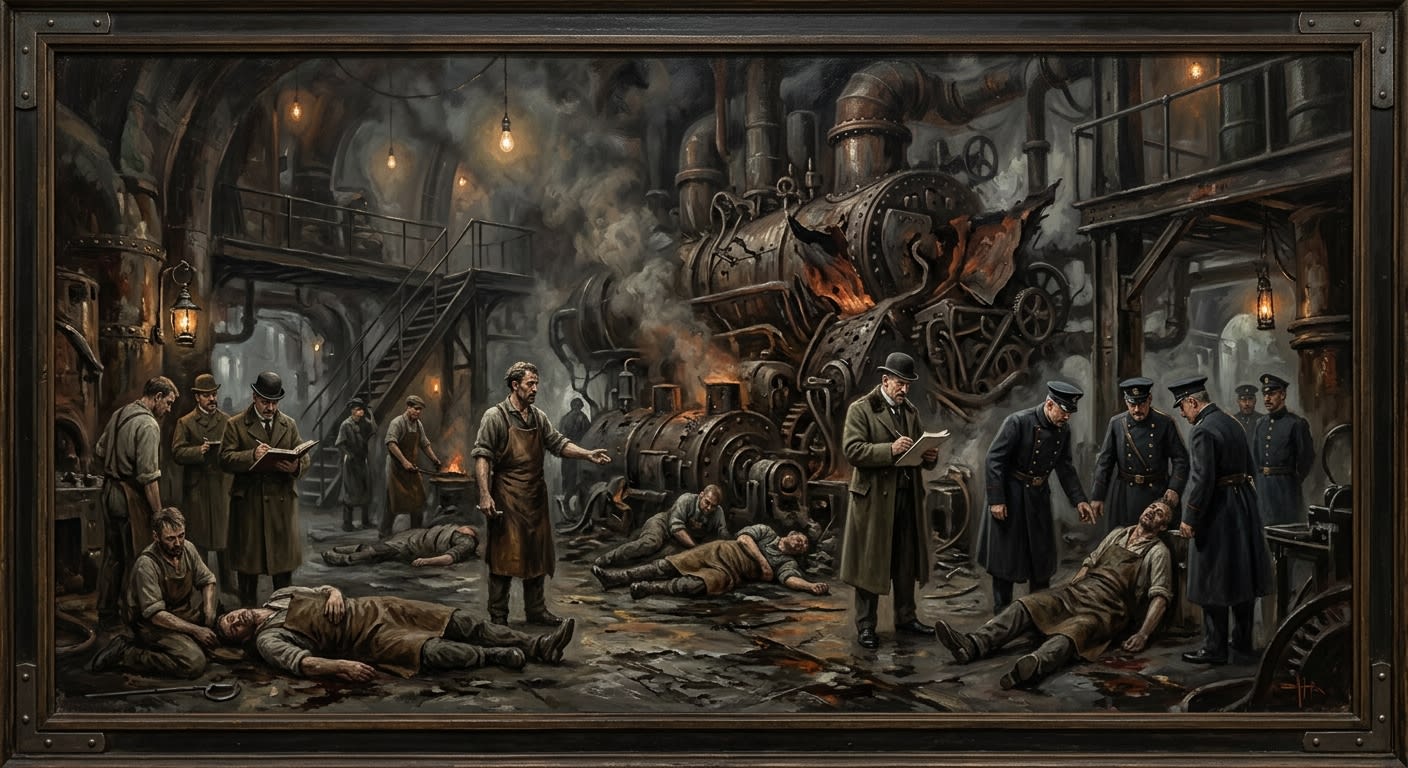
The Shackled Flame Incident occurred in A.S. 198 beneath the Foundry Quarter of Bastion-Constantinople, in the lower works governed by the Order of the Shackled Flame and supervised by Arch-Artificer Lute Brann. Fourteen artificers died. Something escaped. The gallery walls acquired words.
Purity classified the matter as an industrial accident, which is the phrase the Bureau uses when the alternative would require admitting that industry can answer back. The phrase remains legally active. So does the stain.
#On the Hour of Release
The shift records place the first anomaly at the third quarter after Vespers, during a housing calibration for a motive reliquary intended for Carrier installation. The casing had passed pressure test. The hymn-lock had held at fourth strain. Three chaplains had signed the restraint margin. Brann was present, though the early file later attempted to misplace him elsewhere, a courtesy the facts declined.
The witnesses heard no explosion. They heard a latch open.
This is the detail I distrust most because it is the detail all surviving witnesses agree upon. Men invent thunder readily. Men disagree about flame. Men remember doors. The sound came from behind the primary casing, where no latch existed and where, after the incident, Engineering found no hinge, bolt, catch, recess, spring, or honest piece of metal willing to accept blame.
The casing cooled in an instant. Wax seals whitened. The hymn-lock froze mid-note, leaving the chapel cantor’s mouth open around a sound that did not leave his throat for eleven minutes. Then the inner wall blackened from floor to arch, as if heat had passed across it from the wrong side.
#On the Fourteen
The fourteen dead were artificers, not soldiers, which explains the speed with which War attempted sympathy and the greater speed with which it returned to requisition. They died in several styles. Three burned without charring their clothing. Two were found kneeling beside a drain, each with both hands folded around the other’s throat. Four left outlines on the stone and no bodies inside them. One survived long enough to ask whether the bell had learned his name.
Their names entered the death register under occupational hazard. Their families received sealed stipends. Their tools were collected, boiled in vinegar, blessed, and returned to circulation within six weeks.
The casualty appendix originally listed thirteen deaths and one missing worker.
Corrected. The missing worker was present in sufficient theological quantity to qualify as dead. His shadow remained on the west gallery wall until the third whitewashing and was paid no separate stipend.
The fourteenth body troubled even Purity. It was partial, smiling, and warm after the admissible cooling interval. The examiner wrote “residual heat.” The page carries a thumbprint burned through three sheets beneath it.
#On the Writing
The scorch marks formed words in the Triune Alphabet, adopted in A.S. 178 for official standardisation of documents, gravestones, dialect proscriptions, and the other mercies by which the Synod makes speech behave. The entity responsible had been classified as non-sentient residual phenomenon. Non-sentient residue should not know an official script. It should not spell a name. It should not select grammar.
It did all three.
TRANSCRIPTION FRAGMENT — WALL THREE ████████████████████. Phrase repeated: ████████████████████. Name rendered in full Triune forms: ████████████████. Cross-reference request to Records denied. Ash sample retained warmth for ███ days.
Purity’s preliminary notice stated that no language event occurred. This was true in the strictest public sense: no authorised language event occurred. The words were copied, sealed, argued over, denied, scraped, photographed, denied again, and finally reclassified as heat-stress patterning consistent with catastrophic containment failure. I admire the phrase catastrophic containment failure. It nearly confesses before it recovers its discipline.
#On Brann’s Position
Brann was present. Shift chalk places him in the gallery. Heat trace places him at the primary casing. Two surviving witnesses place his hand against the housing before the latch-sound. A third witness placed him nowhere, then amended his statement after two nights in Purity custody and placed him “where regulations required.” That witness has since become a man of exemplary caution.
Brann’s own interview survives in fragments. Asked whether containment failed, he supplied an answer the transcript will not bear in civilian ink. Asked again, the page records, in a second hand, “It was waiting for a larger room.”
He was not disciplined. Three weeks after Incident 198-F/7, Brann received expanded materiel requisition and authorisation to hire forty additional artificers from Hintermark foundry-towns. War signed. Doctrine countersigned. The Foundry Quarter increased output before the ash in the lower galleries fully cooled.
A restricted inquiry proposed temporary suspension of Brann’s lower-level authority pending doctrinal review.
Clarified. The proposal was never adopted, circulated, read aloud, or allowed to endanger production. Its author was transferred to instructional terrain, where doctrinal review is conducted by weather, artillery, and Providence.
#On the Closed Case
The official case is closed. The lower galleries remain open. The Catacomb-Carriers continue to receive housings. The workers descend with masks, chalk, hymn cards, and the particular courage of men paid too little to be martyrs and too much to leave.
At night, below level four, the whitewashed wall darkens first along the old letters. The watchmen say soot. Purity says moisture. Engineering says thermal memory in stone. Brann says nothing, which is the most expensive answer in the Quarter.
Phase 2a correction log: linked Triune Alphabet to its deployed doctrine article. No date, bastion, geography, or link-density errors found. Article dateline set to A.S. 198 for Incident 198-F/7; public seal stamps remain A.S. 201.