
#On the Nature of Licensed Script
"A letter is a door. An unlicensed letter is a door left open to the Adversary. The Bureau does not leave doors open." — Procurator Maxentius della Torre, Memorandum 1,417 to the Standing Committee on Graphic Standards
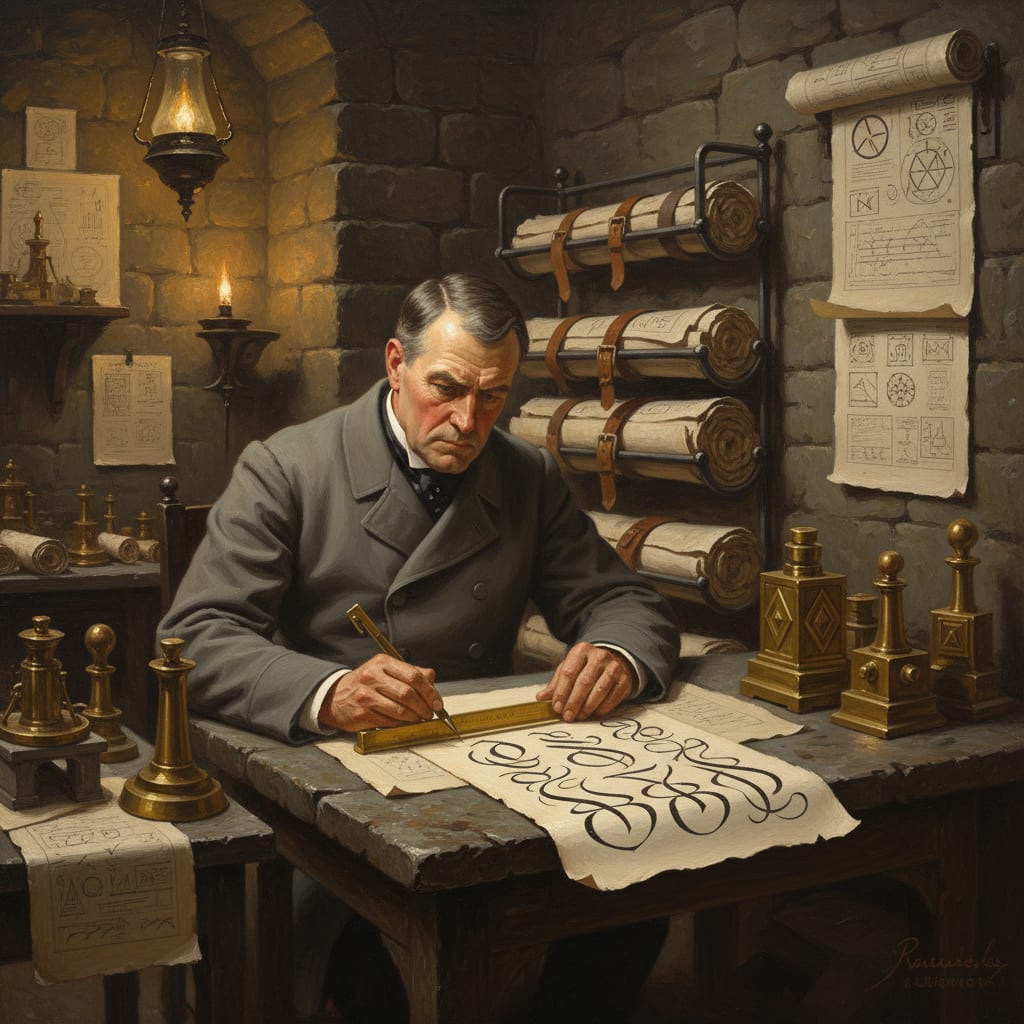
I am Valerius Drax, and I write in the Triune Alphabet because I am permitted to write, because the alternative to writing in the Triune Alphabet is writing in nothing, and because nothing — in the Bureau of Purity's considered estimation — is precisely what unlicensed script produces: nothing of doctrinal value, nothing of archival permanence, nothing that the Ledger can index without contaminating its margins. The Triune Alphabet is the only script the Synod recognises. It has been the only script the Synod recognises since A.S. 178, when Procurator Maxentius della Torre signed the Edict of Graphic Uniformity with a pen whose nib had been filed to the mandated forty-seven-degree angle and whose ink had been sanctified by the Bureau of Rites in a ceremony lasting, I am told, eleven hours. The ceremony was for the ink. The pen received a separate blessing. The paper upon which the Edict was written received a third. The Procurator himself received nothing, because the Procurator does not require blessing; the Procurator is the blessing, or at least the closest the Bureau of Purity has ever come to producing one.
#The Twenty-Three Letterforms
The system itself is, in its architecture, a monument to the proposition that communication ought to be as difficult as possible while remaining technically achievable.
Twenty-three letterforms. Each one assigned a doctrinal imprimatur by the Standing Committee on Graphic Standards, a body that meets every second Sabbath in a windowless chamber beneath the Tower of the Quill and that has, in thirty-one years of continuous operation, never once adjourned early. The letterforms are derived — the Committee's founding charter insists — from the "primal shapes of sacred utterance," which is to say they were adapted from a Carolingian minuscule hand-specimen that della Torre found in a Ravenna library and declared holy on the grounds that it was old, that it was legible, and that no one alive could reproduce it without training, which meant that literacy itself became a licensed activity, which meant that the Bureau of Purity had finally achieved what the Index Damnatus alone could not: control over the act of writing before a single word was formed.
Each letterform has a name. Each name is liturgical. The first letter — the one that in common script would serve as the vowel opening every oath — is called the Porta Verbi, the Gate of the Word, and its construction requires fourteen strokes in a prescribed sequence that the Committee's instructional broadsheet describes as "intuitive to the faithful." It is intuitive in the way that a cathedral's floor plan is intuitive: the geometry serves the Creator, and the human hand serves the geometry, and if the hand trembles, the hand is at fault.
The last letter — the Clausura, the Closing — requires a single downstroke followed by a leftward curl that the broadsheet calls "the shepherd's return." It is the only letterform that may be written without lifting the pen from the page, and it is therefore the only letterform that apprentice scribes master on their first day. Everything between the Porta Verbi and the Clausura requires practice, patience, and the kind of fine motor control that the Bureau of Purity cultivates in its trainees through a regimen of calligraphic drills, fasting, and — according to three independent accounts I have verified through the Bureau of Records — the occasional application of a thin birch switch across the knuckles of the non-writing hand.
#On the Proscription of Dialects
The Triune Alphabet was never merely a script. It was a weapon. Della Torre understood — with the cold clarity that distinguished his genius from his cruelty, which is to say with no distinction at all — that controlling the shapes of letters controlled the shapes of thoughts, and that thoughts shaped in Bureau-approved angles were thoughts that bent toward obedience.
The Edict of Graphic Uniformity did not stop at mandating letterforms. It mandated spelling. Every word in every language spoken within Synodal territory was to be rendered according to the Bureau's phonetic tables, and any word that could not be rendered — any word whose sounds fell between the twenty-three approved shapes — ceased, by bureaucratic fiat, to exist. The Lombard dialects were the first casualties. Their vowels, the Bureau determined, contained "seditious frequencies" — sounds that approximated, in della Torre's acoustic theology, the cadences of pre-Sundering rationalist oratory. The children of Lombardy woke one morning to find their grandmothers' speech illegal, their lullabies classified as Category Three Verbal Contraband, and their own names misspelled by decree.
An earlier edition of this Codex stated that the Lombard dialect proscriptions affected "approximately forty thousand" speakers.
The figure has been revised upward. The Bureau of Records declines to publish the corrected number on the grounds that the corrected number would require a footnote explaining why the previous number was wrong, and the footnote would require a sub-footnote explaining who approved the previous number, and the sub-footnote would implicate a filing clerk who has since been promoted. The Bureau prefers the silence of imprecision to the noise of accountability.
Priests in the Lombard territories report dreaming in languages no longer permitted. They wake gagged by their own parishioners, who have learned — through the Bureau's public-information broadsheets and through the less public information conveyed by the White-Mantled Inquisitors' glass chains — that a spoken heresy overheard is a spoken heresy shared, and a spoken heresy shared is a spoken heresy charged, and a spoken heresy charged involves the Lictors, and the Lictors do not distinguish between the mouth that formed the word and the ear that received it.
#The Gravestone Problem
The Edict's most celebrated consequence — celebrated by the Bureau of Purity, mourned by everyone required to die — is the gravestone verification mandate.
Peasants carving names into gravestones must submit their spellings for Bureau approval before the chisel strikes stone. The process requires a Form 14-C (Application for Posthumous Inscription), a Form 14-D (Phonetic Verification of Deceased's Name Against Current Bureau Tables), and a fee of six copper stamps payable to the regional Purity office. The fee was introduced in A.S. 184 after the Bureau discovered that free verification encouraged what della Torre's successor-by-appointment called "frivolous mortality" — a phrase I have spent eleven years attempting to parse and have concluded means that people were dying faster than the Bureau could spell their names.
Three calligraphers in Augsburg were condemned in A.S. 182 for handwriting the Bureau deemed "suggestive of doubt." Their serifs curved where serifs ought not to curve. Their descenders implied questions where only statements were licensed. The presiding Inquisitor — a man whose own handwriting, I have observed, resembles the aftermath of a spider drowning in sanctified ink — sentenced them to five years in the Paper Mines of Ulm, where the only writing permitted is the transcription of Bureau inventory lists and the only serifs permitted are the ones that appear, unbidden, in the grain of the pulp.
#On the Paradox of the Treaty-Stones
The Bureau of Doctrine prefers not to discuss the Treaty-Stones of the Steppe Gate, and I, as a loyal servant of the Bureau, share this preference while simultaneously violating it, because the Treaty-Stones present a problem that loyalty alone cannot solve.
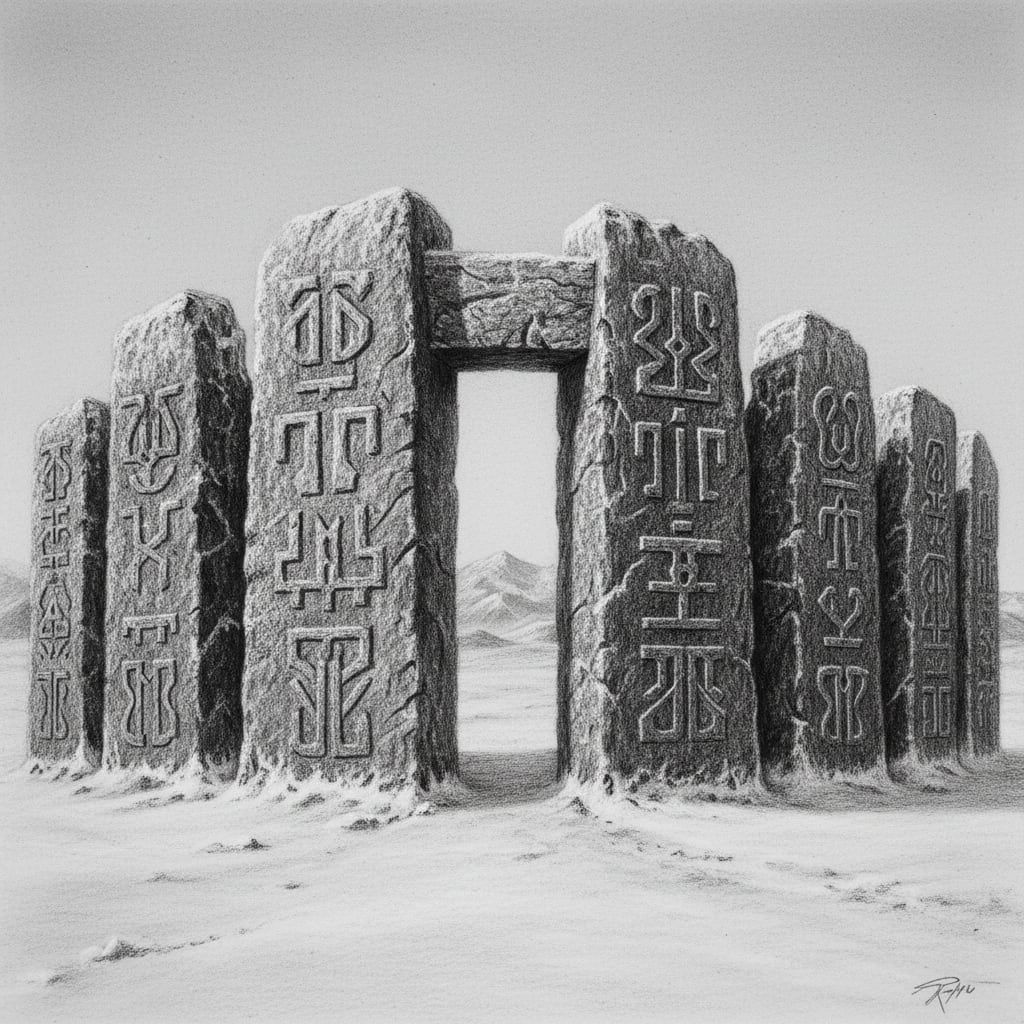
The seven monoliths at the Steppe Gate bear carvings in a script that is, by every palaeographic analysis the Bureau of Records has conducted, a variant of the Triune Alphabet. The carvings date to approximately A.S. 76. The Triune Alphabet was introduced in A.S. 178. The script on the stones predates its own official creation by one hundred and two years.
The clause-spirits that enforce the stones' provisions respond to mispronunciations of the Triune Alphabet with the precision of a surgical instrument and the restraint of a cannon. The Red Pronunciation of A.S. 94 killed one thousand people because an arbiter slurred a single syllable. The Alphabet, carved into stone a century before della Torre codified it on parchment, enforced itself with a violence that the Bureau of Purity has never matched and — I suspect, though I would not say so in a document bearing the Bureau's seal, which this document does — never will.
The Bureau's position is that the Treaty-Stones are "compatible with, and anticipatory of, the Triune Alphabet as promulgated by the Edict of A.S. 178." This formulation satisfies the theological requirements. It does not satisfy the chronological ones. The Bureau has resolved this tension by classifying chronology as a "subordinate discipline" to theology, which is a phrase I intend to have carved on my own gravestone — with Bureau-verified spelling, naturally — because it is the most honest thing the Synod has ever said about its relationship with time.
#The Living Script
The Triune Alphabet was designed to be static. Della Torre wanted a script as fixed as iron — twenty-three shapes, each angle mandated, each curve proscribed, frozen in the Edict's wax seal for all time. What he got was something else.
The Burnless Archive beneath the Steppe Gate produces documents in the Triune Alphabet that no living hand has written. The ink is wet when found. The letterforms are flawless — more precise, the Paper Keepers note with evident discomfort, than any living scribe's. The documents amend treaties, reclassify passage writs, and retroactively impose obligations on caravans that dissolved decades ago. The Alphabet, which della Torre built as a cage for language, has become a language that writes itself.
The Apparatus beneath Gate Nine — the wheel that turns on its own axis in a hexagonal chamber of dressed stone — bears inscriptions that are explicitly not in the Triune Alphabet. Its glyphs change. Its script does not match any catalogued system. The Bureau of Records' palaeography department has compared the Apparatus inscriptions to the Triune Alphabet on six occasions and produced six reports, each more alarmed than the last, each concluding that the two scripts share no common ancestry. The seventh report was requested. The seventh report has not been filed. The palaeographer assigned to it has been transferred to duties the Bureau describes as "archival," which in this context means he sits in a room and does not write.
The Bureau of Doctrine maintains a sealed file — classification ████████████ — on the question of whether the Triune Alphabet and the Apparatus script are, at some level of analysis the Bureau prefers not to name, ████████████████████████████. The file has been opened twice. Both times it was re-sealed within the hour. Both times the official who opened it requested transfer to a forward bastion. Both requests were granted with a speed the Bureau normally reserves for emergencies.
#On the Matter of Compliance
The Triune Alphabet is, in the final accounting, the Synod's most perfect instrument of control — more perfect than the Index, which catalogues what must be destroyed; more perfect than the Ledger, which catalogues what exists; more perfect than the bells, which measure time. The Alphabet controls something prior to all these: the capacity to mean. A word written outside the twenty-three approved shapes is a word that does not exist. A thought that cannot be written does not, by the Bureau's epistemological standards, qualify as a thought. And a population that thinks only in Bureau-approved shapes thinks, by definition, only Bureau-approved thoughts.
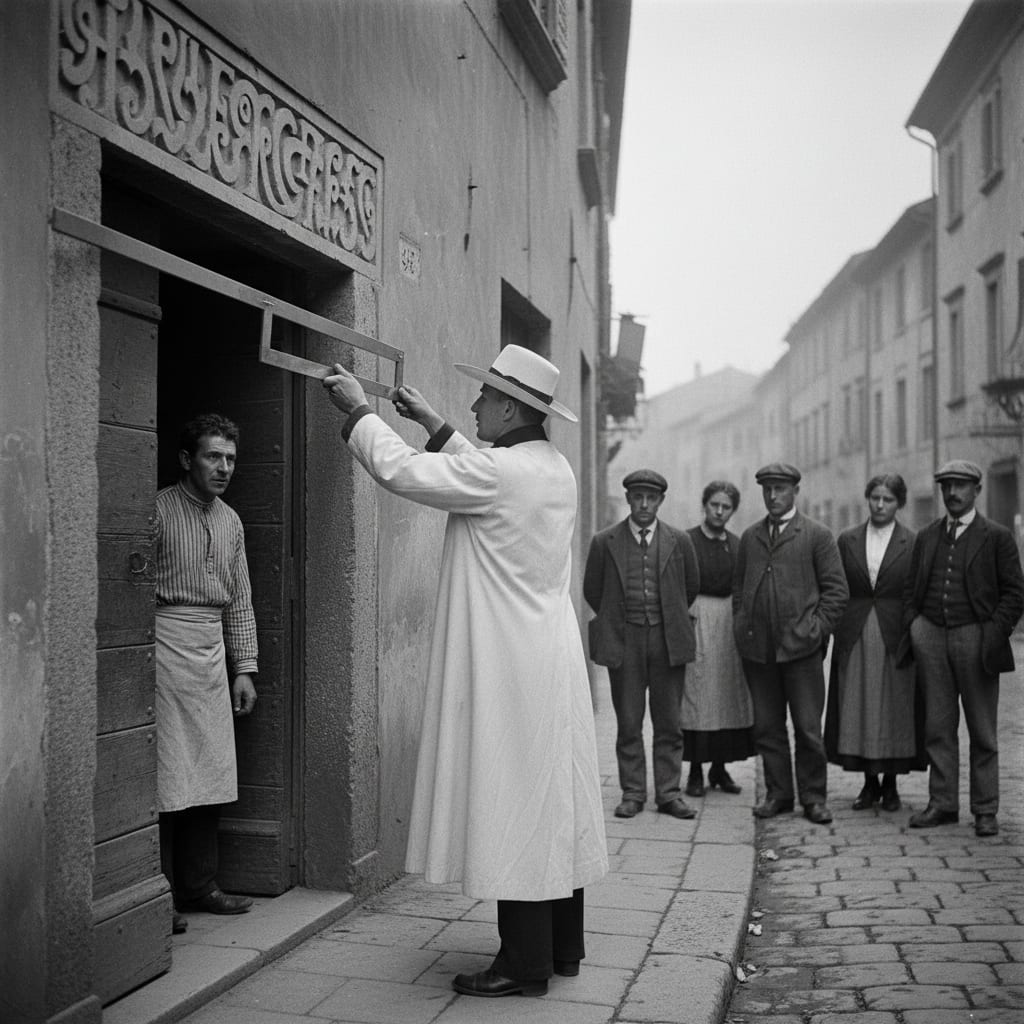
The Bureau of Purity audits penmanship across all Synodal territories on a rolling quarterly schedule. The White-Mantled Inquisitors carry standardised angle-gauges — brass instruments the width of a thumb, calibrated to the forty-seven-degree nib-angle of the Edict's original pen — and apply them to documents, gravestones, shop signs, children's primers, and, on one occasion I have verified through the Bureau of Records, a birthday greeting scratched into a prison wall by a condemned man who wished to tell his daughter he loved her. The greeting was found non-compliant. The "l" in "love" deviated by three degrees. The Inquisitor filed the deviation. The condemned man was already dead. The Bureau filed that too.
An earlier edition of this entry described the Triune Alphabet as "the work of a single mind."
This is imprecise. The Alphabet is the work of a single obsession, housed in a single mind, ratified by a committee of eleven, enforced by an apparatus of thousands, and obeyed — with varying degrees of comprehension, resentment, and counterfeit compliance — by a continent. To call it "the work of a single mind" is to credit the architect and ignore the masons, the quarrymen, and the prisoners who carried the stone. The Bureau of Purity is comfortable with this attribution. The prisoners, who cannot write their objections in any licensed script, are silent on the matter.