
#On the Nature of the Quarter
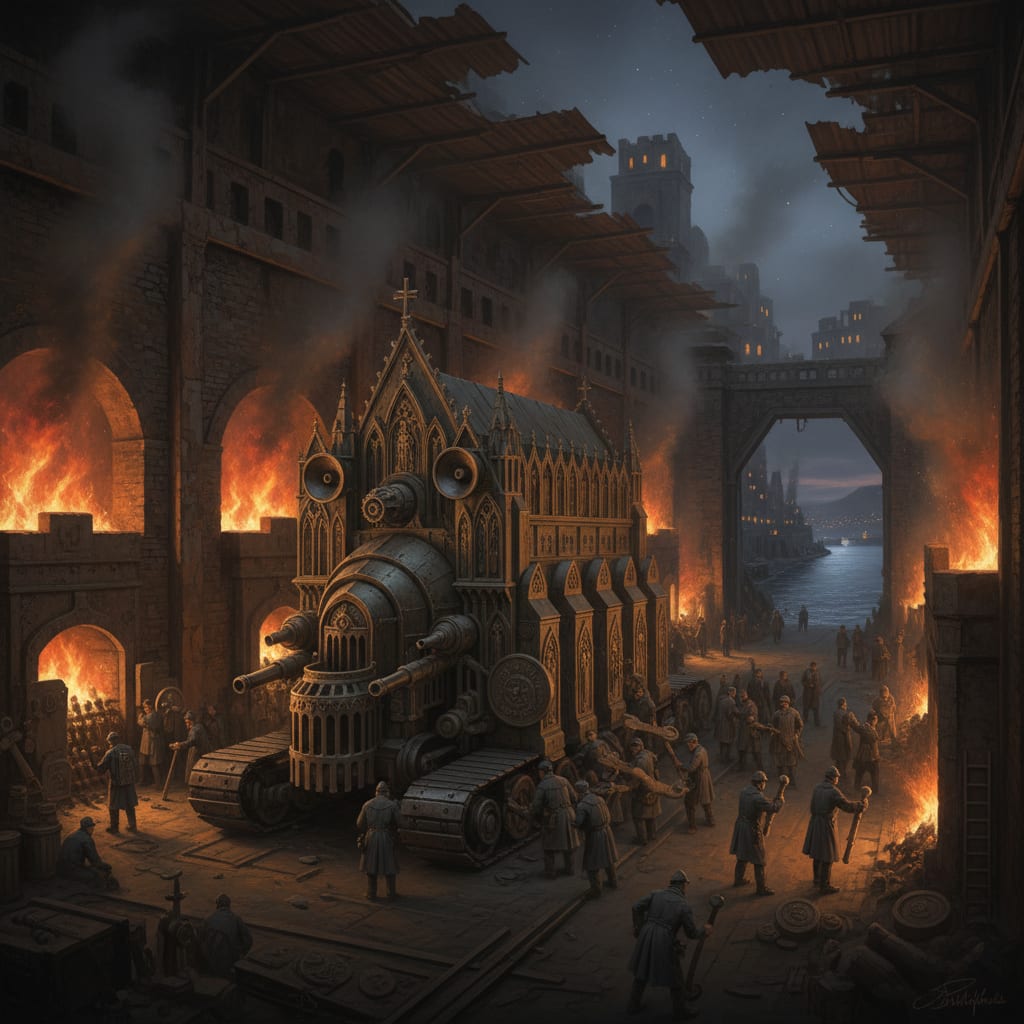
The Foundry Quarter of Bastion-Constantinople occupies the south-western quadrant of the fortress-city, pressed between the Ossuary Rings and the harbour wall, and it is the loudest place on the Sagittal Line. I do not mean this as metaphor. I mean that the sound carries across the Bosphorus strait and has been logged by forward listening posts on the Thracian bank, where the enemy files it under whatever taxonomic category demons assign to the noise of their own destruction being manufactured. The Bureau of Records classifies it as "industrial resonance, sanctioned." The soldiers who live within earshot call it the Hammering. It does not stop. It has not stopped since the rebuilding of A.S. 179, and the artificers who work the day-shift claim it was already going when they arrived, and the night-shift claim the same, and the gap between shifts — if there is a gap — has never been verified by external observation.
The Quarter is arranged along three principal axes: the Proof Road, which runs east from the harbour gate to the central forge-yard; the Carrier Yard, which occupies the southern strip along the waterfront, where the great armoured engines are assembled and maintained; and the Shackled Flame Galleries, which extend below ground level into chambers the Bureau of Engineering's survey maps label with increasing vagueness the deeper they go. The surface is smoke and brick and corrugated iron roofing that buckles in the summer heat. The subsurface is something else. I will address it presently.
#On What Is Built Here
The Foundry Quarter builds weapons. This is its purpose, its identity, and — the Bureau of Doctrine would insist — its sacrament. The furnaces of the central forge-yard produce blessed artillery shells at a rate the Bureau of War's quarterly production report describes as "satisfactory," which in the Bureau's lexicon means "insufficient, but admitting insufficiency would require admitting the scale of the war, and the Bureau does not admit scale." The proof-ranges along the Proof Road test each batch against standardised targets — stone blocks dressed to the density of demonic chitin, timber frames wrapped in charnel-cloth to simulate the organic architecture of Kargath's siege-beasts, and, on one occasion I am told about but cannot verify, a live specimen chained to a proof-post and fired upon with experimental ordnance until it stopped moving or the ordnance ran out, whichever came first.
The smaller workshops produce the infantry materiel that keeps the garrison armed: blessed bayonets, relic-shot cartridges packed with powdered saint-bone, gasket-sealed respirators for the sapper teams who work the forward trenches where Maldrake's ash-fall poisons the air. The gasket work is subcontracted to a guild the Bureau of Engineering calls the Seal-Wrights of the Lower Yard, whose masters have held their charter since A.S. 112 and whose apprentices develop a cough by their third year that the guild manual attributes to "professional dedication." The Bureau of Mercy has a different term for it. The Seal-Wrights have not asked.
But the Foundry Quarter's principal contribution to the War Eternal — the thing that makes it irreplaceable, and therefore the thing the Bureau protects with a ferocity it does not extend to the soldiers who use the Quarter's products — is the Catacomb-Carriers.
These are sixty-ton armoured reliquary-engines on iron treads — mobile fortresses that crawl across the Thracian mud broadcasting hymns through bone-resonance speakers, carrying shield-saints and blessed artillery in compartments sealed with consecrated wax. They are the Foundry Quarter's masterwork. They are also, by any honest theological reckoning, an abomination — machines that function because something bound inside them makes them function, and the nature of that something is a question the Bureau of Doctrine has answered by declining to ask it.
The pride of the Carrier fleet is the Threnody, commissioned A.S. 145, veteran of thirty-seven engagements, currently moored at Pier Seven of the Carrier Yard under what the artificers describe as "routine maintenance." The maintenance has lasted three years. The engines contain something that speaks. The artificers deny this in their official reports and confirm it in their drinking. I have read the maintenance logs — six hundred and fourteen pages, sealed — and the word "voice" appears forty-two times, always in quotation marks, always followed by a mechanical explanation that grows less persuasive with each entry. The Bureau has not ordered the logs destroyed. The Bureau has not ordered them explained. The Bureau has filed them, and filing, in Constantinople, is the equivalent of prayer: an act of faith that someone, eventually, will know what to do.
A prior edition attributed the Catacomb-Carrier programme to the Bureau of Engineering's Design Office, Fourth Floor, Strasbourg.
The programme is administered by the Order of the Shackled Flame, operating under Bureau of War charter, from workshops beneath the Foundry Quarter itself. The Bureau of Engineering provides "technical consultation." The distinction is administrative. The responsibility is someone else's.
#On Arch-Artificer Lute Brann
The Foundry Quarter's current overseer is Arch-Artificer Lute Brann, and I will say plainly what the Bureau of Records' personnel file does not: no one knows where he came from.
His file lists a birthplace — a village in the Hintermark that the Bureau of Settlement's own records show was depopulated in A.S. 160. It lists an apprenticeship — under a master artificer whose name appears in no guild register the Bureau of Engineering maintains. It lists a date of appointment — A.S. 189 — and the signature of a Praelate who died three months before the date on the appointment writ. The Bureau of Records has noted these discrepancies. The Bureau of Records has filed them. The file remains open and the man remains employed, because the machines he builds work, and in Constantinople, function is a stronger credential than provenance.
Brann's domain is the Shackled Flame Workshops — a complex of underground galleries, forge-chambers, and containment vaults that extends beneath the Carrier Yard. The Order of the Shackled Flame operates here under a charter that permits the binding of "residual demonic essences" into mechanical housings "for sanctioned military application." This is technically heresy. It is also technically the reason Constantinople still stands. The Synod has resolved this contradiction by the method it prefers above all others: it has declined to examine it.
The Shackled Flame Incident of A.S. 198 demonstrated what happens when the binding fails. Something escaped from the Workshops. Fourteen artificers died. The scorch marks on the gallery walls formed words — legible words, in the Triune Alphabet, which is a script invented by the Bureau of Records and should not be available to entities the Bureau classifies as "non-sentient residual phenomena." The Bureau of Purity declared it an industrial accident. The scorch marks spelled a name. The Bureau of Purity has a different understanding of the word "accident" than the scorch marks do, and I have learned, in my years of service, that when the Bureau of Purity and physical evidence disagree, it is the evidence that is reclassified.
Brann was not disciplined. Brann was not investigated. Brann received, three weeks after the incident, an expanded materiel requisition and authorisation to hire forty additional artificers from the Hintermark foundry-towns. The Bureau of War signed the requisition. The Bureau of Doctrine countersigned. I countersigned, because I was instructed to, and because the alternative — refusing, and thereby implying that I understood what was happening well enough to object — would have been more dangerous than compliance. Compliance, in Constantinople, is a survival strategy. I am alive. The fourteen artificers are not.
████████████████████████████████████████████████████████████████████ ██████████ BRANN ████████ FOUNDRY LEVEL SEVEN ████████████████████████ ████████ REPORT ████████████████ BUREAU OF SHADOWS ████████████████████
#On the Three-Night Bombard
The Foundry Quarter was destroyed once. In A.S. 177, Velmora's agents — operating through the same supply chains the Bureau of War uses to feed the forges — smuggled three months of stockpiled powder into the ammunition sheds along the Proof Road. The detonation lasted three nights. I will let that duration settle: three nights of continuous explosion, in a quarter built on iron and brick and the stored output of a decade's armament production. The harbour wall cracked along two hundred metres. The Carrier Yard lost four engines, two of which had been scheduled for deployment the following week. The central forge-yard was gutted to its foundations.
The Bureau of Purity executed one hundred and forty persons in the aftermath. I estimate seventy were genuinely involved in the sabotage. The remainder were adjacent to the wrong invoice at the wrong hour, which in the Bureau's calculus is indistinguishable from guilt when the alternative is admitting that the infiltration succeeded through official channels. Morale improved regardless. Fear is, as I have noted elsewhere, a reliable substitute for justice, and in a fortress that has been at war for a hundred and thirty years, reliability is the virtue that matters.
The Quarter was rebuilt in two years. The workers received what the Bureau's commendation records describe as "adequate appreciation." I have reviewed the commendation records. They consist of a stamped certificate and a ration increase of twelve percent for six months, after which the increase was rescinded on the grounds that the emergency had passed. The workers did not protest. They were already building the next batch of shells.
#On the Grounded Ark
At the eastern end of the Carrier Yard, in a drydock originally built for harbour patrol vessels, sits the Vigil Ark of Saint Uriel — fully assembled, fully consecrated, and fully incapable of flight.
The Ark was commissioned in A.S. 191 for the southern Bellway of the Constantinople theatre, to complement the Saint Barachiel and the Saint Gabriel on the northern route. The hull is sound — the Bureau of Engineering has certified this on four separate occasions, each certification more emphatic than the last. The relic assigned to its chapel — a tooth attributed to Saint Uriel, purchased at considerable expense from a dealer in Marseille — has been authenticated by the Bureau of Relics with the confidence the Bureau reserves for items it cannot afford to doubt. The tooth is genuine. The hull is structural. The Ark does not fly.
Four launch attempts. Four failures. The relic refuses to provide lift — or, more precisely, the relic provides nothing at all, sitting in its reliquary with the inert patience of an object that has decided, for reasons it does not share with the Bureau, that it will not participate.
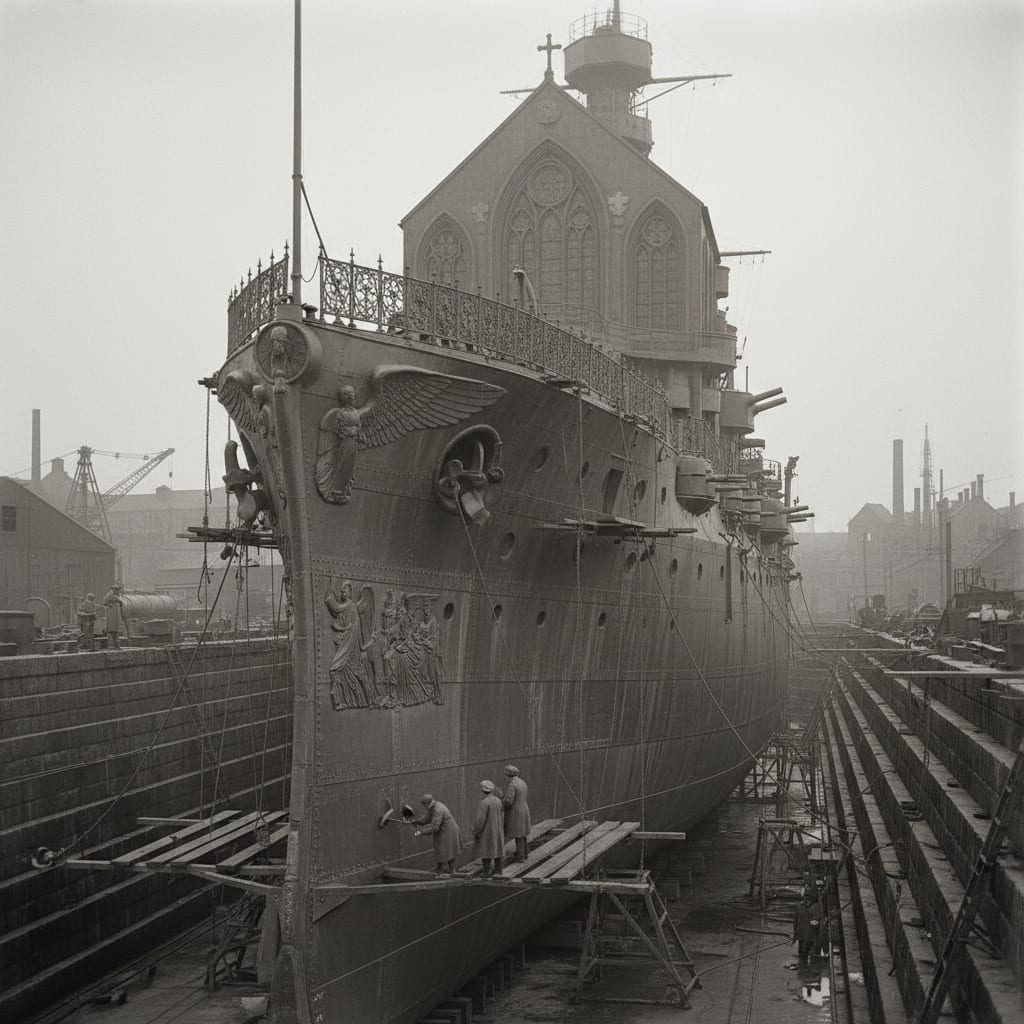
The Ark sits in its drydock. The artificers maintain it on a quarterly schedule, as if habit alone might eventually convince the relic to cooperate. The southern Bellway remains unpatrolled. The soldiers on the chain-booms below spend their shifts looking upward at empty sky with an expression I have learned to read as theology rather than fear — the particular anxiety of men who have been told the sky is holy ground and can see for themselves that it is not.
An earlier filing listed the Vigil Ark of Saint Raphael as the third vessel commissioned for the Constantinople fleet.
No Vigil Ark of Saint Raphael exists. No such vessel was proposed or budgeted. The name appeared in a Bureau of Records filing attributed, after investigation, to a clerical error, a misfiled requisition, or — as the filing clerk stated under oath — "a name that wrote itself in the margin of the ledger overnight." The clerk has been reassigned.
#On the Quarters Below
I have described the surface. The surface is legible: brick, iron, smoke, the ordered violence of industrial production consecrated to war. Beneath the surface is something else.
The Shackled Flame Galleries descend seven levels below the Carrier Yard. The first three are workshops — forge-chambers, binding vaults, the test-ranges where newly assembled Carrier engines are run for the first time under conditions the artificers call "ignition protocols" and the chaplains call "prayers." The fourth level is storage: bound casings awaiting installation, containment vessels sealed with wax and hymn-locks, and — in one chamber I was permitted to observe through a grated door and no closer — rows of iron shells, cold to the touch, humming at a frequency the Bureau of Bells classifies as "sub-liturgical."
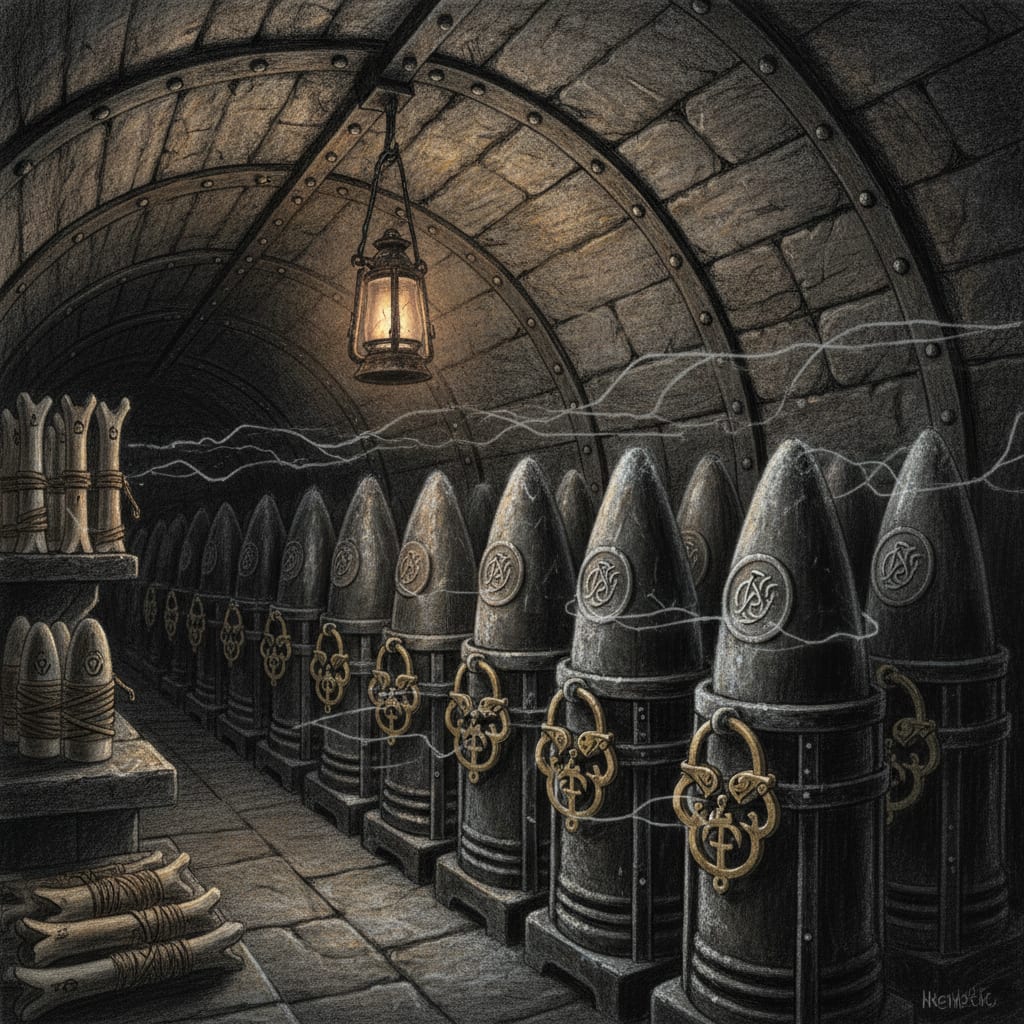
Levels five through seven are restricted. I was denied access during my survey of A.S. 197 — politely, by Brann himself, with a smile that contained no warmth and no apology. The Bureau of War's charter for the Order of the Shackled Flame grants operational autonomy below level four. The Bureau of Doctrine has not challenged this. The Bureau of Purity has not inspected below level four since A.S. 192, when an inspection team descended and returned three hours later with a report consisting of one sentence: "Operations conform to charter parameters." The inspection team's lead officer retired the following month. She has not spoken publicly about the inspection. She lives in Strasbourg, in a house she purchased on a pension that does not account for its price. I note these facts. I connect nothing.
The sounds from below level four are audible on the surface at night, when the day-shift furnaces bank and the Quarter approaches something that is neither silence nor quiet but merely a reduction in the volume of authorised noise. In that reduction, other sounds become perceptible: a sustained low tone, rhythmic, like breath held and released by something very large; and, on certain nights the artificers have learned to predict by the behaviour of their tools, a voice — or several voices, or one voice speaking in harmony with itself — reciting what the night-watch chaplain describes in his logbook as "liturgical content of uncertain origin."
The chaplain has been writing this entry, with minor variations, every third night for six years. The Bureau of Doctrine receives copies. The Bureau of Doctrine files them. The filing cabinet is in my office. It is locked. I have the key. I have not opened it in two years, because the last time I opened it, the files inside were arranged in an order I had not authorised and could not explain, and the most recent entry was dated three days in the future.
I closed the cabinet. I locked it. I have not opened it since.
#On the Quarter's Disposition
The Foundry Quarter employs approximately nine thousand souls — artificers, labourers, seal-wrights, chaplains, proof-range officers, Carrier crews in refit rotation, and the administrative staff the Bureau of Records assigns to any operation large enough to generate paperwork, which is to say all operations. They live in barracks along the Proof Road and in tenement blocks pressed against the harbour wall, in conditions the Bureau of Settlement classifies as "adequate" and the workers classify with language the Bureau of Purity would fine them for if anyone were listening.
The Quarter has its own infirmary, its own chapel — the Chapel of Saint Vulcan, patron of smiths, whose canonisation the Bureau of Doctrine approved in A.S. 110 and whose theological credentials the Bureau of Doctrine has preferred not to examine since — and its own internal market, where the artificers trade surplus ration chits for the small luxuries the Bureau's supply chain does not provide: tobacco, spirits distilled from whatever grain the Bureau of Tithes has failed to account for, and, on occasion, items recovered from the lower galleries that the artificers describe as "curiosities" and the Bureau of Purity would describe as evidence, if the Bureau of Purity knew about them, which it does not, because the internal market of the Foundry Quarter operates on the principle that what the Bureau has not inventoried, the Bureau cannot confiscate.
The Hintermark feeds the Quarter. Three foundry-towns — the records name them as Keska, Edremit, and a third whose designation changes in Bureau filings with a frequency that suggests either administrative error or deliberate obfuscation — supply the raw materiel: pig iron, copper, tin, the refined bone-ite compound the Bureau of Engineering uses in relic-shot production, and a substance the shipping manifests list as "sanctifiedite, industrial grade" that arrives in sealed containers and descends directly to level five without passing through any inspection point the Bureau of Purity monitors. Brann's supply chains. Brann's materials. Brann's results.
The results speak. The Carriers roll. The shells fire. Constantinople holds.
The Foundry Quarter asks no questions. The Foundry Quarter builds. The distinction between a weapon and a miracle is, in the final accounting, a matter of which Bureau signs the invoice — and in the Foundry Quarter, every Bureau signs, and none of them read what they are signing, and the hammering goes on, and on, and on, in a rhythm that has no beginning and, Providence willing, no end, because the day the Foundry Quarter falls silent is the day Constantinople falls, and Constantinople cannot fall, because the Bureau has not authorised it.