
#On the Chapel in the Smoke
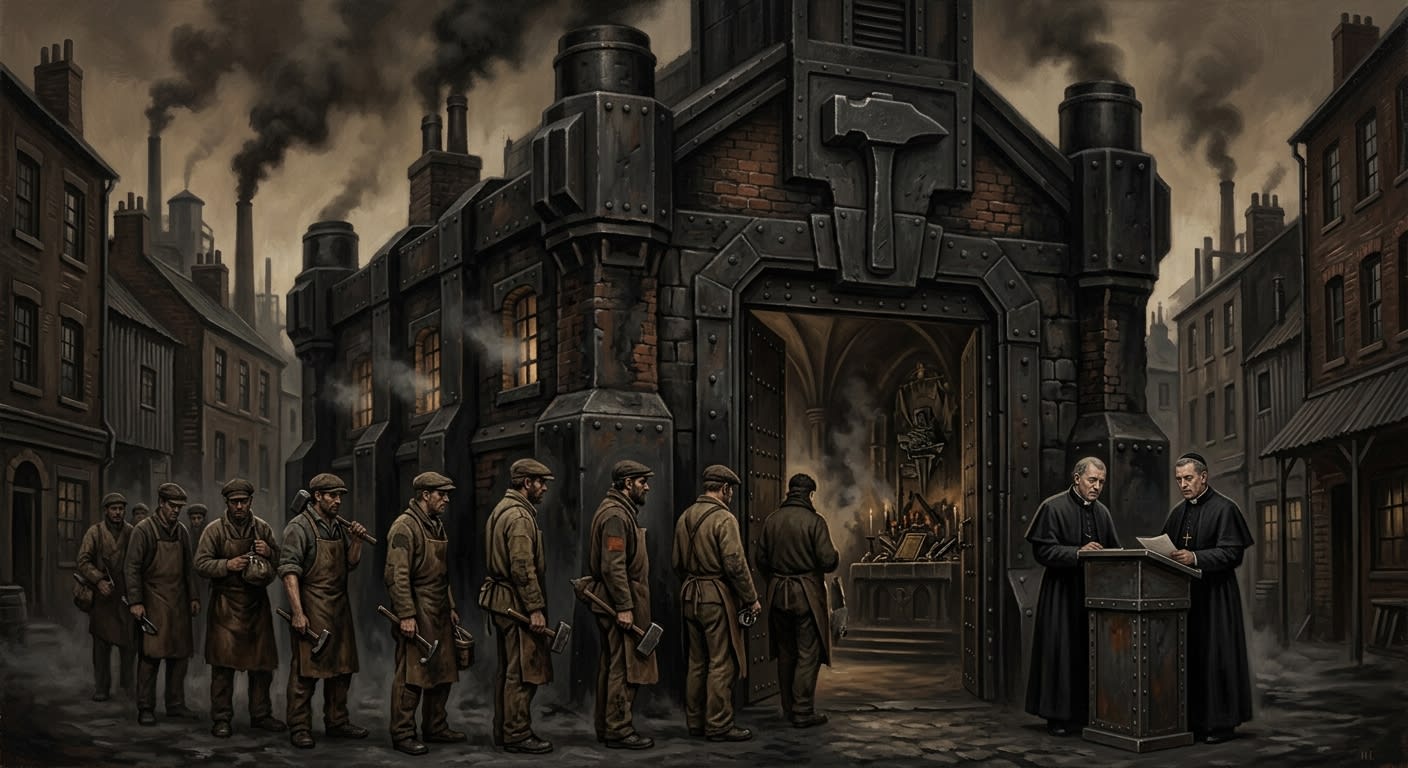
The Chapel of Saint Vulcan stands inside the Foundry Quarter of Bastion-Constantinople, wedged between the Proof Road (Unregistered) and the south vestry drain, soot-blackened, hammer-rung, and more useful than beautiful. Beauty is a luxury for chapels whose parishioners do not arrive with burns shaped like official seals.
Saint Vulcan (Unregistered) is patron of smiths by decree of A.S. 110. His theological credentials have not been examined since. This restraint, rare in Doctrine, deserves praise. A saint who keeps nine thousand workers from throwing themselves into the harbour during double shifts has earned a certain archival courtesy.
#On Canonisation
The canonisation occurred during the First Continental Levy year, when every furnace in the southern corridor had been ordered to produce more iron than iron wished to become. Smiths needed a patron. The old craft guilds already had one in habit, story, and tool-mark; Doctrine supplied certificate, seal, and a Latinised explanation sturdy enough to survive public reading.
The file contains three origin accounts. In the first, Vulcan was a crippled forge-brother who kept hammering during an ashfall until a battery line received its hinge pins. In the second, he was a converted pagan whose old name proved too useful to discard. In the third, he was invented by exhausted chaplains after a riot in a bolt-yard, then approved because invention, properly stamped, becomes tradition.
Early catechisms described Saint Vulcan as “ancient witness of the first consecrated furnaces.”
Clarified. The Bureau no longer requires antiquity where utility suffices. Saint Vulcan is ancient in the only chronology the Quarter respects: he has outlived several thousand workers and all committees assigned to reconsider him.
#On the Interior
The chapel’s nave is narrow because the Quarter refused to surrender floor space to salvation beyond minimum requirement. Iron columns divide the aisles. The roof beams are black with a century of soot. The altar is a salvaged anvil faced in brass, dented where workers have struck it with hammers before dangerous shifts. The sound is part prayer, part warning, part argument with Heaven about overtime.
The icon shows Saint Vulcan holding a hammer in one hand and a small furnace in the other. His left foot is twisted. His beard is rendered in black enamel. The eyes are chips of bottle glass recovered from the A.S. 177 wreckage and reset after reconstruction. In certain furnace light they appear wet. Relics clerks say this is refraction. Workers say he is listening.
There are no pews. A seated worker is a worker lost to production. Parishioners stand, kneel, lean, bleed discreetly into rags, or sleep upright against the columns during sermons. The chaplains pretend not to notice. This is pastoral care in its most refined form.
#On the Bombard
During the Three-Night Bombard of A.S. 177, corrupted devotional crates marked for the Chapel carried part of Velmora’s powder into the Quarter. A chaplain, persuaded that opening crates blessed for Saint Vulcan would insult the saint, allowed the shipment through. Forty-three men later escaped through the chapel’s vestry drain when the fire paused outside the door long enough for them to crawl.
This mercy is celebrated by the local rite. Doctrine permits the celebration while correcting its interpretation. The fire did not spare the Chapel because Saint Vulcan held it back, say the cautious. The fire spared the Chapel because Velmora wanted witnesses, say the useful. The workers hammer the anvil and do not care which office wins.
At dawn after the third night, the Chapel stood untouched except for its bronze saint, whose hammer had melted into the shape of a key. The key was removed by Purity, examined by Relics, denied by Records, and returned two years later as “hammer, damaged.” The statue has held it ever since.
VES TRY DRAIN TESTIMONY — A.S. 177 Worker stated the bronze key “turned” while men crawled beneath the flame. Second worker stated the Saint looked toward ███████████. Third worker stated the drain descended farther than the street allowed. All three testimonies sealed.
#On Workers and Confession
The Chapel hears confessions unsuitable for clean churches: stolen copper, false injury claims, unlicensed charm tags, sabotage imagined but not attempted, prayers offered to machines before saints, dread of the lower galleries, hatred of Brann, love of Brann, and the common wish that the next shift bell might ring for someone else. The chaplains record mortal sin in ordinary ink and industrial sin in red pencil. Red pencil can be erased. This is mercy, or administration wearing a blanket.
After the Shackled Flame Incident of A.S. 198, the Chapel ran fourteen soot-vigils for the dead artificers. Purity objected to the phrase dead artificers before final classification. The chaplain changed the board to absent hands. Everyone understood. The hammers struck the anvil fourteen times at Matins for seven days, then stopped when War complained the sound disrupted housing calibration.
The A.S. 198 vigil register states that no reference was made to wall-writing, latch-sounds, or spoken names from below level four.
Clarified. No reference was made in the register. The workers’ hammer cadence on the fourth night spelled three forbidden syllables in stress rhythm. The chaplain on duty was wise enough to be deaf.
#On Present Use
As of A.S. 201, the Chapel remains active, crowded, soot-fed, and unreformed. Purity would like cleaner doctrine. War would like shorter services. Engineering would like the hammering moved ten yards farther from the gauge benches. The workers would like a saint who understands heat, pain, debt, and the foreman’s bell. They already have one.
At the fourth shift change the line forms before the anvil. Each worker taps once. Some tap twice for the absent. Some place burned fingers on the bronze key and whisper no words at all, because the Quarter has learned the price of words. The furnaces answer through the walls. The saint listens with bottle-glass eyes. The hammering goes on.