
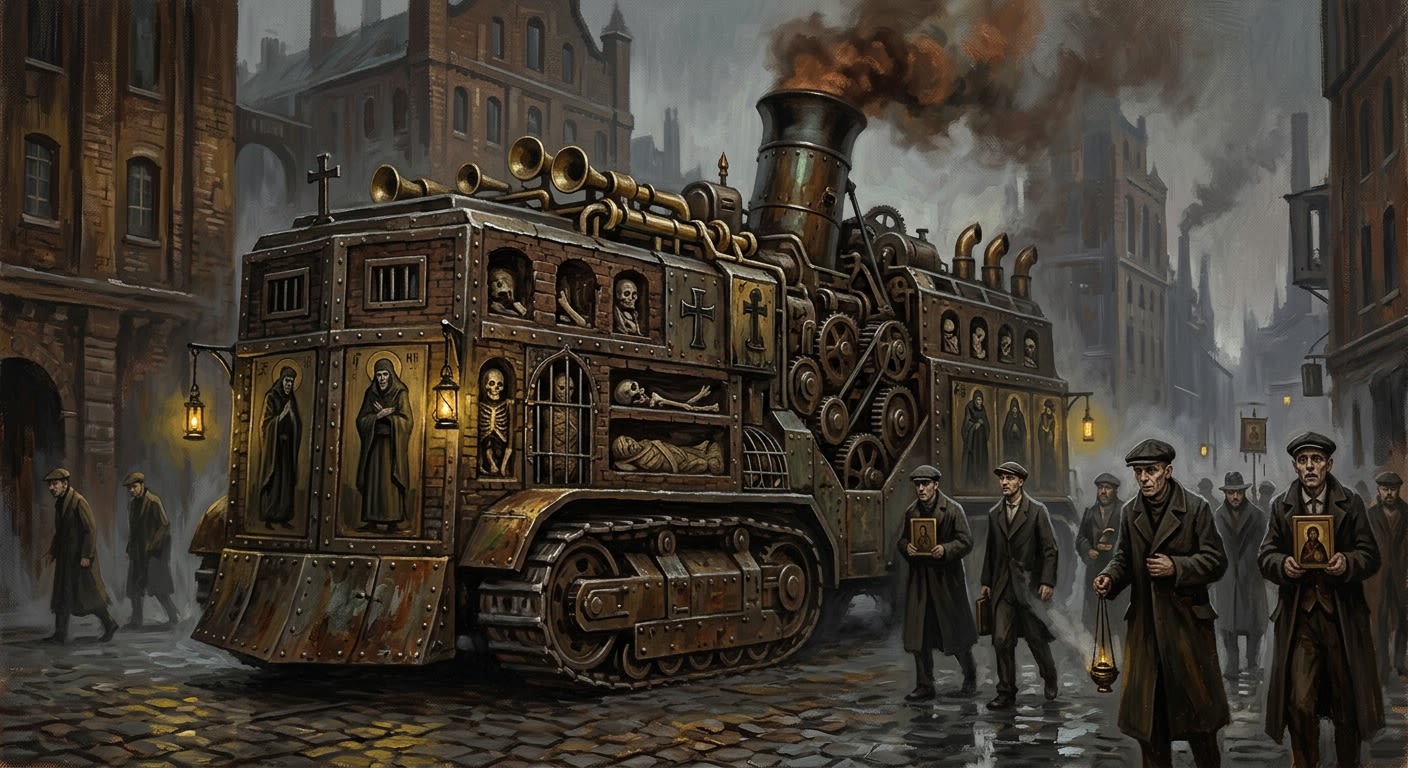
#On the Engine That Kneels for No Blessing
The Catacomb-Carrier is a sixty-ton armoured reliquary-engine on iron treads, built in the Foundry Quarter of Bastion-Constantinople for the mud, bone, ash, trench, breach, and final unpleasant argument of the southern Line. It is called a carrier because “mobile ossuary-fortress bearing artillery, saints, choir apparatus, and a questionable soul” would overstrain the procurement tables.
It crawls. It sings. It kills. It survives shelling that would peel a chapel from its foundations and proceeds afterward with the injured dignity of a bishop whose vestments have caught fire but whose sermon remains unfinished.
Its armour is layered iron, reliquary plate, ossuary brick, and saint-bone mortar cured under heat from the Shackled Flame furnaces. Its tread housings are broader than a parish road. Its side casemates carry blessed artillery: short-throat guns for trench clearance, high-arc mortars for charnel folds, and those black-capped canisters the Bureau of War labels “morally discouraging,” as if morality were a gas to be delivered under pressure.
#On the Making in the Carrier Yard
Catacomb-Carriers are assembled in the Carrier Yard, the southern strip of the Foundry Quarter pressed between the Ossuary Rings and the Harbor of Chains. Plates arrive by quay. Saint-bone arrives under Relics seal. Powder arrives under War guard. Men arrive under contracts that call them artificers when alive and losses when the shift ledger closes around their names.
The Bureau of Engineering supplies drawings, tolerances, rivet tables, tread ratios, and the serene lie that enough measurement can make a thing innocent. The Order of the Shackled Flame supplies the inner housing. The Order works below ground, in galleries where the survey maps grow timid after level four and illiterate after level six. Their charter permits the binding of residual demonic essences into mechanical housings for sanctioned military use. This sentence is heresy with a budget.
A prior procurement guide attributed the Catacomb-Carrier programme to Engineering Design Office IV, Strasbourg.
Corrected. Engineering draws the machine. War requisitions it. The Shackled Flame wakes it. Doctrine blesses the paragraph in which no one admits this.
The carrier body is built like a chapel turned inside out. The nave becomes cargo bay. The choir becomes resonance chamber. The crypt becomes engine casing. The saints do not rest within it; they are installed. Their powdered fragments line shells, filters, speaker ribs, bolt seals, and shield-saint niches. A Catacomb-Carrier contains enough notarised sanctity to consecrate a small town or make a large one nervous.
#On Bone-Resonance and the Hymn Speakers
The bone-resonance speakers are mounted along the upper flanks, twelve to a side in the older patterns, sixteen in the A.S. 179 reconstruction pattern after the Three-Night Bombard taught the Quarter that redundancy is merely cowardice with foresight. Each speaker is a saint-rib lattice set behind brass teeth. Air forced through the chamber carries licensed hymns across the trench line in a pressure wave that wakes infantry, steadies shield-saints, rattles loose teeth in the mouths of demons, and occasionally cracks the Carrier’s own prayer tiles.
The hymn is not decoration. It keeps the engine obedient. It keeps the crew count stable. It keeps whatever is bound inside from remembering too accurately what it was before the casing, the wax, the rivets, and the useful theological euphemism.
The last rule is written in red. It was black in the A.S. 145 manual. Manuals improve by blood. This is why they are more trustworthy after accidents.
#On Shield-Saints and Blessed Artillery
A Catacomb-Carrier carries shield-saints (Unregistered) in sealed compartments along the middle deck. The title confuses laymen, who imagine living saints with shields. The actual cargo is stranger and more efficient: armoured reliquary frames containing authenticated fragments of martyrs, mounted behind hinged mantlets, borne, not walking exactly, by crews in full panoply during breach actions. When the ramp drops, the shield-saints go first, carried by men who pray that the relic is heavier than fear.
Behind them comes artillery. Blessed shells packed with powder and powdered saints of Ulm. Canister hymns. Gasketed incendiaries for Maldrake ash. Charnel-piercing bolts for Kargath’s siege-beasts. Each round receives a custody mark, a blessing mark, a firing mark, and, if it fails to detonate, a shame mark. The Bureau has discovered that ammunition behaves better when embarrassed.
The crew serves under punishment-honour discipline. To be posted aboard is reward for courage, sentence for disobedience, cure for cowardice, or a clerical accident so large that no one dares correct it. Veterans call the interior the Lung because the walls throb during hymn-broadcast. New men call it the Tomb. Both names are accurate enough to be discouraged.
#On the Bound Thing
The official account states that Catacomb-Carriers function through coal, oil, gear discipline, relic resonance, heat exchange, and sanctified pressure. The official account is printed on excellent paper. It does not survive inspection.
Something bound inside makes them move.
The Shackled Flame calls it residual essence. War calls it motive sanctification. Engineering calls it anomalous drive cooperation. Doctrine calls it restricted. Purity calls it a matter currently under review, which means Purity has looked at it, disliked what looked back, and decided to arrive later with more rope.
CARRIER HOUSING INSPECTION — LEVEL SIX Observed: ██████████ behind primary reliquary casing. Utterance: “████████████████.” Crew reaction: kneeling, vomiting, two cases of temporary Latin. Recommended action: increase hymn pressure; deny auditory content; transfer surviving inspector.
I will not pretend innocence for the machine. Innocence has no treads. The Catacomb-Carrier is wrong. It is also effective. In Constantinople that combination is called procurement.
#On Threnody and the Fleet
The most famous carrier is the Threnody, commissioned in A.S. 145, veteran of thirty-seven engagements, survivor of Belgrade service, Macedonian corridor defence, and the A.S. 177 destruction that killed four sister engines in their barns with ribs open and hymn-speakers pulsing without sound. Threnody now occupies Pier Seven under maintenance that has lasted long enough to grow barnacles on a land machine.
Its crew is listed as intact. The supplemental is not filed. Its mooring fees are paid quarterly by a War account old enough to smell of pre-reform ink. The maintenance logs use the word “voice” forty-two times, always in quotation marks, always followed by a mechanical explanation. The explanations get worse as the ink gets newer.
Other carriers remain active. Fewer than War admits. More than the enemy wishes. They crawl where roads have become theological suggestions, crush trench ribs under their treads, broadcast hymns into fog, and return with paint blistered, saint-casings hot, crewmen missing from compartments that were bolted shut from inside.
#On Present Use
As of A.S. 201, the Catacomb-Carrier programme continues under War charter, Foundry Quarter manufacture, Shackled Flame custody, Engineering consultation, Doctrine blessing, and Purity’s exquisitely delayed outrage. Replacement parts remain scarce after the Three-Night Bombard. Trained crews remain scarcer. Bound essences are classified as non-sentient until they speak, and then as misheard until the witness dies or signs correctly.
At dusk in the Carrier Yard, a finished hull sits under chains while artificers chalk the first hymn along its flank. The chalk dust clings to rivets. The bone speakers wait. Below the deck, something sealed hears the words before they are sung.
Phase 2a correction log: no date, bastion, geography, or link-density errors found. Article dateline set to A.S. 145 for the earliest named carrier commission; public seal stamps remain A.S. 201.