

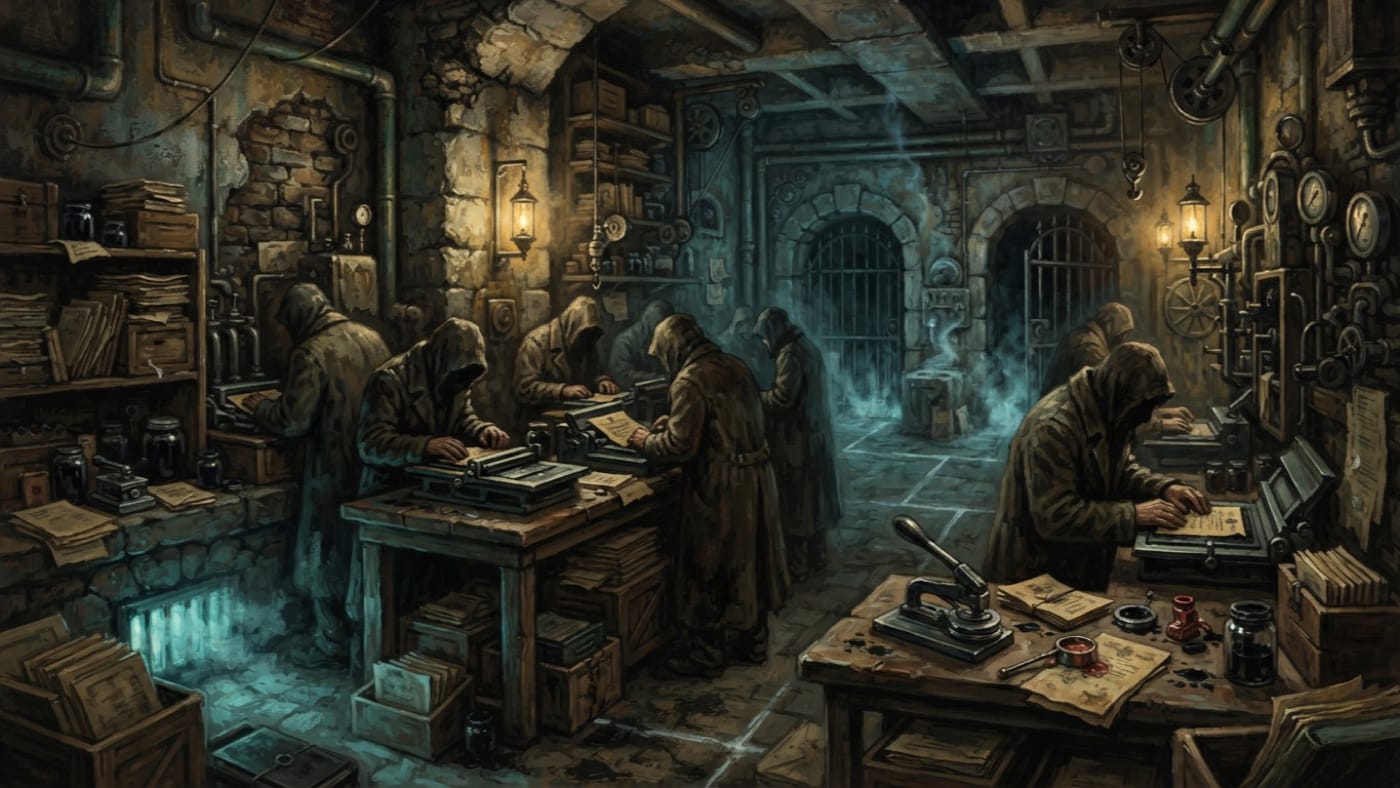
#On the Entry
"A clean slip isn't a clean soul." — Candle-Sump proverb, recited chiefly by people holding one
In Candle-Sump a person is a tag-skin stretched over a cough, and the skin is paper. The Bone-Tag Registry, a Bureau of Records adjunct working the counters of the Bone-Tag Arcade, issues that paper to the dead. Each tag carries a name, a date, a cause and a confession attachment sealed in wax. With it a corpse becomes a filed soul, and the district's accounts can be reconciled upward into the Great Ledger of Souls. Without it the body is refuse. With it, the name belongs to the state, which will defend it against all comers, occasionally including its former owner.
The living draw on the same cabinets. A name that passes inspection buys a ration entry, a bed in a registered house, passage through the lock-gate checkpoints and the right to inherit whatever a dead relation failed to drink. A name that fails buys a sanitation draft. The shadow registry operates between those two outcomes. It has no charter, no seal of its own and no head that anyone has managed to serve with a summons. Even so, it supplies the Sump with identities made well enough that the Registry's own clerks accept them at the counter.
#On the Names
Burial lanes and crypt routes lie beneath the Sump. They belong to a riverside shrine district older than the Sundering. Nobody has told me when they were dug, and nobody can tell me when they were sealed. Air from them rises into the district through the vent alleys and maintenance shafts of the Crypt Mouths, and it arrives laden. It carries rot-spores, which the residents' lungs faithfully report as Rot-Lung. It also carries what the residents call name-whispers: syllables in the draft that people standing where the stone smells sweet sometimes hear as whole names.
Paper near the vents grows fur at its edges. Ink bleeds. Coughs worsen at the same corners where they have always worsened. Candles gutter in patterns resembling letters. Near the mouths they are said to burn blue, and on those nights custom requires a person to keep their own name behind their teeth. Residents lay salt lines around the vents and wear bone beads against the draft. I record both as local precaution and give no warranty for either. The vinegar bath and the wax-sealed folder I warrant entirely. They keep paper alive, and in the Sump paper is the only part of a person that keeps reliably.
Someone below harvests these names. I file that as my finding. I have not established where the names come from before they reach the draft, whether all their owners are dead, or whether, as one Sump saying holds, some belong to people still living somewhere underneath. Nor do I credit the draft with writing any document. Candles spell. Clerks write. I have kept those offices separate throughout my career and see no reason to merge them now.
My published assessment called the harvested names pre-doctrinal, the forgotten congregants of the shrine lanes. That description fits some of them. It does not fit the slip I was shown in the autumn of A.S. 197, which bore the name of a woman entered in the tag archive as dead in A.S. 72, twenty-seven years after the Sundering. I therefore assign no age to the names as a class.
#On the Paper
A name in the air is worth nothing. A name on the right paper is worth a life, and the shadow registry's whole craft lies in the paper.
As far as I have traced it, the sequence runs upward. Names are taken below and set down on fresh sheets. The accounts disagree on whether that writing happens in the tunnels or in some room above them, and I will not settle the question with a guess. The sheets pass next to the Washhouse. Its public trade is laundry, soap and paper-cleaning, and its brokers, runners and back rooms handle the rest. From the Washhouse the names enter the legitimate bone-tag channels. Once a name holds a receipt from the Arcade, it has a history.
The product is dangerous because so little of it is false. Clean slips carry accurate seals and regulation ink on paper that matches the Registry's own supply. The Arcade keeps a back press associated with clean slips, and its front counter does not acknowledge it. An ordinary forger in the Sump works with blank tag stock and master-seal wax. Possession of either is punished with an oath-collar and a sanitation draft that ends when the lungs end. Every material element of a clean slip may be authentic. The one falsehood is the bearer.
That falsehood serves a wide clientele. The deserter becomes a pilgrim, the debtor a dead man's heir, the wanted heretic a registry-certified nobody. Such papers pass ordinary scrutiny at the lock-gate desk, the ration window, and the counter where a widow claims her husband's room. I make no larger promise on the trade's behalf. A slip that satisfies a tired clerk has not yet satisfied the Bureau of Purity. Stolen stock and wax cannot buy what the Sump's black market has never been able to sell: a true Inquisitorial waiver or a genuine quarantine clearance. Those documents are issued, and the people who issue them are not in the laundry business.
The client keeps one name and holds it on the sufferance of whoever wrote it. A borrowed name comes with its own debts and liens, and sometimes with its own warrant. The Washhouse knows which name went to which face. That knowledge is the real merchandise, and the client never finishes paying for it.
#On the Interested Offices
Every office able to close the shadow registry has a reason to keep it open.
The Bone-Tag Registry gains a hold over people that it cannot admit to holding. Chief Clerk Dalen Voss controls the stamps, the master seals and the identity cabinets. Slips leave the Washhouse bearing materials that match what he controls, and the back press stands in his Arcade. I set these facts side by side because they belong there. They do not show that Voss built the operation or directs it, and no document in my possession says so. A clerk may profit from a leak without having bored the hole. A Registry that finds its own paper in a criminal's hand has every motive to say less than it knows.
The Washhouse profits from a pipeline it did not build. Its cartel takes the cleaning fees, keeps the safe rooms and holds the blackmail. Asked where the names come from, it answers "below," the way a grocer answers "the country" when asked about eggs.
Prefect Sera Mott of the Sluice Prefecture controls the gate timings and the flood releases. My assessment linked those timings to the airflow at the Crypt Mouths and, at a remove, to the supply of names the drafts give up. I stand by the link and add nothing to it: no formula, no quota, no vestry meeting between the Prefect and anyone in a mask. Her gloves stay on. That is her policy, and so far it is the only one of her policies I can document.
The Crypt-Mouth Wardens tend the vents and seal passages selectively. I admire selectivity in a gatekeeper and fear it in a witness. If they play any part in the copying, it is unproved. The Quarantine Provosts answer jointly to the Prefecture and to Purity, and they act on blue-burn reports. In the Sump such a report may record a disturbance or settle a neighbour's grudge.
Beneath all of these is a hand I cannot name. It runs the harvest. To judge by the patience of the work, and by its indifference to the profits taken above it, its purpose is larger than fraud. I have not determined who or what it serves. I also decline the Bureau's standing temptation to fill an empty line with the most convenient suspect.
"The Synod sealed the crypt mouths. The seals hold." — Pastoral Assessment, Candle-Sump District
That was the official position, and I reported it as one. The Sluice Prefecture's maps mark certain tunnels beneath the Crypt Mouths as collapsed, yet those same tunnels are maintained, and a collapsed passage needs no maintenance. The blanket assurance is withdrawn. The Prefecture's maps remain in force because they are the only maps available.
#On the Pending Audit
The Registry and the Sluice Prefecture are disputing ownership of seized clean-slip stockpiles. Neither office proposes burning them. Each wants to hold them, because a stack of identities in a locked cabinet is worth more to its keeper than any quantity of ash.
The Washhouse is planning a mass swap: several hundred names laundered in a single week, on stock the cartel claims to have sourced from below. When I made my assessment, the swap was still only a plan. The Care crews have threatened to strike if rations are cut again. Meanwhile Matron Ilka is using the ration crisis to press for independence for the Marrow Kitchens. I have no evidence that she deals in names, and a woman who controls the broth has little need of them. The Paper Loft Quarter reports more rot-lung. That means fewer clerks to notice anything, and more vacancies among those who count the dead.
In the Bureau of Purity's approval chain, a transfer order bearing the name of Inquisitor Halvyr, called White-Lung, moves at the pace proper to such documents. Halvyr carries a portable audit press and burn authority. The Bureau has not told me what that press can prove against paper this well made. If the order completes, the shadow registry may be exposed, sealed, or taken over by whichever office reaches the cabinets first. Nothing in my file says which, or when.