

#On the Prefecture's Authority
"Which gate sings?" This is the question put to strangers on the Ash-Sluice Line. Two answers are in circulation, and one of them marks you as a visitor.
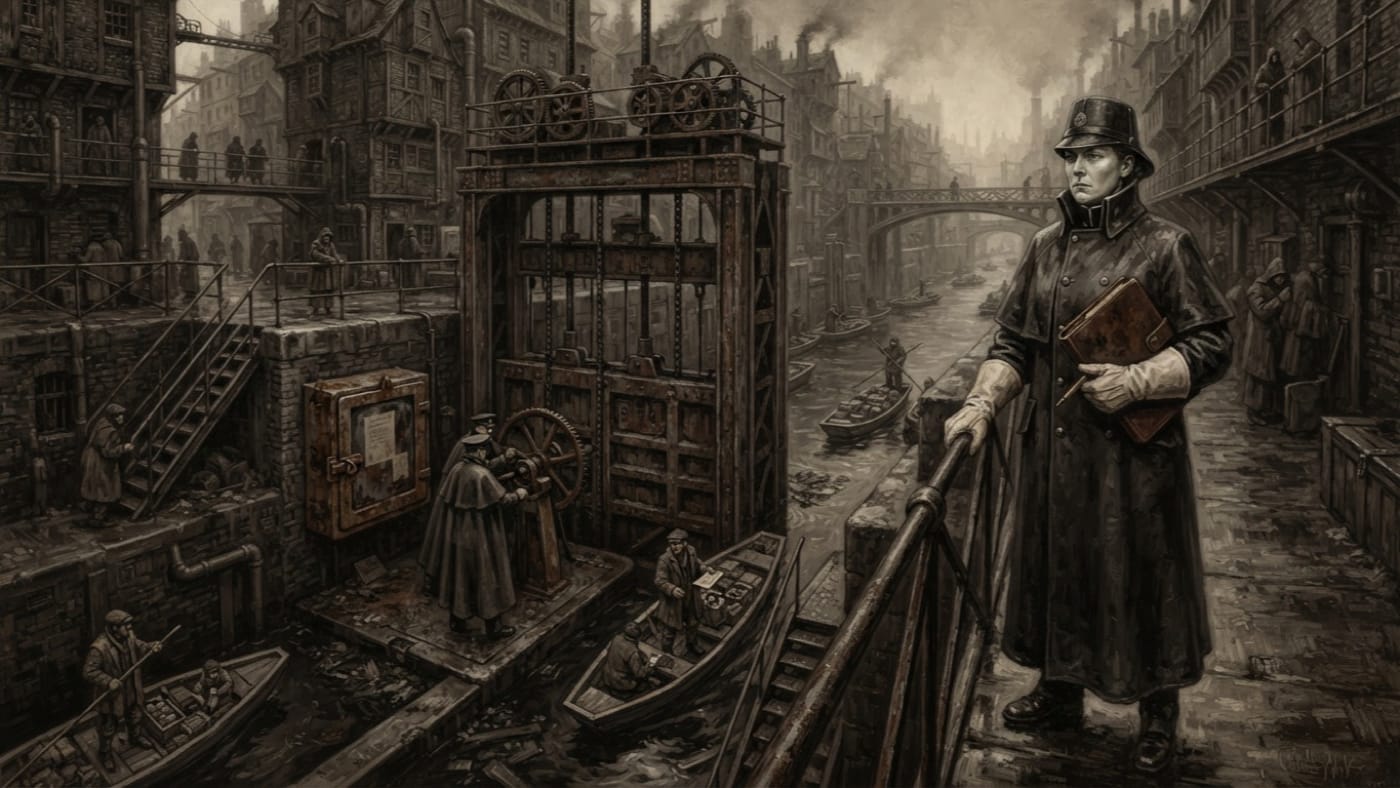
The instrument of government in Candle-Sump is a sheet of paper kept in an iron box. The box is bolted to the gatehouse wall at Sluice Gate IX. Its hasp has rusted to the colour of the keys that open it. The sheet inside is the gate chart, a column of bell-hours ruled against a column of releases in an ink the damp has so far failed to beat. When the chart says open, the gate opens. When it says hold, the water waits, and so does everything floating on it.
The Sluice Prefecture is the sanitation arm of the River-Belt Chapterhouse in Candle-Sump. Its published charge is sanitation and safety. In practice it holds three powers: the timing of the gates, the release of floodwater, and the administrative definition of the word "clean." The first two are engineering. The third is jurisprudence, and the Prefecture exercises it before breakfast.
Gate IX is the district's bottleneck. It regulates the floods, the trade skiffs and the disease runoff, and it cannot move one of them without moving the other two. A held release is a late shipment of tallow. An early release is a street full of wet permits, and in Candle-Sump a wet permit is a void permit. The Prefecture has never had to threaten anyone. It publishes a schedule.
#On the Installation
The Lye Flood of A.S. 84 is the Prefecture's charter, although no one has produced a charter. Ash runoff from the cremation stacks made the canal water caustic. It burned the residents who waded through it, dissolved every paper it reached, and scarred the soot brick of the lower wards to a height the Sump still reads as a flood line. Within the month the Prefecture had been installed, given the gates, and given the vocabulary.
The early Church administration made the installation, acting through the River-Belt Chapterhouse. I state this plainly because the district's own retelling credits "the Synod", and so, I regret to say, does a recent pastoral assessment bearing my name. In A.S. 84 there was no Synod to credit. There were councils, a growing body of offices and a defended Line. The formal Synod was constituted at Strasbourg in A.S. 90, six years after the lye had dried. The year itself is a later courtesy, because the Synod adopted its numbering at that settlement and applied it backward to everything before.
So a sanitation office older than the Concordat now operates under the authority of the body the Concordat created. The Prefecture has never pressed the matter. It gains more from being thought Synodal than from being thought senior.
"The Synod's response was characteristically efficient: the Sluice Prefecture was installed within the month." (Pastoral Assessment, Candle-Sump District)
The installation of A.S. 84 was an act of the early Church administration through the River-Belt Chapterhouse. The formal Synod was constituted by the Concordat of Strasbourg in A.S. 90. The efficiency is retained. The attribution is withdrawn.
The office is older than any of the people who have held it. Matron Ilka of Marrow Row has outlived four Prefects. The Prefecture has outlived all of them.
#On Gates, Permits and Labour
The Prefecture's working doctrine is a short chain of reasoning, which it has never written down. Whoever holds the gates holds the trade. Whoever holds the trade never has to ask for obedience, because it arrives by skiff at the posted hours.
The chain is enforced along the Ash-Sluice Line by the Sluice Wardens, who wear waterproof capes and carry keys that have rusted past any resemblance to their original metal. A Warden checks the sluice pass slip, the drysheet permit and the face, usually in that order. The Bone-Tag clerk at the next counter checks receipts, and he does so under the Registry's authority, not the Prefecture's. The two inspect the same hauler on the same morning, using different seals and different grievances.
Whatever the Wardens cannot settle goes to the Quarantine Provosts, a militia that reports jointly to the Prefecture and the Bureau of Purity and is commanded in full by neither. The Provosts run moving cordons, conduct raids, confiscate goods, and issue ribbons. A green ribbon permits passage, a yellow one restricts movement, and a red one confines the wearer. Black means "concluded assessment," a phrase the Provosts use with the composure of men who will not be wearing one.
The Prefecture's own paper comes out weekly: quarantine decrees, drain-priority lists, audit summonses and health-bell schedules. The drain-priority list is the one that matters most. It decides which street is drained first, which cellar dries before the mould gets into the ledgers, and which household waits a second bell-hour in ash foam to the ankle. Households pay ash-fees for the privilege of being drained at all. Anyone who cannot pay works off the debt in sanitation-penance labour, wading the same channels the fee was meant to keep clear. Payment and penance are recorded separately and cost the same.
The Prefecture's numbered stages of rot-lung belong to the same lexicon. Stage One is a productive cough, Stage Two is blood in the sputum, and Stage Three is a sensitivity of the skin to paper. The Prefecture's handbook calls Stage Four "terminal administrative transfer." The handbook offers no cause and no cure. The Prefecture defines clean; it does not undertake to produce it.
Candle-Sump has other routes than the gate. Foot stairs climb the floodwalls, the Coughwalks carry pedestrians above flood level, and service ladders drop to the catwalks for anyone agile enough to use them. A man may go around Gate IX. A barrel of tallow may not.
#On the Three Authorities
Three powers govern Candle-Sump under the Joint Authority Compact, which was renewed in A.S. 187. Nobody has produced for this office the original instrument, its date or the names of its signatories. The Compact therefore rests on its own renewal, as most River-belt arrangements do.
Prefect Sera Mott holds the water. She also holds the Prefecture's authority over calorie allocation, which decides how much the district's kitchens receive to cook. She smells faintly of soap and never removes her gloves. Neither fact appears in any warrant, and both are known to every skiff hauler on the Line.
Chief Clerk Dalen Voss holds the Bone-Tag Registry, a Bureau of Records adjunct, together with its stamps and master seals. He decides which identities the Great Ledger recognizes. Matron Ilka runs the Marrow Kitchens of Saint Ilka. The sainthood is her own appointment and no Bureau of the Church has ever confirmed it. The kitchens are hers, the fires are hers, and the queue is hers. The allocation that fills her cauldrons is the Prefecture's. Neither Voss nor Ilka answers to Mott, and both behave accordingly.
The Compact's present quarrel is over seized "clean slips," the black-market identity papers confiscated in raids. The Registry claims them as instruments of identity. The Prefecture claims them as contraband found in its waters. Each side keeps its own inventory of the seizures, and the two inventories disagree.
#On the Maps Below
Officially, the underworks beneath the crypt mouths are sealed, and the Prefecture's maps label the tunnels beyond them "collapsed." The maps are well drawn. The tunnels are maintained.
Responsibility for vent maintenance at the crypt mouths belongs to the Crypt-Mouth Wardens, a separate crew with a confusingly shared title. Anyone who infers from the title that they serve under Prefectural command has confused a word with a warrant. The Prefecture does not need to command them. The airflow at the crypt mouths rises and falls with the gate timings, and the gate timings are the Prefecture's.
That airflow carries what the Sump calls name-whispers. The Bureau of Purity has classified the disturbance since A.S. 194 as a Category Two Localized Atmospheric-Scribal Disturbance. The classification concerns air and ink. It makes no medical claim about anyone's lungs.
Below the "collapsed" tunnels a shadow registry takes names from the drafts and copies them onto fresh paper. The Washhouse then feeds them upward into legitimate identity papers. How the drafts produce names at all is unknown, and this office does not propose to guess. The Registry gains leverage it cannot admit to. The Washhouse gains a supply it did not build. The Prefecture, which sets the timings that govern the draft, gains control at the remove of a closed glove. Some hand below all three gains something larger, and nobody has identified it.
The Bureau of Alchemical Standards keeps a field notation on the phenomenon. It is stamped in full, it recommends a further survey, and in place of its additional notes it reads Page removed by Sluice Prefecture. The notation names no official, gives no reason and says nothing of where the page went. The Prefecture removes things for sanitary reasons. Apparently a page can be unsanitary.
Ash-sluicers say the chart in the iron box at Gate IX keeps a second schedule, for boats that do not appear on the first. I have examined the chart, and it is a remarkably orderly document.
#On the Present Application
In this office's assessment for A.S. 201, every instrument of the Prefecture is under pressure at once.
The seized clean slips are still in dispute. The Care crews have threatened to strike if rations are cut again, and the decision to cut is the allocation authority's, while the consequences fall on the kitchens. Ilka is pressing for autonomy for the Marrow Kitchens, which would take the broth system out of the Prefecture's calorie allocation altogether. She does not have it yet. The Washhouse is planning a mass identity swap, and the slips it intends to use are claimed to come from below. The Paper Loft Quarter reports more cases of rot-lung, and the Provosts report more blue-burn candles at the crypt mouths. A rise in the second kind of report may be an anomaly or may be neighbours settling scores through official channels. The Provosts have never been able to tell those two apart.
In the Bureau of Purity, meanwhile, a transfer order for Inquisitor Halvyr, called "White-Lung," is working its way through the approval chain. Halvyr carries a portable audit press and holds burn authority. The order has not yet been executed. The Prefecture continues to publish its schedule.