

#On the Affliction
"Terminal administrative transfer." — Sluice Prefecture medical handbook, entry for Stage Four
Rot-lung is the endemic disease of Candle-Sump, the lowest quarter of Lower Vire. It is the only affliction in the River-belt that seems to read the employment register before it settles into a chest. It thrives where damp meets paper-dust, and it settles in the people who handle both. In the Sump it is an occupational hazard and a mark of class. It is also the reason a clerk's cough is attended to in the Arcade the way a cloister attends to its bell: for the hour it tells.
The Synod has named no cause. The Bureau of Purity has issued no classification of the disease itself. The Sluice Prefecture has numbered it, which in the administrative theology of the River-belt is the higher sacrament. A thing classified may be argued over. A thing numbered may be filed.
Upper Vire buys the district's candles and leaves the district its cough. The cough stays below with the people who render, tag, dry and copy, and in the wards that work paper it is spoken of without lowering the voice. It is too ordinary there for whispering.
#On the Four Stages
The Prefecture's handbook recognises four stages. To its credit, it recognises them in order.
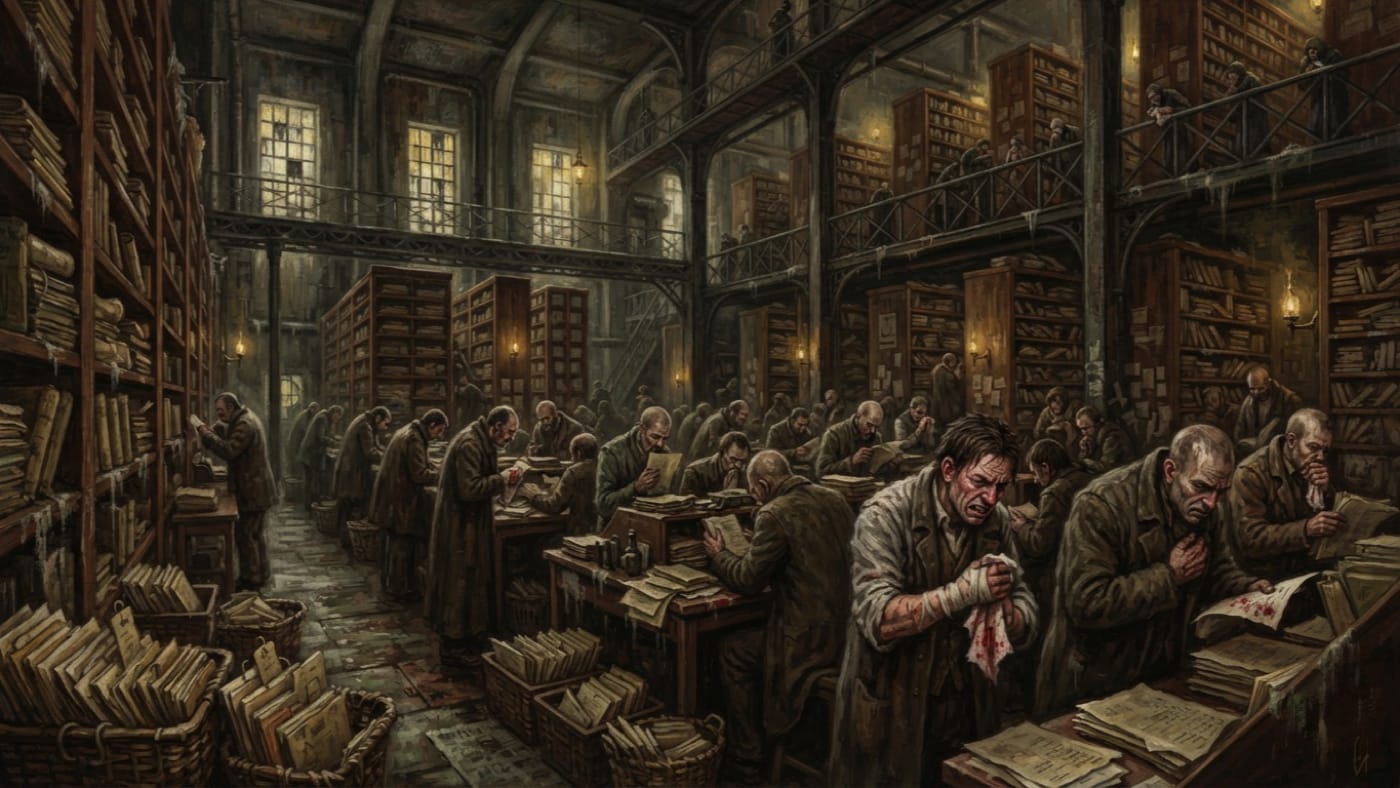
Stage One is the productive cough: wet, persistent, and heard in the drying lofts over the creak of the racks. Productive is the handbook's word. It describes the cough. With equal accuracy it describes the clerk, who keeps working.
Stage Two is blood-flecked sputum. The cloth reports what the chest would rather keep to itself. In a district where a rot-lung symptom declaration is a printed form with a Provost waiting at the end of it, a stained cloth is evidence awaiting its docket, and it is folded accordingly.
Stage Three is paper sensitivity. The sufferer's skin reacts to contact with documents. The handbook says no more, and I will add nothing to it. The reader may take the measure of the sentence alone. A woman whose wage is the handling of paper reaches the stage at which her own skin objects to her trade. She goes on being paid by the sheet.
Stage Four is "terminal administrative transfer," which the residents of the Sump call dying. I have read a great many euphemisms in the service of the Ledger and written several of the better ones, and I salute this one as a colleague. The transfer goes, in practice, to the Bone-Tag Arcade, where a tag is stamped with name, date and cause, and the entry proceeds upward into the Great Ledger. The clerk who handled the tags becomes the subject of one.
The handbook records the order of the stages and nothing of their pace. It does not say how long a cough stays productive before it stains, or whether anyone who reaches the third stage is spared the fourth. Those are questions of arithmetic, and no one has ever accused the Prefecture of arithmetic.
#On Paper and Breath
Under the Sump lie the Crypt Mouths and the underworks behind them, which the Synod sealed and the Prefecture's maps describe as closed. The seals are reported to hold. I report it. The air is another matter. Drafts from the crypt routes rise through vent alleys and maintenance shafts, and the district's own lore says they carry rot-spores. The same drafts fuzz the edges of paper and bleed ink past legibility. The Sump has noticed that the air which spoils lungs also spoils ledgers. The Bureau of Alchemical Standards has noticed it three times, in three reports that agree on nothing.
Crypt Mouth 3 is the vent alley the district names when it names a rot-lung corner. It smells of cold stone and sweet rot. Elsewhere, residents know the corners where cough fits worsen as surely as a precentor knows which stalls in his choir are draughty. No one has drawn that map. It is kept in the chest. The Coughwalks stand above the floodwater on their planks, and their air is merely unpleasant. That is a statement about flooding. Residents who take it for a statement about medicine learn the difference.
The disease takes clerks first. The cruelty needs no ornament from me: damp paper is their livelihood, so the work that feeds them is the work that exposes them. The Bone-Tag Arcade reportedly loses three to five clerks a season. The figure is the Arcade's own and concerns its staffing. Whatever becomes of the lost is recorded elsewhere, if anywhere.
The Paper Loft Quarter dries the district's documents on vinegar-soaked racks, and its absences come in rolling succession. The Registry enters them as "scheduled maintenance." The reasoning runs as follows. Plague attrition, once written down, would bring a quarantine. A quarantine would close the drying racks. Closed racks would stop the paper. Without the paper the Bureau of Records cannot keep anyone's identity in order, and Chief Clerk Dalen Voss keeps the Registry whose workers are the ones coughing. So the entry reads maintenance, and the racks stay full.
#On the Ribbon
The Quarantine Provosts report jointly to the Sluice Prefecture and the Bureau of Purity. Their insignia is the ribbon shears, and they enforce with raids, ribboning and confiscation. Their cordons move through the district as the Provosts see fit, and a family that was free on one day may be inside a cordon on the next. Before a household is confined, the Ribbon Yard serves as the staging ground: ash flags, the cough choir, and Provosts who sell immunity by colour.
There are four ribbons. Green permits passage. Yellow restricts movement. Red confines. Black marks what the Provosts call "concluded assessment" and the district calls a death warrant.
Four stages and four ribbons invite the reader to pair them, and the Provosts do not. A ribbon records what has been decided about a household. A stage records what has happened in a chest. A first-stage cough can live behind red. A clerk at the third stage can walk under green, provided the green was properly paid for.
It is paid for. The Provosts take tallow, soap, clean paper and medical tincture, and the published account of this district says plainly that ribbons can be bought and immunity negotiated. The bribe list deserves a pause. Tincture meant for the sickroom is accepted as currency by the men appointed to contain the sickness. The Sump's broader black market deals in ribbon scams and quarantine warnings sold by runners for a fee. Falsifying a ribbon is among the district's red lines. Moving a living patient without one is forbidden cargo. A bought ribbon is a local permission bought locally. It is no Inquisitorial waiver, and the Wickmarket, which sells nearly everything, cannot sell one of those.
The River-Belt Chapterhouse Annual Report of A.S. 199 stated that "rot-lung incidence in Lower Vire Sanitation Ward remains within acceptable parameters."
The parameters were revised that same week. The revision was not appended to the report. The incidence was acceptable by the measure in force at the time the report was read, and the measure in force at the time it was read was not the one in the drawer.
#On Care and Clearance
The cough-mask is the Sump's first rite of the disease. A child receives one at twelve, and touching another person's mask is taboo. Masks dry on clotheslines across the district. Whether they keep the spores out of the lungs is a question the district answers with practice, not proof, and the Codex will not answer it on the district's behalf.
The rest of the pharmacy is commerce. Medical tinctures come in with the clean water, grain and soap. Cough tonics are sold in the Wickmarket's back lanes, and anyone who has tasted one will tell you its strength without telling you its benefit. The Care crews and their medics guard the broth wagons and tend whom they can. The Sump has no rot-lung hospital and no named physician of the disease. The Bureau of Mercy keeps its wider custody of care, confession and the sick, but nothing in the record gives it command of this quarter's cordons. Matron Ilka holds no physician's licence and needs none. She controls calories, and in Candle-Sump a coughing worker who can no longer earn a ration chit eats from her kitchens or does not eat.
Against the vents, the district lays salt lines and wears bone beads. Locals say these help, sometimes. I enter the claim as reported.
The district's best-kept protections belong to its paper. Vinegar baths draw the damp out of documents. Wax-sealed sleeves of ash-wax blend shield folders from the drafts. Both are local crafts done with real skill. Neither is applied to a patient.
#On the Present Assessment
As of A.S. 201, the Paper Loft Quarter reports a rot-lung spike. Under Prefect Sera Mott, the Prefecture holds the gates, the water and the definition of clean, and its gate timings govern the air that reaches the crypt mouths. Voss's Registry runs on clerks, and its clerks are the ones coughing. Ilka's kitchens feed those who can no longer stand at the racks. Each of the three has reasons to keep the paper moving. None of them has a reason to call the absences by their name. Meanwhile, a transfer order for an Inquisitor whose sobriquet the Sump finds medically suggestive is still working through the Bureau of Purity's approval chain. It has not arrived, and this entry makes no forecast.
The cough continues in the lofts. The racks are full. The schedule is maintained.