
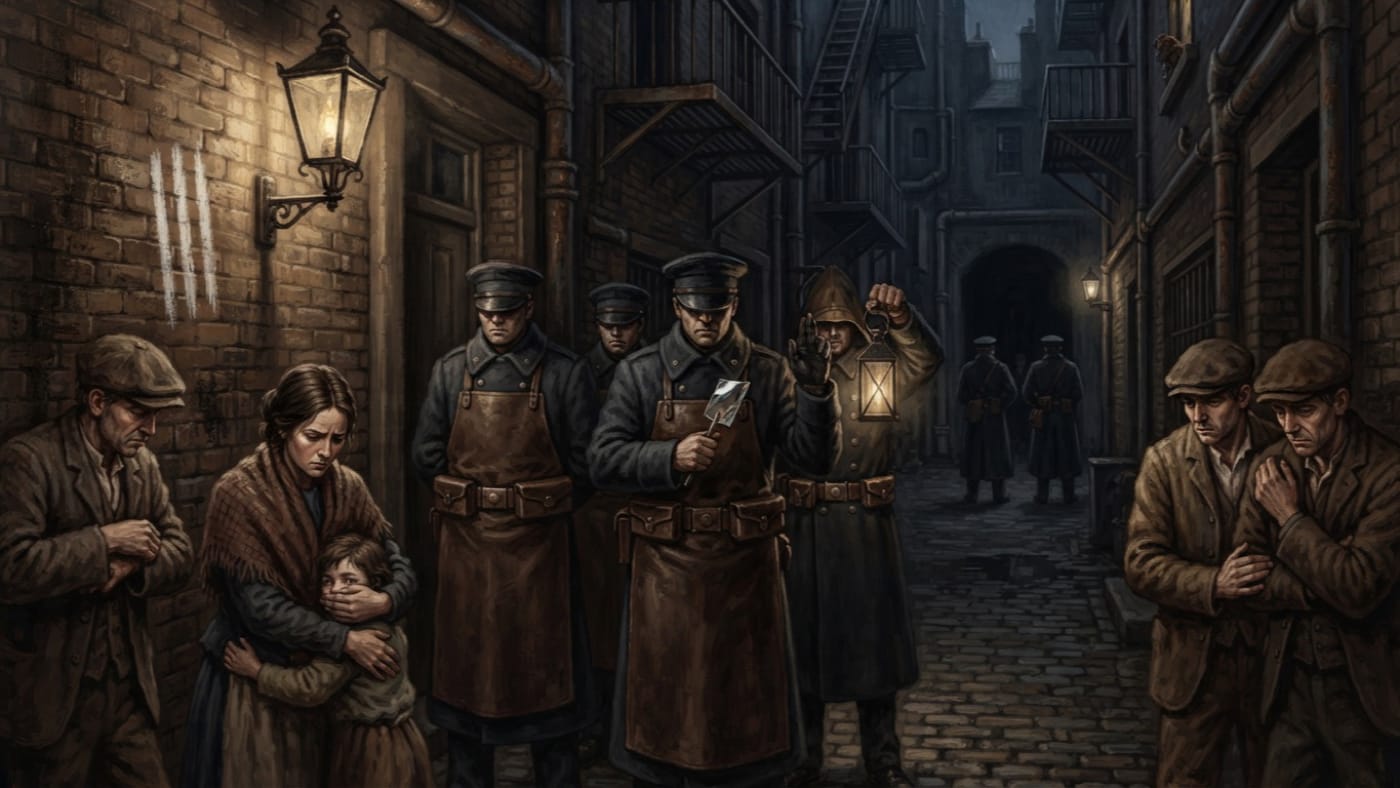
#On the Silence Mandate
Silence-order is the mandate of the Circle of Mute Radiance. Its charter states the whole of it in one line: no screams, no gatherings, no audible truth. The Circle wrote the line and the Circle enforces it. No council has adopted it for the Church at large, and no other office has signed it. This has never troubled the Circle and only troubles me on the occasions when someone asks me to file it.
The reason given is panic. In a quarter where the bells cannot be heard, a frightened street has nobody to tell it to stand still. A crowd that hears no instruction does what crowds have always done. It finds the narrowest stair and dies on it. Silence-order is presented as stampede prevention and quiet crowd control, and the Circle's returns describe it as nothing else.
The mandate reaches further than its reasons do. One scream can start a rout, and that is the Circle's whole argument. A gathering can also start a rout. It can equally start a petition, or a lament for someone taken in the night, or a sermon that nobody licensed. The third prohibition is the loosest. The charter gives no volume at which truth becomes audible and does not say which truths it means. Nor does it say how many neighbours make a gathering. The Brothers settle each of these questions in the street, by eye, every night.
#On the Claimed Ground
The bells fail before the mandate begins. The charter names four kinds of ground where this happens: bell-dead alleys, dome-scar districts, hush corridors and quake-splits. In all of them a tower's warning arrives flat or late, if it arrives at all. Bureau of Bells instruments read dead air there, and a Warden's bellow hits the brickwork and slides down it. The ground has been surveyed under Hush-Zones. I will not walk it twice.
The masonry forbids nothing. It only loses sound. Silence-order adds a human prohibition to that acoustic failure. The two are confused most often by the people who enforce the prohibition, because it is convenient to blame the bricks for it. In a quake-split a mother can still quiet her child at arm's length, and a penitent can still be heard through the confessional screen. The hush takes the shout and leaves close speech alone. Close speech is the trouble.
The Circle supplies the theology itself. Sound is leakage. Leakage is invasion. For the devotional hour it adds: In silence, the Synod is closest. These are Circle sayings and no Church seal has certified them. Every protective tower in the Church rings on the opposite assumption. The Counter-Toll Corps warns that pouring too much sanctified peal into a hush corridor can turn it into a breach, but that warning shows only that sound can be misused. It does not prove that silence protects. The Silence Domes show the same symptoms, and the Brothers learned their drill from the trench. Nobody has certified that the two share an origin, and a borrowed drill gives no Brother an Orison pass.
The charter claims these streets. Other offices claim them as well, and the charter wisely says nothing about which claim comes first.
#On Auxiliary Toleration
The Circle's permission to exist does not come from its charter. It comes from the A.S. 94 Ordinance of Quiet Hours, whose auxiliary clause tolerates "auxiliary vigil personnel, locally licensed, subject to revocation without notice or appeal." The clause was written for a Lantern Brotherhood that already existed. It allowed the Brotherhood to be tolerated while the Church kept the right to deny it. It is not the birthday of silence-order, and anyone who copies the year onto the mandate has misread both documents.
The charter has no recorded author and no recorded date of adoption. No Bureau has ratified it as general code. It binds the Brothers and claims authority over the alley, and its legal force ends at that.
The bargain has limits. A Brother who detains a resident does so without a Bureau commission or an officer's rank, and without any authority to arrest. The Bureau of Records maintains the conditions of toleration. Under Standing Order 14-V, revised in A.S. 199, toleration is reviewed every quarter and no Circle may hold more than thirty licensed operatives. The ceiling sets a maximum. It tells us nothing about how many Brothers Mute Radiance actually keeps in the Hush Loft.
#On Compliance
Residents learn the mandate from chalk. Three parallel lines on a wall mean speak softly or not at all, and a widow who has never read a catechism can count to three. The Brothers give their orders by hand-code and mirror-shard flash and never raise their voices. A shard tilted 1–2–1 against a half-hooded lantern means Circle converge. The light carries only as far as a clean line of sight allows, so smoke defeats it and so does a corner. The rest of the vocabulary and its quarrels belong to Signal Law.
When the chalk is ignored, the Circle escalates at once and without a sound. A gathering that does not disperse meets the silent formation: three Brothers at the front, two along the wall and a Spark behind, with lanterns shuttered down to a slit. Most gatherings break up before the formation arrives. The kit is small: mirror shards, cloth gags, chalk, hood clamps and the "soft cuffs" the Brothers are so fond of naming.
The punishments are separate instruments, and the charter sets no order in which they must be used. The Mouth-Seal is a dab of wax at the centre of the lips. It is symbolic and humiliating, and the whole alley sees it. The Hush Beating is methodical and non-lethal, and it is done behind closed doors so that no story gets out. Removal is the Circle's tolerated sin. Its motto is No sound, no record—unless we choose to write one. No Bureau has licensed the Circle to kill, and no Bureau has asked it to account for the people it removes.
The Brothers obey the mandate before they enforce it. In the Breath Oath an initiate carries a lit lantern down a corridor without audible breath for a count of one hundred, and repeats the walk each time he fails. In the Hush Loft the shrine candle is kept barely alight, because a larger flame makes a noise in the glass. Even the candle is under orders.
#On the Quiet Return
The returns are a pleasure to read. They report festival crowds dispersed and panics suppressed, and they report alleys in which nothing was heard. The night that produced them does not appear. At dusk the Brothers test their breath, their shards and their hood clamps. Gatherings are broken up early, before they have become noise. Removals and sealed-mouth detentions happen around midnight, and no witnesses are kept. Late in the night come the "leak hunts" for whoever has been spreading stories. Before dawn the field notes go into the fire and the shards are washed in ash water. When the clerk arrives in the morning, the only record left is the return.
I countersign them in the afternoon. A return from a street where nothing can be heard has no rival in the Synod for neatness.
The Wardens use what the Circle produces and resent what it implies, namely that commissioned authority needed help from men who have no commission. The Bureau of Shadows watches the Circle and the scandal that may yet attach to it. That scandal has a name. The Tongue Cabinet is said to hold trophies from removals. It remains a rumour. If anyone ever substantiates it, toleration would end within the quarter, because the Synod cannot afford to be seen keeping that cupboard. Until then the rumour is a matter for review, and I have no intention of opening anything.
#On the Quiet Congregation
The charter's hardest case says nothing at all.
A Lantern Mercy Preacher speaks softly in a bell-dead alley. Nobody screams. The listeners stand close enough to hear and too close for the hush to swallow the words. When they see the chalk they disperse. Their quiet keeps the street calm, which is the service the Circle sells, and they carry home a meaning the Synod never licensed. The charter forbids gatherings without qualification. Later Brotherhood folios describe such quiet congregations as compliant. Nobody has reconciled the two, and I will not pretend that either one cancels the other. No clause sets a size or a volume at which a congregation becomes an assembly, and I will not invent one.
The Brothers are divided. Some admire the quiet sermon and others call it blasphemy. The Bureau of Purity considers both reactions hazardous and recommends that any Brother assigned to preacher contact confess after his watch. The A.S. 178 Brotherhood Schism at Cologne made the quarrel worse. Ward-Soothe Purists accuse the Circle of indulging heresy whenever it calms a street. Lantern Loyalists call that charge piety without sense. The Soft Insurgents say nothing, and silence-order cannot punish them for it.
Standing patrol instruction: "Silence all unauthorised preaching."
Withdrawn by marginal order after the Cologne disputes, year not entered. A preacher may already be silent. Substitute: "Interrupt the congregation before meaning accumulates."
The correction moved the offence from the preacher's voice to the congregation's understanding. It tells a Brother when he ought to act. It gives him no way of knowing when that moment has come, because no mirror shard can show how much a listener has understood.
#On the Present Watch
As of A.S. 201 the mandate is maintained in the streets the Circle claims, and the Circle remains conditionally tolerated under quarterly review. The chalk is renewed and the Breath Oath is still administered. The returns arrive clean. The question of quiet preaching remains open on the Ledger, and Purity's recommendation is still on file without an answer.