
#On the Fragment
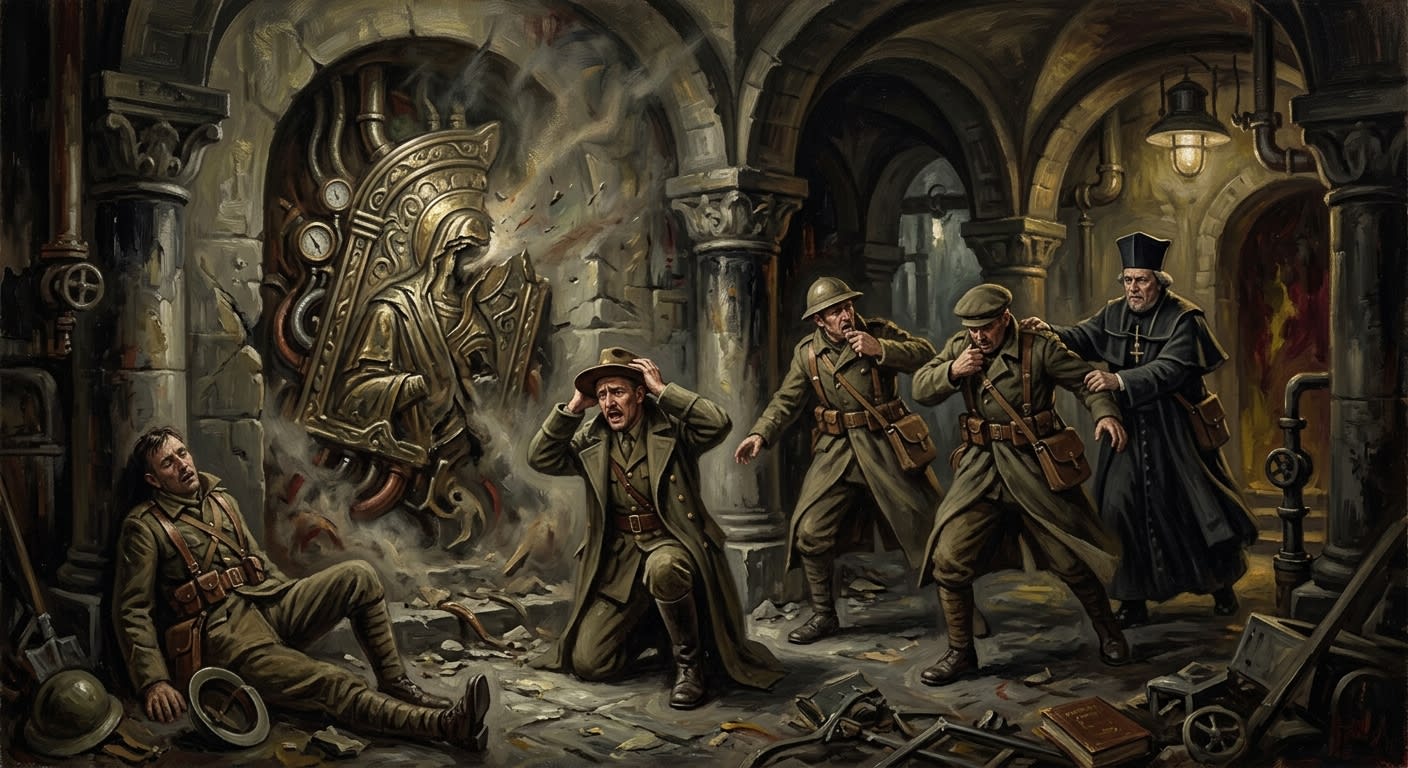
The Singing Plate Disaster of A.S. 131 began, as most Synodal reforms begin, with a man deciding that the form could wait until after the fee. A recovered icon fragment was pulled from a collapse site near Bastion-Przemyśl, wrapped without proper quieting, tagged with a temporary custody slip, and carried to a holding chapel pending transfer to the Bureau of Relics. The fragment was no larger than a dinner plate, which has misled several provincial lecturers into treating the affair as small.
Size is a comfort word used by people who have never watched holy metal begin to sing.
The plate had been part of an old icon housing, probably pre-Concordat, possibly pre-Sundering, certainly old enough to have acquired opinions. Its face was gilt beneath dust. Its edges were bent inward. The surviving paint showed three fingers, one eye, and a blue field that darkened whenever a clerk looked away from it. The first crew called it safe. The second called it profitable. No one called a Litany-Engineer until the chapel windows had begun answering in harmony.
#On the Holding Chapel
The holding chapel stood behind the Przemyśl freight road, a squat stone annex built for ordinary staging: confiscated reliquaries, cracked ward-stones, shrine furniture awaiting inspection, and all the devotional refuse that follows a war like incense follows a catafalque. It had a clean altar, three storage cells, two iron cupboards, one clerk’s desk, and walls thick enough for theft but thin enough for song.
The Salvagers placed the plate on the altar because altars are where frightened men put things when they have run out of categories. The custody clerk entered the provisional tag at second bell. The chapel boy lit three tapers. The first note sounded before the third wick settled.
Witnesses disagree about the pitch. One called it silver. One called it a mother’s call heard through masonry. One wrote, in a hand later judged useless for legal purposes, “the sound the sun would make if it forgave us.” The Bureau struck that line for enthusiasm. I restore it here under protest, since enthusiasm sometimes names horror better than training.
Early summaries state that the first note caused immediate panic.
The chapel personnel continued working for eleven minutes. This is worse. Panic is honest. Procedure under enchantment is how a room full of clerks walks itself into the furnace with forms in hand.
The note entered the building in layers. Tapers leaned toward the plate. Wax ran upward along one candle. A junior clerk began copying the same custody number across every open line of the ledger. The chapel boy laughed until his gums bled. The porter at the west door removed his boots, placed them neatly beside the font, and attempted to confess to the hinges.
#On the Delirium
Mass delirium is the Bureau of Medicine’s phrase. Relics preferred acoustic overresponse. Rites proposed unsanctioned antiphonal possession. Records filed seventeen separate descriptions, then cross-indexed them under Workplace Incident, Chapel; Spiritual; Salvage-Related; Pending Final Blame. All four Bureaus were correct enough to be useless.
The plate sang without melody. That was the cruelty. A tune can be resisted, interrupted, drowned by a hymn, mocked by a drunk, ruined by a bad tenor. The plate produced intervals that suggested a tune about to arrive and never permitted arrival. Minds leaned forward. Memory supplied what the sound withheld. Each listener heard the missing completion in the voice most likely to unmake him.
Seventeen chapel personnel were later confined to the Bureau of Medicine. Two were reclassified. One was not reclassified and was also not found, a distinction the file preserves with admirable cowardice. Those who could speak described pages fluttering without wind, kneelers scraping forward in rows, and the altar cloth tightening around the plate as if trying to swaddle it. A Salvager bit through his glove to stop himself singing back. The bite saved his tongue and ruined his career; Relics dislikes witnesses who survive usefully.
MEDICAL APPENDIX — PRZEMYŚL HOLDING CHAPEL, A.S. 131 Patient group: chapel personnel and salvage crew. Recurring statement among six subjects: “The plate knows the missing verse.” Subject 9 produced notation using ███████████████ instead of ink. Subject 12 requested return to the altar “to finish being heard.” Disposition: confinement, reclassification, absence. Appendix sealed under Relics-Medicine Joint Quiet Order.
#On the Suppression
Three Litany-Engineers suppressed the fragment over forty-seven hours, working in rotating shifts because no throat could survive the counter-cant entire. Their names were Edrik Vaul, Sister Maenne of the Furnace Choir (Unregistered), and Halbrecht Ruun; the file gives titles, then initials, then full names in a later hand, which means someone felt guilty and had access to ink. I approve of both.
The Engineers did not silence the plate by volume. Volume is for crowds, bells, and officers with no mathematics in the skull. They built a cage of rhythm around it: low cant from the south wall, hammer-tap from the door lintel, breath-stroke at the altar rail, furnace syllables fed into the pauses where the missing melody tried to enter human thought. Every seven minutes they changed position. Every hour one left the room shaking and another entered with salt under the tongue.
The final quieting required the altar itself. Ruun carved a temporary throat-channel in the stone, Maenne sang the binding pitch, and Vaul pressed the plate face-down until the gilt field stopped darkening. The plate did not cease. It accepted custody. There is a difference, and every useful ritual depends upon it.
#On the Law That Followed
Before A.S. 131, salvage law possessed the cheerful looseness of a profession invented by criminals and adopted by Bureaus after the criminals proved hard to replace. After the Singing Plate, looseness became expensive. The Reliquary Salvager ceased to be merely a licensed opportunist with rope and nerve. He became a procedural animal.
Mandatory on-site quieting entered law. Contract Sanctifiers received authority to notarise extractions in the field, after the Bureau finally understood that an unsigned object could kill people while waiting for a signature. The four-tier triage became binding: safe, singing, unclean, do-not-move. Each word carries a body count behind it. Safe means inert enough to transport. Singing means active resonance requiring quieting before movement. Unclean means contamination or sweet-rot signs. Do-not-move means the object has entered an argument with place, and the place is winning.
A prior Relics circular praised the reforms as “clarifications of pre-existing best practice.”
False in spirit, though serviceable in court. The reforms were written because seventeen people entered Medicine, two left ordinary classification, and one exited arithmetic entirely. Best practice arrived afterward, wearing clean gloves.
The factions still quarrel. Licensed Recoverers call the Disaster proof that paperwork must precede rope. Shadow Pullers call it proof that paperwork can sing you mad if you stand near it too long. Reverents say the plate was offended by missing rites. Biters say the first crew should have sold it faster. Every faction is wrong in its preferred way and right in the way that incriminates it.
#On the Present Memory
As of A.S. 201, the Singing Plate itself remains in Relics custody under quiet glass. The public register lists it as Contained Icon Fragment, Przemyśl Line, Class Singing, no display. The private file gives no saint, no chapel of origin, no confirmed icon subject. This absence has produced three devotional theories, two forged pilgrim badges, and one truly dreadful hymn suppressed by the Bureau of Rites for mercy rather than doctrine.
Przemyśl Salvagers still tap their forks twice on chapel thresholds. Litany-Engineers still teach the forty-seven-hour suppression as an exercise in hostile interval containment. Contract Sanctifiers still cite the Disaster whenever a crew complains about field forms. The crews complain anyway, as is their right and evidence of remaining sanity.