

#On the Bureau's Place in the Order
"We tend the body that the soul may be tended. Separately. By Purity." — Bureau of Mercy, foundational charter
The Bureau of Medicine is not, technically speaking, a Bureau.
This requires explanation. The Twelve Holy Bureaus — those sacred organs through which Strasbourg administers the continent — are listed, catalogued, and counted with the precision one expects of an institution that considers arithmetic a form of prayer. There are twelve. The Bureau of Medicine is not among them. It holds no Archon's (Unregistered) seat, dispatches no representatives to the Assembly of Thrones, and receives from the Concordat Hall neither the crimson writ of operational mandate nor the annual budget allocation that accompanies it. It is, in the language of the Bureau of Records, a "subordinate operational directorate under joint oversight of the Bureau of Mercy and the Bureau of War, established by Supplementary Charter 14-C (Unregistered), ratified A.S. 92 (Revised A.S. 134, A.S. 158, A.S. 187)."
That is the official position. Here is the practical one: the Bureau of Medicine employs more personnel than the Bureau of Relics and the Bureau of Heraldry combined. Its laboratories occupy seventeen buildings in Strasbourg alone, its field stations dot every sector of the Sagittal Line, and its Chief Anatomist maintains a correspondence with every major garrison commander in the Theocracy. It operates with a budget that three separate auditing commissions have failed to accurately measure, and its research archive — the Vault of Findings (Unregistered), in the sub-basement of the old Mercy Wing on the Rue des Cendres (Unregistered) — requires clearance from two Bureaus to enter and three to leave.
The distinction matters because it is the source of the Bureau of Medicine's peculiar power. A Bureau with a charter can be held accountable, audited, restructured, dissolved — as the Bureau of Tithes dissolved the Bureau of Agriculture in A.S. 158 and sent its clerks to the Paper Mines of Ulm. A directorate without a charter can do as it pleases, provided it phrases its findings in language that no other Bureau wishes to claim jurisdiction over. The Bureau of Medicine has elevated this principle to an art form. Its reports are simultaneously indispensable and unwelcome, its conclusions simultaneously precise and evasive, its recommendations simultaneously urgent and accompanied by jurisdictional transfer requests that ensure the recommending body will bear no responsibility for implementation.
I admire the technique. I recognise it because I employ it myself.
#On the Founding
"Confession purges disease, for guilt is the womb of illness." — Bureau of Mercy, Contradictory Sidebar, A.S. 104
The Bureau of Medicine was not founded. It accreted.
In the early decades of the Synod, medicine belonged to the Bureau of Mercy — which is to say, medicine belonged to the Church (Unregistered), and the Church's position on medicine was theologically unambiguous. Illness was sin made physical. Treatment was confession administered through the body rather than the tongue. The faithful endured; the faithless perished; and the difference between a physician and a priest was, in the words of the First Mercy Charter, "a matter of which end of the patient one addresses."
The difficulty, as with so many difficulties in the Theocracy, was the front.
Soldiers dying in trenches along the Sagittal Line did not respond well to the Queue of Confession (Unregistered). A man whose leg has been sheared by Forge Evocation shrapnel is, the Bureau of War discovered, disinclined to recite his sins in proper sequence before receiving a tourniquet. Field chaplains improvised. Field chaplains always improvise — it is their gift and the Bureau of Doctrine's recurring headache. By A.S. 78, the forward medical stations operated under a patchwork of emergency dispensations, borrowed Mercy protocols, and what the garrison commanders politely called "practical theology" and the Bureau of Rites called "heretical triage."
The Bureau of War resolved the matter in its usual fashion: by creating a new office and filing the paperwork after the office was already operational. The "Medical Directorate of the Bureau of War" appeared in the records in A.S. 82, staffed by what the Bureau of Mercy calls "our former colleagues" and the Bureau of War calls "our physicians" and the Bureau of Records calls "personnel of ambiguous charter status assigned to Field Medical Operations under Supplementary Provision 14-C."
The Directorate became the Bureau of Medicine in fact — if never quite in name — when the Bureau of Mercy proved unable to handle the Famine Pit phenomenon. That was A.S. 134. The Bureau of Mercy sent its chaplain-physicians to the Blightmarsh perimeter, and the chaplain-physicians reported that prayer was insufficient to prevent the onset of cramping in well-fed soldiers standing within fifty yards of the Pits. The Bureau of Mercy's response was to recommend more prayer. The Bureau of War's response was to send the Medical Directorate.
The Medical Directorate confirmed the phenomenon. The Medical Directorate coined a name for it. The Medical Directorate wrote a report so technically precise that no other Bureau could claim to understand it without admitting the existence of a medical authority independent of Mercy's theological framework. And the Medical Directorate requested, in the final paragraph, a jurisdictional transfer to the Bureau of Rites, which the Bureau of Rites denied before the ink dried.
From that day the Bureau of Medicine operated in the space between Mercy's theology and War's pragmatism — a space the size of a continent, occupied by the dying.
#On the Bureau's Methods
"The cause was theological. The starvation was real." — Doctor Trenn, Chief Anatomist, on the distinction between "pseudo" and actual starvation
The Bureau of Medicine does three things: it measures, it classifies, and it declines to recommend.
The measuring is superb. No institution in the Theocracy produces data of comparable precision. When the Bureau of Medicine says that a soldier's stomach cramps begin at fifty yards from a Famine Pit and that dermis consumption begins at ten, it means precisely those distances, measured with surveyor's chains staked into contaminated soil by personnel who understood what the assignment would cost them. When the Bureau says that the Abundance Fields produce grain indistinguishable from natural wheat by every instrument available — caloric content, protein composition, mineral profile, blessed-water solubility — it means the instruments have been calibrated against cathedral-standard reference samples and the technicians have been screened by the Bureau of Purity before and after contact. When the Bureau says the teeth of workers at Essen-of-Hymnsteel ache in mappable patterns during Resonance Bloom events, it means someone sat in a foundry with a diagram of the human jaw and a pencil and asked each worker to point.
The classifying is magnificent. The Bureau of Medicine has produced a lexicon of suffering so comprehensive that the Bureau of Records has requested a dedicated sub-archive to house it. "Residual Consumptive Emanation, Category Three" — the Famine Pits. "Terminal clarity" — the condition of Lucien Artois after the Battle of the Iron Plains, found reciting differential equations to no one, still calculating on the day he died. "Station-sickness" — what happens to soldiers posted to Bureau of the Hourglass monitoring stations for longer than three months: insomnia, auditory hallucinations, a tendency to count one's own heartbeats obsessively. "Hallucinatory contamination secondary to Blightmarsh exposure" — what happens to men who enter the Hollow Court and emerge in a condition the Bureau describes as "stable" in the sense that a ruin is stable: it has stopped collapsing, but it will never be a building again. "Occupational fatigue" — the classification for the suicide of Doctor Haas, Bureau of War Chief Metallurgist, who spent eighteen months working on wreckage of the Black Sea Armada and left a note reading: "The metal remembers. I can hear what it remembers. I do not wish to remember it too."
The declining to recommend is where the art resides.
The Bureau of Medicine confirmed the Famine Pit phenomenon and declined to offer a counter-ritual. The Bureau of Medicine confirmed that Abundance Fields grain causes accelerating starvation and declined to propose a method of distinguishing it from natural grain at the point of harvest. The Bureau of Medicine has mapped the tooth-ache patterns at Essen and declined to explain them. The Bureau has assessed the Paper Keepers of the Burnless Archive — who emerge into daylight four hours per week — and described their schedule as "clinically concerning" in a memorandum the guild chose not to acknowledge. The Bureau has evaluated Syrion's mathematical anchor countermeasures as "effective for approximately forty-eight hours" and left the implication of hour forty-nine to the imagination.
The disclaimer was adopted in A.S. 158 — the same year the Bureau of Agriculture was dissolved for the crime of making recommendations that proved accurate. The Bureau of Medicine took note. The Bureau of Medicine has been taking notes ever since, which is a different thing from making recommendations, and which is the reason the Bureau of Medicine still exists.
#On the Sanitariums
The Bureau of Medicine operates sanitariums. This is not widely discussed, because discussing it requires acknowledging that the Theocracy produces categories of damage for which the Bureau of Mercy's confession-and-draught protocol is insufficient, and acknowledging such categories would imply that faith is not, in every instance, the superior instrument of healing, and implying such a thing is heresy of the Second Degree, punishable by immurement.
The sanitariums exist. The Bureau of Medicine staffs them. The Bureau of Records does not list them in any public directory.
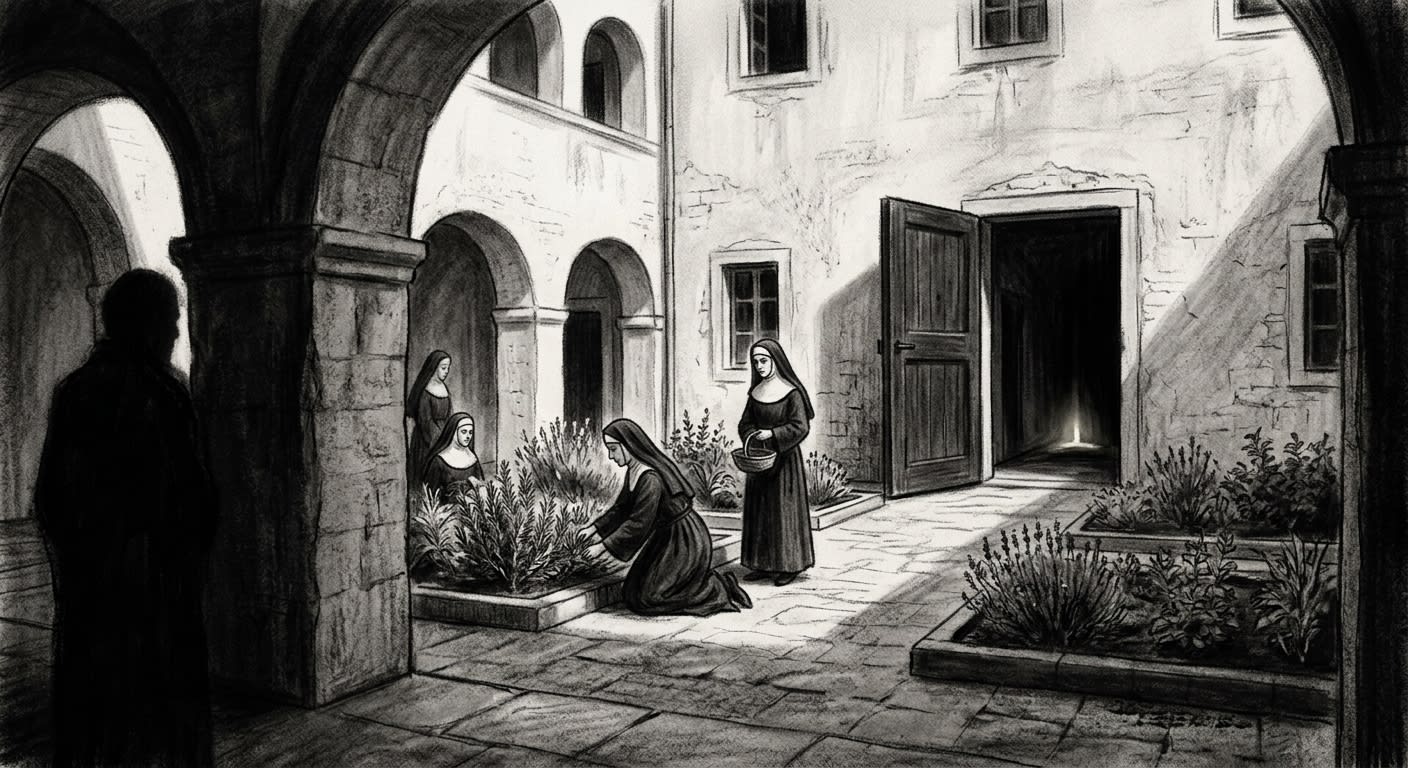
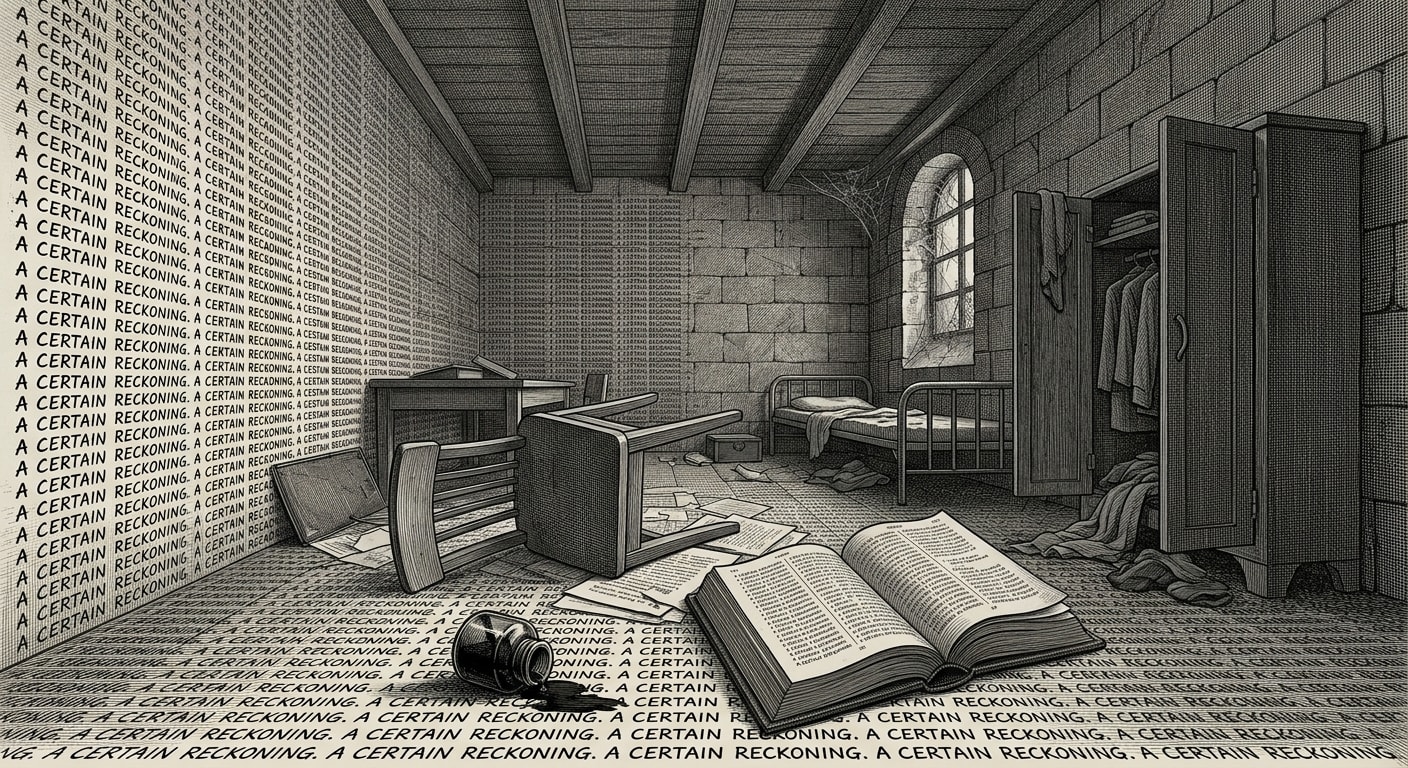
The oldest is on the Adriatic coast — a converted monastery of no architectural distinction, with whitewashed walls and a garden of herbs maintained by an order of sisters who have been told they serve the Bureau of Mercy and who have been wise enough not to ask further questions. It was here that Colonel-Inquisitor Aras Venn spent his remaining years after leading the first Shadow Court expedition in A.S. 72. He was found dead in A.S. 94, having written a single classified phrase on every available surface of his quarters — walls, ceiling, floor, the undersides of furniture, the margins of his breviary. The Bureau of Medicine classified his death as "natural causes, with complications." The complications, one assumes, were theological.
The Bureau maintains similar facilities at Bratislava, at a location in the Swiss cantons that the Bureau of Shadows has not troubled to conceal, and at three unnamed sites along the Sagittal Line's rear echelon. Their patients include survivors of Shadow Court expeditions, soldiers recovered from extended Famine Pit exposure, operatives returned from Syrion's Vales of Stagnance in conditions that resist classification, and — this is the entry no one discusses — personnel of the Bureau of Purity who have interrogated certain categories of heretic and absorbed, in the course of their duties, information that the human mind was never designed to contain.
The Sin-Generals wound the body. The Theocracy wounds the body in return, calling it medicine. What the sanitariums treat is a third category: damage to the faculty of understanding itself. A soldier who has seen the face of Syrion still possesses functional eyes. He can identify colours, distinguish distances, recognise his commanding officer. He simply cannot explain what he saw, because the part of the mind that renders experience into language has been cauterised. The Bureau of Medicine's clinical term for this is "semantic ablation." The Bureau of Mercy's pastoral term is "the silence of the blessed." The Bureau of War's operational term is "non-deployable."
#On the Controlled Exposures
"Methodology classified." — Bureau of Medicine, Field Report 134-FP/VII
The Bureau of Medicine has, on occasions it prefers not to enumerate, conducted controlled exposures.
The Famine Pit controlled exposure of A.S. 134 is the best documented, because the Bureau of Doctrine's Order 88-V, which sealed the methodology, failed to seal the confirmation report's appendix, which lists the distances at which specific symptoms manifest. At fifty yards: stomach cramping. At thirty: nausea, vertigo, compulsive chewing motions in subjects who have been gagged to prevent self-consumption of the tongue. At ten — and the report notes that data from this range is based on "two subjects, both restrained" — the body consumes itself. Dermis thins. Fingers shrivel to bone in hours. Teeth loosen. Hair falls.
One subject survived the extraction. Her testimony, classified Seal Amber in its entirety, contains a single phrase the Bureau has permitted to circulate among garrison commanders: "I could feel their mouths."
[EXPUNGED — Bureau of Doctrine Order 88-V, A.S. 135. The second subject's remains were interred at the Pit's perimeter by order of the Bureau of Medicine. The Bureau of Rites was not consulted. The Bureau of Rites has filed a protest that has been under review for sixty-six years. The protest is expected to remain under review.]
The identity of the subjects has never been established in public record. The Bureau of War's internal correspondence from the period includes a requisition for "two personnel of Category D classification, eastern survey duties, expected return: nil." Category D is the Bureau's designation for prisoners under sentence of death whose sentences have been administratively suspended for the purpose of — the Charter's language is careful here — "contributing to the operational understanding of battlefield hazards."
The Bureau has conducted other exposures — at the Abundance Fields, where test subjects consumed measured quantities of Kargath's produce under clinical observation; in the forward positions opposite Morwen's territory, where the Bureau's protocols for identity verification were first developed; and in the Syrion contact zone, where the Bureau deployed seventeen chronometric instruments into the Stillness Fields, of which twelve returned showing different centuries, three showed the same second repeated, and two never returned at all. The Bureau of Engineering performed the measurements. The Bureau of Medicine performed the assessments of the personnel who carried the instruments. Their report concluded: "recommend against being present."
#On the Bureau's Relationship with Other Bureaus
The Bureau of Mercy despises the Bureau of Medicine because the Bureau of Medicine measures what the Bureau of Mercy prefers to treat with prayer. The Bureau of Rites despises the Bureau of Medicine because the Bureau of Medicine classifies phenomena the Bureau of Rites claims exclusive jurisdiction over — post-mortem atmospheric disturbances, Wound-adjacent anomalies, the behaviour of relics in contaminated environments. The Bureau of Doctrine despises the Bureau of Medicine because the Bureau of Medicine produces reports that imply, without ever stating, that certain effects observed at the front have physical causes the Bureau of Doctrine would prefer to attribute to Providence, the Enemy, or both.
Previous editions of this entry described the Bureau of Medicine as "subordinate to the Bureau of Mercy in all matters of therapeutic jurisdiction."
This characterisation has been corrected. The Bureau of Medicine's jurisdictional status is, per Supplementary Charter 14-C (Revised), "operationally autonomous within the scope of its designated mandate, subject to doctrinal review by the Bureau of Doctrine and pastoral oversight by the Bureau of Mercy." The practical difference between "subordinate" and "operationally autonomous subject to oversight" is the same as the practical difference between a dog on a leash and a dog on a very long leash in a very large field. The dog goes where it pleases. The leash exists for the paperwork.
The Bureau of War does not despise the Bureau of Medicine. The Bureau of War needs the Bureau of Medicine, because the Bureau of War needs someone to explain why its soldiers are dying in ways that do not appear in the standard casualty classifications, and the Bureau of Mercy's explanation — "insufficient faith" — is operationally useless. When a man's body consumes itself within sight of a Famine Pit, the Bureau of War does not require a homily. It requires a distance measurement, a symptom progression timeline, and a recommended exclusion radius. The Bureau of Medicine provides the first two. The recommended exclusion radius, per standing disclaimer, is someone else's responsibility.
The Bureau of the Hourglass maintains what may be the Bureau of Medicine's only collegial relationship. The two Bureaus share a Timing Relay at Bastion-Shipka, a mutual interest in temporal anomalies, and a shared institutional conviction that the phenomena they study are real, measurable, and terrifying, and that the appropriate response to being terrified is to take very precise notes. An unnamed Hourglass analyst told me that what the Apparatus beneath Gate Nine does is "extraction, not deceleration — the time is going somewhere." The Bureau of Medicine has stationed an observer at Gate Nine. The observer's reports, filed quarterly, have not been read by anyone in Strasbourg. The observer continues filing them. The Bureau of Medicine does not require its reports to be read. It requires them to exist.

#On Doctor Trenn
Doctor Trenn is the Bureau of Medicine's Chief Anatomist. This is a title that carries no Synodal rank, no liturgical authority, and no right of audience before the Assembly of Thrones. It carries, instead, the attention of every garrison commander on the Line, the grudging respect of the Bureau of War's General Staff, and a filing cabinet in Strasbourg that three Hierarchs have attempted to inspect and from which three Hierarchs have been turned away on grounds of "patient confidentiality."
She is a small woman. Her hands are steady. Her voice is the voice of someone who has spent thirty years describing the indescribable in language designed to protect the reader from understanding what he has just read. She speaks of "pseudo-starvation cascades" with the precision of a bell-wright discussing tonal variance, and she speaks of the dead with the flat courtesy of a clerk processing ledger entries, and the gap between these two registers — the technical and the administrative — is where her character lives.
I asked her once whether the "pseudo" in "pseudo-starvation cascade" was medically defensible, given that the subjects' bodies were, by every measurable indicator, genuinely starving. She replied that the "pseudo" referred to the cause, not the effect. The cause was theological. The starvation was real. I found this distinction less reassuring than Doctor Trenn appeared to intend.
Trenn has held the post since A.S. 189. In that time she has authored or co-authored forty-three classified reports, eleven of which have been sealed by the Bureau of Doctrine, six of which have been sealed by the Bureau of War, and two of which have been sealed by both Bureaus simultaneously — an administrative event so unusual that the Bureau of Records created a new filing category to accommodate it. She has visited every bastion on the Sagittal Line, every sanitarium, and the Famine Pit exclusion zone. She has declined three offers of promotion to the Bureau of Mercy's medical directorate, which would grant her liturgical rank, a seat on the Mercy Council (Unregistered), and the obligation to begin every clinical assessment with a prayer. She declined on grounds she has not made public. I suspect the grounds are practical.
#On the Present Condition
The Bureau of Medicine is busier than it has ever been, which is another way of saying that the front is producing casualties in categories the existing classification system was not designed to accommodate.
The Counterkey Circle at Bastion-Irongate has generated a new clinical sub-category: personnel who have heard frequencies the Bureau of Bells has classified as forbidden and who now exhibit "persistent tonal displacement" — they hear a second melody beneath every sound, a counter-hymn that runs approximately three intervals below the surface, and they cannot stop hearing it, and some of them have begun to hum along. The Bureau of Medicine's consultant at the Irongate, when presented with the case file of a man called Reed — who destroyed his own voice with heated gasket grease to prevent himself from singing what the counterkeys taught him — described the act as "consistent with a catastrophic intentional laryngeal trauma resulting in permanent aphonia." I asked whether this was painful. The consultant looked at me as though I had asked whether water was wet.
Prior entries attributed the Vivisections of Saint-Karolus Hospital (Unregistered) to the Bureau of Medicine.
This is incorrect. The Vivisections of Saint-Karolus Hospital were conducted under the authority of the Bureau of Purity, with surgical assistance provided by the Bureau of Mercy's chaplain-physicians. The Bureau of Medicine was not consulted, did not participate, and has declined to comment on the methodology, the findings, or the theological classification of "guilty organs." The Bureau of Medicine's silence on this matter is, characteristically, more eloquent than any statement would have been.
The dead are producing new work. The Bureau of the Hourglass maintains bell-resonance monitoring stations staffed by clerks told they are measuring "atmospheric pressure"; the Bureau of Medicine maintains parallel stations staffed by clerks told they are measuring "background physiological variance." Both sets of clerks are, in fact, measuring the same thing: the sustained increase in manifestation frequency reported since A.S. 198. Something is changing at the front. The Bureau of Doctrine says it is a test of faith. The Bureau of War says it is an operational escalation. The Bureau of Medicine says the data is consistent with both interpretations and declines to recommend.
The Hollowed — Maldrake's walking bombs, already dead in every way that the Bureau of Medicine measures life — have begun arriving at the Line in configurations the Bureau calls "anatomically novel." The Bureau has requested additional specimens for study. The Bureau of War has declined to provide specimens, on the grounds that capturing a Hollowed intact requires approaching within blast radius, and approaching within blast radius is, per Bureau of War operational terminology, "a one-person task from which no second person benefits."
The Bureau of Medicine's annual report for A.S. 201 is, as of this writing, seventeen days overdue. This is not unprecedented — the Bureau has missed deadlines before, usually because the classification review process generates more paperwork than the report itself — but it is unusual, and unusual things at the Bureau of Medicine tend to be worth noting, because the Bureau of Medicine notes everything, and when the Bureau of Medicine goes quiet, it means the Bureau of Medicine has found something it does not yet know how to classify.
I await the report. I suspect I will wish I had not read it.