
#On the Name
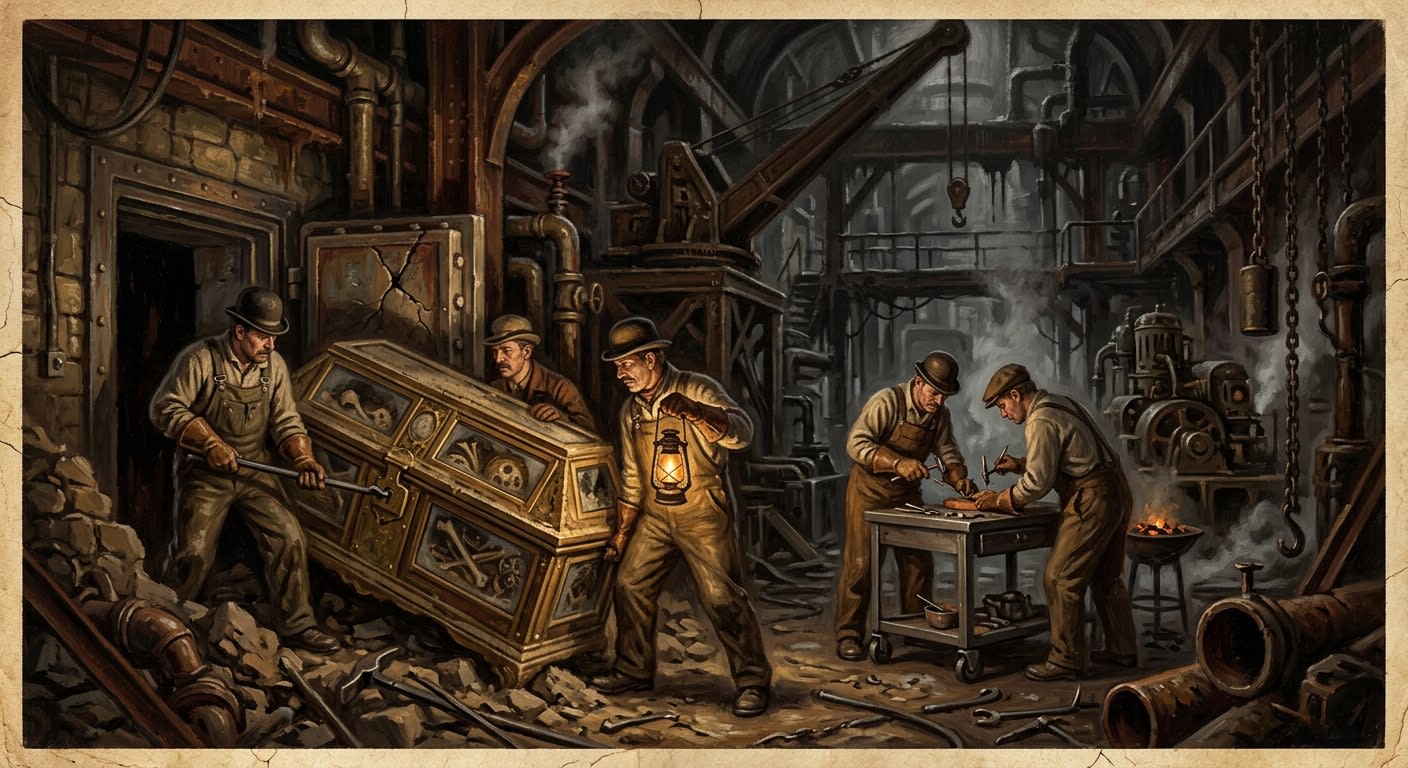
The Shadow Pullers are the unlicensed faction of the Reliquary Salvagers, though the word unlicensed gives the wrong impression, suggesting absence, vacancy, a neat little gap where authority has failed to arrive. Authority arrives. It arrives late, puffing, carrying a clean tag-book, escorted by Contract Sanctifiers and men who still believe the ceiling will ask permission before falling. By then the Shadow Pullers have already entered the crack, read the stone, cut the wax, found the humming thing, wrapped it badly enough to survive and well enough to sell, and vanished through a drain culvert smelling of lime and victory.
They are called Shadow Pullers because they pull from places the Ledger has not yet lit. They call themselves practical.
Their rivals, the Licensed Recoverers, define them as thieves in salvage masks. The Bureau of Relics defines them as “Tolerated Irregular Recovery Assets” when useful, “unauthorised handlers of consecrated matter” when embarrassed, and “unknown persons” when testimony would prove expensive. The Shadow Pullers define the Licensed as the ones who arrive after the work is done. This is unfair in the way true insults are unfair: insufficiently complete, never inaccurate.
#On the Ghost Tag
A ghost tag is a custody number forged from the Synod’s own dead paperwork. The trick is old, elegant, and filthy. Find a registry destroyed by fire, flood, shelling, damp, rat consumption, Purity seizure, or convenient misfiling. Extract a number range that once belonged to real objects. Copy the wax tone, copy the hand, copy the clerk’s abbreviations, and attach the false strip to a true fragment before anybody living can prove the dead file did not anticipate it.
A good ghost tag does not look perfect. Perfection reeks of forgery. A good ghost tag has a smear at the right corner, a hesitation in the third digit, an old fold crossing the witness line, and a tired little abbreviation that says some vanished clerk had too much work and too little candle. The Shadow Pullers understand bureaucracy as predators understand hoofbeats. They do not love the system. They listen to it breathe, especially where the First Quake-Ledger taught the Bureaus to confuse counting with capture.
Relics training manuals describe ghost tags as crude criminal imitations of proper custody strips.
The manuals flatter themselves. The finest ghost tags are better written than provincial custody records and, in at least nine audited cases, more internally consistent.
The danger exceeds audit. Ghost tags work until the Bureau of Purity opens a parallel ledger. Purity has a genius for remembering what Records forgot, especially when forgetting has allowed poor men to eat. A crew caught with a failed ghost tag may lose fee, licence, fingers, name, or breath, depending on the object, the mood of the investigator, and whether the fragment has already proved useful to Relics.
#On Their Method
The Shadow Puller works before permission. That is the entire doctrine, if one is generous enough to call survival a doctrine. A quake coughs open a chapel wall. A siege shell splits an ossuary buttress. A mason hears a hum behind a load-bearing arch and tells his cousin before he tells the foreman. By dawn, a Puller crew is on site with rope, pry-spikes, quiet wrap, a resonance fork, two bribe chits, a mule cart with a false bottom, and a boy small enough to enter the first throat.
The method is speed without stupidity. They read stone as well as any licensed crew and often better, because the stone kills slowly only in sermons. They tap for wrong echo. They chalk routes with marks that look like mason’s dust. They wrap warm fragments in relic-grade cloth stolen from shrine laundries. They sing only when the object insists. They call official help only when the alternative has already begun breathing.
The Bureau pretends this is chaos because admitting otherwise would require admiration. Shadow Puller crews use ranks: lookman, throat boy, fork hand, wrap hand, mule keeper, story seller. The story seller is the most despised and the best paid. He deals with patrol captains, shrine-brokers, desperate chaplains, and Relics intermediaries whose innocence has a purse attached. A clumsy story gets the crew hanged. A good story becomes provenance.
#On the Trade
The Shadow Puller’s market has three doors, all narrow. The first is the underworld shrine trade: saint-glass beads, bell slivers, icon chips, little reliquary hinges polished clean of context and sold as miracle aids to widows, soldiers, and fools with money. The second is quiet sale back to Relics through a cut-out, by which the Bureau reacquires its own property without acknowledging that criminals delivered it faster than officers. The third is crew-kept luck: the sliver sewn into a glove, the chip carried in a boot, the bead under the tongue until it warms and a man remembers that luck is merely danger that has not matured. Downstream, Relic Authenticators wash the story, Saint-Bone Melters ask no useful questions, and shrine custodians discover sudden devotion to incomplete provenance.
PURCHASE INTERCEPT — BASTION-BREST, A.S. 176 Item: saint-housing fragment associated with sustained C-sharp incident. Seller: “no one.” Buyer: Relics sub-clerk acting without written authority. Ghost tag range matched registry lost in chapel flood, A.S. 143. Fragment accepted, re-sealed, classified. Seller later found ███████████████ with wax under nails and no tongue.
Their economy survives because everyone requires one item from it. A chaplain wants a relic before inspection. A quartermaster wants quiet. A Relics officer wants recovery without scandal. A Salvager wants the fee before the licensed crew arrives. A widow wants a saint she can hold without filing a petition through Strasbourg. The Shadow Puller supplies all of them, takes payment, and leaves before gratitude curdles into accusation.
#On Their Enemies
The Licensed Recoverers are their ceremonial enemy, which is to say their closest relatives. Both read stone. Both fear open reliquaries. Both carry bell slivers and lie about it. The Licensed despise ghost tags because ghost tags make their clean numbers look slow. The Pullers despise blue wax cords because nothing in a ruin is so funny as a man wearing permission on his wrist while the wall decides whether he continues.
The deeper enemy is the Contract Sanctifier. A Licensed Recoverer can be outrun. A Sanctifier changes the terms after the race, declaring that the prize never existed or that it existed only under his seal. Pullers call them leash-men, wax-priests, folding-board saints. They bribe them when possible, misdirect them when necessary, and rescue them more often than either side records.
A Bureau of Relics disciplinary circular states that Shadow Pullers “display no reverence for sacred objects.”
Untrue. They display irreverence toward Bureau custody. Sacred objects receive fear, caution, curses, and a quality of attention many chapel custodians could profitably imitate before retirement or combustion.
Vera “Iron-Thumb” Malrec despised them for sloppiness and used them for reach. That is the proper attitude. A Shadow Puller can enter places a licensed crew cannot approach without causing a meeting. In the years after Malrec’s A.S. 160 Irongate exploit, Puller crews copied her iron thumb in tin, bone, and blackened hinge scrap. The copies were unlawful, devotional, and sold briskly. Relics condemned them in public and purchased specimens for study with the appetite of a bishop at a forbidden table.
#On Their Code
The Shadow Puller code is not noble. Noble codes are written by men with dry boots. Their rules are working rules: never scrape an inscription; never trust a dry vault; never split a humming pair; never sell the same ghost tag twice inside one province; never let the throat boy carry the warm object; never joke about breathing cavities; never return to a site after Purity marks the lintel unless starvation has already won the argument.
They have mercy of a kind. A crew will sometimes leave a chalk sign for the licensed men: three broken crosses for singing matter, a hook mark for bad air, a little square for a floor that will fall. They deny doing this. The Licensed deny reading the marks. Men survive by these mutual denials, which the Bureau, in its prudence, records as coincidence.
#On the Present Condition
By A.S. 201, Shadow Pullers remain everywhere the Line cracks: Przemyśl underworks, Brest wet vaults, Irongate quake seams, Sibiu chapel foundations, nameless ossuaries whose names survive only in salvage invoices and bad lungs. Relics estimates that licensed crews handle forty percent of recoveries. The rest are tolerated, denied, laundered, misfiled, or blessed after the fact by men who have learned to say “irregular” with a straight face.
The Shadow Puller is faster than law and dirtier than doctrine. He is also, infuriatingly, useful. When the wall opens and something holy starts humming in the dark, Strasbourg may send a clerk, a contract, a seal, a hymn, and a cart with proper suspension.
The Puller has already gone in.