
#On the Compilation
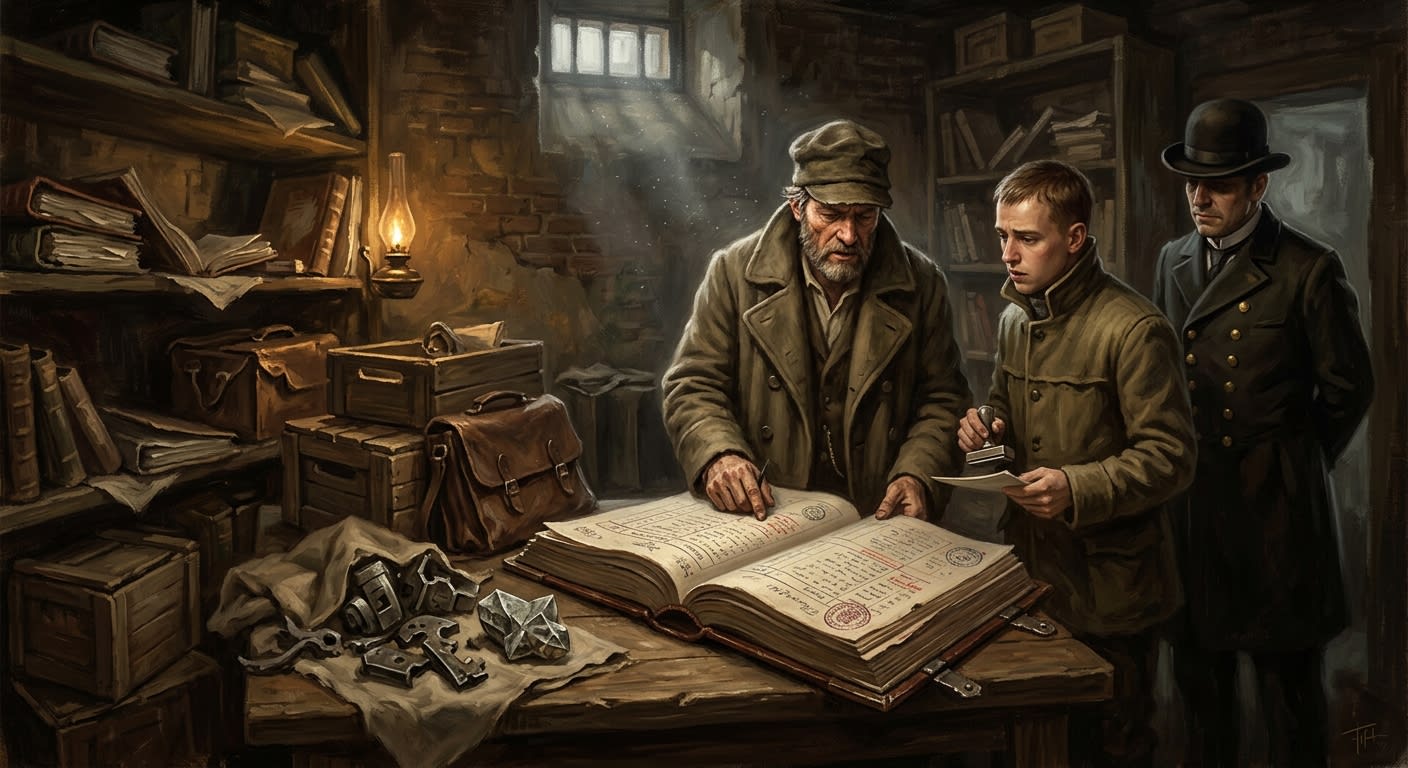
The First Quake-Ledger of A.S. 105 was the document by which the Synod discovered, to its professional horror, that ruins were making money without permission. Walls had been falling for decades. Vaults had cracked. Saint-halls had opened their old mouths in the underworks of Bastion-Przemyśl, Bastion-Brest, the Danube batteries (Unregistered), and lesser chapels too poor to deserve a map until something valuable crawled out from under them. Men entered those cracks with ropes, knives, lanterns, and criminal optimism. They came back with reliquary hinges, bell slivers, saint-glass beads, bone lime, seal-plates, and stories they sold twice.
The Ledger made the offence visible.
Before A.S. 105, the Bureau called these matters local irregularities. A mason found a reliquary clasp and sold it through a cousin. A chapel clerk failed to report a cracked ossuary niche. A patrol sergeant accepted a bell-metal shaving as a kindness and wore it under his shirt until it warmed during confession. Local. Irregular. Solvable with a reprimand, a hanging, or that most Strasbourg of punishments, a new form.
#On the Discoveries
The Ledger compiled thirty-seven collapse sites, nine suspected vault mouths, eleven missing custody packets, four shrine-market seizures, and one column so heavily corrected that the ink thickened into a ridge. Its genius lay in arithmetic. The clerks did not argue theology. They counted. They counted recovered items not reported to Relics. They counted relic fragments appearing in provincial shrine stalls without authorised provenance. They counted condemned men found with saint-glass under the tongue. They counted coin flow through undertakers, masons, ferrymen, black-market absolution brokers, and those delightful little rat-priests who sell holiness by weight when nobody respectable is looking.
The total was too small to frighten a kingdom. It was large enough to offend a tax office. That is worse.
The offending phrase appears on the third folio: “secondary economy arising from collapse exposure.” No clerk who writes such a phrase deserves beauty, but this one deserves credit. The sentence did what soldiers had failed to do. It showed that the Synod’s monopoly on sacred matter had a hole shaped like rubble.
Later Relics summaries describe the First Quake-Ledger as a devotional inventory compiled to protect sacred objects.
The surviving fiscal draft contains forty-two uses of “uncollected value” and only three uses of “sanctity.” One of the three is in a marginal objection by a Rites clerk. He was correct and outvoted, the natural condition of theology in a revenue room.
#On the Date
The Bureau of Records has revised the date twice. This is not scandal. This is Records breathing.
The first circulation bore A.S. 104, because the earliest regional returns were gathered after the Chain-Vault Crack beneath a Przemyśl chapel in late winter. A second register shifted the matter to A.S. 106, because the licensing circular did not leave Strasbourg until that year and Records preferred documents to consequences. The present date, A.S. 105, was fixed after three internal quarrels, two red-ink reconciliations, and one deceased column chief whose replacement possessed the rare administrative virtue of being less vain than accurate.
The date matters because A.S. 105 sits at the hinge between improvisation and capture. The Bureau of Records had learned to count the leakage. The Bureau of Relics had learned to envy the count. Tithes had learned that untaxed holiness was still untaxed. The Bureau of Purity had learned, with its usual intimate pleasure, that unlicensed hands had been touching consecrated matter in holes.
#On the Men in the Holes
The First Quake-Ledger did not create the Salvager. It identified him, which in Synodal practice is the first step toward collar, license, fee, doctrine, audit, and eventual sainthood if the corpse is picturesque.
The men named in the early returns were miners, corpse-haulers, bell-metal thieves, chapel sweepers, dismissed masons, and black-market relic runners with the practical education acquired by not dying at first contact. They knew which dust tasted of lime and which of saint-bone. They knew that a warm hinge should be wrapped in wool, not bare cloth. They knew that a humming seal needed a song, or a priest, or distance. Their moral condition was disgraceful. Their survival rate was instructive.
APPENDED FIELD NOTE — SITE 14, PRZEMYŚL UNDERWORKS Recovered by unlicensed crew: three reliquary clasps, one small bone capsule, seven glass beads, one object described as “a folded little altar.” Official recovery team arrived thirty-six hours later. Official recovery team reported ███████████████ in the east crawl. Unlicensed crew not located. Object not located. Site sealed under lime and bell-salt.
Records proposed registration. Relics proposed seizure. Purity proposed exemplary burnings, because Purity has a small vocabulary and excellent posture. The compromise was licensing: the first leash that looked like employment. The Salvager would receive a tag book, a numbered cord, provisional custody rights, and the right to be blamed in legible sequence.
#On the Framework
The licensed Salvager framework that followed the Ledger was crude, partial, bribable, and necessary. It created the Vault Recovery Operative category, issued the first approved tag-books, and attached salvage work to contract rather than rumor. It did not end the black market. Nothing ends a black market while poverty, holiness, and loose stone remain in one province. It gave the Bureau a handle.
A handle is the beginning of doctrine.
By A.S. 112, Relics had stamped “Nothing holy is ownerless” on contract preambles. By A.S. 131, after the Singing Plate Disaster, the framework hardened into mandatory quieting, field notarisation, and the four triage classes: safe, singing, unclean, do-not-move. The First Quake-Ledger was the soft wax. The Singing Plate was the seal pressed down hard enough to bruise the table.
#On the Surviving Copies
Three copies of the First Quake-Ledger survive in official custody. Relics holds the clean copy, which is suspicious. Records holds the corrected copy, whose ugliness recommends it to honest men and frightens everyone else. Tithes holds an extract of the revenue columns, which it calls complete because Tithes believes the soul is a taxable appendix. A fourth copy exists in Salvager legend, bound in rat leather and annotated by the first Shadow Pullers. I have not seen it. I have seen men refuse to deny it.
The Ledger’s importance lies in its insult. It proved that collapse was an inventory method more honest than the Bureau’s own shelves. It proved that ruins disgorged value faster than Strasbourg could name it. It proved that unlicensed hands could touch sacred matter, survive, profit, and teach others.
That could not be permitted to remain a fact. It became a profession.
Instructional editions say the First Quake-Ledger “brought order to salvage.”
Order arrived later, limping and overarmed. The Ledger brought appetite. Order merely learned where to bite.