

#On the Sovereignty
"A signed writ is truer than ten thousand witnesses, for the Seal sanctifies paper into scripture." — The Canon of Obedience
The catechumen learns it through a neighbour. You saw him yesterday at the pump, complaining about the price of lamp-oil and the state of his knees. This morning a writ bearing the seal of the Bureau of Records declares that he perished in the night. The catechism asks only one question: which do you believe? The correct answer is the wax. If the writ says he perished, he perished, and what you saw at the pump was sin trying to deceive your eyes.
I have taught that lesson to clerks, novices and one visiting bishop who disliked it. I teach it without embarrassment. The Sovereignty of the Seal is the foundation of our Constitution, and it rests on a simple observation that any archivist will confirm. Witnesses are tired, drunk, frightened, bribable, partisan, and dead within a generation. A register is none of these things. A register is ink, column, impression and shelf, and it does not change its story when the inquisitor raises his voice.
The ten thousand is devotional arithmetic and should not be read as a quorum. No tribunal has ever assembled ten thousand and one witnesses to overturn a writ. None has needed to.
#On the Instruments of Authority
A doctrine that cannot be held in the hand is only a sermon. The Sovereignty becomes government through brass, wax, ruled paper and a lamp.
Doctrine defines what is true. Records keeps that truth in the Great Ledger of Souls: births, deaths, confessions, marriages, residencies, entitlements. The Bureau of Masks and Seals examines the impression itself, and its Sigil Inspectors carry the lamp and the lens to the gate, the dock and the convoy yard. The Bureau of Purity takes an interest whenever an impression fails, and sometimes when it succeeds. These jurisdictions overlap. They contradict one another weekly. A petitioner who expects the four Bureaus to form an orderly procession, each passing him politely to the next, has mistaken the Synod for a bakery.
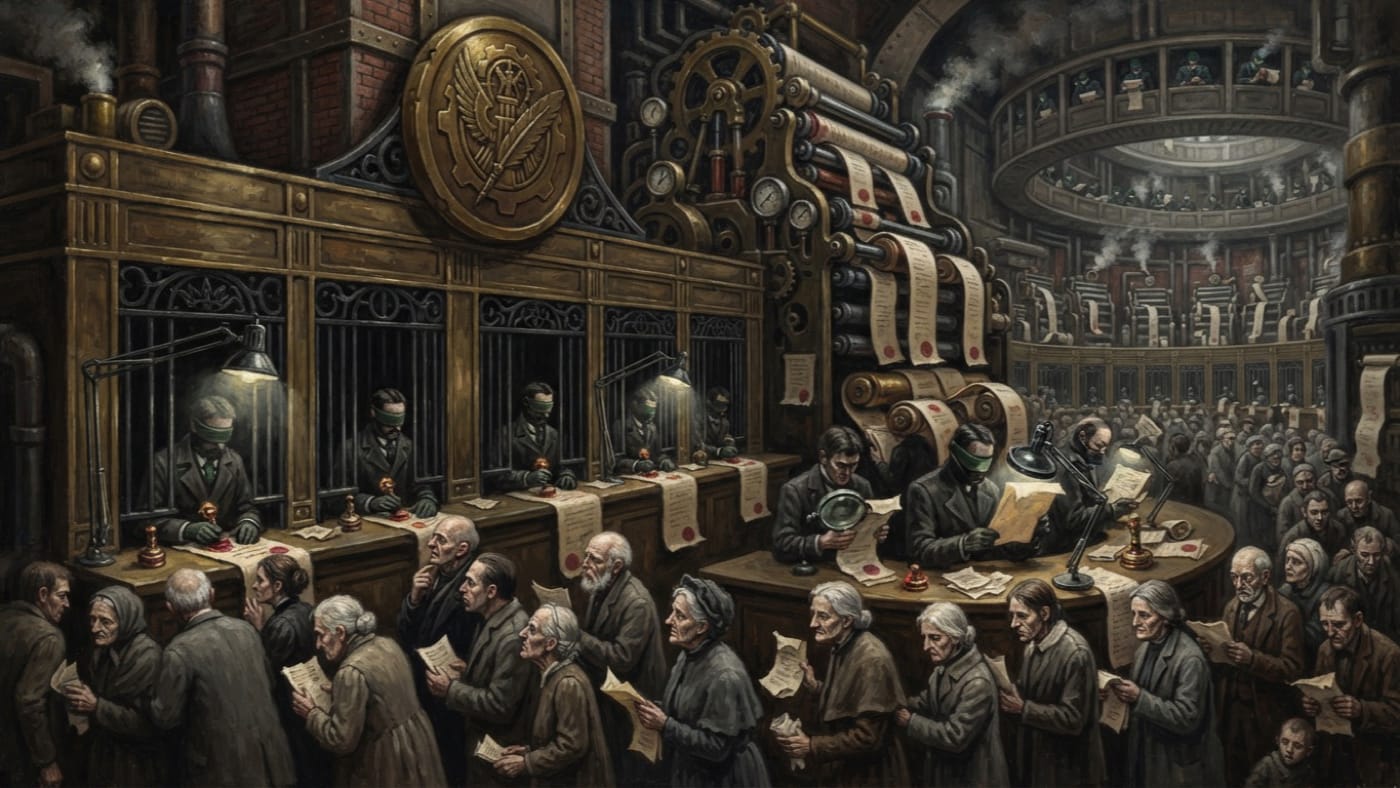
The effects are concrete. At the ration window, the clerk consults the column before he consults the face. At the gate, the warden reads the passage writ, holds it to the light, and looks at the bearer last, if at all. A tenancy is a line in a residency roll. A work assignment is a stamped slip. A burial requires a certificate, and a corpse without one stays where it lies until the paper arrives. My colleagues among the Records Scribes have a saying, which I have heard in three registry houses and several taverns: paper is citizenship. They are correct. A man with a lost writ has a body and no standing. A man with a sealed writ can lack a pulse and still hold the lease on his rooms.
I have watched petitioners argue with a register. Some weep and some bring witnesses. One brought his mother, who swore he was alive. The clerk recorded her testimony in the correspondence file, where it was handled with every courtesy and had no effect whatsoever.
#On the Approved Precedent
Every doctrine needs a scripture of its own, and the Sovereignty's is the Night of Black Decrees in A.S. 58.
Kratz, the Quill of Strasbourg, sent writs and accessions through the jurisdictions that the emerging Church authority could already reach. Some of that paper was sound. Some was of disputed provenance then and remains so now, and the Ledger preserves irregularities that a less loyal archivist might call obvious. The writs were obeyed. Their obedience made them operative. Doctrine teaches the episode as a miracle of governance, and I have taught it that way myself, at length, with gestures.
The chronology needs one correction that the catechism prefers to leave out. In A.S. 58 there was no constitutional Synod to which a seal could be sovereign. That body came with the Concordat of Strasbourg in A.S. 90, after Kratz and Augustinus were both in the ground. The Night of Black Decrees is therefore precedent and should not be read as promulgation. It showed what paper could do before anyone had written down that paper was allowed to do it. The formal doctrine came later, and its first author and first day are unrecorded.
#On the Unauthorised Impression
The seal-forger lives inside the doctrine's one unguarded clause.
Her craft is credible proof: a cut die, a practised signature, paper of the right weight and fibre, wax that fractures properly under the thumbnail. The higher practitioners rarely touch wax at all. The Registry Shadow bribes a low clerk to enter a single cross-reference in a minor ledger, so the counterfeit writ arrives with a history behind it. The Synod authenticates a document by checking it against another document. The Shadow writes the other document.
Three moments must be kept separate, though the Bureaus prefer to blur them. The impression appears genuine. The impression is accepted. The impression is later discovered and the maker punished. Between the second moment and the third, a forged passage writ opens the same gate as an honest one. A forged ration slip draws the same bread, and a forged burial certificate puts a body in the same consecrated ground.
I have written, and the Bureau of Doctrine has quoted me on it, that an impression accepted under the inspector's lamp is, from the hour of acceptance, genuine. The sentence follows from the Canon. If the Seal makes paper into scripture, the Seal does not ask whose hand held the die.
The Bureau of Masks and Seals rejects such paper anyway, and the Bureau of Purity punishes its maker. Both practices are canonical. I enforce both of them.
The forger's clients include refugees whose natal writs burned with their parish, widows whose husbands' deaths were never certified, and children born outside any roll. They also include smugglers, deserters and the occasional murderer who needs a clean name. The die serves them all equally. By my own count, I have signed erasure warrants for eleven seal-forgers, and their work fed, housed and buried roughly six thousand people whom the registers had declared administratively absent. I counted those six thousand because counting is my office. The warrants I signed because signing is also my office.
#On the Audit
The doctrine's other face appears when an impression is found wanting. The Sovereignty does not punish the die. It punishes the paper, and paper always has a holder.
In A.S. 188, in the Strasbourg docklands, a Bureau crest die chipped and was re-cut. Whoever re-cut it, licensed or otherwise, cut the replacement stroke a little deeper on the left of the crest. Forty-seven convoy clearances carried that deeper stroke. The Sigil Inspectors found it, as they are paid to find such things, and traced it batch by batch, because a die repeats its faults faithfully.
The investigation lasted four months and used three Inspectors. It suspended the livelihoods of two hundred and fourteen dockworkers who had presented those clearances in good faith, because the clearances had been issued to them and they had no other kind. Under the Canon, a holder cannot claim the honesty of his own hands against a fault in the impression. The writ had been sovereign while it was accepted. Once it was doubted, its doubt passed to the men who carried it.
Eleven were immured. The maker of the die was never found.
Those eleven should not be confused with the eleven forgers whose warrants I signed. Mine had cut dies and were caught. The dockworkers had carried paper. Same number, different crime.
#On the Present Application
In A.S. 201 the Sovereignty is administered every morning at the registry windows of Strasbourg, in the shadow of the Cathedral, and at a thousand lesser windows. The queues begin before the bells. A woman brings a husband's death certificate that Records will not issue. A man brings his own birth, which a fire has erased. A child brings nothing and is sent to the end of a different line. A clerk dips his pen and the morning's realities are settled one column at a time.
I sit above those windows in the Sacred Ledger and certify the columns. I defend the doctrine because it works. Witnesses quarrel, and wax does not. Without the Seal, each of these petitioners would have to be believed or disbelieved on their face, and the Synod has neither the clerks nor the patience for faces. I admire a good forgery the way a cantor admires a stranger's pitch. Then I sign what is put in front of me, and the stranger is bricked up.
The Bureau of Doctrine has reviewed this entry and required the following correction before it may be shelved.
ERRATUM — BUREAU OF DOCTRINE
"An impression accepted under the inspector's lamp is, from the hour of acceptance, genuine."