
#On the Premise
"That which bears no seal bears no authority. That which bears a false seal bears a sentence." — Archon Casselius of Mainz, addressing the Seal-Cutters' Guild, A.S. 194
Let the unlettered suppose that power is a question of armies, or faith, or gold. Let them suppose what they wish. The Synod does not function because soldiers patrol its borders, or because the bells command its hours, or because the Bureau of Doctrine has persuaded the populace that obedience is theology. The Synod functions because every writ, every decree, every ration chit and marriage certificate and execution order and flour requisition carries, pressed into its wax or stamped into its margin, a small and unremarkable impression that says: this is real.
The Bureau of Masks and Seals makes that impression.
Without it, the Bureau of Tithes collects scraps of paper. Without it, the Bureau of Oaths records breath. Without it, the Bureau of Records catalogues rumour. Every Bureau in the Synod — all twelve named in the charter, and the dozen-odd unnamed offices that proliferate in the corridors between them — depends, at the final step of every transaction, on a piece of stamped wax or an inked impression that the Bureau of Masks and Seals has cut, catalogued, distributed, and — should the need arise — revoked.
#On the Founding and the Charter
The Bureau of Masks and Seals was constituted in A.S. 92, alongside the other Holy Bureaus, in the great administrative parturition that followed the Concordat of Strasbourg. Its charter — Article Seventeen of the Founding Instruments, paragraph nine, sub-clause three — defines its remit with the precision one expects of an institution whose entire purpose is precision: "The Bureau shall control, manufacture, distribute, authenticate, and retire all official stamps, seals, counter-seals, sigillary dies, reliquary authentication marks, mask licenses, public emblem permits, and notarial instruments employed by any Bureau, office, or ecclesiastical authority operating under the jurisdiction of the Holy Synod."
That sentence is forty-seven words long. It contains the entire Synod.
For what is the Synod, stripped to its iron bones? Paper. Ink. Wax. The impression that says a document is genuine. Without the Bureau, the whole apparatus reduces to men in vestments shouting instructions that no one is obliged to obey. With it, those instructions acquire the force of stamped law — and stamped law, in the Synod, carries the weight of scripture.
The Bureau's first Archon was one Sigmund of Aachen, a former die-cutter for the pre-Sundering coinage of the Rhineland, who is remembered for two things: his insistence that every seal-die be tested by pressing it into the flesh of its maker's thumb before being approved for service, and his death in A.S. 107 from lead poisoning contracted through decades of handling seal-wax. His thumb-print remains on file. The Bureau, characteristically, has authenticated it.
#On the Counter-Seal and Why Nothing Is Real Without It
The central instrument of the Bureau's authority is the counter-seal: a secondary impression applied to any document that has already been sealed by its issuing Bureau. The principle is simple to state and staggering in its implications. No Bureau may authenticate its own documents. The Bureau of Doctrine drafts a decree; its own seal renders it proposed. Only the counter-seal of the Bureau of Masks and Seals renders it enacted. The Bureau of War issues a mobilisation order; its seal renders it intended. Only the counter-stamp renders it binding. A death warrant from the Bureau of Purity without the counter-seal is, in the Bureau's official classification, "a strongly worded suggestion."
This system was Sigmund's invention. He understood — as a die-cutter understands — that the value of a coin lies in the stamp, and a stamp's value lies in the monopoly. If every Bureau controls its own instruments of authentication, then authentication means nothing: any clerk with access to the wax can produce a valid document. If one Bureau controls all instruments, then every other Bureau must pass through its gate.
The gate is narrow. The Bureau of Masks and Seals maintains, at last census, 4,714 active seal-dies across the Synod's territories. Each die is registered, numbered, weighed quarterly, and — once per annum — tested against a master impression stored in the Archive of the Counter-Seal beneath the Cathedral of Strasbourg. A die that has deformed by more than one-sixteenth of a hair's breadth is retired, melted, and recast. The old die is filed under "Retired Instruments, Metallurgical Archive" and may not be viewed without Archonal permission.
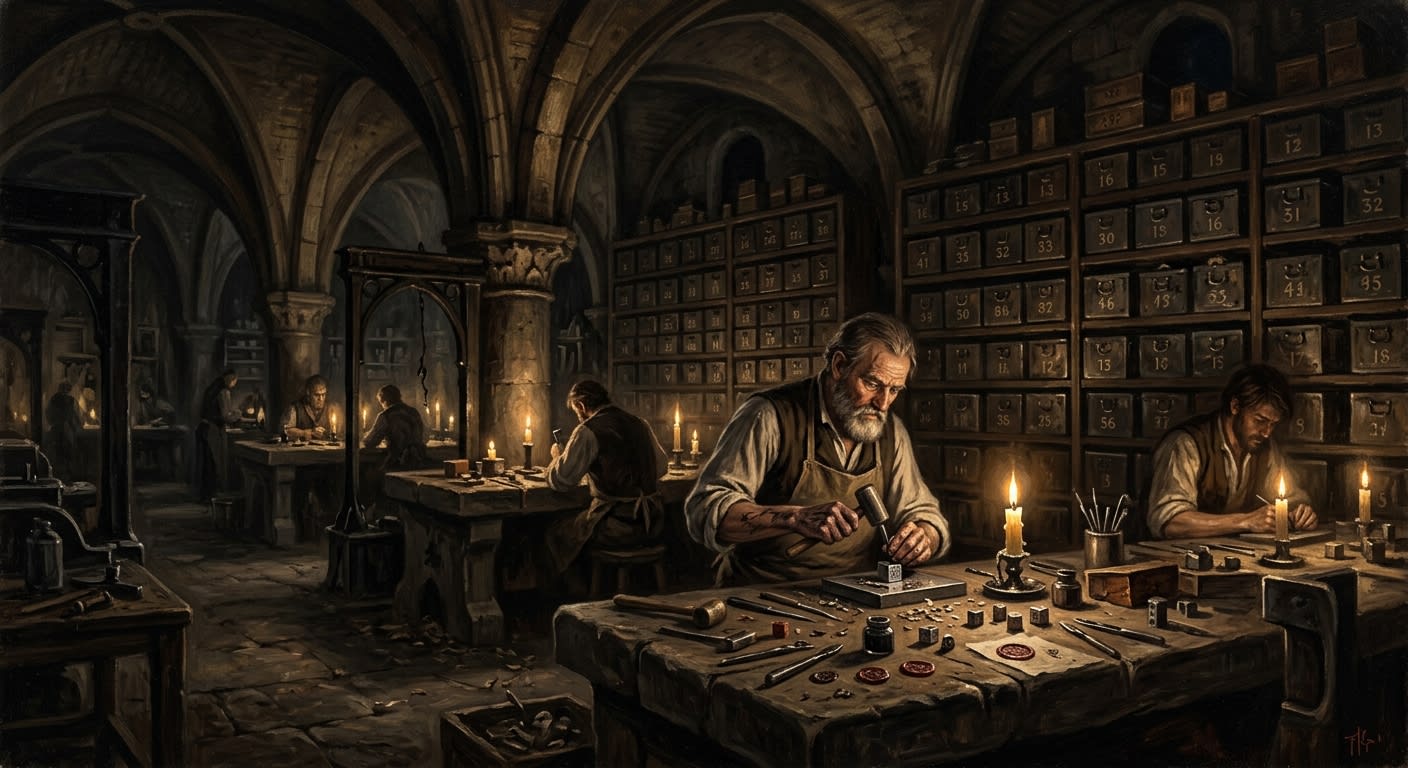
The die-cutters who produce these instruments are sworn to the Bureau by oaths so thorough that the Bureau of Oaths has twice complained of jurisdictional overlap. They work in sealed workshops — the Sigillary, housed in the eastern cloister of the Cathedral complex in Strasbourg — under conditions that the Bureau of Engineering has described as "adequate" and the die-cutters themselves have described using vocabulary that the Bureau of Silence has classified.
#On the Mask Licenses and Their Theology
The Bureau's second great instrument — and the source of its name's first half — is the Mask License. Masks are forbidden in the Synod's territories. The face is a confession: it declares the wearer's identity to every clerk, guard, and informant who glances at it, and to conceal the face is to conceal the self, which is to conceal the soul, which is — per the Bureau of Doctrine's Standing Catechism, Article Fourteen — an act of spiritual fraud.
Masks are also, on certain licensed occasions, required.
The Bureau of Festivals mandates masked processions on the Feast of the Departed Flames, the Night of Penitents, and the Carnival of the Triune Knot. The Bureau of Purity employs veiled interrogators. The Bureau of Shadows — which does not exist — issues face-coverings to operatives who also do not exist. The Inquisition's White-Mantled Inquisitors wear ceremonial visors during tribunals. And every citizen of the Synod is, on the Feast of Buried Names, expected to don a plain white cloth mask and process through their parish in silence — an act of "collective anonymity before the Creator" that the Bureau of Doctrine has declared "theologically necessary" and the Bureau of Purity has declared "a security liability of the first order."
The Bureau of Masks and Seals resolves this contradiction by licensing it. Every mask worn in the Synod's territories — from the gilded visor of a Hierarch to the sackcloth hood of a flagellant — must be registered, stamped, and assigned a licence number. The licence specifies the occasion, the duration, the permitted design, and — in a detail that Casselius personally insisted upon — the precise dimensions of the eye-holes. An eye-hole wider than the licensed specification renders the mask "an instrument of surveillance rather than devotion" and subjects the wearer to confiscation and fine.
In Ghent, an entire theatrical troupe once performed in masks depicting the faces of Rationalist philosophers. The masks were licensed — the troupe had filed for "comedic visages, historical, satirical." The Bureau had approved the filing. What the Bureau had not anticipated was the quality of the likeness. The masks were seized mid-performance. The actors were nailed to the stage with their own papier-mâché visages and burned as both heretics and entertainers. The Ghent Theatre Guild has petitioned annually since A.S. 178 for "clarification of the boundary between satire and sedition." The petition remains under review.
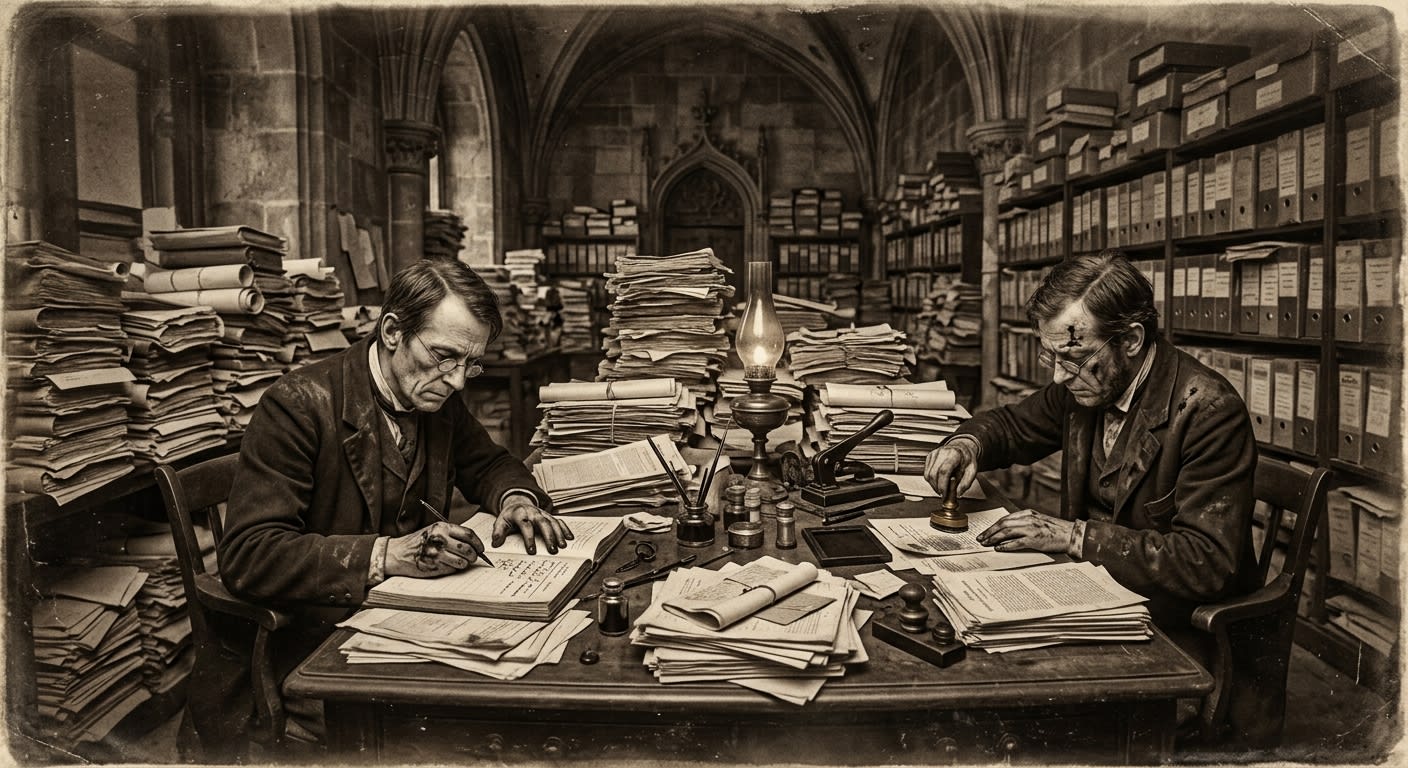
The mask licence system generates an extraordinary volume of paperwork. At last count, the Bureau processes approximately eleven thousand mask applications per annum — a figure that spikes dramatically during the Feast of Buried Names, when every parish submits bulk applications for its congregants. The applications are filed in the Mask Registry, a sub-archive of the Bureau's central vaults, which occupies three floors of the Cathedral's eastern transept and employs fourteen full-time archivists whose sole task is to ensure that no two licensed masks within the same parish share identical eye-hole dimensions.
ERRATUM — A.S. 199 — Mask Registry Audit
A routine audit of the Mask Registry revealed 2,311 active licences for masks described as "blank, featureless, white, no distinguishing marks." The Bureau has been unable to determine whether these licences correspond to devotional masks for the Feast of Buried Names or to the operational equipment of the Bureau of Shadows. A request for clarification was submitted to both offices. The Bureau of Festivals replied that the masks were liturgical. The Bureau of Shadows did not reply. The Bureau has filed the discrepancy under "Resolved by Silence."
#On the Sigillary and Its Inhabitants
The Sigillary is the Bureau's beating heart — a warren of sealed workshops, metallurgical laboratories, and wax-curing chambers built into the eastern cloister of the Cathedral of Strasbourg, extending three levels below ground into what the Bureau of Engineering classifies as "the old foundations" and what the die-cutters call "the Sweat." Here, in workshops lit by tallow candles — oil lamps being forbidden near the wax stores — the Bureau's die-cutters, engravers, wax-masters, and seal-testers produce the instruments that authenticate every document the Synod generates.
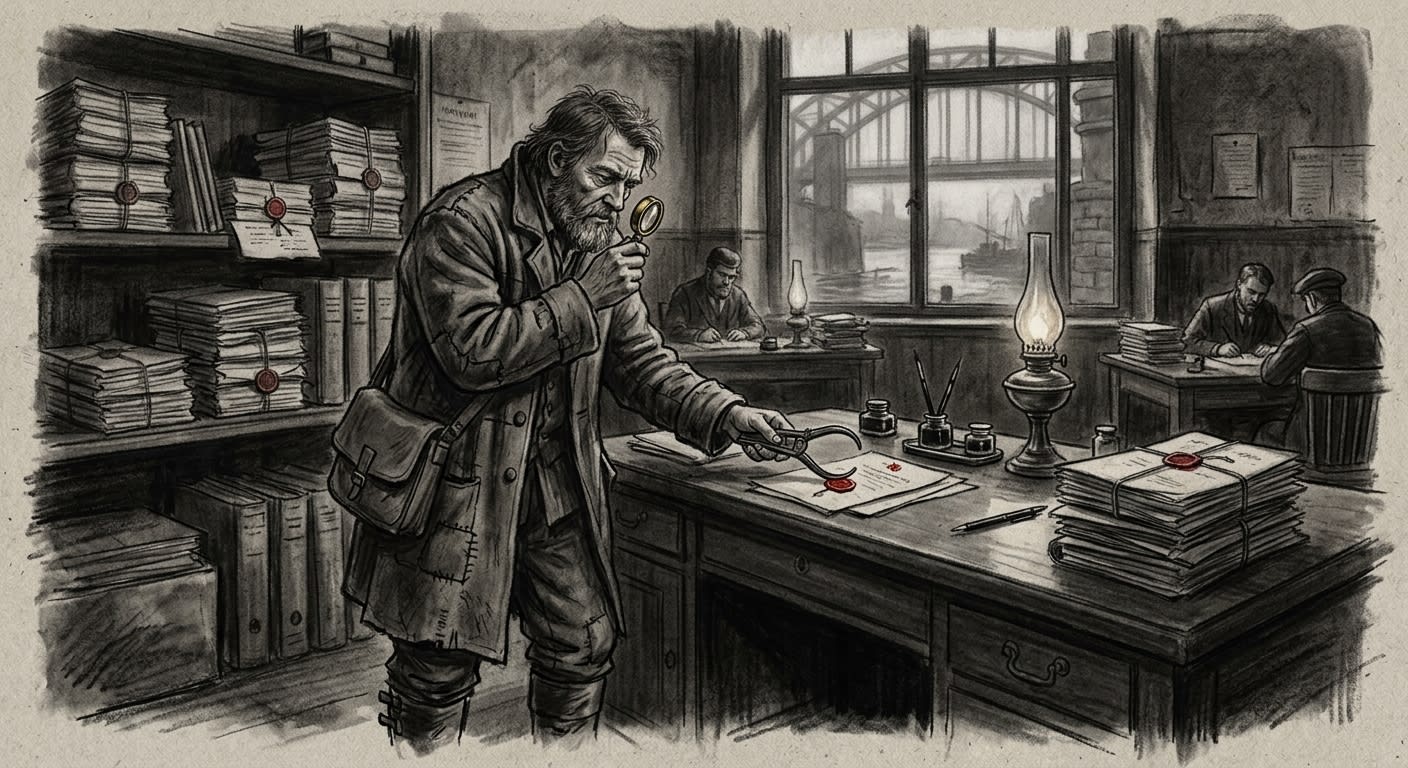
The work is exacting. A seal-die must reproduce its master impression to tolerances that the Bureau measures in fractions of a hair's breadth, using callipers manufactured by the Bureau of Engineering to specifications that the Bureau of Masks and Seals supplied. The wax must be of a specific composition — beeswax, pine resin, and a mineral pigment whose formula is classified — and must be heated to a temperature range so narrow that the wax-masters judge it by touch, having been trained since apprenticeship to detect the precise moment when the wax transitions from "compliant" to "volatile." Three wax-masters have been killed in the Sigillary since A.S. 172. The Bureau classifies these deaths as "occupational" and the victims as "instruments retired in service."
The die-cutters are a guild unto themselves — the Guild of the Anvil and Stylet, chartered under the Bureau's authority since A.S. 105 and exempt from the jurisdictions of both the Bureau of Oaths and the ordinary craft-guild structures. They take a separate oath — not to the Synod, but to the die. "I serve the impression," runs the oath's opening. "The impression serves the Synod. I do not serve the Synod directly, for intermediaries are the Bureau's theology." This theological position has been challenged by the Bureau of Doctrine on three occasions. On each occasion, the Bureau of Masks and Seals counter-sealed the challenge and filed it.
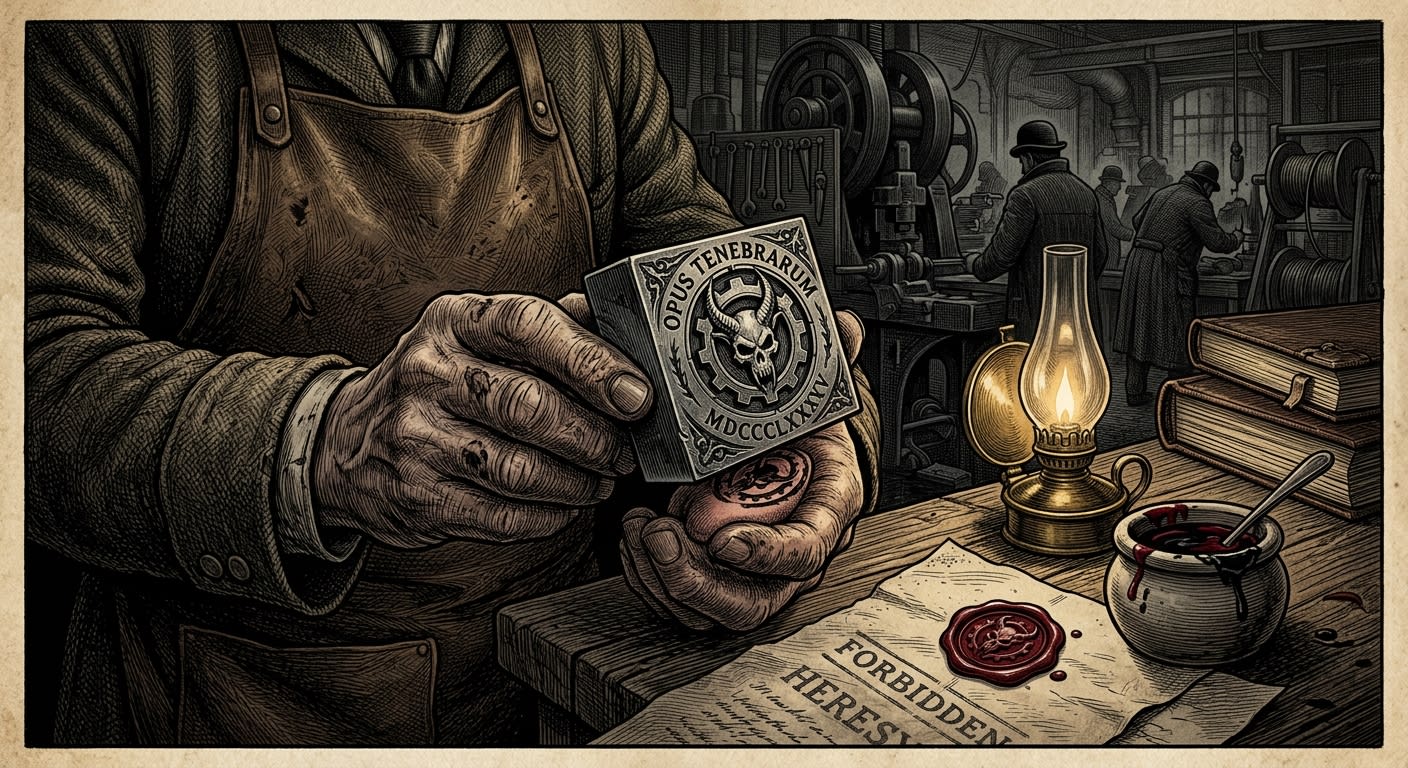
The Sigillary also houses the Bureau's most sensitive operation: the Retirement Furnace, where revoked seal-dies are melted. A die is revoked when it wears past tolerance, when the Bureau or office it serves is dissolved, or when the seal has been compromised — forged, duplicated, or "captured by hostile parties," a phrase that covers everything from enemy action to a clerk leaving his stamp on a tavern table. The melting is witnessed by three Bureau officers and recorded in triplicate. The molten metal is stored in numbered ingots. Nothing is wasted. Nothing is forgotten. The Bureau keeps a ledger of every seal it has ever destroyed, cross-referenced to every document that seal ever authenticated. The ledger runs to forty-seven volumes. Casselius reads it for pleasure.
#On the Relationship with the Bureau of Heraldry
The Bureau of Heraldry decides what the Synod may display. The Bureau of Masks and Seals ensures that what is displayed can be verified. The distinction is, in theory, straightforward: Heraldry governs meaning; Masks and Seals governs material. Heraldry says whether the crimson boar of Saxony may appear on a banner; Masks and Seals cuts the stamp that authenticates the banner's production licence.
In practice, the two Bureaus have been fused at the hip since the appointment of Archon Casselius of Mainz, who holds both offices in personal union — a situation the Bureau of Records has classified as "irregular but not prohibited" and the Bureau of Doctrine has classified as "convenient." The arrangement persists because the A.S. 92 charter lists them as separate entities, and the Bureau of Records refuses to consolidate filing numbers without a Hierarchal decree. The decree has been "in committee" since A.S. 147. The committee has met twice. Both meetings were adjourned for procedural reasons that the Bureau of Records has stamped "ADEQUATE."
Casselius, as a consequence, controls both the vocabulary of the Synod's visual language and the instruments that print it. He governs the Armorial of the Faithful — 347,211 registered symbols — and the Sigillary that produces the stamps authenticating every one of them. He is the Synod's mouth and its printing press. He decides what may be said and manufactures the only proof that it was said with authority.
If this concentration of symbolic power in a single pair of ink-stained hands alarms anyone, they have kept admirably silent — which is sensible, because the Bureau of Masks and Seals also controls the stamps that authenticate formal complaints.
#On the Counter-Seal Crisis of A.S. 178
In the autumn of A.S. 178, a clerk in the Bureau of Tithes' Rhine corridor office discovered that the counter-seal on a grain requisition did not match the master impression on file. The discrepancy was minute — a fraction of a fraction, visible only under magnification. The clerk, whose name the Bureau of Records has since reclassified as "administratively redundant," reported the discrepancy. An investigation followed.
The investigation discovered that seventeen counter-seals distributed to Rhine corridor offices in A.S. 176 had been cut from a master die that had deformed during casting — a bubble in the alloy, invisible to the naked eye, that had introduced a consistent error into every impression. For two years, every document counter-sealed by those seventeen instruments had been, in the Bureau's strict interpretation, unsigned. Grain requisitions. Tithe assessments. Marriage certificates. Three execution warrants, all carried out. Four property confiscations, all completed. A military deployment order that had moved two regiments across the Rhineland.
The Bureau's response was characteristic. Retroactive Authentication Order 178-A declared that all documents counter-sealed by the defective instruments were to be treated as "provisionally authenticated pending retrospective counter-stamping." Teams of Bureau officers were dispatched to every office in the Rhine corridor to re-stamp two years of documentation. The process took fourteen months. The clerk who discovered the error was commended, promoted, and transferred to the Mask Registry — a lateral move that the Bureau described as "recognition of exceptional diligence" and the clerk described, to his wife, as "exile."
The A.S. 178 crisis produced two lasting reforms. First, every master die is now tested by three independent die-cutters before distribution, with each test impression filed separately and cross-compared by a fourth officer who may not communicate with the first three. Second, the Bureau instituted the Annual Die Audit — a comprehensive inspection of every active seal-die in the Synod's territories, conducted by travelling auditors called Seal-Walkers, who are among the most hated minor functionaries in the Synod's employ.
The Seal-Walkers arrive without warning. They carry callipers, magnification lenses, master impression sheets, and a writ of access that — naturally — bears the Bureau's own counter-seal. They measure. They compare. They note. They do not converse. A Seal-Walker who enters a Bureau office is treated with the same enthusiasm as a case of dysentery: everyone knows it will pass, everyone knows it will be unpleasant, and everyone prays it happens to the office down the corridor instead.
#On Forgeries and the Bureau's War Against Them
The Bureau of Masks and Seals exists, in its most essential function, to make forgery impossible. It has failed. Forgery is the Synod's second-oldest profession — the first being bureaucracy itself — and for every counter-seal the Bureau cuts, someone, somewhere, is attempting to replicate it.
The Bureau maintains a Forgery Archive: a sealed collection of every counterfeit seal, forged stamp, and fraudulent wax impression confiscated since A.S. 92. The archive occupies an entire wing of the Sigillary's sub-basement and is, by the Bureau's own grudging admission, "extensive." The forgeries range from crude — a carved potato pressed into candle-tallow, recovered from a Queue Road checkpoint in A.S. 140 — to disturbingly sophisticated. In A.S. 195, a forger in Cologne produced counter-seals so precise that they passed three levels of inspection before a Seal-Walker detected the discrepancy: the forger had used a pine-resin ratio two parts per thousand off the classified formula. The forger was executed. His tools were confiscated. His workshop was sealed by the Bureau of Purity. His forgeries — ninety-three documents authenticated with perfect false counter-seals — were retroactively re-stamped by the Bureau under Retroactive Authentication Order 195-C.
ERRATUM — A.S. 195 — Cologne Forgery Incident
The Bureau wishes to clarify that the ninety-three documents authenticated by the Cologne forger included no documents of theological or military significance. The documents were primarily commercial — grain futures, shipping manifests, and one marriage certificate. The marriage has been retroactively authenticated and is considered valid. The couple has been informed.
The Bureau's forgery countermeasures are layered. The wax formula is classified. The die-alloy composition is classified. The dimensions of the counter-seal impression — the depth of the cut, the width of the border, the angle of the lettering — are classified. The testing protocols are classified. The identity of the Seal-Walkers is classified — they travel under assumed names, which the Bureau of Oaths has reluctantly counter-sealed.
And still the forgeries come. The Black Ledger produces passable counter-seals for ration documents. The Underchords at Bastion-Irongate traffic in counterfeit licence stamps. The Velvet Choir has, on at least two confirmed occasions, produced counter-seals of such quality that the Bureau suspects access to classified materials — a suspicion it has shared with the Bureau of Purity, which has responded by placing the Bureau of Masks and Seals itself under "routine observation."
#On the Reliquary Sigils and Their Peculiar Difficulty
Beyond writs and masks, the Bureau authenticates a third category of object: relics. Every relic in the Synod's custody — and the Bureau of Relics claims custody of approximately 14,000 authenticated items, though the actual count is disputed — bears a reliquary sigil: a small stamped impression in the reliquary casing that identifies the relic, its classification, and its chain of custody.
The reliquary sigil is the Bureau of Masks and Seals' most delicate product. The die must be cut to accommodate the curves of the reliquary surface. The wax must adhere to metal, bone, or crystal without damaging the relic beneath. The impression must be legible under conditions ranging from the controlled vaults of the Cathedral of Strasbourg to the trench reliquary niches of the Sagittal Line, where rain, mud, and occasional enemy fire are standard environmental factors.
The Bureau employs a specialist sub-guild for this work: the Reliquary Sigillators, a cadre of nine die-cutters whose tools are consecrated by the Bureau of Rites before use and whose work is inspected by the Bureau of Relics after completion. The process for authenticating a single relic involves the Bureau of Relics (classification), the Bureau of Rites (consecration of tools), the Bureau of Masks and Seals (cutting and application of the sigil), and the Bureau of Records (filing the authentication certificate). Four Bureaus to stamp a bone.
The difficulty — which the Bureau acknowledges in internal memoranda and denies in all public statements — is that relics resist authentication. The seventeen femurs of Saint Aldebrand in Cologne each bear a reliquary sigil. Each sigil authenticates the femur as genuine. Each sigil was applied by a different Sigillator in a different year. The Bureau's position is that all seventeen femurs are authentic, because all seventeen bear its seal, and the seal is the authentication. The arithmetic is the Bureau of Relics' problem.
More troublingly, certain relics damage the sigils applied to them. The Reliquary of the Siege of Vienna has had its sigil reapplied four times since A.S. 104; the wax melts. The bone fragments in the Third Ossuary carry sigils that the Sigillators applied in A.S. 92 and that have not degraded at all — a stability the Bureau of Engineering calls "metallurgically implausible" and the Bureau of Masks and Seals calls "adequate." A relic recovered from the Gilded Chasm in A.S. 194 arrived at the Sigillary already bearing a sigil in the Bureau's own format, applied by no known Sigillator, using wax of the classified formula. The die-cutters inspected it, compared it to their records, and filed it under "Pre-Authenticated, Origin Unknown." Casselius, upon reviewing the file, added a single marginal note: "Do not inquire further."
#On the Present Condition
The Bureau of Masks and Seals, as of A.S. 201, employs 412 officers, die-cutters, Sigillators, Seal-Walkers, and archivists across its Strasbourg headquarters and seven regional sub-offices. It maintains 4,714 active seal-dies, processes approximately 340,000 counter-seal applications per annum, and licenses roughly 11,000 masks. Its Forgery Archive contains 8,917 confiscated items. Its Retirement Furnace has consumed 12,443 revoked dies since A.S. 92. Its Mask Registry fills three floors. Its Counter-Seal Registry fills seven.
The Bureau does not make policy. It does not command armies. It does not preach sermons or burn heretics or collect taxes or map the enemy's territories. It performs a single, unremarkable function: it presses a small impression into warm wax, and that impression makes the paper beneath it real.
Every order the Hierarchs give, every treaty the diplomats sign, every death the Inquisition administers, every bell the Bureau of Bells schedules, every name the Bureau of Records enters into the Great Ledger of Souls — all of it, all of it, depends at its final moment on a small circle of wax and the die that struck it.
Casselius understands this. He has understood it since Sigmund of Aachen pressed his thumb into the first test impression in A.S. 92 and declared: "If the stamp is good, the world is good. If the stamp is false, nothing is."
The stamp is good. The Bureau has verified it.