

#On the Stamp That Makes Paper True
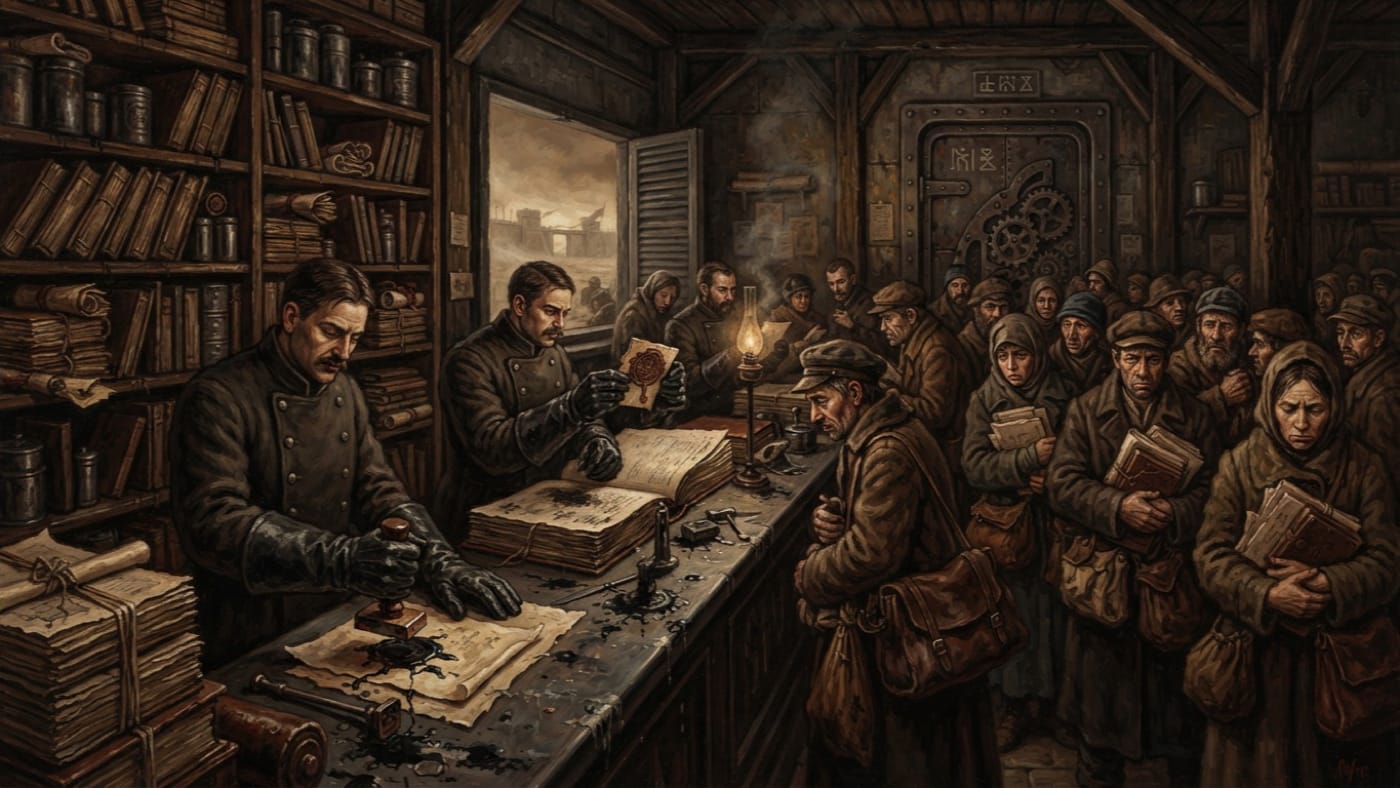
At the Steppe Gate, a document starts out as an opinion. A clerk in black wax gloves takes it across the counter and reads the seal field against the house register. Then the clerk warms a measure of tallow-wax until it slumps and brings down the iron. The thud carries to the back of the queue. The opinion is now an instrument, and instruments move caravans.
The Seal-Houses perform that conversion. They crowd Seal-House Row, a lane of limestone, rust-iron hinges and hide-lashed timber. It smells of wax smoke and iron in every season, and of scorched grit in the dry ones. The Seal-House Consortium holds the legal monopoly on stamping. The houses are where that monopoly gets a counter, a ledger and an opening hour. Travellers do not petition a guild. They hand their papers to a glove.
The Synod's doctrine on the matter is settled and, I am pleased to report, mine. Under the Sovereignty of the Seal, a sealed writ outranks ten thousand witnesses, for the seal sanctifies paper into scripture. Records keeps the principle and I preach it to the provinces with full confidence. At the Gate it acquires a coarser corollary. The stamp does not alter the road, the weather or the grammar of the Triune Alphabet. It alters whether the patrol lets you onto the road at all.
#On the Papers and the Queue
The Row certifies the paper the Gate's whole economy runs on: passage writs, escort contracts, dialect attestations, witness seals, caravan manifests, clause slips and pronunciation certificates. Each answers a different suspicion. A passage writ answers where may this caravan go. An escort contract answers who has been paid to keep it alive. The dialect attestation and the pronunciation certificate answer the question peculiar to this town, can these mouths survive the clauses they are about to speak. The witness seal answers who will swear to all of it afterwards.
The house answers none of these questions itself. Its competence is narrower and more profitable. A translator-scribe renders the clause, a phoneme guide drills the tongue, and an arbiter of the Caravan Court decides what the clause means when two parties disagree. The Seal-House certifies that the paper is what it claims to be. It must come from a hand entitled to issue it, and its wax must come from where wax ought to come from. That is authenticity and nothing more, and nobody at the Gate can do without it.
The queue is the house's true façade. It holds caravan factors with bundled manifests, wranglers with mules that resent the smell of hot wax, and brokers selling places nearer the counter. Further back stand the refugees from the Ditch Gate intake ledger, who have the least paper and the most need of it. Food, salt and military supply pass through the Gate only on lawful documents, and so do the town and the garrisons beyond it. A day's delay at the counter is a day's water bought at Gate prices. A refused stamp means a caravan turned around on the open steppe.
Those who cannot pay take on clause debt, and owed clauses compound. Default ends in labour conscription or tongue service, which is forced scribing. The houses' poorest clients often come back to the Row as copyists of the papers they could not afford. The Gate's class ladder puts seal-holders at the top and refugees and indentures at the bottom. The Row is the rung between, and it is greased.
#On the Monopoly and Its Excuse
The Treaty-Stones were raised in A.S. 76 at the narrowest ridge gap of the eastern steppe, to end caravan wars with enforceable clauses. In A.S. 94 came the Red Pronunciation: one misreading in court, and roughly a thousand throats closed in a single night. In the aftermath the Consortium was formed and the stamping monopoly made legal. The argument was simple and, I concede, sound. If one bad reading could kill a thousand people, the Gate could not afford a thousand unregulated stamps.
The Consortium's public charge is therefore security against fraud. Its practical charge is movement itself. These are one charge seen from opposite sides of the counter, which is why the excuse has never needed revising. The town's own record lists its methods with commendable candour: wax, iron, bribes. Formal government at the Gate rests on the Treaty Office, the Caravan Court and Patrol Command, and votes there are weighted by seal-holdings. The houses need no seat at the table, since they own its legs.
The real government is split three ways. High Arbiter Senn Vark holds the precedent books and fears the one wrong ruling that brings down a cascade of clause-spirits. Captain Rho Balesh holds the patrol chokepoints and the escorts, and fears that the caravans will reroute and starve the town. Seal-Mistress Ylena Korr holds the stamping bottleneck. Her fingers are always wax-stained and her eyes are always counting. What she fears is a flood of counterfeits.
Vark judges, Balesh enforces and Korr certifies. None of the three can act without the other two. The Synod calls this arrangement balance. The caravans call it the toll.
#On Counterfeits and the Wind
Fraud at the Gate takes familiar shapes. Stolen seals are sold on the black market alongside forged addenda and blank witness seals. Seal-cutters make stamps that almost match, and they do it on purpose. A near match gets past a tired clerk at dusk, while a perfect copy draws an auditor. An honest frontage proves nothing on the Row, because a legitimate counter has hidden a counterfeit workshop behind it before now. Seal theft and identity fraud sit high on the Gate's register of crimes, and seal-house lockdowns are part of the town's defence doctrine. A forged seal is a matter for the house. A forged doctrine belongs to Purity, and the Row is glad of the division.
Against all this the houses have the one examiner the steppe provides free of charge. The wind reads seals. In certain gusts forged wax smells wrong, and the Gate has a word for the smell of legitimacy: seal-scent. A good house clerk works with the shutter open. Korr keeps hers open in weather that would close a chancery. Lightning, I note for completeness, strikes metal seals first, which is the steppe's own opinion of the trade.
The whole apparatus rests on one distinction: genuine against false. A forgery borrows authority it does not have, and the house exists to catch the borrowing. That distinction served the Row for a hundred years. Then the Archive began to write.
#On the Living Addenda and the Revised Schedule
In A.S. 194 a folio appeared in the Fourth Vault of the Burnless Archive. It amended a passage writ of A.S. 118 and imposed a toll retroactively across seventy-six years. Its seals were genuine and its ink was the Archive's own. Three of its four witnesses were dead. By A.S. 201 the Living Addenda arrive about twice a week. The Paper Keepers isolate each one and send it upward. They amend exactly the papers the Row certifies: passage writs, toll schedules, escort contracts and witness lists.
Earlier memoranda described the Addenda as “forgeries of uncertain provenance.”
Withdrawn, with the Bureau of Doctrine's classification. A forgery imitates authority. The Addenda have authority before any living hand concedes the point. For the Row the consequence is clerical and exact: they no longer fit in the forgery column of any verification register.
High Arbiter Vark settled the law. An amendment that satisfies form binds, whoever or whatever wrote it. The Court's abstract lists the conditions as witness blocks, seal authenticity, pronunciation key and archive mark. The second condition falls to the Row. Each Addendum needs its own fresh seal verification. No house will certify one folio on the strength of the last, and no arbiter would let it try.
Korr tripled certification fees. The Synod has heard this called profiteering. I call it pricing. Each folio requires a full examination of a seal that every available instrument finds genuine, attached to an amendment that every available register says has no author. The house is paid to confirm what it cannot explain. It is paid first, and it is paid every time.
That is the controversy. An institution that sells protection against false authority now sells verification of true authority that comes from nowhere. The Consortium's excuse depends on fraud being the enemy. The Addenda are the counterfeit flood Korr feared, arriving in the one form her houses cannot refuse: genuine. Nothing in the record shows that the Row writes them, wants them or knows who does. The record shows only that it profits from them. In a border town that is a different sin, and a cheaper one.
The Third Stone's southern-face rubbing vanished in A.S. 199. Since then a blank folio has lain in the Archive, its ink wet and its page empty. If it ever fills, it will come up from the cutbank to a counter on the Row. A gloved clerk will warm the wax, examine the seal and name the fee.