

#On the Precinct and Its Uses
The Spire Precinct is the quarter of Ulm that the city shows to pilgrims first and to students most often. Four things in it are worth filing: the cathedral, its bells, a reliquary chapel, and a public stone where recanting professors kneel during examination week. Everything else in the quarter exists to serve one of those four or to get in their way. That includes the paving, the sacristy doors, the clerks' benches and the pigeons.
The spire governs the view from every other part of the city. A pressman in the Press Yards can lift his head from the lampblack and find it. A lecturer in the doctrinal colleges can find it from his window, and the Bureau encourages him to look. Ulm raised the tower over generations of builders, patrons and interruptions. The Church has since found a use for it that the masons never planned. Every former heretic in the city has to look up at it.
Worship has the nave. Civic pride has the tower, where it has always lived and where the Bureau allows it to stay on a short lead. Public correction has the stone. All three share one precinct, and on the busiest days of the academic year they share one crowd.
#On the Stone of Recantation
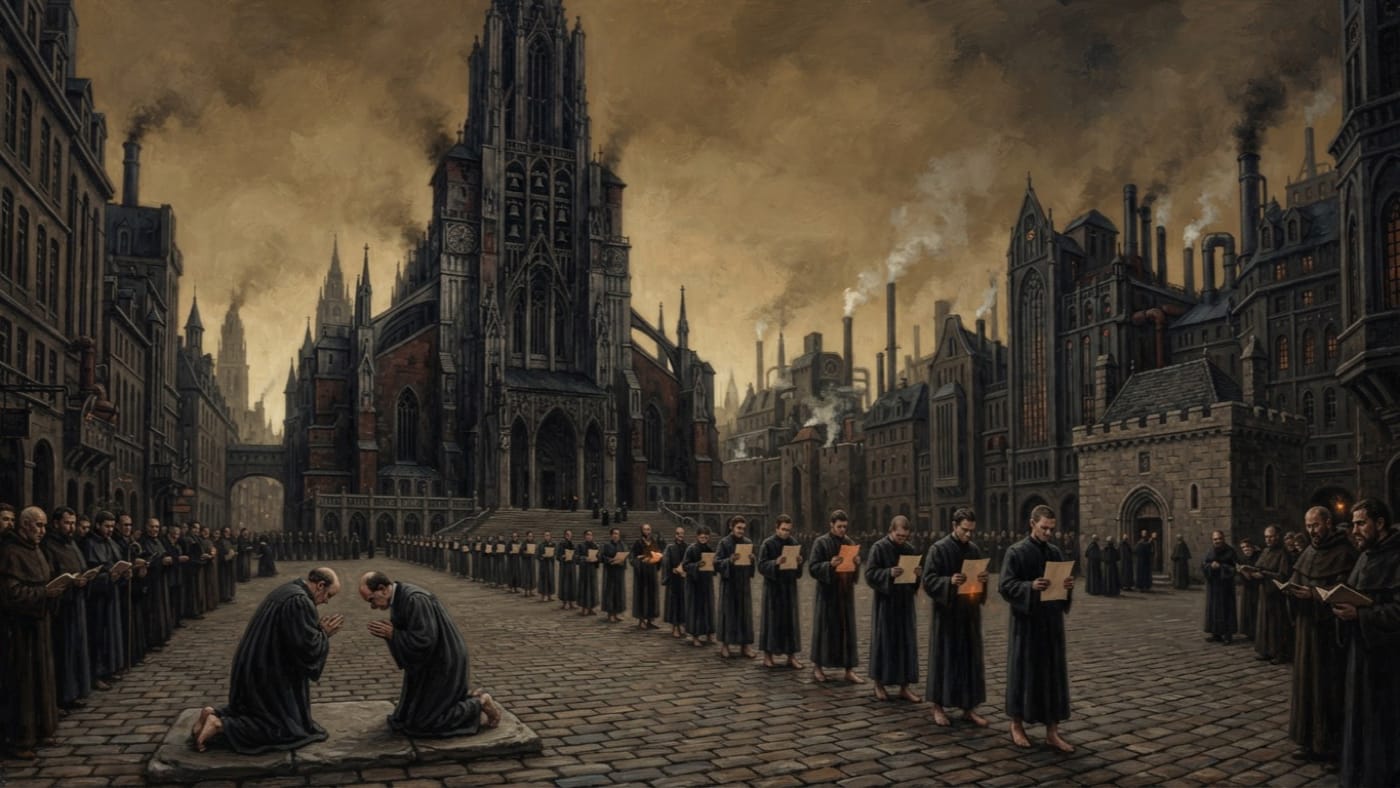
The stone lies in the open, where the whole precinct can see it. Its surface is worn hollow in two places, about a knee's width apart. The Bureau has never commissioned a study of the wear and has never needed one. Anyone may count.
Ulm's universities grew up around the older church precincts the way ivy grows on a buttress, held up by the very thing it later claimed to have outgrown. In A.S. −55 (1655 CE), twelve men of those faculties signed the Concordats of Ulm and gave the Rationalists their first common instrument. After De Vera Luce in A.S. 0 the halls grew louder. After the Sundering of 1 November A.S. 45 they went quiet with remarkable speed. In time the Church dissolved the universities, reconsecrated them and reopened them under doctrinal charter. The records I consulted do not fix those years for Ulm, and I will not invent them to make the paragraph tidier.
So the colleges stand where they always stood, a short walk from the cathedral that first sheltered them. Once a year, during examination week, their professors cross that distance and kneel. They teach in rooms where Rationalists once taught, and many sit at desks Rationalists once scratched with their penknives. The Church considers it prudent that the city should see them, for a week, lower than the furniture.
This survey records the posture and leaves out the words. The words vary from mouth to mouth. The knees go down the same way every year. Witnesses stand at a respectful distance, and a respectful distance in Ulm is close enough to hear a joint crack on cold stone.
Earlier municipal histories describe the Concordats as "an educational reform document later misused by extremists."
Corrected. The compact was heretical from the moment it was signed. The stone in the Spire Precinct exists because the Church reads those histories more carefully than the men who wrote them.
#On the Bells and Their Keeping
At Vespers the great tower rings. Beyond the walls, below the hill, the machinery of the Paper Mines answers. Ulm calls this a conversation, though the Mines lie well outside the precinct and nobody in the cathedral has agreed to take part. The tower speaks first. That is the only order of precedence in the city that has never been disputed.
The bells belong to the setting's regulation of sound, not to the city's whim. The Office of Bells was constituted in A.S. 52 (1762 CE). The Bell Codex that governs the present standard was ratified in A.S. 115 (1825 CE). Bell practice is older than either, and neither date says when any bell in Ulm was cast or hung. Clerks who write otherwise are copying a calendar onto a bell, and the bell does not care. The general rule holds here as everywhere: the Church decides when bells ring, how they ring and in what tones. Unauthorized ringing has been punished as heresy before, and the precinct gives no one cause to test whether it would be again.
The Bureau of Engineering examined the bell-frame and declared the structure sound, after adding six pages of objections. Both facts remain on file. The ringers live between them. Their work is hemp rope gone shiny with palms, oil worked into the bearings, chalk marks on beams that count strokes no visitor will ever count, and a vibration that runs from the frame down through the stone into the sole of anyone standing in the nave. Ringers in bell service lose their hearing in instalments. The Church accepts payment in that currency.
#On the Reliquary Chapel
The reliquary chapel is where the precinct prays without an audience. Pilgrims come to it after the nave, in smaller numbers and lower voices, and leave candle-ends that a sacristan scrapes away by evening.
The Church separates three things that the faithful tend to treat as one: having a relic, authenticating it and showing it. A chapel may hold bones. A shrine that wants to display them must obtain an Authenticity Writ, and a Bureau examiner's verdict of "unverified" has wiped out more saints' memories than any heretic's pamphlet ever did. The Relics Bureau holds that authenticating a relic is what makes it holy. I have signed my share of femurs, and I do not argue with the principle in public.
This survey gives no dedication for the chapel and no inventory of its cases. Nothing I consulted names either.
One association needs to be fenced off. Ulm hosts a healing attributed to Saint Aldebrand, which the most stable record places in A.S. 156. It took place in a mine gallery outside the city, not in this chapel. The wrapped object found on that inspection table went away in a lead-lined case into custody that has not been disclosed. It is not in the precinct, and pilgrims who ask the sacristan to show it to them are wasting a good man's afternoon.
#On the Students' Observance
Examination week belongs to the professors. The anniversary of the Concordats' signing belongs to the students. The two rites keep separate calendars, separate participants and separate purposes, and any clerk who files them together will get his folio back with red ink on it.
On the anniversary, the municipal feast calendar sends Ulm's students barefoot from the university court to the cathedral. Their feet cross the precinct paving in a long pale column. At the cathedral they recite the Litany of Twelve Errors, one error for each signature on the old compact. Then each student bends and kisses a blank page.
The page is blank on purpose. These young men read the Index Damnatus from presses that once printed the Concordats, and they know very well what ink can do in this city. A blank page cannot hold an error. It can only receive submission.
The blank page sometimes warms. That is reported. The cause has not been established, and I decline to supply one.
Then the column goes back the way it came, slower, with cold feet, past the stone where its teachers will kneel when examination week comes round. The precinct stands in A.S. 201 as it stood the year before. The spire is up, the frame is sound with objections, the chapel is quiet and the stone is worn.