

#On the Examiner's Function
"A relic authenticated is a relic made holy." — Standing axiom of the Bureau of Relics
This folio is a documentary compilation, submitted in A.S. 201 (1911 CE), on the examiner who works for the Bureau of Relics. It describes a profession as the present record shows it. It founds nothing, dates no appointment and reports no fresh inspection. The vaults, the holdings and the charter quarrels belong to the parent entry and to the Holy Bureaus. This folio concerns one officer, one table and one pair of brass scales.
The Bureau claims four mandates: custody, authentication, classification and distribution. The examiner takes the second out of Strasbourg and into the parishes. The office carries very few instruments, and its consequences are total. One signature decides whether a bone stays in its reliquary or leaves in a box.
The word "examiner" is in common use across the Church. Other Bureaus examine confessions, accounts and the knees of professors, and a transcript that mentions "the Bureau's examiner" does not, on that word alone, place its author under Relics. The title the record attaches to relic assessment is Examiner of the Third Degree. The record does not say how many degrees exist, how an officer rises through them, or when the third was created. I will not build a ladder for clerks who are fond of ladders.
#On the Writ
The examiner does not start the work. A petition starts it. A shrine, parish, cathedral or military chaplaincy that wishes to display a relic, transport it or invoke it in liturgical service files an Authenticity Writ. Holding a relic is a separate matter. A chapel may keep bones in a cupboard for a century and trouble no one. The Church distinguishes having a relic, authenticating it and showing it, as the survey of the Spire Precinct sets out. The Writ asks permission to do something with the bones in public.
The Writ must supply four things. The first is a provenance chain that is unbroken, witnessed and notarized at every transfer. The second is a description of the relic: its material composition, weight and dimensions, and the saint to whom it is attributed. The third is a theological justification citing at least two canonical sources and one reference from the Bureau of Doctrine. The fourth is a fee in Crowns of Grace. The Bureau of Tithes collects it on the Bureau of Relics' behalf, and the Bureau of Relics maintains that the full fee never reaches it.
So the examiner arrives already holding the petitioner's own sworn measurements. A parish that swore to a weight has given evidence against itself before anyone unpacks the scale.
The record gives no form number, no universal fee and no fixed waiting period, and this folio supplies none. Three separate papers concern us. The Writ is the parish's application. The examiner's form is the Bureau's verdict. The receipt is what a parish holds after it has lost. Clerks who file all three as one document deserve the confusion that follows.
#On Examination
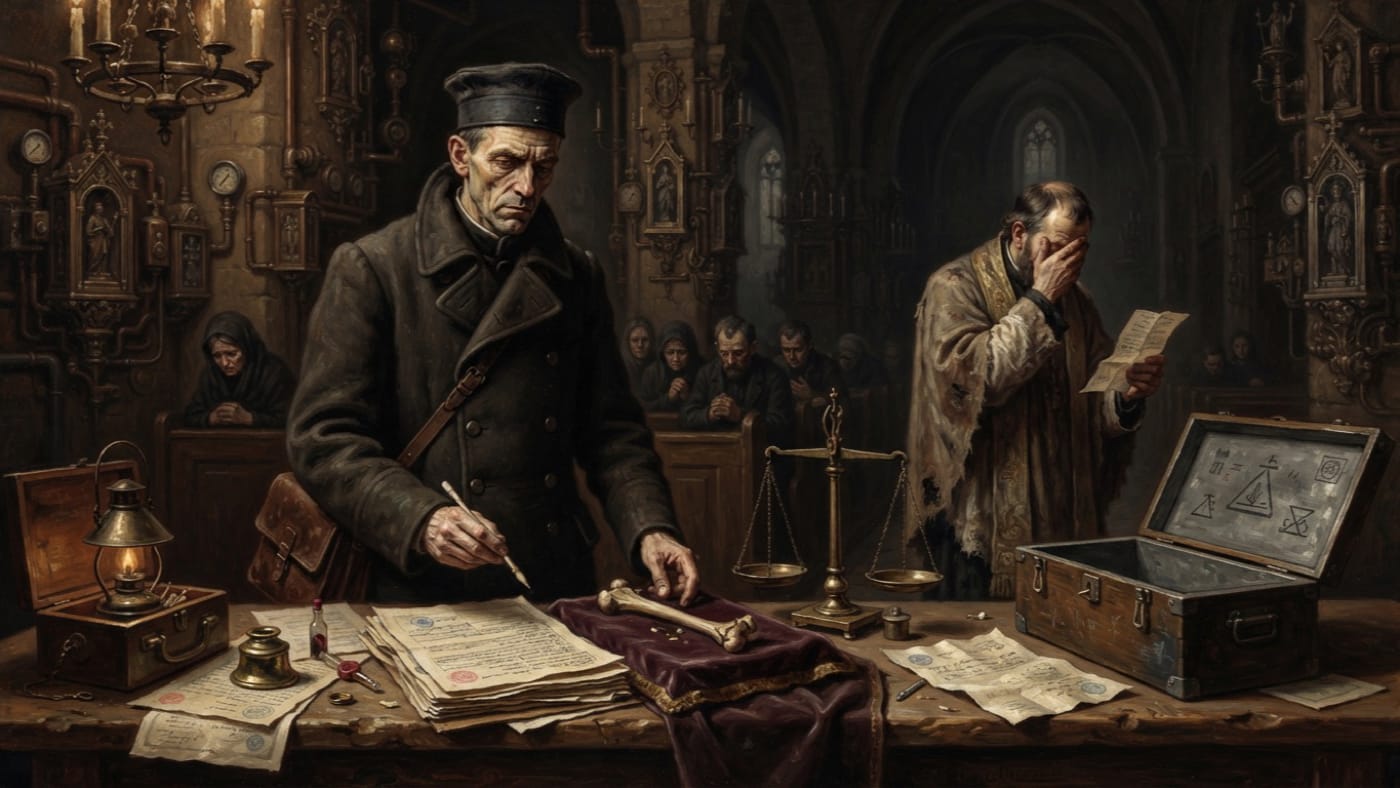
The examiner is trained in osteology, liturgical history and chemical analysis, and inspects every relic in person. The instruments are attested. There are brass scales, which the Bureau of Engineering calibrates monthly. There are reagents in wax-sealed ampules stamped with the Bureau's counterseal. There is the Liber Examinationis, a prayer book so dense with cross-references that the Bureau of Mercy classifies reading it as a Category Two Devotional Strain.
The examiner may test a relic by touch, by weight, by bringing a flame close, and by immersion in consecrated water. In disputed cases the examiner prays in the relic's presence and notes any thermal, luminous or auditory phenomena. These are the tests available. The record does not number them or require all of them on every visit, and an examiner who treats them as a fixed liturgy is inventing one.
The Bureau's acceptance rule has two clauses, and both deserve attention. A relic that produces phenomena passes. A relic that produces none may still pass, provided the provenance chain is unbroken and the fee has been received.
Read the second clause again, slowly. The examiner records heat, light and sound. The rule decides what a recorded phenomenon earns, and it says nothing about what caused it. Certification is a judgment about a file that has met the procedure's requirements. Whether the bone belonged to the saint named on the petition is a separate question, and the Bureau has arranged its forms so that it never has to answer it in writing.
#On Removal and the Ulm Receipt
A relic that fails is confiscated. It enters the Bureau's permanent custody and is never returned. The official phrase is retired from service. In general, retirement can mean interment in the Vault of Sacred Custody. For eligible fragments of insufficient provenance, it can mean rendering into lime for mortar under the Saint-Bone Melting Acts. The examiner gives the verdict. Other people carry the box, shelve it and work the kilns, and the record keeps their work separate from the verdict.
I give the one removal I witnessed, in the words I have always used and with nothing added.
I watched an examiner declare a tibia "doctrinally insufficient" in a parish church near Ulm. The parish priest wept. The congregation wept. The examiner filled out the form. The tibia was removed in a lead-lined box. The parish received a receipt.
That is the whole of my testimony, and the Ledger records its limits plainly. It gives no year. It names neither the saint nor the parish's dedication. It does not identify the examiner, and it does not say what failure lay behind the phrase "doctrinally insufficient." It does not give the wording of the receipt or say where the box went. Anyone who supplies these details is writing fiction and should apply to the Bureau of Festivals for a licence.
The phrase itself has limits too. "Doctrinally insufficient" does not mean counterfeit. The verdict did not say the bone was false, and it did not say the bone belonged to a pig. It said the file did not satisfy Doctrine. A parish can lose a saint on that finding alone.
There is a second lead-lined case in Ulm's record, and it must be kept apart from this one. The healing attributed to Saint Aldebrand in A.S. 156 (1866 CE) took place in a mine gallery outside the city. The wrapped object from that inspection went into custody that has never been disclosed. Nothing connects it to the parish tibia, and nothing places either object in the Spire Precinct's reliquary chapel. Two boxes from one city's neighbourhood do not make one incident.
The receipt stays. Of all the Bureau's documents it is the most honest. It makes no claim that the bone was holy and none that it was not. It acknowledges only that the Bureau now holds the bone and the parish holds a piece of paper.
#On Field Verification
Examiners also serve on the Sagittal Line, and there the taper does much of the work. The Bureau's published interpretation of the Candle Proof holds that a relic of genuine provenance draws a lit taper's flame toward it and a counterfeit makes the flame withdraw. The soldiers watching care more about which way the flame bends than about the interpretation.
The danger comes from the south. The Bureau documents counterfeit relics, sent by Velmora, that reached frontline chaplains in three incidents since A.S. 180 (1890 CE). For this work the Bureau maintains Counter-Relic Examiners, a specialist cadre trained to detect Velmoric corruption and posted to the bastions south of Przemyśl. Their prayer-resonance rods and sanctified reagent sets belong to that cadre. An ordinary examiner who takes the cadre's equipment or authority is overreaching.
Three schedules govern the Line, and clerks confuse them constantly. Bureau custodians rotate the trench-niche relics quarterly. Frontline relics are re-authenticated weekly. The single examiner stationed permanently aboard the Black Sea Reliquary Flotilla files quarterly reports.
Standing Order 88-R (A.S. 182 / 1892 CE) directed that all frontline relics be re-authenticated monthly.
The correct frequency is weekly. The original directive said monthly, and the Order was revised within the season. Three chaplains and one prayer-company learned the difference in terms the Bureau does not reproduce.
The Bureau authenticates eleven relics per annum. That figure covers the whole Bureau. It does not measure any one examiner's labour, and it does not include the weekly re-examinations, which never stop.
#On the Limits of Certification
The procedure has never been shown to be infallible, and the Bureau's own history shows the opposite. During the Reliquary Schisms, roughly A.S. 140 to 160 (1850 to 1870 CE), the cathedrals of Cologne accumulated seventeen femurs attributed to Saint Aldebrand. Each was notarized, each had an unbroken chain and each was authenticated by a separate Examiner of the Third Degree. The most generous anatomist allows the saint two.
The Fourteenth Doctrinal Congress ratified the Femur Principle in A.S. 147 (1857 CE): all femurs are authentic if notarized. The Principle did not make a saint's skeleton any larger. It made the anatomical question inadmissible. Afterward the Bureau of Records was given co-custody of every provenance chain, so an examiner now reads each link while a second Bureau keeps its own copy.
A certificate shows that the procedure was followed, and a receipt shows that it was followed to the end. Neither shows what the bone was. The examiner's craft lies in keeping those three things apart on the form, even while the congregation in the nave is treating them as one.
This compilation records the examiner's function as it stands in A.S. 201 (1911 CE). It adds no new removal, names no officer and gives no destination for the box from Ulm.