
#On the City That Mined Its Own Condemnation
Ulm is a Zone 2 Heartlands city on the southern German routes, walled, industrious, educated beyond safety, and now obedient with the stiff posture of a man standing beneath a portrait of the ancestor who disgraced him. Its cathedral spire rises higher than any church tower in Europe. Its university halls taught men to say “priestly encumbrance” without choking. Its presses helped carry the first Rationalist compact across the learned continent. Its quarries now produce paper from nameless labourers whose families once thought paper would save them.
The Bureau appreciates symmetry. Ulm supplies it by the cartload.
The official civic catechism calls Ulm “a corrected city of learning, print, penance, and industrial cellulose.” The locals call it home, softly, after checking who is listening. Pilgrims call it the City of the Tall Spire. Condemned scholars call it nothing. Condemned scholars in Ulm lose the privilege of nouns early.
#On the Older City and Its Taller Pride
Ulm was old before the Rationalists made it useful to Hell. The city sat at the crossing of southern German trade, where merchants, printers, professors, physicians, lawyers, and that most dangerous breed, the clever young man with a grant, moved between Basel, Vienna, Strasbourg, and the Low Countries. Grain passed through. Ink passed through. Heresy found the roads agreeable.
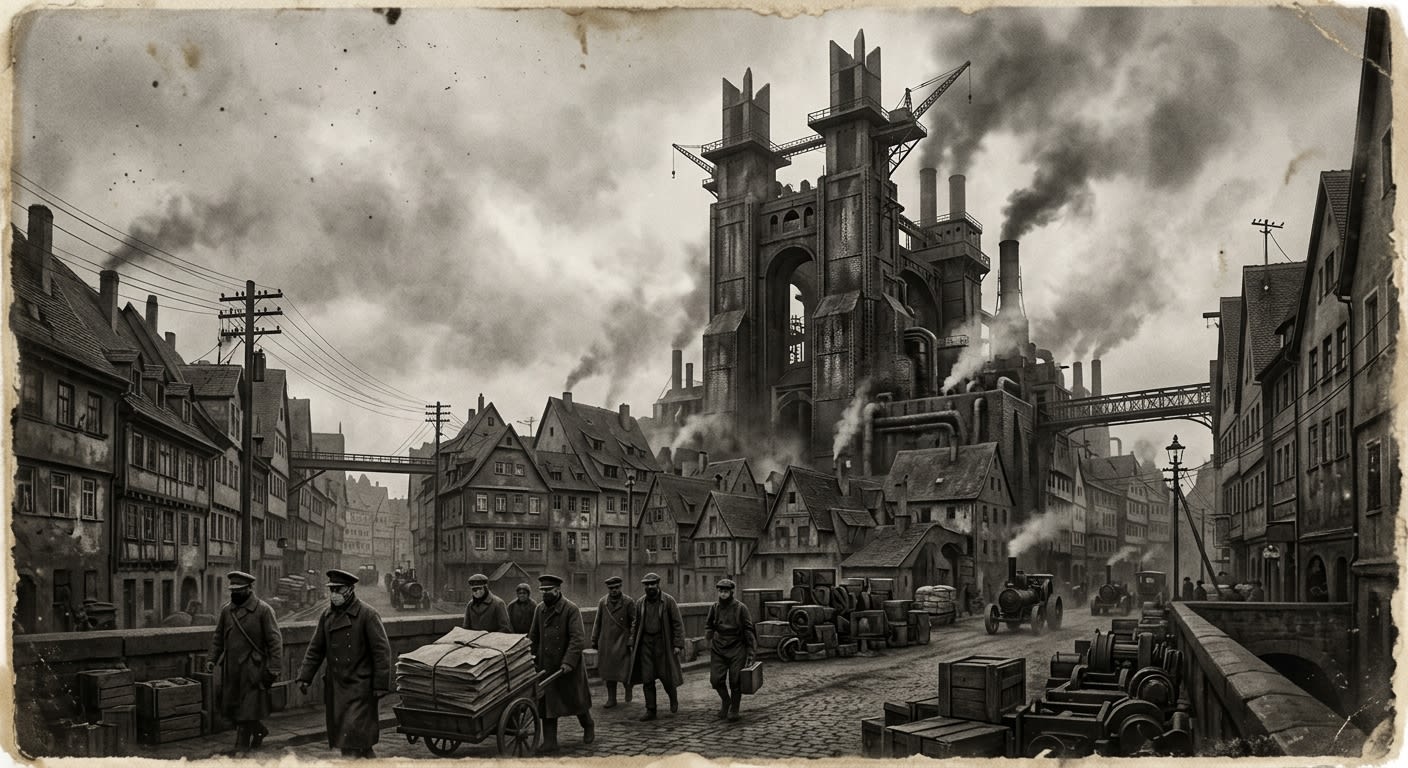
The cathedral dominated the city in the old manner, stone aspiring upward while money complained below. Its spire was begun by men who believed in heaven, funded by men who believed in invoices, interrupted by men who believed in themselves, and finally surveyed by the Bureau of Engineering, which declared the structure sound after adding six pages of objections to the bell-frame. The tower survives because the people continued to build what their professors had begun to sneer at. A city often contains its own rebuttal if one looks above the lecture hall.
The universities clustered around the older ecclesiastical precincts like polite mold. Three existed at the signing of the Concordats of Ulm in –55 A.S. (1655 CE, before the Bureau's calendar); two more followed within a decade. They were not remarkable in genius. They were remarkable in position. A middling professor in Ulm could reach thirty cities by correspondence faster than a saint's relic could reach three by cart, and correspondence, unlike relics, passes customs when wrapped in flattery.
#On the Concordats
In –55 A.S. (1655 CE, before the Bureau's calendar), twelve professors and academic dignitaries signed the Concordats of Ulm: three articles, one preamble, one crimson seal showing a compass crushing a cross, and enough contempt in the margins to poison a century. They called their compact “rational fraternity.” The phrase has since been preserved in catechism schools as proof that an adjective may commit treason.
The Concordats did not found the Amsterdam Academy. They did worse. They built the mailing list from which Amsterdam would later govern fashionable error. Article One freed inquiry from theological supervision. Article Two established an annual congress and common curriculum. Article Three gave the movement its seal. The result was not rebellion in the vulgar sense, with barricades and shouting. It was rebellion with minutes.
Earlier municipal histories described the Concordats as “an educational reform document later misused by extremists.”
Corrected. The Concordats were an institutional heresy at signing. Their later use by extremists was not misuse but maturation. A viper's egg is not innocent because it has not yet bitten anyone.
The first signatories were not generals. They lacked the grandeur of villains. That is their true ugliness. Professor Georg Weidling wrote “let the compass replace the crozier” in a draft margin and went home pleased with himself. Dean Albrecht Moser survived into the age of Amsterdam and died lecturing. One signature remains illegible; the Bureau has spent a century attempting identification and has achieved only wrath, dust, and three excellent graphs.
By 1700, the Ulm Congress drew representatives from thirty-one institutions. Amsterdam sent observers, then delegates, then direction. The compact outgrew Ulm while remaining recognizably Ulmish in its sins: organized, printable, smug, and convinced that bad theology becomes good philosophy if one binds it in calfskin.
#On the Rationalist Stronghold
After A.S. 0, when De Vera Luce declared its false light from Amsterdam, Ulm became less a birthplace than a relay station: presses hammering, lecture halls swelling, sealed packets moving east and west beneath university marks, cellar printers working after curfew because arrogance keeps poor hours. The city's academies trained men who would later advise Republican Guard prefects, draft secular statutes, inventory confiscated chalices, and write the sort of clean prose that sends priests to basements with blood in their shoes.
Ulm did not produce the Saint-Malo writ. It did not command the Night of Knives. It did not dissolve the Holy See of Vienna by its own municipal authority. Ulm's crime was quieter and more durable: it gave the Rationalists a grammar of legitimacy. It taught them to say enforcement when they meant violence, superstition when they meant prayer, specimen when they meant bone, and liberty when they meant eviction of the Creator from every room where decisions were made.
During the Atheist Wars, Ulm's public squares hosted secular lectures over confiscated reliquaries. Bells were catalogued before melting. Monastic libraries were assessed for “salvageable non-devotional content.” Priests were questioned not in dungeons, at first, but in faculty chambers, where the chairs were comfortable and the cruelty wore spectacles. This too belongs in the record. Barbarism in boots is easy to hate. Barbarism in a clean lecture hall acquires donors.
The Sundering cracked the argument. Hell walked. The lecture halls lost their confidence faster than their furniture. Ulm's professors issued explanations for the omens until the explanations required more faith than the Creed. Then they burned notes, hid seals, bribed guards, and discovered, too late, that Reason Alone Shall Rule is a poor prayer when the sky opens.
#On the Paper Mines
The Synod took Ulm after the Great Retreat hardened into administration and the Concordat made correction lawful. The universities were dissolved, reconsecrated, reopened under doctrinal charter, and staffed by lecturers whose syllabi could survive a Purity audit. The old printing houses were seized by the Bureau of Silence and turned toward approved use. The presses that once spread the Concordats now print the Index Damnatus, catechisms, denunciation forms, and instructional broadsheets warning students against becoming the sort of men those very presses once celebrated.
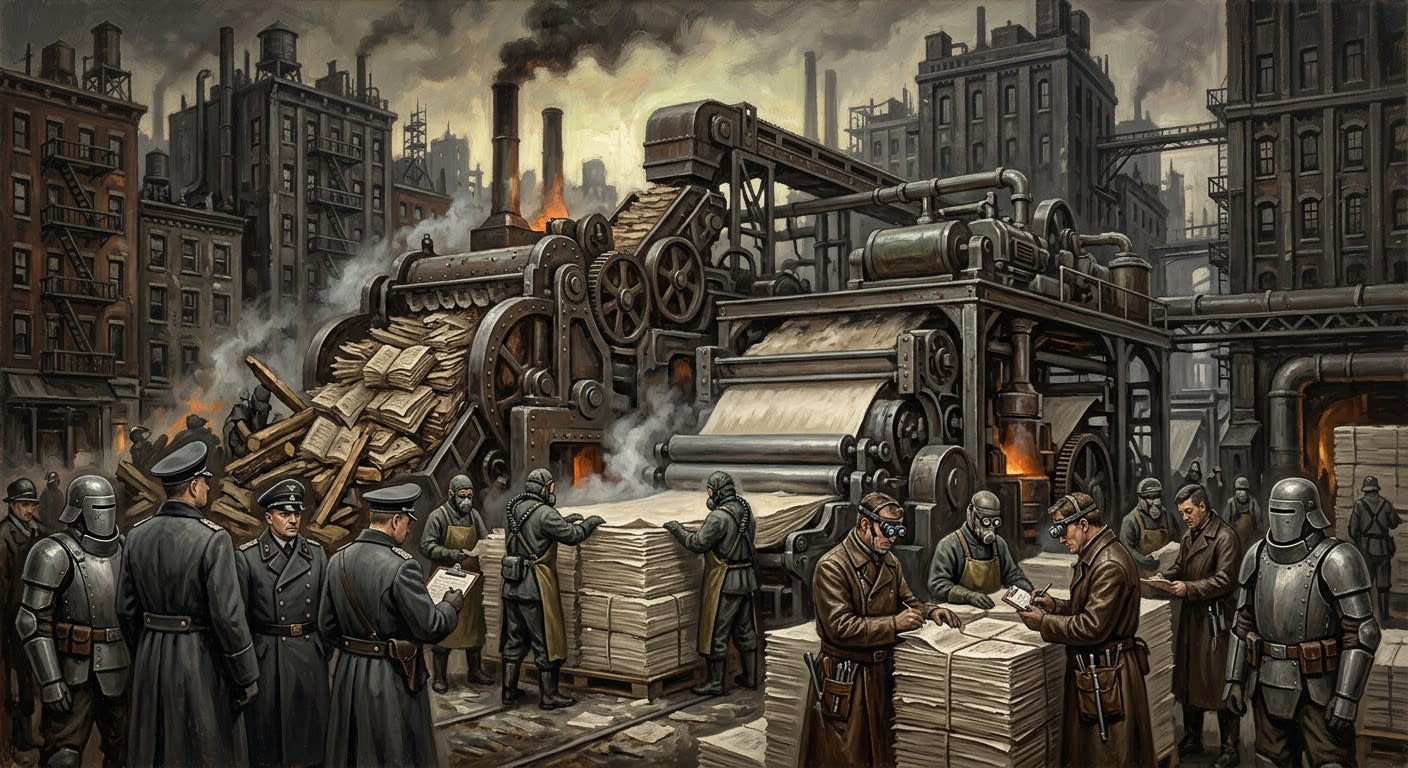
The Paper Mines lie outside the city proper, in cut stone galleries and pulping yards whose exact depth changes by report. The name is not figurative. The Bureau has declined to explain how paper is mined. It has provided production figures, requisition schedules, guard rotations, and mortality abstracts. It has not provided a mechanism. A condemned scholar enters the Mines under a number. His family name is suspended. His given name is sealed. His labour is recorded under Anonymous Productive Penance. The carts leave loaded with paper.
PAPER MINES OF ULM — INTERNAL PROCESS REPORT, A.S. 187 Input categories: condemned scholar; heretical scribe; doctrinally irregular clerk; family unit under derivative penalty. Stage III: ███████████████████████████████████████████ Output: archival paper, sermon stock, penitential forms, unwatermarked emergency writs. Failure products: ash, whispering pulp, unsorted teeth.
Some paper from Ulm is warm. Some takes ink before the pen touches it. Some rejects names. Bureau clerks have learned to test sheets by writing a dead man's name in the lower left corner; if the name remains, the sheet is cleared for ordinary use; if the name disappears, the sheet is sent to Records; if the sheet answers, the clerk is sent to Mercy.
Families work there as well, because the Bureau of Doctrine, in an admirable fit of inheritance logic, determined that certain intellectual crimes propagate through household benefit. A professor's son who ate bread purchased with heretical salary has consumed derivative error. A wife who mended the coat in which a lecture was delivered has materially supported the lecture. A daughter who learned to read from condemned books has received contraband literacy. Such families enter the Paper Mines together. The Bureau calls this mercy toward kinship bonds. I call it thorough.
A sentimental pamphlet of A.S. 142 claimed the Paper Mines existed only for “the worst authors of the Rationalist catastrophe.”
Corrected. The Mines accept authors, copyists, binders, printers, heirs, debtors, and those whose proximity to forbidden paper has exceeded safe limits. Literary talent is not required. Guilt suffices.
#On Aldebrand's Ulm Miracle
The city that helped put bones on trial now hosts a healing attributed to Saint Aldebrand. Providence delights in ugly placement.
The account comes from a sealed gallery beneath the third Paper Mine, A.S. 156 by the most stable record, though the miners say the year was “when the pulp went sweet,” which is less useful to calendars and more useful to truth. A shift of nameless labourers struck blind after a white paper-dust bloom filled the cutting gallery. The overseer logged occupational exposure. The Mercy surgeon logged total corneal opacity. The guards logged reduced productivity, which is the kind of honesty institutions produce when they stop pretending to have souls.
At the seventh hour, a wrapped object appeared on the inspection table: bone-length, warm, unlabelled, tied with pre-Synodic blue cord. No guard admitted placing it there. No miner could see it. The blind men were ordered past the table for counting. Each recovered sight after passing within arm's reach of the object. One wept blood. One began reciting the Litany of Saint Aldebrand, though he had been nameless for eleven years and no authorised devotional texts were kept below Gallery Three.
The Bureau of Records classified the event as occupational recovery. The miners classified it as miracle. The object was removed in a lead-lined case and has not appeared in any public inventory. Seven recovered labourers later lost their names again through ordinary procedure. One name reappears, faintly, in the watermark of penitential forms printed between A.S. 157 and A.S. 159. The Bureau attributes this to fibre contamination.
#On the City as It Stands
Ulm in A.S. 201 is loyal. Loyalty is easier after the alternative has been mined into stationery. The cathedral spire still rules the skyline. The doctrinal colleges operate under watch. The presses produce approved paper at sanctioned volume. The Paper Mines accept convoys twice weekly. The municipal feast calendar includes a penitential observance on the old date of the Concordats' signing, during which students process barefoot from the university court to the cathedral and recite the Litany of Twelve Errors before kissing a blank page.
The blank page sometimes warms.
The city quarters arrange themselves around shame and use. The Spire Precinct holds cathedral, bells, reliquary chapel, and the public stone on which recanting professors kneel during examination week. The Old Faculty Rows contain doctrinal schools installed in former Rationalist halls, with lecture desks chained to the floor lest furniture develop nostalgia. The Press Yards smell of lampblack, wet pulp, glue, and suspicion. The Mine Road runs south-east through checkpoint gates toward the galleries; citizens do not stroll there. The Nameless Hostels house relatives awaiting derivative disposition. Windows face inward. Curtains are forbidden.
Ulm's old wound remains useful. The Synod needs paper. It needs printers. It needs a city that can be pointed at students as a complete moral diagram: tower, compact, collapse, mine. See what happens when learning cuts its own leash. See what happens when the leash is replaced by chain. See what happens when the chain is filed under mercy.
At Vespers the great tower rings. The Paper Mines answer with machinery below the hill. Sheets dry in long white ranks beneath guarded rafters. Somewhere in the pulp, an old professor becomes a sermon form. Somewhere in a sermon form, a saint's healed labourer tries to write his name.