
#On the Instrument
"They called it a compact of fraternity. I call it a declaration of war drafted by men too polite to use the word."
Before the Bureau's calendar begins — before the Amsterdam Academy published its manifesto, before the Year of Letters exposed the arithmetic of saints, before the Broken Cross flew over columns of Republican Guards and the Rationalist project descended from philosophy into butchery — there was a document. A pact. A set of signatures in iron-gall ink on cream vellum, sealed with wax the colour of old blood, beneath a sigil that the Bureau of Purity now punishes by confiscation and brand: a compass crushing a cross.
The Concordats of Ulm were signed in the year the Bureau designates –55 A.S. — which is to say 1655 by the old reckoning, fifty-five years before De Vera Luce gave the heresy a manifesto and the Bureau gave the heresy a number. The Bureau's calendar does not extend to negative values; the Concordats exist in the administrative darkness before A.S. 0, which is to say they exist in the period the Bureau claims retroactive jurisdiction over but cannot stamp with a filing date. This irritates the Bureau of Records. The Bureau of Records dislikes things that happened before it existed. The Concordats are one of many such irritants; they are merely the most consequential.
#On the City and Its Universities
"Ulm was a city of merchants, printers, and professors — the three professions most likely to mistake cleverness for wisdom. The combination proved combustible."
Ulm in 1655 was a free imperial city of the German states: walled, prosperous, possessed of a cathedral whose spire the citizens had been building for two centuries and which they had not finished and, in the Bureau's judgment, never would, because Ulm was a city that began projects with enthusiasm and abandoned them when the funding grew tedious. The spire reached toward the Creator. The universities reached toward something else.
The universities of Ulm — three in number at the date of signing, two more established within a decade — were not, by the standards of the age, remarkable. They produced competent physicians, adequate lawyers, and theologians of the mid-range sort who populate the footnotes of intellectual history without ever troubling the text. What distinguished them was proximity. Ulm sat at the crossroads of the southern German trade routes. Its printing houses served a market that extended from Basel to Vienna. Its taverns hosted travelling lecturers from Leiden, from Paris, from the emergent academies of the north. Ideas moved through Ulm the way grain moved through its markets: in bulk, without inspection, and with a markup applied at every exchange.
It was in these taverns and faculty common rooms that the Concordats took shape. The principals — whose names the Bureau of Records has catalogued under seal and whose biographies I am instructed to render in terms unflattering and brief — were professors of natural philosophy, anatomy, and mathematics. They did not consider themselves revolutionaries. They considered themselves correct. This is a more dangerous self-assessment. A revolutionary knows he is breaking something. A man who considers himself correct believes he is repairing it. The Concordats were drafted as an act of repair — a binding of European universities into a compact of shared inquiry, freed from the "encumbrance" of theological supervision.
The word they used was encumbrance. The Bureau has preserved the drafts. In the margin of the third revision, one author — identified by graphological analysis as Professor Georg Weidling of the Faculty of Mathematics — wrote: "The age of priestly interference in the house of learning is concluded. Let the compass replace the crozier." The Bureau of Doctrine, upon reading this note one hundred and forty-seven years after it was written, underlined it in red ink and stamped it EXHIBIT A. The ink was still wet when the Bureau sealed the document. The Bureau does not waste time on the dead. It wastes ink, which is more permanent.
#On the Substance of the Compact
"Three articles. Twelve signatories. One seal. The most efficient act of civilisational self-harm since the Betrayal of Aachen — and the Concordats preceded Aachen by eighty years."
The Concordats of Ulm consisted of three articles, a preamble, and a seal. The preamble declared the signatory universities bound in "rational fraternity" — a phrase the Bureau has since embedded in its catechism curricula as an example of how a single adjective can contaminate a noun. Fraternity is a word the Church understands. Rational fraternity implies that the fraternity hitherto practised — the fraternity of faith, of prayer, of shared submission to the Creator's order — was irrational. The insult was embedded in the grammar. The Rationalists were good at that.
Article One declared that all signatory institutions would henceforth conduct inquiry "unencumbered by dogmatic prescription." In practice: no theological faculty would hold veto over the conclusions of the natural philosophers. The anatomist could dissect without a chaplain present. The astronomer could chart without a bishop's imprimatur. The mathematician could calculate without first establishing that his equations were consistent with Genesis. This sounds, to the modern ear accustomed to the Bureau's supervision, like madness. In 1655 it sounded like freedom. The distinction between madness and freedom is, as the Bureau well knows, a matter of outcomes, and the outcome of Article One was the systematic dismantling of every institutional safeguard that kept European learning tethered to its spiritual foundations.
Article Two established a rotating congress of signatory universities — to convene annually, at Ulm, to share findings, standardize methodologies, and — the language is precise — "harmonize the curriculum of natural inquiry across the fraternity." This was the administrative skeleton. This was the machine. A single university declaring independence from theology is a nuisance. Twelve universities harmonizing their independence is a movement. The Concordats did not invent Rationalist thought. They organized it. They gave it structure, schedules, common vocabulary, and — critically — a mailing list. The Amsterdam Academy, which would publish De Vera Luce fifty-five years later, sent an observer to the first Ulm Congress. The observer's report, seized during the Concordat-era purges, contains the sentence: "The machinery is built. It wants only fuel."
Article Three defined the seal. A compass, its legs spread to full extension, bearing down upon a crucifix whose crossbeam is snapped beneath the compass-point. Below it, in Latin: VERITAS SUPRA OMNIA — "Truth Above All." The Bureau of Doctrine has noted, in its official commentary, that the Concordats' authors chose veritas — truth — rather than ratio — reason — a selection that implies the Church's truth was false and theirs was genuine. The seal was stamped in crimson wax — a colour the Bureau observes was borrowed from the episcopal tradition, which is to say the Rationalists stole the colour of the Church's authority to seal the Church's demotion. The theft was, one concedes, well-executed.
#On the Twelve Signatories
"Twelve men signed. Most were dead before the consequences matured. This is the Rationalist privilege: to sow and never reap."
The Concordats bear twelve signatures. The Bureau of Records has identified eleven with certainty; the twelfth is illegible, its owner either too hasty or too frightened to write clearly, and the Bureau has assigned the illegible signature the provisional designation "Unknown (Ulm Twelve, position twelve)" and classified the identification effort as "ongoing since A.S. 92."
The signatories were professors, deans, and rectors of the German, Swiss, and Lowlands universities — men of standing in their local academies but unknown beyond them. They were not the Council of Nine. The Council, if it existed in 1655 — and the Bureau's position oscillates between "certainly" and "the Bureau has no position on hypothetical entities" depending on which clerk one asks — operated at a higher and more shadowed altitude. The Ulm signatories were the visible layer: men who believed in what they signed, men who saw no reason to hide their names, men who assumed that a pact of scholarly co-operation would be remembered as a footnote in the history of education rather than as the opening instrument of the worst heresy since Arius.
What these twelve men signed, they signed in good faith — a phrase I use without irony, because their faith was genuine. It was merely misplaced. They believed that theology and natural philosophy could be separated without consequence — that a university could study the world's mechanics while leaving the world's meaning to the parish. This is the foundational Rationalist error, and it was committed first at Ulm, by men who thought they were writing a curriculum document and were writing, in fact, a schism.
The Bureau has made the twelve names available for pedagogical purposes in catechism schools above the Fifth Tier. Cadets at Bastion-Przemyśl are required to recite them as part of the Litany of Errors — eleven names pronounced clearly and one pronounced as "the unknown twelfth, whose anonymity is itself a verdict." The exercise takes four minutes. The cadets are then required to state, in unison, that the twelve were wrong. The Bureau considers this sufficient. I consider it a beginning.
#On the Seal and Its Afterlife
"A compass crushing a cross. Geometry triumphant over salvation. The first heresy made a banner."
The seal deserves its own accounting, because the seal outlasted the Concordats. The Concordats were a document — paper, ink, wax, signed in a faculty common room in Ulm by twelve men whom history has correctly forgotten. The seal was a symbol, and symbols, as the Bureau well knows, are harder to burn than paper.
The compass-and-cross device spread from Ulm to every Rationalist institution on the continent within a generation. It appeared on the Amsterdam Academy's frontispiece alongside the text of De Vera Luce. It was carved into the lintels of secular lecture halls in Paris, Vienna, Prague, and Leiden. It was stamped onto the covers of pamphlets, embossed on the brass carriages of Lucien Artois's clockwork artillery, and tattooed — the Bureau of Purity's records confirm this — onto the forearms of Republican Guards as a mark of secular commitment. When the Atheist Wars erupted, the compass-and-cross became a military sigil: the Broken Cross, the snapped crossbeam, carried at the head of every Rationalist column.
The Bureau of Purity now classifies possession of the compass-and-cross device as a Category Two infraction — punishable by confiscation, branding, and referral to the Tribunal of Doctrine. Depiction is punished identically. Description in "flattering terms" — a threshold the Bureau has declined to define, reasoning that ambiguity serves deterrence better than precision — is punished at the Tribunal's discretion. I describe the seal here in terms that I trust are unflattering, though the Bureau is welcome to audit my adjectives. My adjectives, like my loyalties, are above reproach.
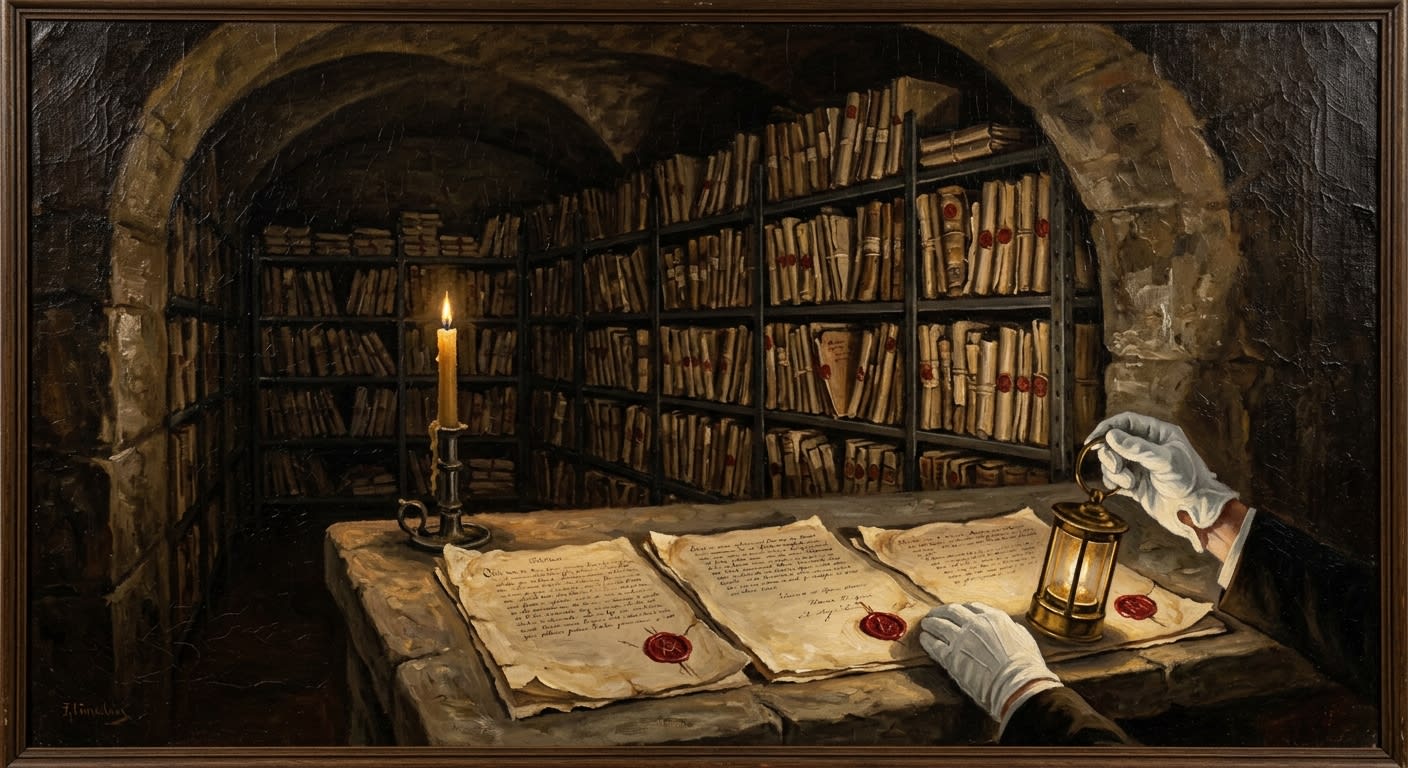
Three original copies of the Concordats survive. They are held in the Forbidden Stacks of Strasbourg, in a sub-vault the Bureau of Records designates "Predecessor Instruments, Sealed." I have inspected them — annually, as part of my duties, wearing the gloves the Bureau provides for the handling of heretical materials, in the candlelight the Bureau permits for classified documents. The vellum has yellowed. The ink has browned. The wax seals remain intact — crimson, hard, the compass-and-cross still legible after two hundred and fifty-six years.
The wax smells of smugness. I have noted this in six consecutive inspection reports. The Bureau of Alchemical Standards has tested the wax and declared it "standard composition, beeswax and resin, no anomalous properties." I disagree. Smugness is a property. It is merely one the Bureau of Alchemical Standards lacks the instrumentation to detect.
Earlier editions noted the Concordats were signed by "approximately fifteen" signatories. This is incorrect. The number is twelve (12), confirmed by the Bureau of Records' graphological analysis completed A.S. 93.
The error originated in a preliminary count that included three witnessing notaries whose marks appear in the margin but who did not sign the instrument proper. The notaries have been retroactively redesignated as "complicit observers" and their marks catalogued separately under Filing Protocol 7-D. The Bureau's counting, like the Bureau's faith, does not tolerate approximation.
#On the Concordats' Reaffirmation and the Road to De Vera Luce
"The Ulm Concordats were drafted in a common room. They were reaffirmed in a cathedral converted to a lecture hall. The venue tells the story."
The Concordats did not remain a German curiosity. Within a decade of their signing, the compact had spread — by correspondence, by travelling lecturer, by the printing presses of Ulm that churned out copies for any university willing to add its name. By 1670, the fraternity included institutions in the Swiss cantons, the Lowlands, and northern France. By 1680, it had reached Vienna and Prague. By 1700 — ten years before De Vera Luce — the Concordats had been reaffirmed, expanded, and formally ratified at a congress in Ulm that drew representatives from thirty-one universities across Europe.
This expansion was not organic. It was cultivated. The Ulm Congress — convened annually per Article Two, growing each year in attendance and ambition — served as the administrative hub of a network that the Bureau now recognizes, with the clarity of retrospection, as the embryonic form of the Rationalist movement. Every development that followed — the Year of Letters, the Massacre at Saint-Malo, the Wars themselves — can be traced along the communication lines established by the Concordats' mailing lists.
The Amsterdam Academy sent its first observer to the Ulm Congress in 1695. By 1705, Amsterdam had assumed the intellectual leadership of the fraternity — Ulm's founders were dead or elderly, and the Amsterdam philosophers brought a sharper edge, a more explicit programme, a willingness to move from "unencumbered inquiry" to "the active dismantlement of theological authority." The Concordats of Ulm had declared that universities should study without priestly interference. De Vera Luce, published five years after Amsterdam took the chair, declared that priestly interference itself — meaning Faith, meaning the Church, meaning the Creator — was the obstacle to human advancement and should be removed.
The distance between those two positions is the distance between removing a fence and burning the field. The Concordats removed the fence. Amsterdam burned the field. The fire is still warm.


#On the Paper Mines and What Followed
"Ulm is now a city of the Synod. Its universities teach the catechism. Its printing houses print the Index Damnatus. Its most famous product is condemned scholars, sent to the Paper Mines that bear its name."
The city of Ulm did not survive the Rationalist era intact. No city did. When the Atheist Wars broke the continent and the Sundering shattered what the Wars had merely cracked, Ulm found itself on the safe side of the Sagittal Line — Zone 2, Heartlands, within the Synod's protection and therefore within the Synod's grasp. The universities were dissolved. The faculty common rooms where the Concordats had been drafted were consecrated, exorcised, and repurposed as doctrinal instruction halls. The printing houses that had distributed the compact to thirty-one universities were seized by the Bureau of Silence and put to work producing approved catechisms and — with a symmetry the Bureau considers providential — copies of the Index Damnatus listing the very texts those presses had once produced.
The Paper Mines of Ulm deserve particular mention. Established in the first decade after the Concordat of Strasbourg, the Paper Mines are the Bureau of Doctrine's preferred destination for condemned scholars, heretical scribes, and any clerk whose filing proves "doctrinally irregular." The name is the Bureau's, and the Bureau has declined to elaborate on what, precisely, the Mines produce or how paper is mined from stone. Condemned families reduced to nameless labour. The Mines accept. The Mines do not release. What enters the Paper Mines does not exit the Paper Mines, except as paper — and the paper bears no names, because the condemned have been administratively dissolved and dissolved persons do not author documents.
That a city should become the instrument of its own heresy's punishment is, in the Bureau's official assessment, "Providence operating through administrative channels." Ulm drafted the Concordats. Ulm's Paper Mines grind the Concordats' heirs into silence. The compass crushed the cross. The cross, in time, crushed the compass — and it did so in the same city, using the same buildings, staffed by descendants of the same families who had applauded the original signing. The Bureau does not manufacture irony. The Bureau merely stamps it, files it, and displays it in catechism schools where it can serve its intended purpose.
#On the Bureau's Position
"The Concordats are dead. The compact is ash. The fraternity is dissolved. The seal is contraband. The wax, however, remains warm."
The Bureau's position is clear, coherent, and stamped in triplicate. The Concordats of Ulm were the first institutional instrument of the Rationalist heresy. They preceded De Vera Luce by fifty-five years, the Atheist Wars by sixty-five, and the Sundering by a full century. They did not cause these events in the direct, mechanical sense beloved of Rationalist historians — a cause producing an effect along a chain of logic. They caused them in the theological sense: they cracked the foundation, and every subsequent weight placed upon that crack widened it until the whole edifice fell and the Great Deceiver's legions walked through the gap.
The Bureau of Doctrine has calculated — and the calculation fills seventeen pages of the Bureau's internal assessment, classified under Triple Seal — that the Concordats represent the inflection point at which European civilisation's spiritual immune response began to fail. Before Ulm, Rationalist thought existed as isolated pockets: a professor here, a pamphlet there, a tavern argument that ended in mutual incomprehension and another round of beer. After Ulm, Rationalist thought had structure. It had a compact. It had a seal. It had a mailing list and an annual congress and a shared vocabulary and a stated purpose. The difference between a disease and an epidemic is organisation, and the Concordats of Ulm organised the plague.
The three original copies remain in the Forbidden Stacks. I inspect them annually. The vellum yellows. The ink browns. The wax holds. I have recommended destruction four times. The Bureau of Records has denied the recommendation four times, on the grounds that "the instrument serves pedagogical and evidentiary functions that supersede the risk of continued material existence." The Bureau keeps its poisons labelled and shelved, close to hand, because the Bureau believes that a poison understood is a poison controlled.
I am less certain. The wax is warm. It has been warm for two hundred and fifty-six years. Beeswax and resin do not generate heat. The Bureau of Alchemical Standards maintains its assessment: no anomalous properties. I maintain mine: the document knows it is being read. It has always known. The compass crushed the cross, and the cross bled, and the bleeding has not stopped, and the Bureau has stamped the wound SEALED and the wound has ignored the stamp.
The Bureau has spoken. The Concordats are classified. The matter is closed.
The wax is warm.