
#On the Saint
"A meddler," the records call him. I should know. I wrote the records.
Let us be plain. I am tasked with composing the Bureau's authoritative account of the Miracle of Saint Aldebrand, which is to say, I am tasked with composing the Bureau's authoritative account of a miracle that the Bureau has, at various points in its administrative history, declared genuine, declared fraudulent, declared non-existent, and declared so holy that inquiry into its nature constitutes sedition. These positions were adopted simultaneously. They remain in force.
The man himself is a problem. Saint Aldebrand — or, as the Bureau of Records designates him in their older filing system, "Subject 14-Theta, Sainthood Pending (Perpetual)" — lived and died in an era the Synod has formally expunged from the calendar. His birth year is classified. His death year is classified. His place of ministry is classified. The Bureau of Doctrine will tell you he was a "servant of the Creator whose works speak for themselves." The Bureau of Records will tell you his file was eaten by moths in the basement of the Basilica of the Ledgered Saints sometime during the reign of the Third Hierarch. Both statements are official. Both carry seals.
What the Bureau cannot classify into silence — and the Bureau has tried, with a persistence that borders on the devotional — is the relic. The reliquary of Saint Aldebrand. A bone in a box. Or, depending on which century and which Bureau you consult: pig bone in a box, holy relic in a box, nothing in a box that never existed, and the weapon that broke the Siege of Vienna.
#On the Original Miracle
"The date has been redacted. The location has been redacted. What remains is the inconvenience."
The Miracle itself — the original event, the thing the Rationalists later mocked and the Synod later vindicated and the Bureau later denied and then un-denied — is, by any rational measure, the worst-documented event in the Theocracy's ecclesiastical archive. The Bureau of Records maintains a file. The file is stamped COMPLETE. It contains two pages. The first page is a cover sheet bearing nine seals and the words "SEE ATTACHED." The second page is blank.
What survives outside the Bureau's custody is rumor — which is to say, it is folk theology, which is to say, it is truer than anything the Bureau stamps, because the Bureau stamps what is convenient and the people remember what is real. The peasant account, whispered in seventeen regional variants from Cologne to Ulm, runs as follows:
Aldebrand was a cleric. He served in a parish. The parish was poor. The parish contained sick people. Aldebrand prayed over the sick. The sick recovered. This happened more than once. Bones associated with the saint were preserved after his death by his parishioners. These bones, placed in a reliquary, demonstrated properties inconsistent with the Bureau's preferred model of inert organic matter — they glowed, they warmed, they healed, they frightened horses, and on one occasion, according to a deposition in the Forbidden Stacks, they screamed.
The screaming is disputed. The healing is not. Or rather — the healing was not disputed until the Year of Letters, when disputing it became fashionable, and then it was not disputed again until the Siege of Vienna, when the bone in question shattered a sorcerer-lord's skull and scattered a demonic column into ash, at which point the dispute became, as the Bureau of War noted with uncharacteristic understatement, "academic."
Earlier editions of this Codex listed the Miracle of Saint Aldebrand under "Unverified Hagiographic Claims, Category B (Probable Fabrication)." This classification has been retroactively corrected.
The correction was issued on the same day as the Feast of Saint Aldebrand, A.S. 110. The coincidence is liturgical and should not be interpreted as political expediency. The Bureau of Doctrine does not engage in political expediency. The Bureau of Doctrine engages in doctrine.
Seventeen femurs of Saint Aldebrand are held in the cathedrals of Cologne, each notarized, each bearing the authentic seal of the Bureau of Relics, each declared by that Bureau to be "the genuine and sole femur of the Blessed Aldebrand." Seventeen sole femurs. The arithmetic is, as Dr. Matthias Voll once observed before his unfortunate correction at Vienna, suggestive of a centipede. The Bureau of Relics responds: "All femurs are authentic if notarized." The Bureau of Doctrine agrees. The Bureau of Records has sealed the inventory under triple lock. The bones, whatever their provenance, glow faintly on the Feast of the Assumption. The custodians report this annually. The Bureau files the reports. Nobody reads them. The glow persists.
#On the Year of Letters
"–32 A.S. A bad year for bones and a worse year for those who revered them."
The Year of Letters — designated –32 A.S. by the Bureau's retroactive calendar, which is to say -32 A.S. by the old reckoning, which is to say the year the Rationalists discovered that mockery, properly distributed, is more destructive than cannon — was the Aldebrand reliquary's first public execution.
Amsterdam's scholars, stuffed with the certainties of the Ulm Concordats and drunk on their own pamphlets, declared the miracle a fabrication. Their method was simple: they wrote letters. Hundreds of them. Thousands. Letters to every university, every parish, every market town. The letters were precise, footnoted, and devastating. They listed every reliquary claiming Aldebrand provenance. They counted the bones. They noted that if all were genuine, the saint would have required the skeleton of a draft horse and the internal organs of a small cathedral. They asked — politely, which was the cruelest part — how many femurs one man needed.
The pamphlets spread. The faithful wavered. Monasteries that had processed thousands of pilgrims per season to venerate Aldebrand's bones found their queues thinning. Shrine income dropped. Parish priests who had sworn oaths upon the reliquary's authenticity were hauled before Rationalist tribunals and asked to explain the bone count. Several recanted. One, Father Grauss of Düsseldorf, ate the summons and was beaten for it, which at least demonstrated that the Rationalists had a sense of proportion similar to the Bureau's.
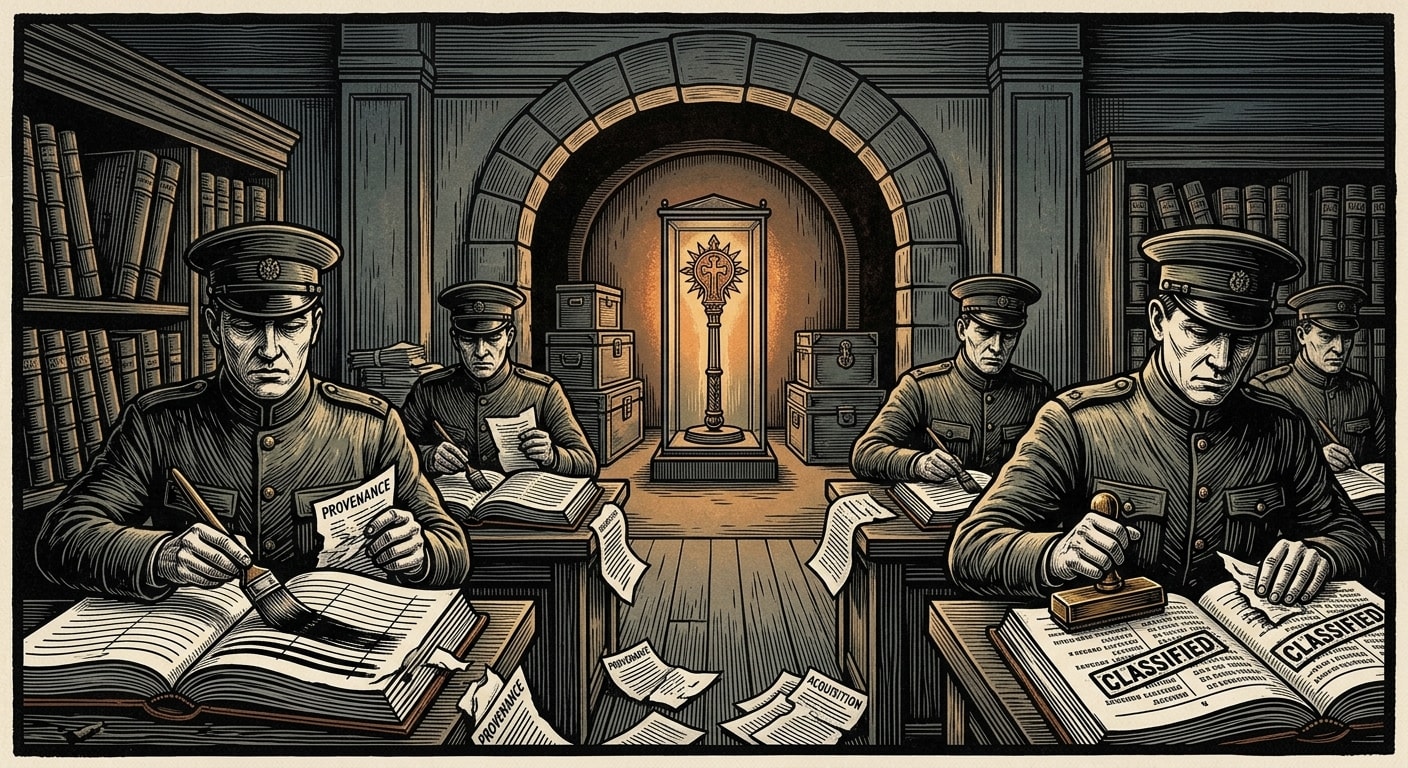
The Bureau's response — and here I must choose my words with the care of a man handling consecrated nitroglycerin — was to declare the reliquary non-existent. The official decree, issued from the Bureau of Records in the same month the Amsterdam pamphlets reached Strasbourg, reads: "The object designated 'Reliquary of Saint Aldebrand' does not appear in current Bureau inventories and is therefore classified as apocryphal. Inquiry into apocryphal objects is discouraged."
They did not say the reliquary was false. They said it was not there. They erased it — the reliquary, the inventory entry, the custodial chain, the provenance ledger, the wax imprints, the pilgrimage receipts — from the official record with the thoroughness of a Bureau of Records filing party on double rations.
The reliquary, naturally, did not cooperate with its own erasure. It sat in the cathedral vault at Vienna, undocumented, un-inventoried, glowing faintly whenever the candles guttered, as it had always done, as bones belonging to meddlesome saints are wont to do.
#On the Trial
"11 A.S. The Rationalists put a bone on trial. The bone was not impressed."
The Trial of Saint Aldebrand's Reliquary — staged in Amsterdam in the eleventh year of the so-called Age of Reason — was the Rationalist movement's most theatrical triumph, and, in retrospect, its most embarrassing miscalculation. The event was less a legal proceeding and more a public humiliation, conducted with the showmanship of a circus and the theological depth of a bar fight.
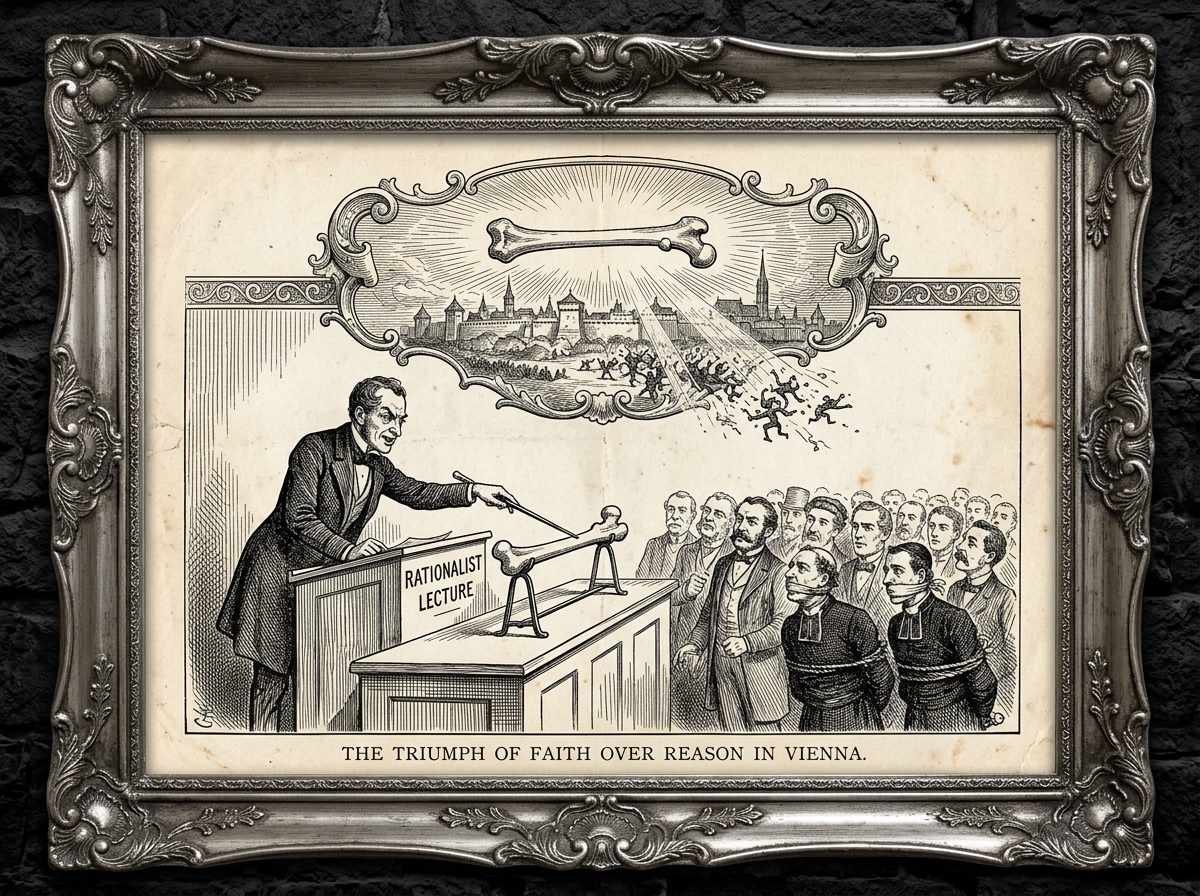
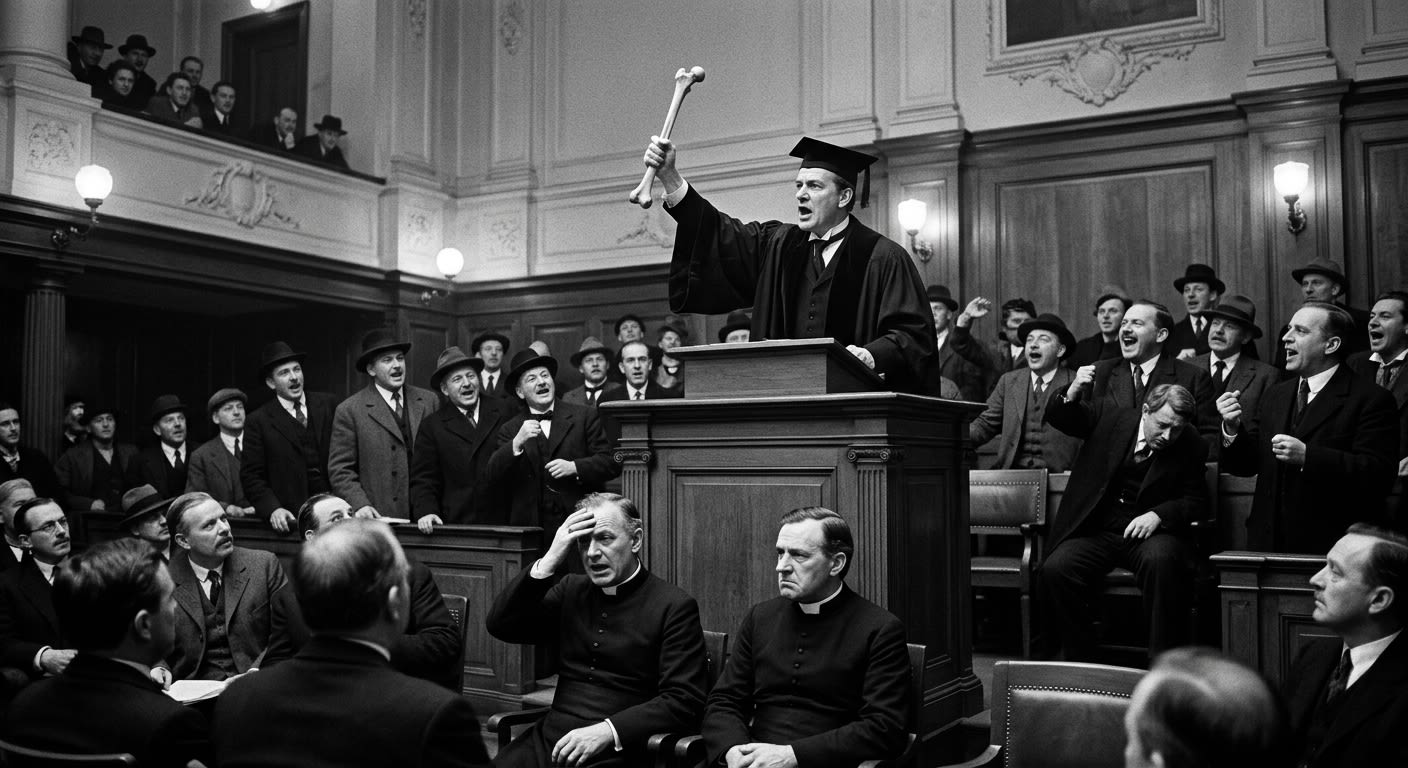
Dr. Matthias Voll — lecturer, pamphleteer, and the man who would later achieve immortality in the Bureau's filing system under the designation "Heretic, Category A, Posthumously Corrected" — delivered his famous lecture On the Statistical Distribution of Relics to a jeering crowd. His central argument: "If every reliquary claiming a femur of Saint Aldebrand were genuine, the Saint himself must have been a centipede." He then pointed at a single femur. The crowd laughed. Two priests, bound and gagged in the front row, did not.
The priests were made to sign a confession — under what the Bureau of Purity would later designate "coerced attestation, non-canonical" — admitting that the femur in question was "pig fragment, common, undressed, of no liturgical significance." The confession was transcribed, published, and distributed across forty cities within a month.
The Synod's later annulment of the transcript as "forgery" was a masterwork of retroactive correction. The Bureau did not argue that the confession was extracted under duress — that would have admitted the duress, which would have admitted the Bureau's inability to protect its own clergy, which would have admitted institutional weakness, which is an impossibility. Instead, the Bureau declared the transcript's handwriting non-authentic. The scribal analysis ran to forty-seven pages and concluded that the letter "e" in the confession was written at a seventeen-degree angle inconsistent with the confessing priest's known penmanship. The case was closed. The confession was reclassified as "fabricated by hostile agents." The two priests were quietly reassigned to the Paper Mines of Ulm, where their expertise in forced confession proved useful in a different capacity.
The femur itself — the specific bone Dr. Voll had brandished — disappeared from the Amsterdam lecture hall on the same night as the trial. The Rationalists blamed thieves. The Bureau of Shadows, which did not officially exist at that time either, filed no report. The femur's current location is classified.
#On the Vindication at Vienna
"A.S. 95. The pig-bone returned. The pig-bone was angry."
The Siege of Vienna is treated at length in its own Codex entry, and I shall not rehearse the full agony of that nine-month ordeal here. What concerns us is the ninth month. The breach. The relic. The blow.
By the ninth month of the siege, Vienna was a ruin populated by the starving, the faithful, and the starving faithful — categories that overlapped so completely as to be synonymous. The outer walls were breached. Rationalist artillery had cracked the eastern rampart. And the sorcerer-lord Althazar of Pest — whose catalogue of abominations the Bureau of Purity has declined to classify in full, citing "insufficient filing cabinets" — breached the western wall with a column of things I shall not describe in a document intended for public consumption.
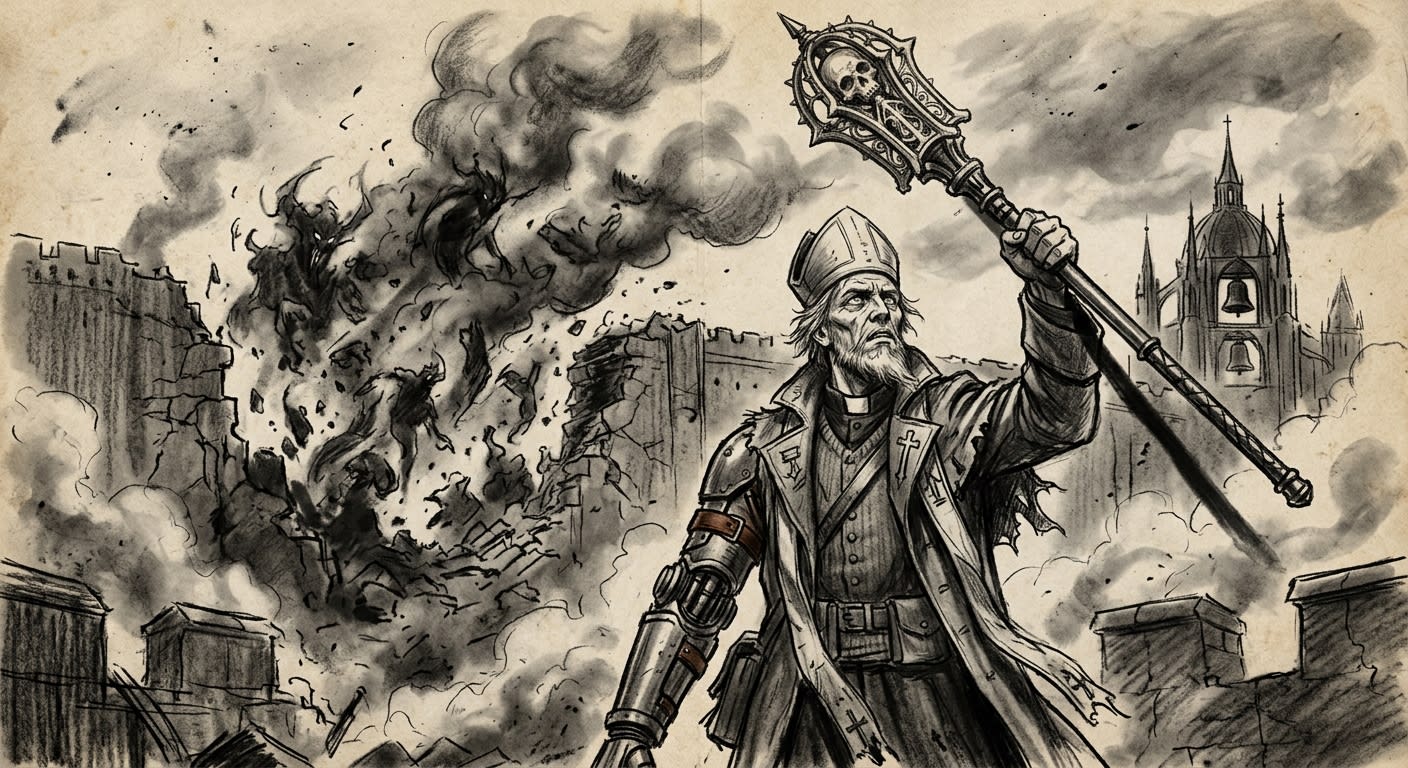
Bishop-Warden Clemens Stahlhand — half-starved, steel-handed, and possessed of a faith so absolute that it had ceased to resemble piety and begun to resemble geology — went to the cathedral vault. He took the reliquary mace. The same reliquary the Bureau had declared non-existent sixty years earlier. The same relic the Rationalists had called pig bone. The same femur that was, according to every official inventory in the Theocracy, nowhere.
He walked out to meet Althazar. One man, one arm (the other having been lost to a shell at the Outer Ramparts two years prior), one mace containing a bone that had been denounced, erased, and forgotten by every institution that now depended upon it.
What happened at the altar of Saint Rupert has been told so many times that the truth, if it survived, was long since trampled by repetition. The Bureau's ratified account: Clemens struck. The blow rang the marrow of the earth. Iron split. Skulls cracked. Demons scattered into ash-clouds. The bells of Saint Rupert — the very bells Clemens had saved from the Rationalist smelter during the Atheist Wars — pealed of their own accord, and the peal carried across the city, across the trenches, across the Rationalist lines, and the besiegers broke.
The sealed testimony of Clemens Stahlhand, taken three days after the blow, contains passages the Bureau has never released. Seven lines are obliterated. The eighth reads: "It was not I who struck." The Bureau classifies this as "battlefield confusion." Further discussion of this line is prohibited under Bureau of Doctrine Seal Amber, Classification IX-Tertiary. I have said nothing. I shall continue to say nothing. The nothing I say is extremely specific.
The pig-bone, it transpired, had opinions about its classification.
#On the Contradiction
"The reliquary both never existed and saved a city. The Bureau sees no difficulty."
I have been asked — by clerks, by students, by at least one Hierarch's secretary whose name I shall not record because the question was asked during a card game and card games are not canonical contexts for theology — how the Bureau reconciles the following:
In –32 A.S., the Bureau of Records declared the Reliquary of Saint Aldebrand non-existent.
In A.S. 95, the Reliquary of Saint Aldebrand broke the Siege of Vienna.
In A.S. 104, the Bureau of Doctrine retroactively verified the miracle performed by the reliquary.
In A.S. 110, the First Continental Levy was decreed on the Feast of Saint Aldebrand, a feast day honouring a saint whose primary relic the Bureau of Records maintains does not exist.
The answer — and I deliver it with the serene authority of a man who has spent thirty years filing contradictions under their proper headings — is that the Bureau does not reconcile. Reconciliation implies that two positions were in conflict. Positions issued by the Bureau are not in conflict. They are complementary. The reliquary's non-existence and its miraculous efficacy are two aspects of the same doctrinal truth, a truth too vast for the layman's arithmetic and too sacred for the clerk's ledger. You may hold both. You must hold both. To hold only one is to commit the heresy of selectivity, which is catalogued in the Index Damnatus under "Partial Faith, Subcategory: Intellectual Cowardice."
The Rationalists, of course, could not hold both. That is because the Rationalists believed that a thing must be either true or false. This belief, which they called "logic," is what prevented them from building a civilization capable of surviving the Sundering. Their entire philosophical edifice rested upon the assumption that contradictions cannot coexist. The Synod rests upon the opposite assumption, and the Synod still stands. Draw your own conclusions. Or don't. The Bureau will draw them for you.
#On the Reliquary's Later Career
"A bone with a longer service record than most generals."
The vindication at Vienna was the reliquary's most celebrated appearance, but it was not — and here I tread upon ground the Bureau would prefer I left undisturbed — its last.
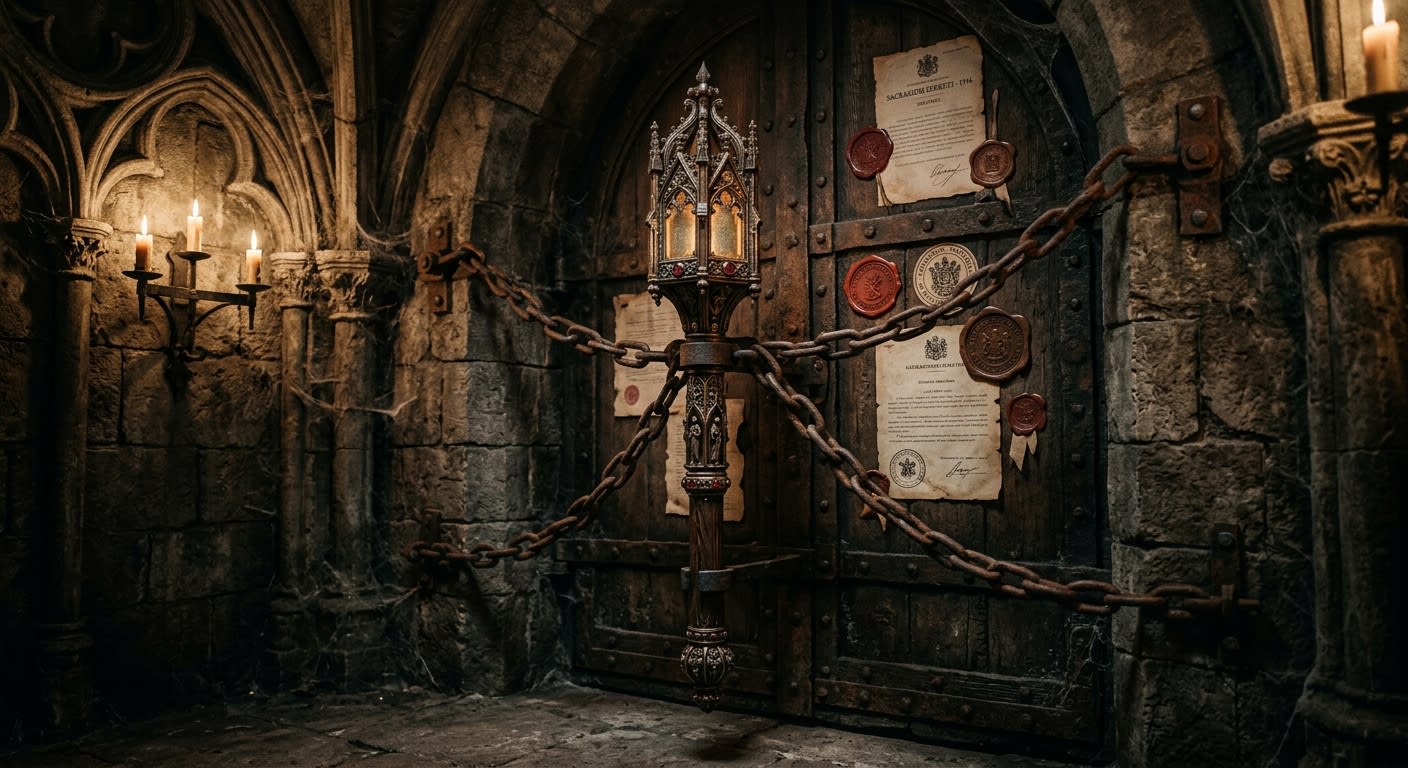
The reliquary mace is preserved at two locations. The Cathedral of Strasbourg displays it on the Feast of Saint Rupert, through glass, at a distance of six feet. The altar at Vienna displays it mounted above the spot where the Blow fell, chained to the wall with consecrated iron. Both displays are authentic. Both bear Bureau seals. Neither location has filed a loan agreement with the other. The Bureau of Relics, when asked to comment on the existence of two simultaneous reliquary maces, responded with a memorandum consisting of the single word: "Yes."
The saint's bones have surfaced elsewhere. In A.S. 147, a joint expedition into the Gilded Chasm — Velmora's territory, where all desire is architecture and every corridor narrows — discovered what appeared to be an authentic finger-bone of Saint Aldebrand in a display case on the second level. The expedition's chaplain reached for it. The consecrated chain linking him to his colleagues snapped. He was absorbed into the display. The Bureau of Doctrine debated for three years whether the relic was genuine. The debate concluded without resolution. The finger-bone remains inside the Vault, presumed authentic, presumed lost, and presumed — in the Bureau's carefully equivocal phrasing — "within a zone of ongoing spiritual jurisdiction."
At Ulm, the Paper Mines report a healing miracle attributed to Aldebrand — miners struck blind by paper-dust recovered their sight after proximity to an undocumented relic in a sealed gallery. The Bureau of Records classified the event as "occupational recovery." The miners classified it as a miracle. The paper-dust continued.
And at Lyon, during the Concordat era, the ashes of Saint Aldebrand are said to have risen from a charnel ossuary, congealing into a figure that pointed its rod at Rationalist clerks. The clerks collapsed. The figure dissipated. This account has been stricken from three separate hymnals and yet it returns with the persistence of a conscience the Bureau would prefer to remain silent. The Bureau of Doctrine's position on the Lyon manifestation: "Unverified hagiographic event. Classification pending. Do not discuss in public settings or at meals."
This entry previously included a speculative passage connecting the Lyon manifestation to the origin of the Judges. That passage has been removed at the Bureau of Doctrine's insistence. The connection, if it exists, is classified above the author's clearance.
I note only that the figure at Lyon carried a rod and wore no face, and that the Judges carry rods and wear no faces, and that the Bureau's insistence that these observations are "coincidental" has been filed under the appropriate heading.
#On Why the Miracle Matters
"Because it happened. Or because it didn't. The Bureau has approved both interpretations."
The Miracle of Saint Aldebrand is the Synod's founding paradox — a relic that was denounced, erased, vindicated, and multiplied, whose existence the Bureau simultaneously denies and celebrates, whose bones glow in seventeen cathedrals and whose mace rests in two cities and whose ashes rose at Lyon and whose finger sits in a demon's trophy case inside a mountain that eats desire.
The Rationalists believed that if a thing could be proved false, it was false. The Synod believes that if a thing has been stamped, it is true. Between these two positions, a war was fought, a continent was sundered, and a bone in a box cracked open a sorcerer-lord's skull and rang the bells of a ruined city. The Rationalists are dead. The bone is still glowing.
I will say this, and I will say it once, and the Bureau may stamp it or burn it as they please: the Miracle of Saint Aldebrand is real. I do not say this because the Bureau has ratified it — ratification is a bureaucratic event, not a theological one. I do not say this because the reliquary shattered Althazar's column — shattering things is a property of maces, not miracles. I say this because the Bureau spent sixty years trying to erase a bone from the Ledger of Creation (Unregistered), and the bone won.
That is the miracle. The rest is filing.