

"Paper lies. Mortar tells." — Causeyworks saying, offered to inspectors as though it flattered them.
#On the Yards, and Why Doctrine Concerns Itself with a Stoneyard
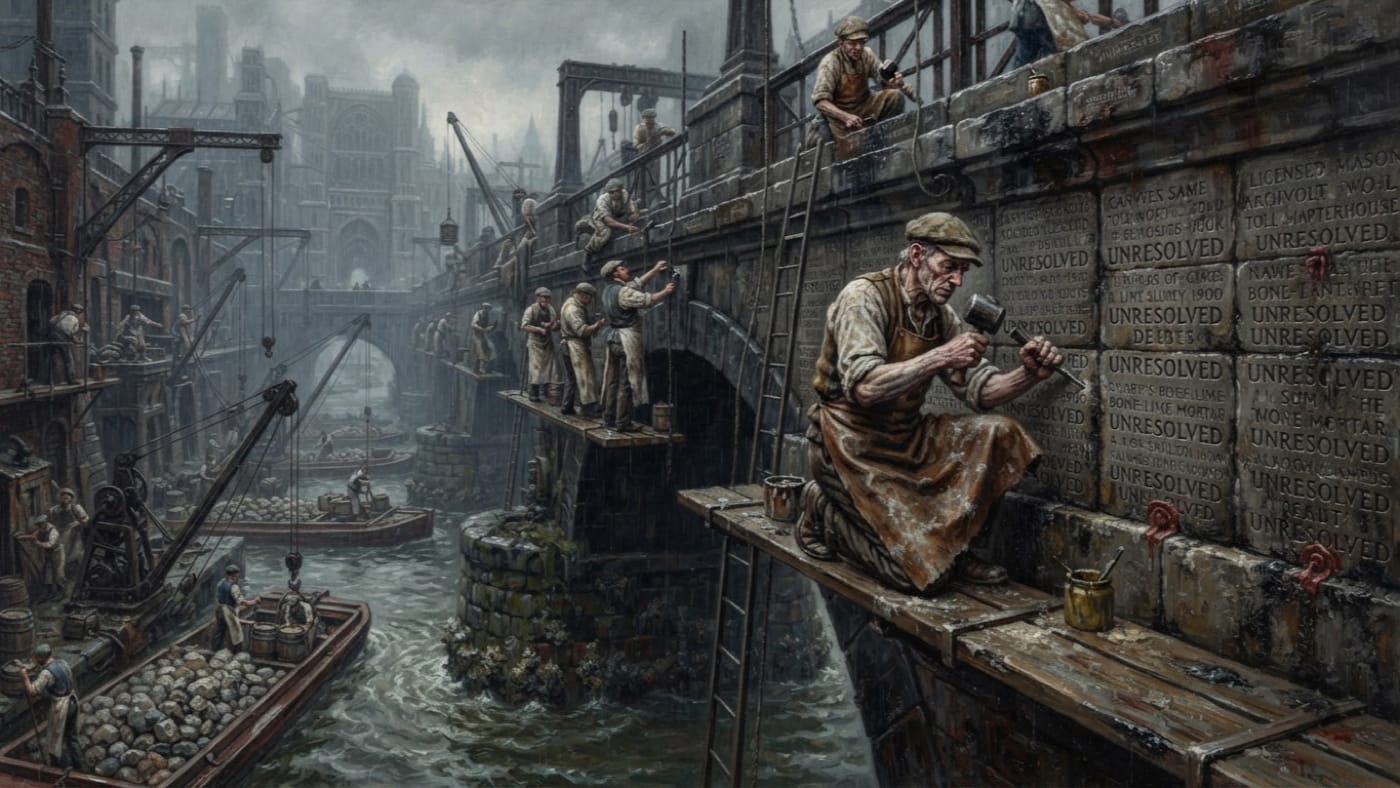
The Stone-Ledger Yards are one of the eight districts of the Archivolt Causeyworks, and the only one where the city's doctrine is made by hand. Archivolt Row recognizes names. Toll Crown sells passage. The Yards cut. They house the guildworks of the Stone-Ledger Masons' Lodge, whose licensed crews carve names, sums, dates, debts and resolutions into the parapets of the city's bridges, and repair the masonry that carries them. The district smells of lime, iron filings and wax. It sounds like a convent of woodpeckers.
The Lodge and the Yards are different things. Visitors confuse them, and the distinction matters to my office: a district cannot be accused of heresy, but a guild can be, and this one frequently is.
The Bureau of Doctrine has an interest in the place because the Causeyworks teaches purity through record and obedience through naming, and because its public catechism holds that stone witnesses never lie. Every other teaching in the city is spoken, sung or pressed into wax. This one is struck with a mallet, in a yard, by people paid by the letter.
#On the Licence to Cut
The Yards are wet the way the whole city is wet, with the wet of the work added on top: lime slurry in the gutters, water running off fresh cut faces, aprons white to the knee and grey above it. Canal water slaps at the footings. Masons go out to the spans along catwalks hung from the bridgework, with iron at the belt and a pot of tallow-wax to seal the new letters against the ledger-drizzle. The drizzle gets them anyway. That fine mineral mist settles on every fresh entry and crusts it white within the season, so a debt carved in spring looks salted for preservation by autumn.
The materials are those of the city: river-stone, bone-lime mortar, salvaged brick held with rust-iron clamps, wax over the cuts, slate where slate is wanted. The Lodge holds the crews, the catwalk access and the quarry contracts that draw on the marsh-quarry villages. Carving without a licence is forbidden in the Causeyworks. In the Yards, the licence is the whole trade.
I will set out the division of authority with the precision of an office that has been lied to by all three parties. Chief Scribe Mael Arct and the Bridge-Scribe Collegium verify names and keep the paper registry on Archivolt Row. Canon-Toller Edris Vane controls crossing through the Toll Chapterhouse. Master Mason Lysa Korr holds inscription authority through the Lodge. Their powers meet at every parapet. They are not a council. The city's formal government is the Toll Chapterhouse, the Collegium and the Lock Authority, and the Lodge is not a fourth chamber, whatever its members say in the barge taverns.
Broadly, the clerks recognize and the masons cut. A stone-entry warrant licenses a carving. A name-correction writ governs what the paper says about a name. A mason does not carve on his own initiative. He does not carve on Vane's word alone either, though Vane would like it known that he could arrange it.
Korr's chisel is older than her registry entry. That is an administrative observation and I make no other. It says nothing about her age, the tool's maker or anything occult. It says the Collegium's paper reached her late, and in the Causeyworks that counts as a biography.
#On Permanence and the Appended Line
This is the doctrine proper. A lawful entry is never erased. When a debt is paid, a name corrected or a dispute resolved, the original line stays where it was cut, and a correction or reconciliation is carved beside it. Both remain. The parapet keeps the debt and adds the discharge, and passers-by read the two together, like a sentence and its pardon bound into one folio.
The stone entry fee is the charge for having a name, debt or resolution carved. Like every charge in the Causeyworks, it is resented in proportion to how long it lasts.
Take a debtor. Any debtor will do; the city has a surplus. He owes the Toll Chapter. The debt is recognized on paper, the carving is licensed, and a mason walks the catwalk and cuts the name and the sum into a parapet on a span he has to cross. From that morning his neighbors read it. His creditors read it. The provosts who walk the causeways read it too, looking especially for the word UNRESOLVED.
The Yards have done nothing to him except write. Toll denial, the flag in the registry and the labour owed against arrears belong to the Chapterhouse, the Collegium and the rest of the enforcement apparatus. The masons only supply the publicity. In a city where the street holds that the stone ledger is the real ledger and paper a temporary lie, the publicity is the sentence.
Now suppose he pays. Arct can alter the paper, and the paper will show him clean. The parapet will show exactly what it showed before, plus a resolution carved beside it. Every morning he will cross over the record of his debt and the record of its settlement, crusted white together. That is what the Causeyworks means by reconciliation.
Korr cannot lawfully remove the original. Her authority over the chisel is an authority to add. Removal is the one service the city agrees cannot be bought. The Undervault Bazaar will sell you nearly anything, but it cannot reliably sell a true uncarving. The work is too loud.
The permanence is a matter of law. Physically, stone weathers, clamps rust and old vaults give way, and the Yards have had their own collapses. A parapet can crack and a span can go into the canal. What the law forbids is erasure by a licensed hand. A fallen inscription has not been erased. It has been demolished, and that goes to a different file and a different bureau.
Their guild, the Stone-Ledger Masons' Lodge, controls what is carved and what is removed.
The Lodge controls what is carved. Nothing lawfully carved is removed. Originals remain beside their corrections, as the same inspection report states in its section on the economy of permanence. The Bureau of Doctrine regrets that its inspector copied the street's idiom into the record as if it were the law.
#On the Masons Who Carve What Is Forbidden
The Bureau of Purity does not care about debtors. It cares about the Mortar Saints, a heretical network that hides forbidden identities and lineages in concealed keystones and coded ornament. These are names the Index Damnatus has struck out, restored in the one medium the city has sworn never to erase. The Saints call this immortality-by-masonry. They mean that the name survives. Whether anything else survives with it is a question for theology, and theology has filed it.
How the Saints relate to the Lodge is disputed. Depending on who was questioned and how, the interrogation transcripts place them inside the guild, beside it or beneath it. Reports in the Bureau's hands say the Saints recruit in the Yards through what are called "apprentice tests." I have no account of what such a test involves, and I will not make one up for the reader's entertainment. An apprentice who passes a test is an apprentice who passed a test. The Bureau does not convict a trade.
The suspicion is not idle. In A.S. 199 a banned name was found inside a keystone cavity of the Stitchbridge, the city's main junction, out of sight of the walkway. That fixes the date of the discovery. It does not date the carving, and it names no carver. The Bureau of Alchemical Standards reported a forty-percent increase in resonance at the span, measured against an estimated date of embedding. That is a measurement compared with a guess. I record it exactly as that Bureau filed it, and with exactly as much confidence.
Some arches respond to spoken names: water shifts, inscriptions sweat lime, candles gutter in rhythm. The designation is Name-Resonance Architecture, Category Three: Pending. It is pending because the Bureau of Doctrine has not decided whether it comes from the Creator, from the Great Deceiver, or from somewhere the catechism does not yet list. Meanwhile a debt notice on an ordinary parapet does nothing but embarrass the debtor. The Yards cut letters. Nobody has shown that the letters listen.
#On the Present Application
Since the Stitchbridge, the masons have been watched. Every keystone set is suspect, and every repair to old work could hide a cavity. The Lodge keeps working anyway, because the Causeyworks cannot stop carving without stopping counting, and it will stop counting when the canals run uphill.
Canon-Inquisitor Silex Marrow holds the Bureau of Purity's authority to unseal keystones in the Saintspan Quarter. The Toll Chapter objected. The Bureau of Records objected. Purity overrode both. As of this filing the audit's outcome is pending. I decline to predict it, having already been corrected once this year for writing faster than the stone.
The rule of the Yards protects lawful entries. Purity holds that a forbidden name was never a lawful entry and so the rule does not protect it. The Saints have placed their names where cutting one out means cutting into a span. That is why the audit was refused so many times on grounds of structural risk, and why the city now waits on an inquisitor who brings his own chisel.
The Yards do not wait. Lime is mixed and wax is warmed, and the mallets start at midday with the toll crush, as they always have. Somewhere on a parapet a resolution is being cut beside an older line, and both will outlast the man they describe.