

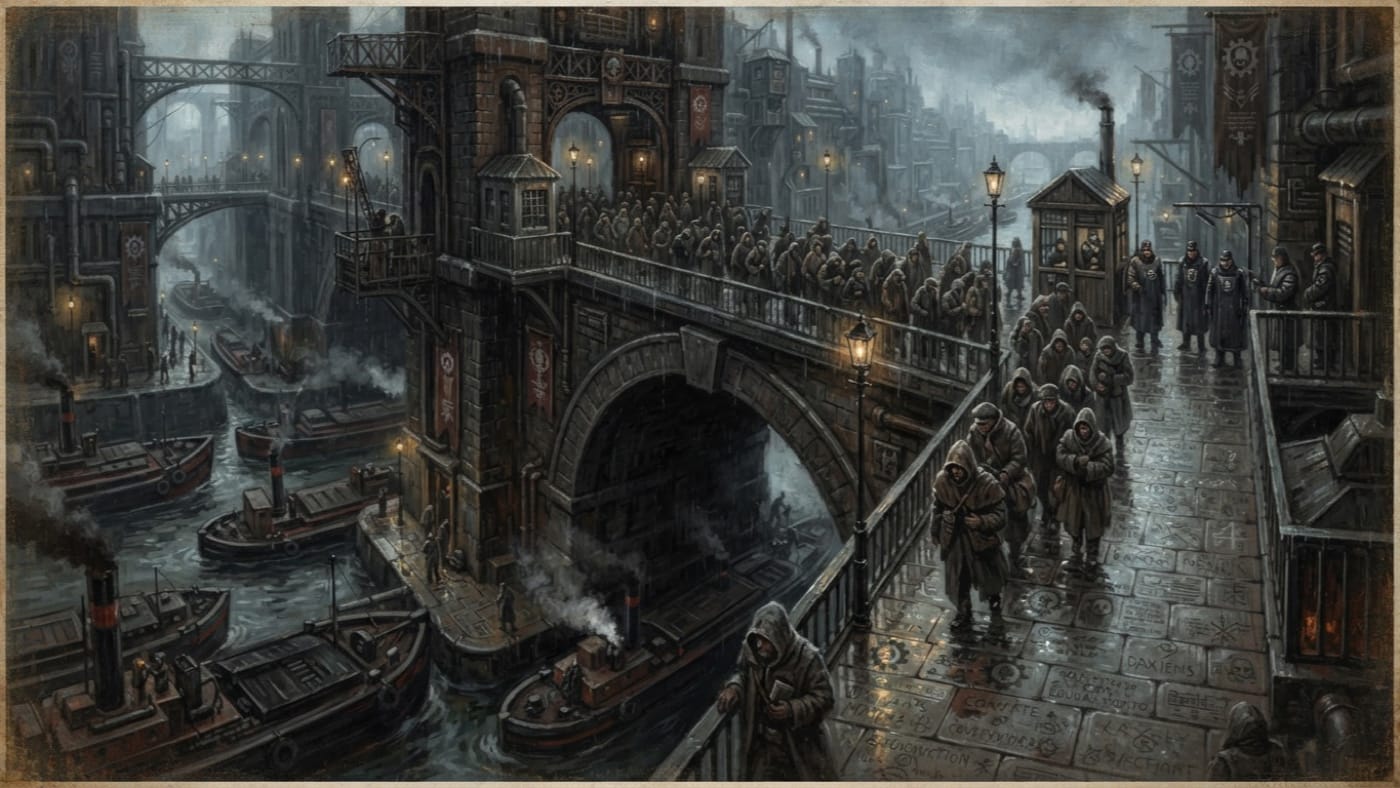
#On the Junction That Everyone Must Cross
"Don't step on the chisel line." — Causeyworks courtesy, recited at every span and observed least at the busiest.
Stitchbridge is the main span junction of the Archivolt Causeyworks, and one of the three chokepoints by which that city takes its living from the River-belt. The other two keep their own trades. The Triple Lock lifts barges and drowns riggers. The Mouth-Sluice admits arrivals and questions them about the weight of their ink. Stitchbridge does neither. It is a crossing, and the city has arranged itself so that crossing it is unavoidable.
I wrote in my second inspection report that every barge and every pilgrim passes through Stitchbridge. The sentence stands. I keep it in two parts because the junction does. Water traffic passes through the canal junction below, and foot traffic passes over it on the walkway above. Each queue blames the other for the delay, and each pays the same Chapterhouse.
The Bureau of Records would like this article to begin with a classification. I decline. Stitchbridge has a classification problem, and the problem is the subject of this article.
#On Wet Stone and the Registered Voice
The crossing is wet. This holds for the whole Causeyworks, but at Stitchbridge it becomes a public-safety matter. Ledger-drizzle crusts the inscriptions white. The paving holds a film of water at all hours. Lamps are set along the approaches so that inspection can go on after daylight fails, and the glare off the wet stone is enough to blind a man for three paces. On a crowded walkway three paces is plenty of room for a fall. The city's own hazard notes list stampedes at Stitchbridge. They give no date, no death toll and no famous disaster, only the plain administrative fact that a narrow wet place full of frightened people tends to empty itself badly.
They are frightened because the Causeyworks governs by name. Every crossing asks for one. A bridge-scribe verifies it. A toll warden checks the pass against it. The pious touch the arch with two fingers and speak their registered name aloud, and the less pious do the same thing more quickly. An unregistered name spoken carelessly on a span earns a fine at best and the attention of the Bureau of Purity at worst.
The stone keeps what the voice declares. In the Causeyworks a bridge is also a record office and a court. Names, debts, sums, dates and resolutions are cut into the masonry for any passer-by to read. A correction never replaces an entry. It is carved beside the old one, and the two stay there together for the edification of everyone walking to market. The system is cruel and the system works, and those two facts do not conflict. It works because every lawful name in the stone has been paid for, licensed, verified and placed in the open.
Consider, then, a name the city never licensed, never verified and never displayed. It sits inside the structure, and everyone who crosses carries it on their backs without knowing.
#On the Keystone Cavity
In A.S. 199 the Bureau of Purity reported a banned name inside a keystone cavity of Stitchbridge.
The particulars that are on record are few. The cavity cannot be seen from the walkway. It sits where the weight of passing feet bears down on it, and every debtor, pilgrim, clerk and porter who crossed above pressed lawful weight onto forbidden syllables. Someone chose that spot on purpose. A name hidden where nobody walks is a secret. A name hidden under the city's busiest crossing is a sermon.
The public record does not give the name. The Index Damnatus struck it once already, and the Codex does not do the Great Deceiver's copying for him. The name of the person who found it is not on record either. The finding is filed to Purity as an institution, and I will not invent a hero for a bureau that does not use them.
The Bureau of Alchemical Standards then sent a team to examine the bridge. That team reported that the resonance at Stitchbridge had risen forty percent since the name's estimated date of embedding. Readers will want more from that sentence than it holds, so I will set out exactly what it says. The forty percent belongs to the team's report, and I have only signed the paper it was copied onto. The starting point is an estimate. Nobody knows when the carving was done; the team only estimated it. The report I have seen does not describe how the increase was measured. It names no mechanism. It does not say what the bridge would do if the name were taken away, and the record does not say the name was ever taken away. It records a cavity, a name and a figure.
In A.S. 194, Inspector Corris of the Bureau of Alchemical Standards attributed the city's Name-Resonance phenomenon to "mineral moisture interacting with vocal vibrations in enclosed stone environments."
The explanation is withdrawn. Inspector Corris has been reassigned, and the phenomenon remains classified as Category Three, Pending. Moisture does not choose where a keystone cavity goes.
The Bureau of Doctrine's position is that the Stitchbridge finding establishes three things: a forbidden identity was placed inside public stone, it was placed under traffic deliberately, and an official team then measured a change it judged significant. Whether that change is the Creator's rebuke, a demonic answer, or something the masons understand better than the theologians has not been decided. I would rather report an open question accurately than settle it falsely and sign my name to the settlement.
#On the Tightening of the Crossing
The response was administrative, so it was fast where it cost the administration nothing and slow everywhere else.
Raids increased. The Toll Chapterhouse ordered emergency crossing inspections. Two years later, at the documented present of A.S. 201, none of it has eased. Inspections at the crossing take longer. Tolls are higher. The Lock Authority calls "safety closures" more often than before, and the barge unions call them extortion. Both descriptions survive in the record, and only one of them gets a seal.
The three officers who actually run the city each answer the finding in their own way. Canon-Toller Edris Vane holds crossing access, so for him the scandal is about the queue: who passes, when, and at what price. Chief Scribe Mael Arct holds identity verification, so every name presented at the walkway is now checked twice, and the second check costs money. Master Mason Lysa Korr holds licensed carving and reconciliation, which means her Lodge must keep proving that its chisels cut only what the Collegium authorised.
Above them the bureaus divide the matter by appetite. Records cares about jurisdiction, Purity hunts the name, and Alchemical Standards studies the stone. None of them has asked what the porter pays, so I record it. He pays a higher toll on a longer wait to cross a bridge that may be closed. Lawful trade gets squeezed, the squeezed go down into the Undervaults, and the Undervault economy grows in step with every new precaution.
#On Masons, Saints and the Problem of Attribution
The obvious suspects are the Mortar Saints. They are a heretical network that preserves proscribed names and lineages in concealed keystones and coded masonry, and they call this immortality-by-masonry. Doctrine treats the phrase as a boast about preservation. It is not evidence that any soul has survived in granite, and I do not allow a cult's sales pitch to set the Church's metaphysics.
The method fits Stitchbridge. The record stops at that fit. No surviving finding names whoever carved the cavity. No finding proves that any civic officer took part. How the Saints relate to the Stone-Ledger Masons' Lodge is still disputed. Interrogation transcripts place them inside the Lodge, beside it and beneath it, depending on the transcript. The old faction registers also mention a stone-scribe guild under the Archivolt name that encoded banned names into bridges. I note it. I will not merge a guild label, a licensed Lodge and a heresy into one body because all three own chisels.
Reconciliation is lawful, because a correction carved openly beside an existing entry is how the city tells the truth. A concealed carving is a different thing. It adds an identity the ledger never accepted, in a place the ledger cannot read. One should also not confuse the cavity with a keystone sliver, the portable contraband sold in the Undervaults. A sliver can be smuggled away. A cavity in a working keystone stays where it is, and every foot that crosses keeps pressing on it.
#On the Warrant and the Present Disposition
Canon-Inquisitor Silex Marrow holds an active A.S. 201 warrant under Purity seal. Its main concern is the Saintspan, the vault in the Saintspan Quarter whose classification is still Category Three, Pending, with no settled starting date I am prepared to print. The warrant's written scope goes further. It covers comparison cuts at Stitchbridge, tool marks in the Stone-Ledger Yards, and the Bridge-Scribe Collegium's correction slates.
That makes Stitchbridge the bridge he measures the Saintspan against. Its cavity is already known. Whatever Marrow cuts at the Saintspan will be compared with what he cuts there. The comparison has been authorised. The cuts have not been reported as complete, nothing taken from the Saintspan has been entered into evidence, and nobody has been prosecuted. Under the Bureau of Doctrine's countersignature the theological verdict stays pending.
Marrow also holds a separate coastal audit at Saffron Bastion, two to four days away by road. No evidence put before me ties that business to this one, and I will not invent a link.
For now the crossing carries traffic, and the queue takes longer to clear.