

#The Office as Surveyed in A.S. 201
This survey of the Storm Warden's office was compiled in A.S. 201, which is 1911 by the Common Era's reckoning, for the frontier files of the Bureau of Doctrine. The date above is the date of the paper. The office is older than the paper. If the bells hold, it will outlast the paper too.
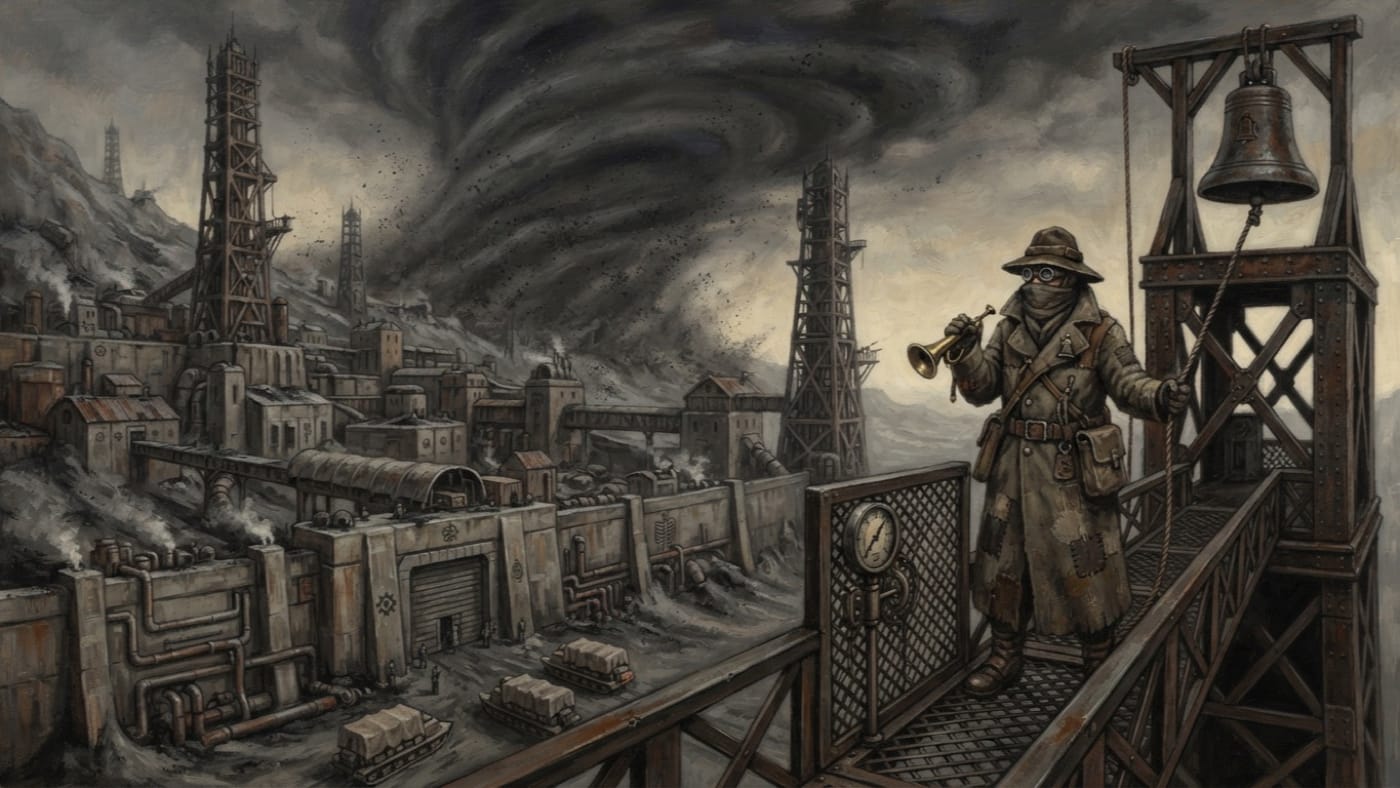
In Black-Snow Lor, a Storm Warden is someone who watches the weather for a living and wears a bell pin to prove it. The title names a profession practised from the Ribwatch Towers above the berm line, on the Carpathian edge of the Sagittal Line. Taken together, the Wardens make up the Storm Warden Corps, which serves Lor as its militia and civil defence. At the head of the Corps stands one commanding incumbent. At present that is Storm Warden Ilex Marr, who controls the bell that orders closure.
Lor confuses these three things on purpose. A Warden on a tower can warn the town. A Warden on the approach road can seal it against an ash-sled. A Warden in the gate passage can detain a man whose permit smells of fresh glue. In the record I was shown, none of them closes Lor on personal judgement. That command is attested in Marr's hand and nobody else's. A clerk who blurs the distinction in a report should spend one storm on the wrong side of it.
#On the Lookouts Who Became Wardens
Lor began in A.S. 71 as Storm-Shelter Node 14-C. It was a checkpoint built by the provisional frontier administration, the body that the Concordat of A.S. 90 later settled into the Synod. After the shelter was founded, convoy lookouts were posted to rib-frame towers above it and paid in filter cloth. Their task was to tell weather that would ruin a convoy from weather that would kill it, and to shout the difference while shouting could still help.
Shouting turned out to be insufficient. A warning obliges no one. A convoy master with a schedule and an angry quartermaster will drive straight into a black horizon unless someone has the authority to stop him. Over time the warning hardened into an order to prepare, and the order to prepare hardened into closure. Once the town learned to obey closure, it became power.
The records available to this survey do not say when the lookouts became Wardens. They do not say who first rang a bell that compelled rather than advised, or what charter, if any, recognised the change. By A.S. 143 the Corps was firmly established. Patterned particles at window seams were first recorded in that same year. The shared date proves how old the Corps is and nothing about the snow. The Year of Ash Rain was a wider calamity and belongs in a different file.
#On the Watch and the Three Bells
The Warden's ordinary work is less dramatic than the bell and takes far longer. Wardens watch the approaches from the towers through grit that scours the lens of any eye foolish enough to stay open. They keep the storm-cycle records, the ledger-cycles by which Lor plans its seasons. They maintain the closure diagrams that say which passages shutter, in what order, and who stands at each seal. They pass warnings along the berm line. They organise the bell-line runners and warn the ash-sled traffic on the flats, whose drivers listen for the first bell the way a penitent listens for his sentence.
I asked Marr how a forecast is made. The answer came as a list: cycle tables, particulate loads, pressure clicks in the lattice screens, and the intervals between sightings of the runners on the approaches. I record these as the methods Marr reported. I was shown no instrument or formula, and I saw no gift of prophecy. Anyone who claims the Wardens foresee storms has never read their amendments.
The signals are fixed. One bell warns. Two bells call for preparation: shutters slam, stalls come down, and the streets move toward shelter with the speed of people who have done this before and buried those who were slow. Three bells order closure. The Filter Gate, Lor's only protected entry, is locked, and the Breath Cordon, the inner boundary of protected shelter, is sealed.
The bell locks nothing by itself. Gate-hands lock the gate. Householders drop the bars. Wardens and provosts stand at the Cordon seals. Every shutter that closes on third bell closes because a person with cold iron in both hands has heard the bell and decided to obey it. The sound does not drive off the storm either. The storm takes no notice of it. Getting through the Filter Gate is also no promise of a place inside a safehouse. The Wardens' diagrams govern where closure happens. Who sits behind it is decided in other ledgers.
The diagrams are also not the vent map. The Breath Office keeps the official airflow plans. The practical map, the one that shows where air actually goes, belongs to the Vent-House of the Bone-Guild of Rib and Reed. A Warden knows which passage seals at third bell, and nothing in the Wardens' papers says what happens behind it.
#On the Discretion to Close
The commanding Warden's authority amounts to one judgement: when to ring three. Ring too early and the people outside die. Ring too late and the people inside die. The ledger-cycles exist to make that judgement look like arithmetic, and the off-cycle storms exist to show that it isn't.
The best-documented case comes from late A.S. 199. No exact day is recorded. During an off-cycle storm, Marr rang closure eight minutes before the Breath Office posted its official warning. Twenty-seven civilians were left outside the Cordon, along with two ash-sled crews and one convoy chaplain. The chaplain was found fused to his own reliquary case. The papers I could consult do not record what happened to the others individually, and I will not invent their deaths to round out a paragraph.
The Breath Office lodged a protest. Marr replied on a single page: The storm arrived nine minutes after first bell. Your notice would have buried three hundred. The timing and the estimate are both Marr's. The three hundred is a commander's counterfactual, not an audited count of lives saved, and it should be cited with that in mind.
Breath Office memorandum 199-B characterised the late A.S. 199 closure as unauthorised panic and a loss of clean-minute revenue.
Amended after casualty review. The closure was procedurally excessive. It was also correct. Both findings stand in the same file, and the Office continues to quote only the first.
Procedure lost on that occasion and the town survived. Lor rarely gets both results, and the people outside the gate got neither.
#On the Offices a Bell Requires
Formal government of Lor is shared by the Synod Frontier Chapterhouse, the Line quartermaster's office and the Storm Warden command. Each can obstruct the other two. A closure is something only the Warden command can impose on the other two. The quartermaster resents it because convoys cannot pass sealed gates. The Chapterhouse tolerates it because no theology overrules suffocation at third bell.
Command does not operate in a vacuum. Breath Comptroller Juno Varr controls the ration records, access to the Clean Room and the allocation of shelter places. Varr's office sells or assigns access, and Marr's bell can cancel that access mid-sale. That is why the two offices need each other and hate each other so precisely. In the Warrens, Varr is accused of selling the same air twice. The accusation remains an accusation.
Rib-Mother Sael's Guild maintains the bell frames, tower lattice, shutters, screens and seals that turn the bell into a working instrument. Since the Bureau of Purity compliance review of A.S. 197, the Guild has also held inspection rights over safehouse upgrades. A Warden can order a shutter closed. If the shutter was badly fitted, the order still fails. A rope runs to a frame, and Guild hands keep the frame tensioned.
Lor's own account credits the Corps with an interest in "priority shelter," meaning the lists that decide who is hurried inside first. The papers I saw show discretionary admission decisions and bitter disputes over lists. They show no payment received by Marr, and I decline to invent one.
The bell's authority reaches past the gate. The Ash-Chapel of Saint Lorn kneels at the first bell, the second and the third, and prays for Marr by name at each. After a closure, the Chapel takes in the storm-orphans it leaves behind.
#On the Present Watch
As of this A.S. 201 compilation, the office works under conditions its ledgers did not foresee. Off-cycle storms have grown worse since A.S. 199. The Wardens' forecasts have failed three times between then and now. That counts three predictions that failed, not every storm that came. Filters clog unusually fast, and some clog from the inside, which is a phrase I have copied as I found it and refuse to interpret.
Marr has asked for filter cloth, lamp oil and more bell-riggers. The Bureau of War has approved the request in principle. A principle cannot be wrung out and refitted to a mask, and none of the three items had arrived when this survey was compiled. The towers keep watch on wet cloth and rationed oil, and the existing riggers climb more often than they should.
Meanwhile Varr has issued emergency safehouse permits to contractors outside the Guild, and Sael has threatened a work stoppage in response. If the stoppage comes, it will reach the Ribwatch Towers: bell frames left untensioned, screens unwashed, seals unpatched. At the time of compiling it had been threatened and not begun. I record no outcome, because none was recorded.
The Wardens are still at their posts, wearing their pins in the grit, listening for pressure clicks in the screens and counting the intervals between runners on the flats. The rope is still in the hand that holds it.