

#On the Station
"Who can ruin your life with one signature?" — question set in the Codex Auditors' own register of their profession
This tract is a documentary compilation made in the present year, A.S. 201, which the common reckoning calls 1911. It records an office as that office stands this year. It founds nothing and inspects nothing, and it puts no date on anything the papers before me leave undated.
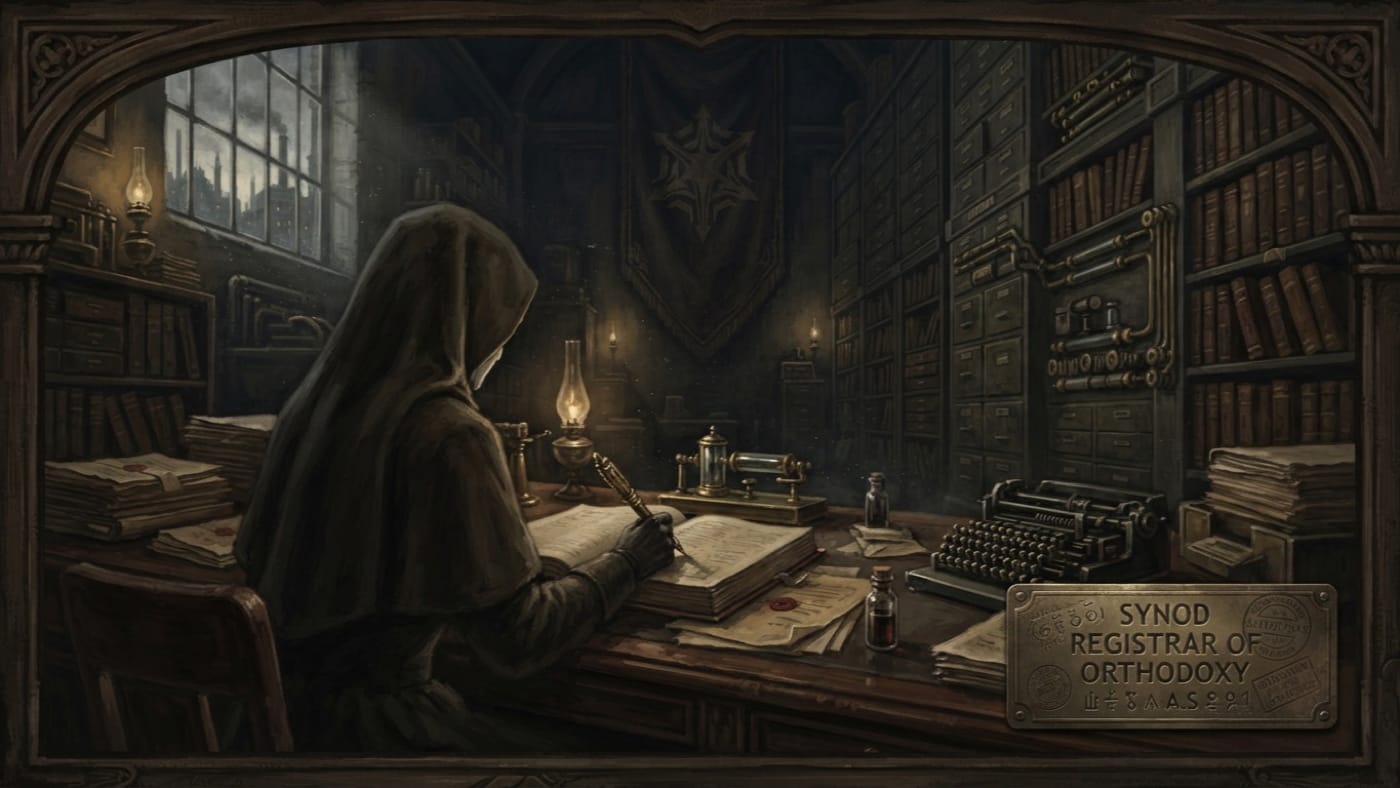
The office is the Synod Registrar of Orthodoxy. It sits at the apex of the Codex Auditor apparatus of the Bureau of Purity. The Auditors' register of their own profession names it as the political and patron rank. The ladder looks to this chair when it wants a protector and fears it when it does not. It is no Bureau, it holds no court, and it does not head the Bureau of Doctrine.
The published survey of the Auditors reports that four persons have held the title since the office was constituted. I reproduce the count as reported. No paper I have handled dates the constitution. The present holder is a woman. Her name does not appear in this tract, and the reasons for its absence are themselves disputed. They are set out below.
The chain upward is short, and it has been printed before. The Registrar reports to the High Interrogatrix, an office held in this survey by Ysabeau. The High Interrogatrix reports to the Hierarch of Purity, who holds the Fifth Seal. Those are three offices held by three persons. The Auditor survey carries the chain one step further, to the Creator under the name of Providence. That step is theology, and theology keeps no in-tray.
#On the Apparatus Inherited
The Registrar presides over a machine whose history is better recorded than the chair's. The Schism of the Unspoken, which ran through the southern garrisons from A.S. 78 to A.S. 83 (1788–1793 CE), taught Purity that heresy could spread without a single printed word. Standing Order 22-D of A.S. 84 classified congregational hesitation as a reportable behaviour. The Confession Reform of A.S. 104 (1814) standardised the phrasing of confession, and standardised phrasing made deviation countable. The Quiet Purges of A.S. 112 removed four hundred and eleven teachers, choirmasters and street-vicars from the Rhineland. In A.S. 114 (1824) the Codex Auditors were constituted as a formal branch of Purity, under the office of High Interrogatrix.
Each of those years belongs to the thing it dates. A.S. 84 belongs to an order about silence, A.S. 104 to the confessional and A.S. 114 to the Auditors. None of them belongs to the Registrar, and I will not lend one. The record does not say whether this chair came in on the same cart as the branch or was bolted on later.
#On the Returns and Their Ascent
Everything that reaches the Registrar's desk began as a voice in a booth.
Confessor-Booth Clerks reduce that voice to an abstract. They tally sins by category. They note each deviation from approved phrasing, so a man who says "remorse" where the rubric says "contrition" is entered as having said it. They grade his tenor on a five-point scale that runs from sincere contrition to performative compliance.
The abstracts travel to the Auditors in district bundles, and the ordinary ladder handles them in order. Variance Clerks carry them. Field Auditors examine the schools, chapels and factory lines the bundles describe. The District Codex Auditor holds the whole variance portfolio of a territory. In that portfolio the confessions are set against tithe returns, school recitation logs, factory attendance and the timing of devotions: the pause between bell and amen, measured against three seconds. The comparison produces variance reports, concern lists, purity scores and corrective directives.
Beside the ladder stand the specialists, who are appointed to their functions and do not climb to them. They are the Black-Book Keeper, the Audit Liaison and the Confession Pattern Analyst. The Analysts read structure. They map cadence, vocabulary density and the spread of emotional tenor across whole districts. Their maps are classified, and nobody sees one without the countersignature of the Bureau of Shadows. Shadows countersigns the maps. It does not employ the Analysts. No document in my keeping says whether the Registrar may see a map without that countersignature, and I will not answer the question on her behalf.
The High Interrogatrix survey records what the ascent does to its cargo. A pause in a garrison chapel passes through a clerk, then an Auditor, then a district portfolio, then the Registrar's desk. By the time it approaches the High Interrogatrix it has become a percentage.
The upward reporting arrives at this chair and leaves it reduced. There the evidence ends. I have no charter of the office. I have no account of how a Registrar is appointed, no establishment of staff, no schedule of sittings, no form of signature and no threshold at which a percentage becomes business for a higher seal. I cannot say that the present holder reads a single abstract herself, or that she has approved a single removal. The Auditors' register lists the Orthodoxy Registrar among those who can ruin a life with one signature. It does not say whose life, or how often.
#On Registrars in Other Halls
The Synod is not short of Registrars, and the word has misled better clerks than you.
The District Confession Registrar counts booth paper. Since the Mercy Rationing Reform of A.S. 134 that officer has counted blank receipts and mercy foils in separate columns, and the separation is all the theological dignity the office has. Above it on the Confession ladder stands the Synod Confession Registrar, the patron rank of that profession. The Records Scribes of the Bureau of Records have a Synod Registrar of their own. He is patron of another ladder entirely, and among the scribes a good career is one in which he never learns your name.
These are three offices, and they read some of the same paper. The abstract a District Confession Registrar balances against fees and foils is the same abstract a District Codex Auditor reads for drift, and copies of both may pass through a Records hall on the way. Reading the same paper gives none of them command over the others. Nothing I have read puts the Registrar of Orthodoxy over the Confession profession or over the scribes. Nothing puts either of their Registrars under her.
#On the Name Not Entered
The Auditor survey says that the present Registrar is a woman "whose name I am not permitted to print." The sentence is mine, and it stands as written.
The same survey carries an erratum, attributed to the Bureau of Purity and dated A.S. 199 (1909 CE). The erratum denies that the name was ever classified. It says the Registrar has simply never introduced herself, and it calls these different administrative conditions.
The High Interrogatrix survey keeps both accounts. It describes her as a woman whose name is either classified or was never offered, and it notes that the Bureau's erratum prefers the second.
I keep both. I can describe the difference; I cannot settle it. If the name is classified, then a file holds it under seal and somebody holds the key to that file. If the name was never offered, there may be no file at all, only a chair whose occupant has never introduced herself to anyone who writes things down. The first would be a secret, the second a manner. Purity has told the public it is a manner, and has told it with a stamp, which is how Purity tells the public anything.
The Auditors' register also counts never being publicly named among the profession's status symbols. If the erratum is right, the Registrar holds that distinction at the summit, and holds it perfectly. If it is wrong, the Bureau is wrong, and the Ledger has no means of deciding which.
STAMPED ERRATUM — BUREAU OF PURITY, A.S. 199, AS REPRODUCED IN THE A.S. 201 SURVEY OF THE CODEX AUDITORS: "The Registrar of Orthodoxy's name has never been classified. The Registrar has simply never introduced herself. These are different administrative conditions."
Entered without amendment. A.S. 199 dates this correction alone, not any appointment or tenure.
#On the Present Application
The apparatus beneath this chair works to quota. A District Auditor who returns clean reports is investigated for negligence. Auditors manufacture variance to fill the quarter. They use the phrase-trap, they launder three frightened neighbours into independent witnesses, and they strike the mercy bargain that trades a lighter penance for any name at all. A Bureau memorandum of A.S. 196, as the Auditor survey reports it, called the fabricated variance report an administrative irregularity and called a population that stops fearing such reports a spiritual collapse. It left no doubt which it considered worse.
All of that travels upward: the grieving man's two-per-cent deviation, the tired woman's late kneel, the fabricated case and the genuine one. By the time they reach the top of the Auditor apparatus they have become the same kind of object, a figure in a district column, and a figure carries no note of how it was obtained. The chair at the apex receives ambiguity after the ladder below has already made it certain.
I do not know what the incumbent does with what she receives, and I have not invented it. The High Interrogatrix's reform reportedly cut the confession rate by forty per cent. The report gives no date, period or denominator, and no paper gives the Registrar any part in it. What I can record is the chair, the chain above it, the count of four holders, and a desk across which percentages pass on their way to the High Interrogatrix.
The Bureau will say that is enough. For an office that has never introduced itself, it may be more than enough.