

#On the Entry Rank
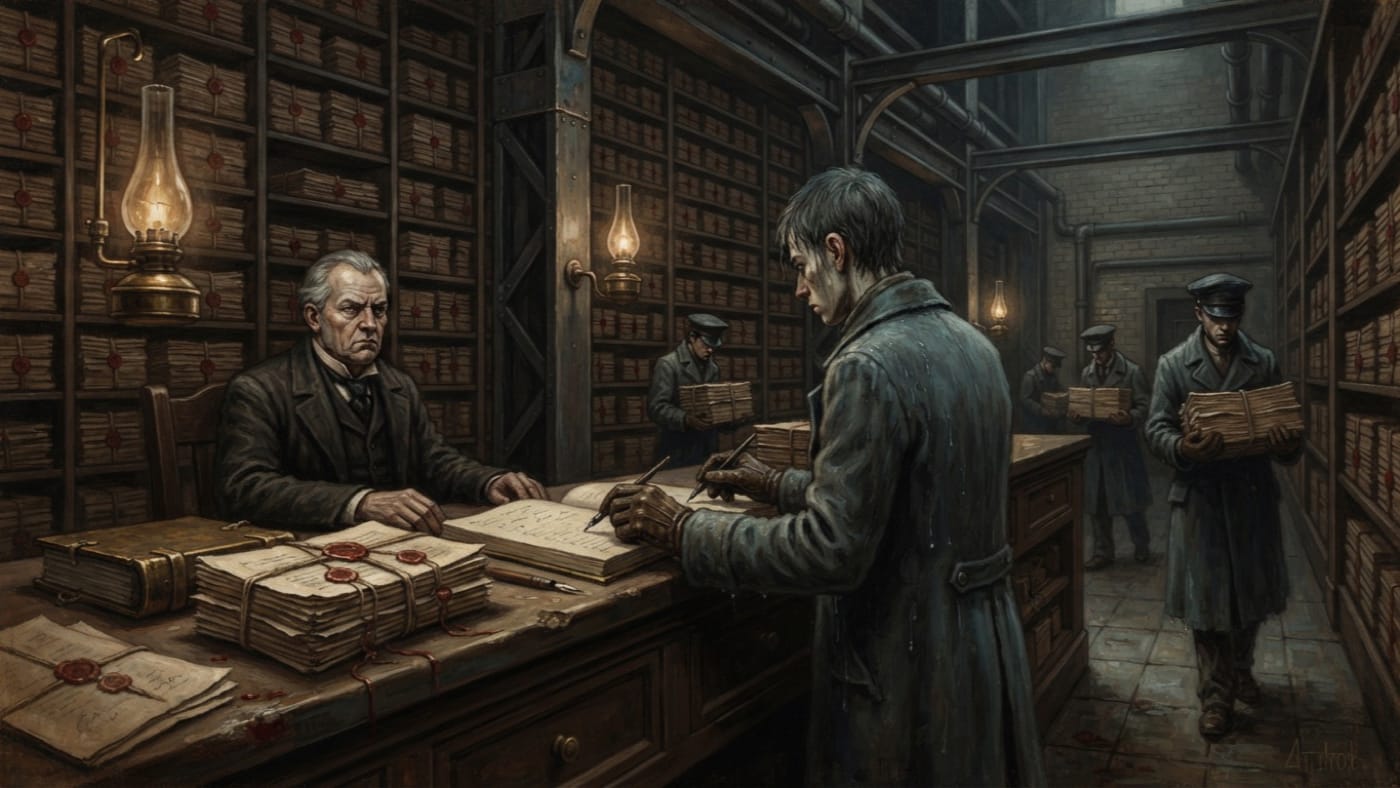
The Variance Clerk is the lowest rung of the Codex Auditor apparatus. Its principal instrument is the forearm. The Bureau of Purity lists the rank on its internal ladder beside an older and more honest name, Transcript Runner, and the older name describes the work better. The clerk carries. Confession returns leave the parish annex tied in cord and closed with wax. They reach the district audit chamber because a young person in a muted coat and gloves walked them there, signed for them, and went back for the next bundle.
I have watched them arrive at Records counters at the end of a sweep. Their hems are damp, their glove-tips are grey where the wax has flaked, and they wait at the receiving desk with the stillness of novices who have already learned that waiting is observed. They do not read what they carry. Reading is the business of the room behind the desk.
The branch they serve has a short official history and a longer real one. The Schism of the Unspoken, A.S. 78–83, taught the Church that silence could spread. Standing Order 22-D made congregational hesitation reportable in A.S. 84. The Confession Reform of A.S. 104 made deviation countable. The Quiet Purges of A.S. 112 proved that removal could proceed without trial. Purity constituted the Codex Auditors as a formal branch in A.S. 114, and the Variance Clerk stood at the foot of its ladder. No document in my keeping names the first clerk to sign for a bundle. Someone did. Someone always does.
#On the Paper Carried
The cargo begins in a booth. A Confessor-Booth Clerk hears the penitent and reduces the voice to an abstract on the form fixed by the Bureau of Rites. Sins are tallied by category and frequency. Each departure from approved phrasing is entered as spoken, so a man who says "remorse" where the rubric requires "contrition" is recorded as having said it. His tenor is graded on a five-point scale that runs from sincere contrition to performative compliance. The abstract is no transcript. The penitent's sentences are gone by the time the ink dries. Only their measurements are kept.
Records Scribes copy and register what the annex produces, because nothing in the Church exists until it exists twice. The Variance Clerk then takes the district's returns into the Auditors' keeping. That walk between the annex and the audit chamber is the whole of the rank's documented office.
The form has a column for the word a penitent used in place of the approved one. It has no column for why he used it. The cough that broke his cadence, the night shift that emptied his voice, the rotten tooth that turned contrition into something lisping and suspect, the burial he came from that morning: none of it survives the abstract. The clerk carries a man's deviations without his circumstances. I approve of the design. Circumstances are expensive to file.
At the district office the returns are set against tithe records, school recitation logs, attendance sheets and household devotions. That comparison produces variance reports, concern lists, purity scores and corrective directives. The clerk produces none of these and makes all of them possible, which is as much as a junior office may hope for and more than most of them deserve.
#On the Lesson of the Choir
The novice's first doctrine is five words long.
Their first case is older than any of them. Every Variance Clerk learns the choir case of Blessed Marrow-Eye Lestine, the restricted blessed whom the Auditors keep as their internal patron. The choir had passed ordinary inspection. Attendance was perfect and confession receipts were current. Lestine listened once and heard hesitation in the harmony. The interviews she ordered produced nothing. She filed variance on the shape of that nothing: no ordinary error anywhere, and every singer denying in the same way. Thirty-seven voices were condemned. Two copyists were reassigned to silence labour.
The lesson is set for carriers because carriers handle receipts. A current receipt certifies that a confession was processed. It certifies nothing about the soul that made it. A parish whose returns arrive spotless, uniform and early is a parish the district office will want to look at twice, and the clerk who carried those returns must learn to feel uneasy about them. The clerk is not asked to judge. The clerk is asked to stop being reassured.
A devotional broadside still found folded in junior primers states that Lestine uncovered an organised heretical choir-cell devoted to counter-harmony against the Creed.
Withdrawn. No cell was proven and no doctrine was recovered. The Bureau of Purity teaches the case anyway, on the hesitation alone.
Her last document is kept from the junior desks. Field Auditors copy her self-report by hand, and its final line is withheld from them until promotion. The Variance Clerk is told that the report exists and that it was correctly sealed. In a curriculum like this one, the saint's own words come with seniority.
#On Advancement and Scrutiny
The ordinary ladder has three rungs. A Variance Clerk may rise to Field Auditor and conduct institutional examinations of schools, factory lines and chapels. A Field Auditor may rise to District Codex Auditor and hold a territory's whole variance portfolio. The Confession Pattern Analyst, the Black-Book Keeper and the Audit Liaison stand beside the ladder. Those specialists are appointed to their functions and do not climb to them. Above all of it sits the Synod Registrar of Orthodoxy, an office whose appointment is no business of a junior's.
No promotion examination for clerks has been entered in any record I am permitted to cite. I will not write one in to tidy the page. What the record does describe is how the branch inspects itself. Supervisors check an Auditor's sources, the chain of custody for evidence, the phrasing logs, and whether the random samples were random. They begin with the exceptions, meaning the people the Auditor cleared.
Chain of custody is where the clerk lives. Signature on a receipt, bundle counted at the annex, bundle counted at the desk. Every bundle that is lost, late or opened without authority is traced back through the signatures until it reaches somebody's name. The Auditor record is frank about who gets sacrificed when pressure rises: informants, junior clerks, or an Auditor conveniently labelled overzealous. It is just as frank that one recognised punishment for a failed Auditor is demotion to transcript duty.
#On the Cost of Listening
The clerk does not read the abstracts. The clerk still hears everything the annexes say. The branch begins its day with brine on the hands and mouth and three counted breaths before speaking, and a novice who works among Auditors takes up their habits long before their title. The rooms are bright and they smell of chalk dust, hot wax and brine-scrubbed stone. Pauses are measured there as a matter of course, until the novice starts measuring them as well.
The Auditor record names the profession's disease echo. Its symptoms are listed plainly: washing beyond the ritual, counting pauses in ordinary conversation, insomnia that keeps time with the bell schedule, and eventually the conviction that one's own prayers contain variance. The Bureau of Doctrine has its own opinions about what else might answer when doubt is counted aloud in the dark. Those opinions belong to Doctrine. The superstition against reading an abstract aloud after midnight is older than any clerk now carrying. Purity classifies echo as a performance metric indicating excessive conscientiousness. It does not appear on any clerk's list of duties. It shows up in the clerks' habits anyway.
Quotas reach the clerk too. A district office that sends up clean reports is investigated for negligence. Toward the end of a quarter the bundles thicken and the walks grow longer, and the clerk at the desk can feel which returns are wanted before anyone has read them.
#On Present Employment
In A.S. 201 the rank stands where the branch first set it, at the foot of the ladder and at the door of every district audit chamber. Abstracts still move from booth to annex to desk. Street-vicars still feed the annexes. The Bureau of Records still copies the copies. Every bundle still needs a pair of gloved hands and a signature, and the Bureau has never found a cheaper way to keep the two together.
The Variance Clerk has no seal authority of its own and asks no questions. It does not appear in any public chart that matters. It knows the choir case by heart and has not been shown the last line of Lestine's report.