

Documentary survey compiled A.S. 201 / 1911 CE from the Calais coastal registers, the Chapterhouse calendar and the published Codex accounts of the harbour. The year belongs to this compilation. It does not date the rite's founding, any particular inspection or any earlier edition of these notes.
#On the Two Names
Calais keeps a storm-season observance under two names. The Synod Coastal Chapterhouse enters it in its calendar as the Breakwater Inspection Rite. The town calls it Teeth Day. The two names cover the same occasion and record different interests in it. The first is about work. The second is about a crowd.
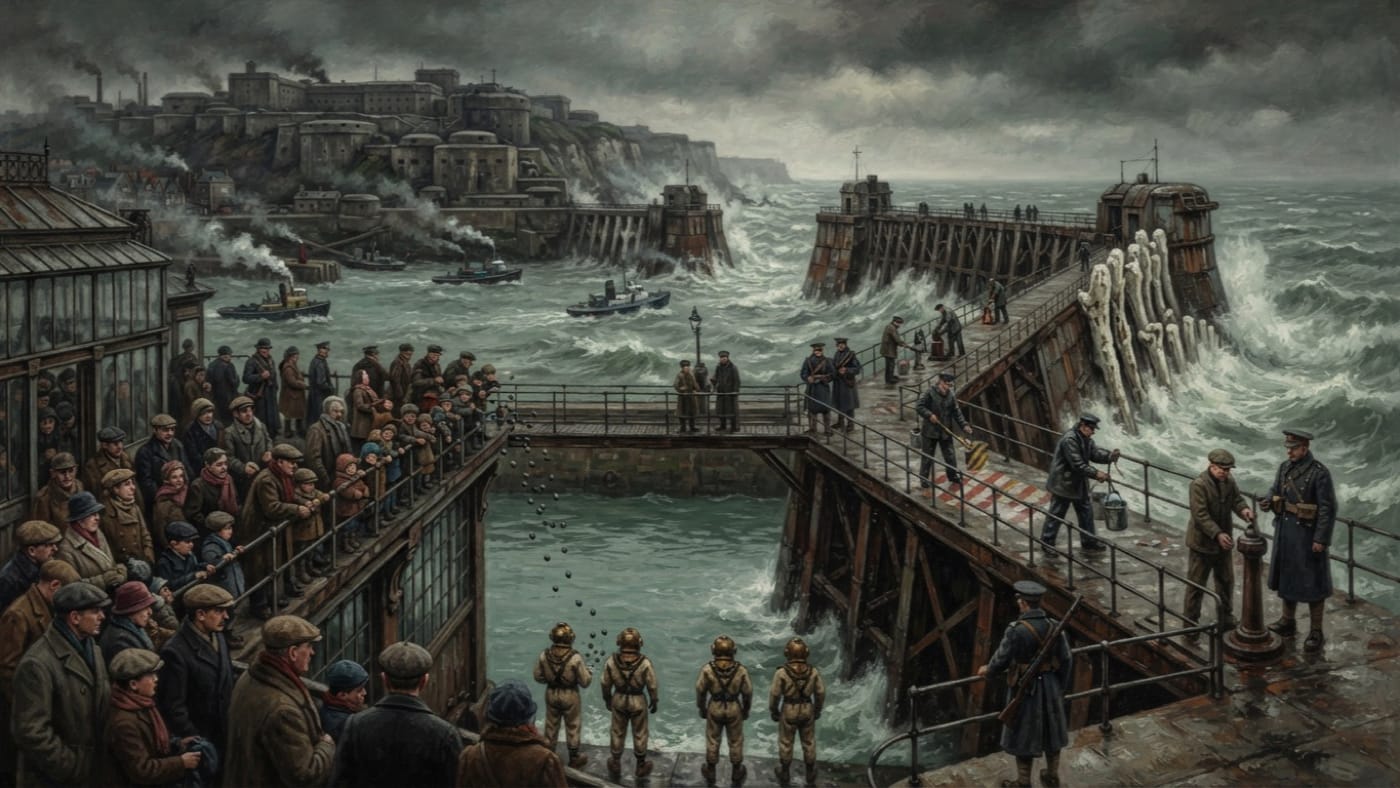
The work concerns the four fortlets that narrow the harbour mouth of Calais: North Tooth, South Tooth, Crown Tooth and Low Bite, known together as the Teeth. They are built of iron, chalk-lime and chainwork, and their pilings are recovered calcified remains of the Undertide. The crowd is made up of civilians who climb the safe galleries above the harbour in the worst weather of the year to watch the inspection.
The survey can certify the season. It cannot certify a day. No record available to this office gives a fixed date for the rite, and none of the calendar entries I have seen ties it to a feast, a tide table or an anniversary. Storm season arrives when the Channel decides it has arrived. The Chapterhouse calendar follows it.
#On What Is Inspected
The Teeth were raised in A.S. 74 / 1784 CE, three years after the Great Breach of A.S. 71 / 1781 CE, when the sea caves under the Chalk Redoubt opened inward and the town learned what came up through them. The offices that built the Teeth belonged to the coastal administration before the Synod. The formal Synod took its constitution in A.S. 90, sixteen years later. Ledgers that credit the work to "the Synod" are writing retrospectively, as the Bureaus' ledgers commonly do.
Those dates concern the breakwaters. They establish nothing about the rite.
Inspection is needed because the Teeth spend the whole year being worn down. Chalk-lime spalls under frost and salt. Iron rusts beneath its tar. Salt-wax cracks along the collars that hold the pilings. Kelp grows back faster than it can be cut, and the hazard marks painted along the walks fade under spray until a man in fog cannot tell a safe ledge from a fatal one. Storm season makes all of this worse, so before the storms do their worst the Chapterhouse looks at the jaw and counts what is loose.
The published accounts are frank about the condition of the jaw in A.S. 201. The outer collars are overdue for replacement. Salt-wax stores have been diluted twice. Oil is short, divers are too few, and the workers on the walks are stretched. The pilings still repel the Undertide. They also hum after heavy contact, and in A.S. 188 they were recorded moving against their collars. No office has explained either report, and this survey does not attempt to.
#On What the Gallery Sees
What follows is the practice as the published accounts describe it. I have kept each practice with the people who perform it, and the crews on the walks apart from the people watching from the galleries.
The chainmen repaint the hazard marks. This is the plainest act of the day and the most useful. Spray strips the painted warnings on the fortlet walks, so the chainmen renew them by hand in full view of the galleries. The crowd tends to treat this as ceremony. The chainmen treat it as the job.
The novices of the Gunline Choir strike practice taps under supervision. The Choir keeps custody of bell practice at Calais, and Cantor-Major Pell keeps its fire-chart. A novice's tap on Teeth Day is struck under an instructor's eye for training and display. It is not Sequence Two. It clears nothing, and it carries no authority to aim a gun or push fog off the harbour mouth. I record the difference plainly because a town that confuses a lesson with a defence will eventually be taught the difference by the sea.
Children throw waxed salt beads toward the inner water. The beads are thrown from the safe galleries into the harbour's sheltered side, never out over the outer grilles toward open sea. The record does not say what the families mean by them. I have entered the custom and left its meaning blank. Doctrine would no doubt write a meaning in if asked, so I have not asked.
The Undertide Divers spit over the rail. This is their own custom and they give their own reason. They say it is not done for luck. As they tell it, the sea needs reminding which fluids still belong to men. I report the explanation as theirs. It is the only interpretation of any Teeth Day custom that comes with the practitioners' signature attached, and that alone makes it the best-documented doctrine of the occasion.
An earlier entry in this Codex stated that the rite began "after the first full storm season in which the Teeth held," and attributed to its first keeping several further customs and a shortened reading of the names of drowned builders.
Corrected for this survey. No record available to this office establishes when Teeth Day began, who first kept it or what was done at its first keeping. The construction of the Teeth in A.S. 74 dates the breakwaters and nothing else. The further customs lack independent support and are withdrawn. A later entry stated that no official name for the liturgy survives. The Chapterhouse calendar gives one, the Breakwater Inspection Rite. It gives no order of service, and this survey supplies none.
#On Who Holds the Keys
On Teeth Day each office at Calais keeps exactly the authority it already has, and this survey has found no single officiant over the whole occasion.
The Chapterhouse governs the coastal installation and its forts, and so it keeps the inspection on its calendar. It also provides the marines. They hold the boundary that makes the day survivable: civilians on the safe galleries, the crowd off the outer grilles. The galleries are open. The walks, collars, rope stairs and diver ledges are not, and a spectator does not join a fortlet crew just because the weather is dramatic.
The Choir keeps its bells. The Divers keep their knowledge of the water, which no other office can take from them. The chainmen keep their paint pots.
The Salt Tribunal, ratified at Calais in A.S. 84 / 1794 CE, has found a use for the occasion. Published accounts say Salt Tribunal Row treats the gathering as a chance to sell temporary viewing permits. I record this as reported revenue. It does not show that the Tribunal founded the rite, owns it or directs the inspection. The surveyed papers give no fee, no attendance figure and no rule saying who may buy a permit. Nor should the permits be confused with the separate fee authority over emergency access to the Teeth that the Tribunal obtained in this Amber season. That grant concerns emergencies. The permits concern spectators. In Calais both go to the same office, and most things eventually do.
#On the Drownings
The local record says drownings rise around Teeth Day. I enter that sentence as it stands. The surveyed papers give no count, no list of names and no breakdown by place, and I add none.
Several explanations are available, and the record proves none of them. Storm season brings surge and rip currents to a coast that has both all year. A harbour mouth narrowed by four fortlets runs fast and confused in a squall. More people near the water means more people who can go into it. None of this needs the Undertide. None of it rules the Undertide out either. The record does not say that anyone drowned from the safe galleries. It does not say that the drownings happened at the rite. It does not say why they happened.
The quays fill the gap with talk. I leave the talk on the quays.
The custom that comes closest to an explanation is the oldest one on the walks: no whistling on the Teeth. Custom there is stricter than any statute, and the rule holds on Teeth Day as on every other day. Nobody gives a reason. The harbour is defended by bell intervals and threatened by something that hears them, and nobody in Calais thinks the reason needs saying.
#On the Present Inspection
In A.S. 201 the Teeth hold under Amber, and the Breakwater Inspection Rite is kept under the same conditions as everything else at Calais. The collars are overdue and the wax is thin. Every lamp on the walks burns from a dwindling oil store shared with the Wall. The marines guarding the galleries are men the Chapterhouse also needs on the quarantine cordon. The divers at the rail will have to work the water under the fortlets afterwards. The novices tapping for the crowd are learning the grammar that the harbour mouth will one day require of them under fog, with no instructor present.
The Gunline Choir was certified in A.S. 92 / 1802 CE. The Teeth have stood since A.S. 74. Neither date tells us anything about Teeth Day except that the town has had breakwaters to inspect and bells to practise for a long time. The rest of what the record says about the day is simple. Once a storm season the jaw is examined. The town comes to watch and the marines keep it on the galleries. Children throw wax at the inner water. Someone sells the view.