


#On the Chapter Above the Mouth
The Synod Coastal Chapterhouse is the chapter and military government of Calais. It sits on the Crownline above the Chalk Redoubt, in officer quarters cut over the gun galleries, and it exists to keep the western coast quiet. Its public face is holy vigilance. Its methods are decrees, drafts, and quarantines. Its resources are the garrison, the writs, and the gun keys. The registry gives its territory as the Crownline and the Teeth forts. That is a modest description for an office that can lock a harbour, summon every throat in a city to a cliff at midnight, and send a woman into a sea cave on a form printed in advance for her death.
Calais calls it the Chapterhouse, or simply up there, with the small lift of the chin the town keeps for weather and superiors. Records calls it the Synod Coastal Chapterhouse, and so shall I, because Records pays for the ink.
Its commander holds the rank of Commander-Prior. As of A.S. 201 the office has belonged for nine years to Sabelle Morn, who sleeps on a cot beside an open window so that she can hear the fog bell before her clerks do. She commands the garrison, the quarantine cordon, the wall defence, the readiness of the guns, the lockdown of the harbour, and the emergency levy of readers. On paper that is everything. In practice the Chapterhouse commands every part of Calais except the parts that keep it alive. The bell-fire chart belongs to the Gunline Choir. The sea passes belong to the Salt Tribunal. The working cave maps belong to the Divers. The names belong to the Wall, and the Wall answers to nobody with a seal.
The Chapterhouse can compel obedience in all of these people. It cannot compel any of them to be competent, and competence is the only thing the sea accepts as payment.
#On the Year Before the Breach
In A.S. 69 the military office that later ledgers style the Bureau of War requisitioned the chalk headland. Fishing vessels had come home with their vocabularies rearranged and their manifests dated weeks ahead. Engineers came from the interior, cut gun galleries into the cliff, and told themselves that artillery could correct the sea. For that year Calais was a redoubt without a government: men with guns and nobody to report to.
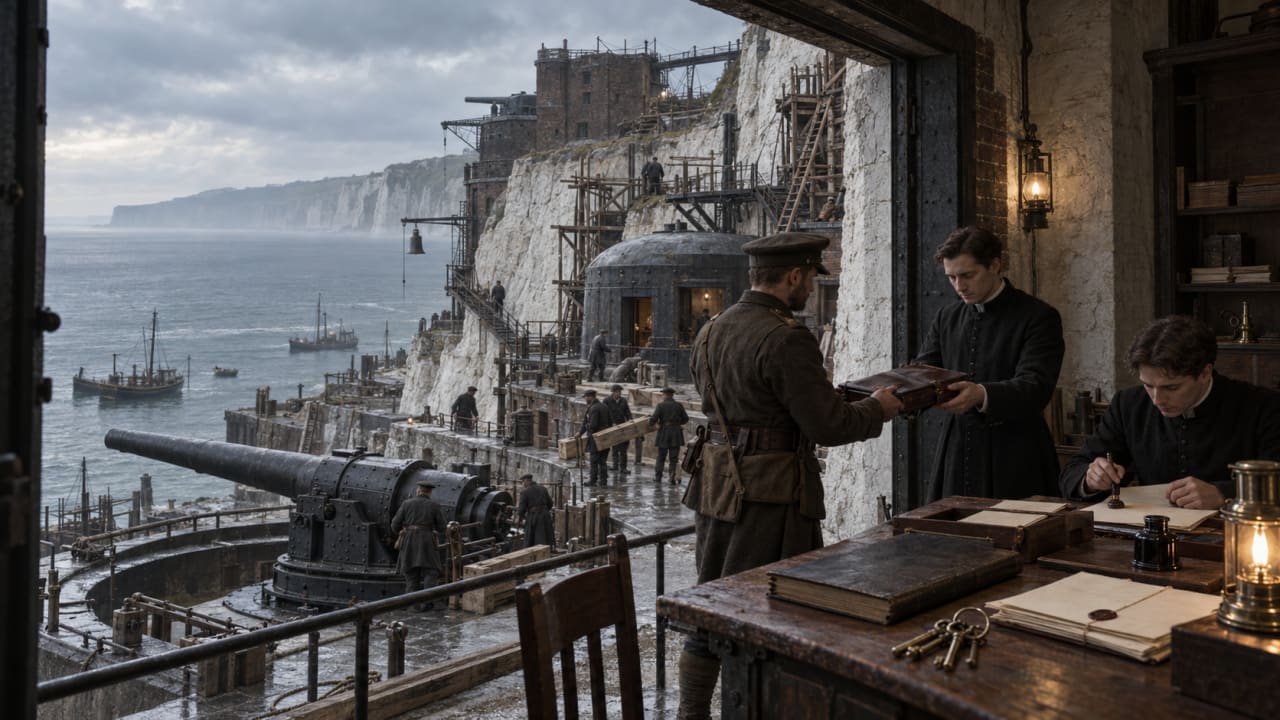
The chapter followed in A.S. 70. I have found no founding charter in any cabinet I am permitted to open. I have no name for its first commander that I would sign, and no record of the day its first writ was sealed. What survives is the bare entry: a local coastal chapter, established, seated above the guns. The word Synod in its title is a courtesy of hindsight. The formal Synod took its constitution at Strasbourg in A.S. 90, two decades after the chapter's first clerks sharpened their quills. Records holds that an institution is called whatever its latest stationery calls it.
The Great Breach came in A.S. 71, when the chapter was barely a year old. During a west-hush the sea caves opened inward. Watchmen came home walking and already drowned. Lamps moved beneath the harbour with no hands to carry them. Black brine seeped from the chalk ceilings. Hundreds died before a makeshift bell-choir drove the things back with signal bells, cracked cannon rims, powder ladles, and one chapel handbell now locked in the Index Damnatus for excessive acoustic efficacy. The garrison held doors, carried bodies, and learned that bayonets have no opinion the sea respects.
Every later power of the Chapterhouse grew out of an emergency that refused to end. When the water drew back it left bodies in the vents and cisterns. Someone had to fetch them, so the recovery dives began, and the expendability form that governs them still carries the year in its number. Recovered things would not stay classified. The then-commanding authority had the barrels carried into the net-drying cellars under the quay, where a clerk scratched temporary holding on a lintel. It has stayed temporary for a hundred and thirty years. When the fog came in, the chalk began to write names. By A.S. 74 the Teeth stood in the harbour mouth and dive duty was permanent. The chapter began as a garrison command. Within five years it also ran a sacrament, a morgue, and a corps of professional drowners.
Its neighbours came later, each with keys of its own. The Salt Tribunal was ratified in A.S. 84 and brought tide-files and pass law with it. The Gunline Choir was certified in A.S. 92 and put an order of bell-gunners in charge of the improvised acoustics that had saved the city in 71. Each ratification gave Calais something it needed and took something from the Chapterhouse.
Frontier maps of the inherited series label Calais the "western Line anchor," and the error has followed the town's chapter into correspondence that styles its commander a Line officer.
Corrected under Geographic Harmonisation, A.S. 201. The Chapterhouse governs a coastal redoubt and Channel installation in Zone 1. It holds no position on the Sagittal Line, no authority over Dover, and no jurisdiction over British hulls beyond the passage arrangements the Channel and the Crown permit.
#On Government from the Crownline
The Crownline smells of wax, ink, and warm stone. The rest of Calais smells of wet chalk, salt, rope, brass, and wind, which tells you where the warmth is kept.
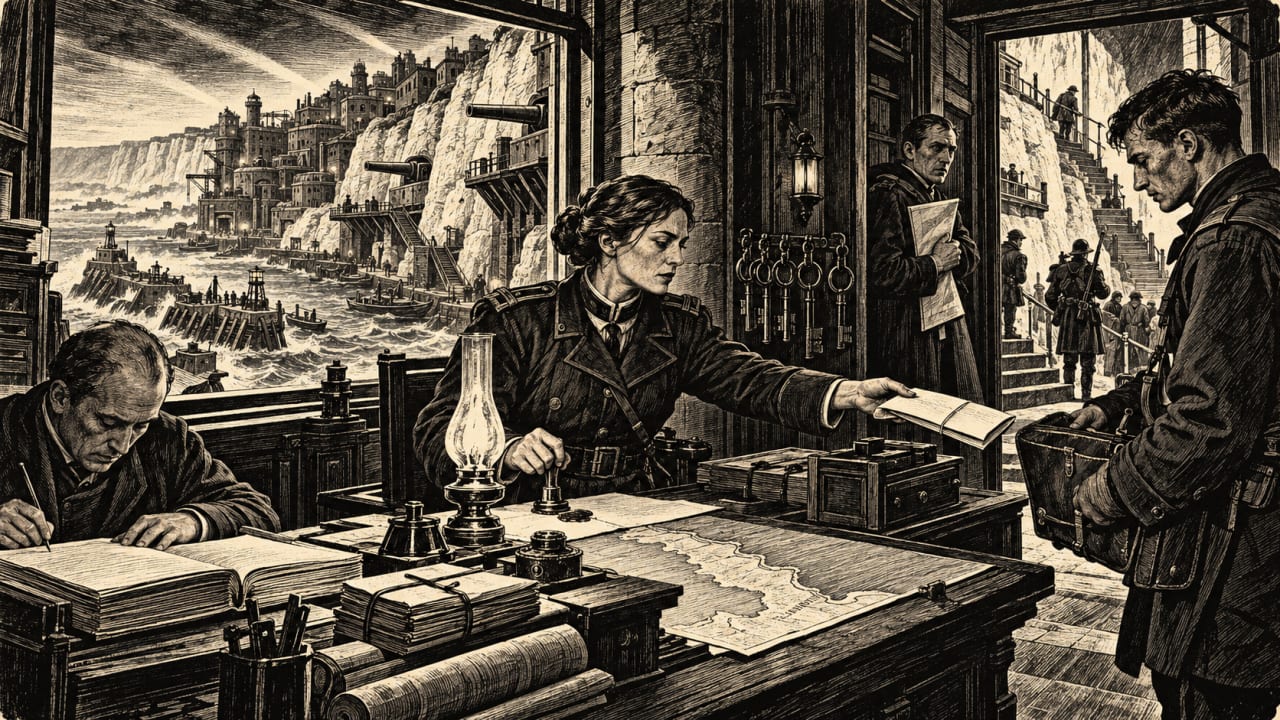
From those rooms the Chapterhouse rules by instrument. The garrison rotation decides which marines stand on the Teeth in storm season and which stand at the quarantine cordon on the quays. The quarantine writ decides which family sleeps at home tonight and which sleeps behind brine-washed brick. The readiness order decides whether powder is broken out, whether the casemates are manned at half or full, and whether the sea-gate closes at curfew or an hour early. The lockdown order freezes the harbour. The reading levy summons voices. Night-watch conscription, sandbag labour, and the drafts that send debtors onto wet stone come down the cliff stairs in the same leather cases, carried by runners who have learned to deliver bad paper without stopping.
The Commander-Prior's office holds coastal charts, breach alarms, quarantine writs, powder tallies, lantern-oil requisitions, diver casualty ledgers, and a drawer of rejected circulars from War. That inventory describes the government better than a constitution would. Every object in the room is either a permission or a count. Permissions go down the cliff and counts come back up. The city in between is expected to make the arithmetic true.
A writ cannot trim a wick, and a lockdown order does not caulk a collar on North Tooth. The registry lists the Chapterhouse's own trigger as Undertide signs on bell chart, and that phrase should be read slowly. The chart that sets off the chapter's alarm is kept by the Choir. The Chapterhouse has written the start of its own emergency into another office's custody, and it cannot even begin to panic without asking first.
Morn runs this machine without ornament. She remembers names, which is a dangerous habit in Calais. She hates waste: waste of oil, of voice, of punishment, and of circulars that praise vigilance while withholding lamps. She kneels in the Chapterhouse chapel and reads tide tables during the homily. I see no conflict between the two. The Creator made tides before He made chaplains.
The chaplain in question, so far as the registry permits me to say, is Chaplain Rook, whose hands are stained with chalk. That is all I can certify. His career, his powers, and any connection between those hands and the chapel's former bell lie outside every file I have read.
#On Neighbours Who Keep Their Own Keys
The registry says the Chapterhouse is allied with the Tribunal and wary of the Divers. Both statements are true. At Calais an alliance means two offices defending the same city by squeezing different parts of it.
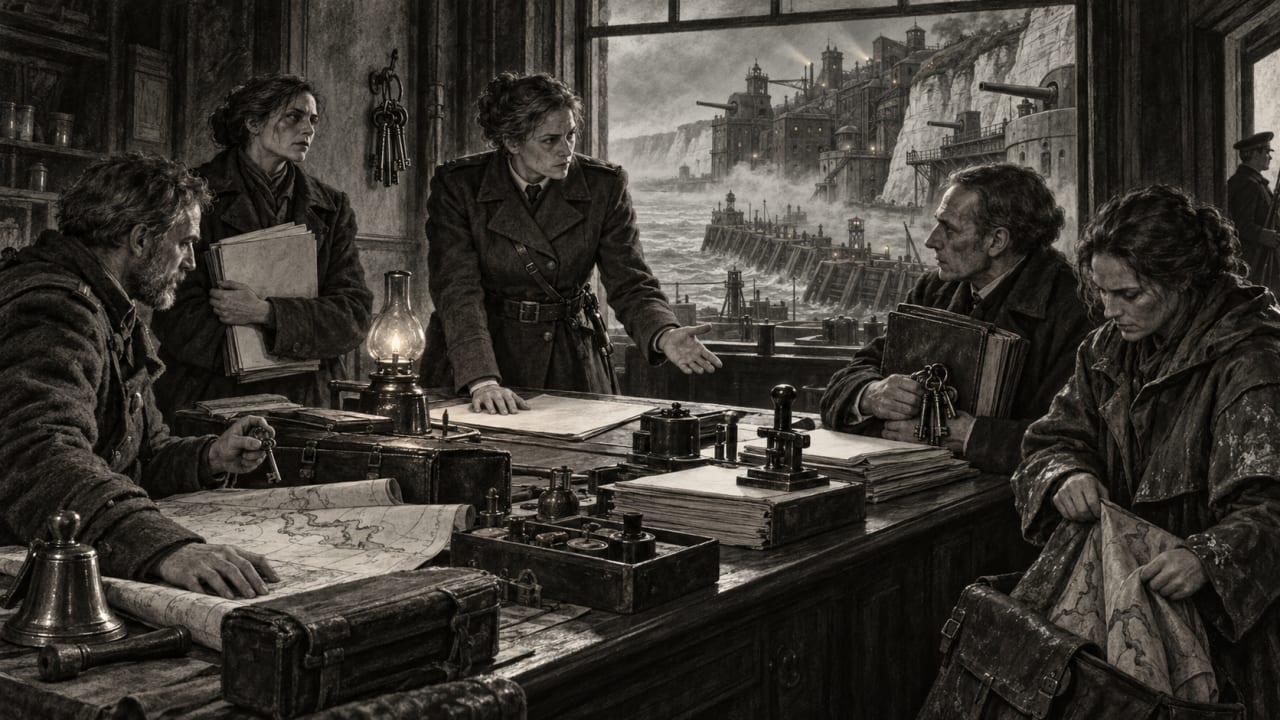
Seal-Justice Corvin Hald holds the sea passes, the cargo seals, the tide-files, the denials, and the fiscal restrictions on leaving. His power rests on one fear, the fear of being trapped on land when the water rises, and he farms it like a good tenant. Every pass application comes with a confession attached. Every confession comes with a cargo seal attached, and a denial waits behind both. The Chapterhouse can close the harbour with a single order. It cannot make one skiff legal. When Morn needs a boat crewed in an emergency, a man evacuated, or a recovery team carried across the inner water, Hald's ledger comes first, and the ledger has a long memory and a fee schedule. This Amber season the Tribunal asked for fee authority over emergency access to the Teeth. It was granted before the Chapterhouse's request for iron. A Bureau may be slow to save masonry, but it has never been slow to price a stair.
Cantor-Major Pell holds the bell-fire chart and sleeps with a copy of it. The Choir guards the chart against Tribunal audit, and against Chapterhouse curiosity whenever curiosity can be called an audit. It is one of the few things in Calais that cannot be bought. It is also the only thing that turns a gun order into a defence, because the seven repulsion sequences depend on tones and timings that Pell counts in his sleep. Morn can order the guns to fire. She cannot make a mis-toned bell forgive her. The Chapterhouse gives the command, and the Choir decides whether the command means anything.
Fog-Reader Captain Lute Auvray holds the reading rosters. The Chapterhouse declares the levy: so many voices, on such a night, for such a section of the Wall. Auvray decides whose voices. Hers is the most intimate fear in the town, the fear of finding your own name on the chalk with your own mother assigned to read it. The Chapterhouse needs that fear and leaves it with her. A commander who chose the readers herself would spend her nights on family histories instead of guns.
None of these officers is a department of the Chapterhouse, and each can delay it. Hald can stall a movement until it no longer matters. Pell can withhold a sequence until conditions are right. Auvray can refuse a throat she knows is cracked. In theory the Chapterhouse can punish all three. In practice it punishes nobody it cannot replace, and in Calais nobody can be replaced in less than a generation.
#On Administering the Night Reading
When the fog comes down the cliff, the Fog Bell Tower strikes three short, one long, three short. From then on the Chapterhouse is quarrelling with the weather, and its paperwork turns into a liturgy performed in the open.
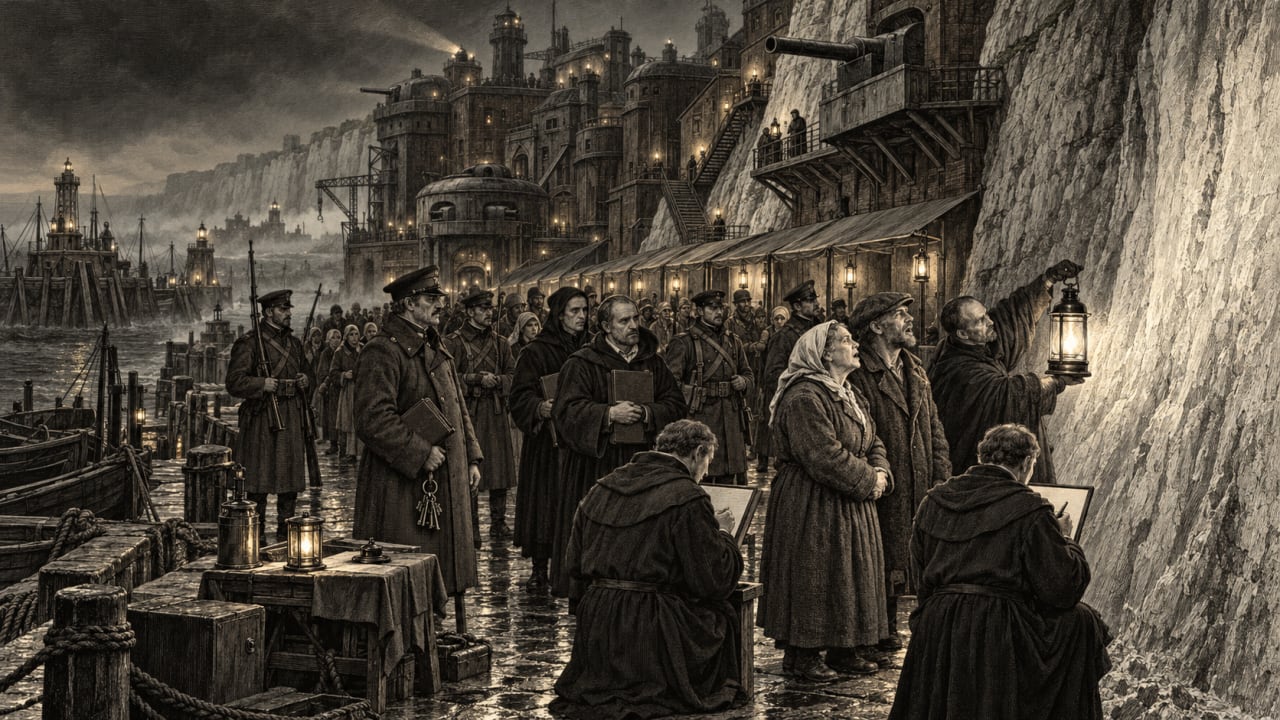
The emergency reading levy is the chapter's broadest power, because it reaches every household. Every house in Calais owes voice and sleep: fishermen, salvagers, chalk-lung miners, widows on the lamp-wick stair. The tax is paid in breath, and the Chapterhouse can call the debt in at any hour the fog chooses. Readers take their stations under Auvray's roster. Lantern-bearers angle their light across the wet chalk of the Script Wall. Chalk Scribes kneel with waxed slates. Doctrine copyists stand behind them, so that every name spoken has a frightened witness ready to swear it was spoken correctly.
The Chapterhouse works around the rite, not inside it. Marines hold the approaches. Silent-Step wardens hold the corridors where speech is forbidden. The quays are locked and curfew is in force. The Divers stay ashore unless a rope is already in the water. Officers on the Crownline watch the harbour for the stillness that follows a sinking. If a name sinks unread, the harbour answers. A skiff does not come back. A diver's rope goes slack. A child in the Chalk Warrens wakes with saltwater in his lungs. At that point the Chapterhouse sounds the harbour bell, holds the dives, extends the lamp corridor, and drafts quarantine orders for whoever answers to the wrong name at dawn.
The chapter's rules for broken readings come from a file Morn did not write. In A.S. 188 a reader on Roster 14-F recognised a daughter's name and left his position before the final consonant. Morn did not command Calais then. She inherited the file, the corridor, the families, and the conclusion written in the margin, which her watch order now makes binding: no reader stands alone. Under the Crownline watch order as she revised it, the commander or an appointed prior attends each fog reading. If a reader recognises kin, a second reader takes the breath-position at once. Punishment for a broken roster waits until the voice record is secured.
CHAPTERHOUSE FILE ANNOTATION — ROSTER 14-F, A.S. 188 Inherited into present command custody. Commanding officer at time of incident: ████████████ Reader abandoned position before final consonant. Name partially sunk. Harbour west-hush within seven minutes. Three lamps extinguished underwater. Recovered body count: █████ Disciplinary finding: sealed. Reader: reassigned to Silent Steps maintenance. Marginal instruction, later hand: no reader stands alone.
Morn attends more readings than her rank requires. Her admirers call it morale. It is surveillance and penance, and it is also the plainest form of command the Chapterhouse has. A reader who sees the Commander-Prior at the edge of the lamplight knows that the officer who will sign tomorrow's quarantine writ is listening to tonight's consonants.
#On Guns, Bells, and the Teeth
The gun keys hang on the Crownline. The chart that tells a gun what to do sleeps in Pell's bed. Every casemate on the cliff and every low embrasure on the Teeth needs two permissions before it is any use: the Chapterhouse's order to arm and the Choir's sequence to aim. When the two agree, Calais has artillery. When they disagree, Calais has a great deal of expensive iron pointed at fog.
The Teeth are where this divided authority has to work with its hands. The four fortlets in the harbour mouth are built of iron, chalk-lime, chainwork, and the calcified remains recovered after the Breach. Mixed crews work them: Gunline Choir riggers, Chapterhouse marines, chainmen, mine-custodians, chalk-lime patchers, lantern runners, and punitive labourers who have learned that debt served on a breakwater is still debt, only wetter. The marines are the chapter's contribution and its hostages. They stand watch, haul the wounded, carry powder, and die at a rate the rotation ledger records without comment. When the Choir strikes Sequence Two, the fog is driven down and away from the harbour mouth for less than a minute. In that minute the chapter's men have to fire, haul a diver's rope through a narrowing gap, or wave a ship through under bell order and Tribunal pass. The Choir provides the interval and the chapter's crews spend it.
Readiness at Calais is mostly maintenance. Chalk-lime erodes, iron rusts, and salt-wax cracks. The outer collars of the Teeth are overdue for replacement. The salt-wax stores have been diluted twice. North Tooth lists three degrees seaward after storms, which Engineering calls optical. The bell-line to the Low Bite answers late during west-hush. Every shortage becomes a decision the Chapterhouse has to sign. If the oil goes to the Wall lamps, the Teeth patrol works in darkness. If the marines go to the quay cordon, the fortlets are short of hands. If the powder is tallied for the casemates, there is none for the rehearsal tones that keep the Choir's sequences true. Each of these is a small order. Together they decide what the harbour mouth can do on the night it has to.
The chapter also keeps the storm-season observance its calendar calls the Breakwater Inspection Rite and the town calls Teeth Day. Civilians climb the safe galleries, children throw waxed salt beads at the inner water, and the Chapterhouse supplies the marines who keep the crowd off the outer grilles.
#On Commanding the Black Lungs
The Undertide Divers are registered under the Synod Coastal Chapterhouse as militia-specialists attached to the Chalk Redoubt. Their remit is rescue, cave inspection, breach response, quarantine recovery, and tunnel mapping. Diver-Captain Sain commands them, confirmed in A.S. 195 under Morn's seal. Her second is Ila "Kelp," who laughs underwater, a matter the Bureau of Purity declines to investigate on jurisdictional grounds. The registry calls the chapter wary of divers, which is the clerical way of saying that its most important intelligence comes from people it does not trust.
A descent begins on the shore under the chapter's authority. The Chapterhouse authorises the dive. Rope and bell are witnessed and named aloud. A Quarantine Warden checks eyes, gums, fingernails, and the name-token hanging against the diver's sternum, stamped with legal name, dock name, and nearest kin. Form 71-M is already on file. It authorises the diver's expenditure in the same plain style it would use for rope. Every diver who goes under the chalk has been entered in advance as something the state is prepared to lose, and that entry is the most honest document the Chapterhouse produces.
Knowledge comes back up in a fixed order. A diver reports first to the corps table, then to the Chapterhouse, and to the Tribunal only when forced. The chapter knows this. Morn tolerates it by never naming it. The Chapterhouse holds the admissible maps, which are clean, current, and centrally kept. Sain holds the working maps, folded in oilcloth under her cot and filed as rope inventories, devotional aids, or damp rubbish, depending on who is asking. The admissible map tells an inspector where the caves are. The working map tells a diver how to get back out of them.
Coastal Chapterhouse Circular 19-C states that all cave maps are held centrally and updated after every dive.
Clarified after the A.S. 199 audit. All maps admissible to the Chapterhouse are held centrally. Field maps, emergency maps, death maps, smuggler maps, and the three charts known only to the Diver-Captain's table do not fall within the circular's meaning, having been reclassified according to immediate legal need.
The Chapterhouse's command of the corps ends where the light ends. Morn can order a descent. She cannot order what the diver will recognise below. Sain's table rule says that if a diver signals kin-mark under water, the rope team hauls whether the diver consents or fights. The rule appears in no Chapterhouse regulation and is kept more strictly than most of them, and the chapter backs it by signing the casualty ledgers it produces. Sain refuses dives that would spend lives on legal proof. She will not describe the faces, and the shore has learned not to ask.
#On Quarantine and Divided Custody
What the sea gives back goes to the Undertide Pens, and there the Chapterhouse owns things only in part. The annex is designated Quarantine and Recovery Chambers, Coastal Annex 71-P. Its stated jurisdiction is the Synod Coastal Chapterhouse, with Salt Tribunal counterseal and an attached Doctrine observer. Three offices share one door. Any one signature can hold something in. None can release it alone.
The Pens lie in the substructure of the Net Quays, under the tribunal pavement and above the older cave approaches. It is a fitting position for a building meant to stand between the city and what comes up from below it. Chief Warden Mavet Rusk commands the annex as of A.S. 201. Warden-Doctor Voss records pulse, pallor, salt bloom, chalk marking, and recurring speech. Porter Bram carries the bodies, with the fear of a strong man who knows his strength makes no difference. The Brine Sisters do the washing and guard their gossip more closely than the Choir guards its chart. These are separate offices with separate tempers. The Chapterhouse issues the quarantine writ and provides the guards, and hears about the rest when something goes wrong.
The Tribunal sends writs for evidence in passage disputes: a captain's token, a crate with a false bottom, a name-slate that might void a cargo claim. Rusk reads each one, notes the missing quarantine countersign, and sends it back damp. Doctrine attends whenever an object speaks, sings, writes, or refuses to decay in the ordinary way. A Chapterhouse writ can put a person or an object behind iron. It cannot make the other two seals agree about what happens next.
The people caught in this pay in time. A recovered diver is held three nights. The hold is seven nights if bells were heard below and thirteen if the diver's name appears on the Wall while the diver is already in the room. At the public arch on Salt Row a family asks for a body and is told the face has altered. A widow asks for a token and is told it came back warm. Every return goes down as one of the three categories the dive protocol allows: body, token, or sealed absence. Families find the third hardest to grieve, because it puts a seal on a door with nothing behind it they can bury.
This season Morn ordered a child into the Pens under quarantine writ after his name appeared across seven lintels in seven spellings. The order was correct by every rule the Chapterhouse keeps. The lintels are under guard. The child is held under the wording of the writ.
#On Silence, Refusal, and Admissible Knowledge
In A.S. 187 the Unread refused the Wall. For three days they withheld their voices from the night readings, held blank pages up at dusk, and argued that every spoken name fed the sea. The Chapterhouse broke them with quarantine writs, quarry conscription, beatings, and arrests. Afterwards it declared the corridors near the Wall no-speech zones. Its circulars called them protective quiet approaches. Calais calls them the Silent Steps.
The contradiction is nearly perfect. On the Steps a mother may be beaten for whispering her child's name. Beside them, the same Chapterhouse levies her voice to read a stranger's. Silent-Step wardens with cloth-wrapped cudgels enforce one half of this, and Auvray's rosters enforce the other. Morn orders beatings on the Steps when silence turns into sabotage, and she does not pretend the contradiction has gone away. That makes her more dangerous than her circulars, and more honest.
The Unread still say that the readings feed the Wall, the Wall feeds the sea, and Calais is baiting the coast instead of defending it. In its fullest form the heresy calls the Wall an interface the Synod installed and the town's own voices keep steady. The Bureau has condemned the claim. It has also forbidden any comparison of reading density with Undertide movement, impounded the rubbings that support the claim, and sealed three cabinets beneath the Salt Tribunal, which are said to hum in fog. The Chapterhouse suppresses the Unread because refusing to read kills people. Meanwhile it depends on readers, divers, and wardens whose observations, honestly written down, would complicate what Doctrine has approved. Morn keeps separate copies of every seized Unread claim that matches a harbour event. Her first duty is obedience and her second is command, and she files them separately.
The Grey Keel Syndicate works the same seam of forbidden knowledge from below. Its boat tunnels carry forged passes, quiet exits, name edits, and the kind of mercy that comes wrapped in tarred cloth and costs three months' wages. The Tribunal calls the routes capital crime. The Divers call them contingency. The Chapterhouse calls them sealed until needed. It has asked for authority to close three of them and has not received it. A route the chapter cannot close is a route it may one day have to use, and nobody on the Crownline says so aloud.
None of this means the Chapterhouse understands the dangers it guards against. The Undertide's classification has been pending since A.S. 71. The Wall is filed as a Category Three Acoustic-Relic Event. The chapter is forbidden to study, and unable to stop meeting, certain questions: whether reading holds the pressure back or draws it in, whether the faces below are copies or relations, and what writes on the chalk first. It governs a mechanism it is not permitted to understand.
#On the Amber Holding of A.S. 201
As of A.S. 201 the Chapterhouse holds Calais under Amber status, and every instrument it owns is being worked past tolerance.
Inland chalkscript was confirmed in A.S. 199. It has since appeared on doorframes in the Warrens and in rooms three hundred yards from the cliff, where no fog should reach. Gone is the old comfort that the horror kept to one cliff face. Cordons drawn for a single wall now have to cover streets. Lamp oil is short, so readings run longer. Longer readings draw more movement under the Teeth. That sends more divers down, and more divers bring more returns into the Pens. The Black Lungs are understrength and overused. The Teeth hum after heavy contact. The Pens are past capacity: bell observers are shared between rooms and object trays are stacked against regulation. The Lower Pens asked for new iron. The request went from the Chapterhouse to War, from War to Tithes, from Tithes to Engineering, and back to the Chapterhouse with a note asking whether cheaper chalk-lime would do. Rusk pinned the note over a crack that breathes at low tide.
The Chapterhouse has asked for bell-riggers, lamp oil, quarantine surgeons, pump leather, powder, divers, and the authority to seal three boat tunnels. None of these has been granted in full, and some have not been answered. War sent a circular praising vigilance. The Tribunal received its fee authority over emergency access to the Teeth. The Crownline cabinets hold plans for more fortlets, heavier reading quotas, and a census of names. They are plans, and I will not record them as acts.
The chapter's real measure is what it does with what it has. Morn redistributes shipments before Hald can attach a fee. After every Unread arrest she moves two extra lamps to the low Wall and audits the roster for the previous seven nights. She signs Form 71-M because the dive has to be made and the form is the only lawful way to pay for it. She keeps her window open. Whether Calais holds this season depends on the Choir's tones, the Divers' working maps, the Tribunal's stamps, and the voices of people who did not choose the chapter and cannot leave it.
If the Redoubt fails, the report will not blame the Chapterhouse for lack of vigilance. It will say the fog exceeded projection, the oil was delayed, unauthorised tunnel use complicated the quarantine, inadmissible evidence stayed inadmissible, and the Undertide's classification was pending at the time of the breach.