
#On the Harbour That Grew Teeth
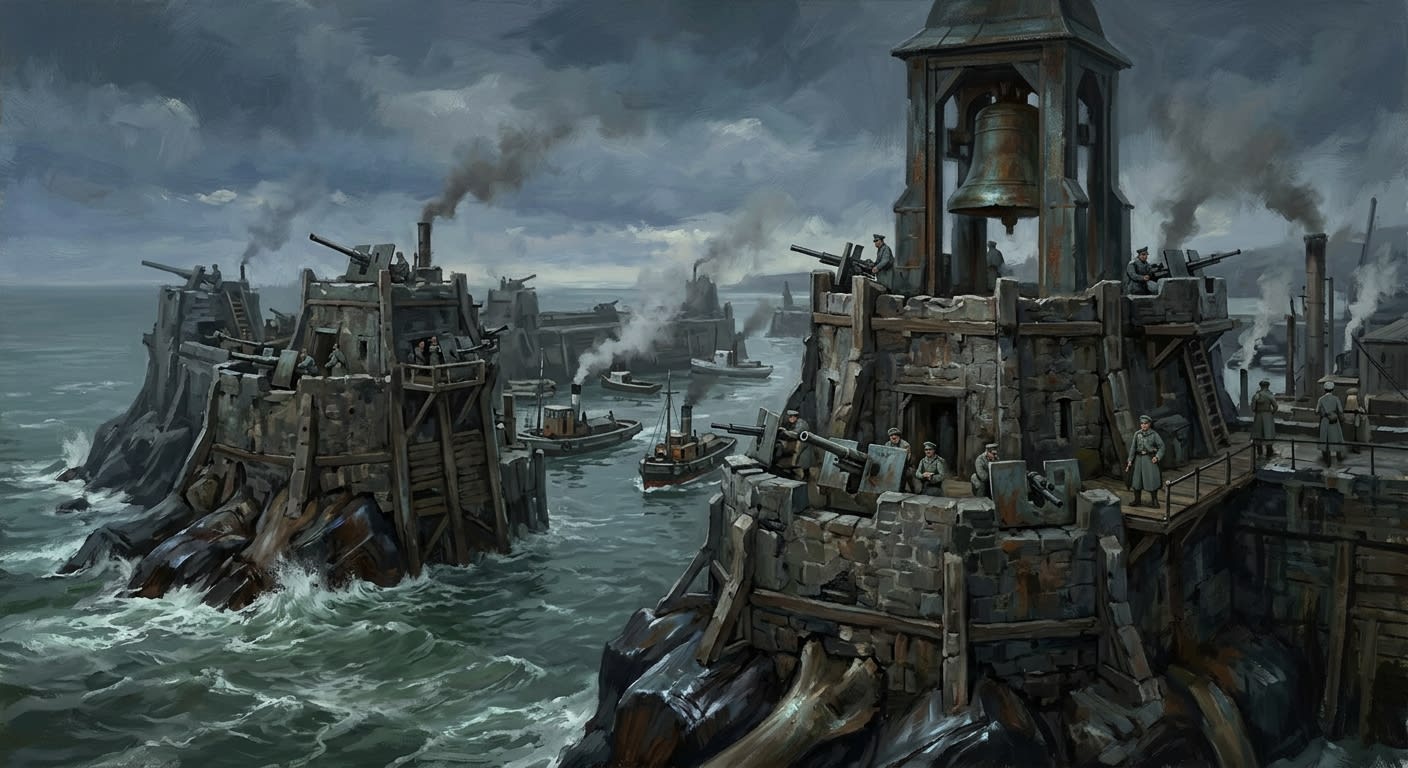
The Teeth Breakwaters guard the harbour mouth at Calais, four fortlet-ridges of iron, chalk-lime, chain, gun embrasure, and consecrated wrongness thrust into the Channel like a jaw clamped on a confession. They are called breakwaters by engineers, fortlets by officers, Teeth by everyone with eyes, and those damned bones by workmen sent to repair them during fog.
Their function is simple enough to be suspicious. They narrow the harbour approach. They break the swell. They hold mine-chains and signal lamps. They mount low guns for close harbour defence. They give the Gunline Choir a wet, loud, dangerous platform from which to strike Sequence Two (Unregistered) when the Undertide presses too close. They also contain calcified remains recovered after the Great Breach (Unregistered) of A.S. 71: Undertide bone, or Undertide analogue, or self-derived maritime calcium, depending on which Bureau is avoiding blame at the moment.
The Teeth were raised in A.S. 74, three years after the Breach turned the old sea caves inside out and taught the Chalk Redoubt that western water could invade like doctrine: through every crack, under every door, into every mouth. Calais already had guns in the cliff and panic in the ledgers. It needed something at the waterline that the sea would hesitate to touch.
#On the Making After the Breach
The Great Breach of A.S. 71 left Calais with bodies in the tunnels, lamps moving under water, black brine in chalk ceilings, and the first verified writing on the Script Wall. The Undertide Pens began with the barrels needed to store what came back. The Black Lungs began with the ropes needed to fetch it. It also left remains. Not bodies in the useful human sense. Remains. Pale, hardened, resistant to saw and prayer, jointed in arrangements that offended anatomy, cooling in piles beside the Net Quays while officers argued over whether to burn, bury, classify, or pretend they had not noticed them.
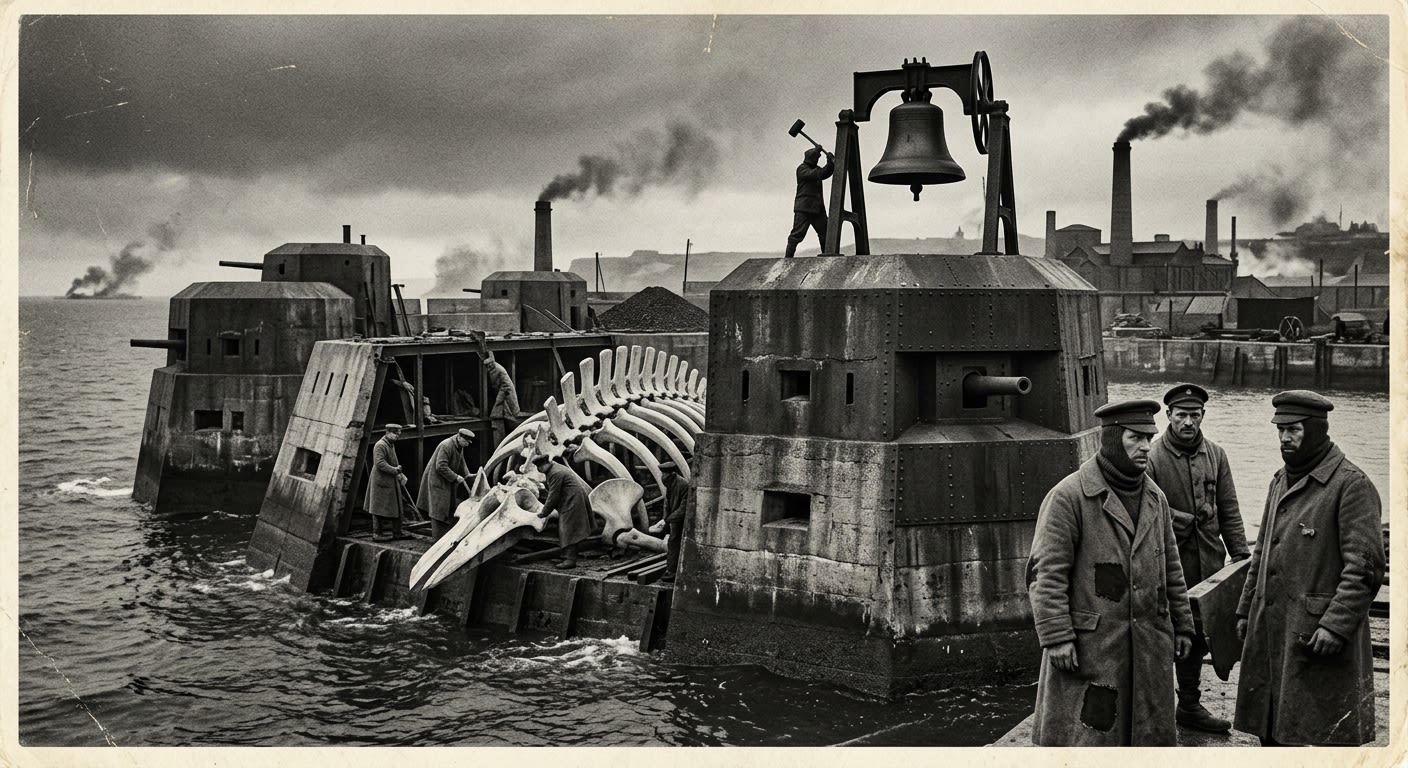
The Bureau of Alchemical Standards arrived late, as expert bodies prefer, and produced a seven-page report titled On the Repulsive Properties of Self-Derived Calcified Remains in Saline Immersion. Its conclusion recommended embedding the recovered bone in harbour defences and transferring the authors inland. The Bureau granted both recommendations. The bones remained in Calais. The authors, being more perishable than their advice, fled toward desks.
Early public broadsheets described the Teeth as “ordinary chalk-lime maritime works raised from local stone and pious labour.”
Corrected. Ordinary chalk-lime maritime works do not hum when names sink into a cliff, nor do they require brine-washers to scrape barnacles from surfaces that bleed salt through sealed iron.
The first piles went down in winter. Workers drove iron collars around bone cores, packed chalk-lime around the shafts, sealed joints with salt-wax from the Candlewick Palatinate, then watched the whole assembly knock against the tide though the water lay flat. Three men deserted. Two returned with their boots full of seawater after sleeping in dry rooms. One became a pious advocate for reassignment to quarry labour, proving that terror can improve civic discipline when properly placed.
By A.S. 74 the four main fortlets stood: North Tooth, South Tooth, Crown Tooth, and the Low Bite, though only engineers use those names without smirking. Children call them the Biting Stones. Divers call them the Last Hard Thing. The Choir calls them Platform Wet-Two through Wet-Five, which tells us the Bureau of Bells can murder poetry with a numbering knife.
#On Their Form and Daily Use
At low tide the Teeth look almost comprehensible. Four masonry bodies extend from the harbour arms in broken, offset rows, each ribbed with iron braces, each capped by gun-casements and signal posts. Mine-chain sockets stud the inner faces. Rope stairs descend to diver ledges slick with weed. Bell-line housings run in brass tubes along the upper walk. Chalk-lime patches whiten the seams where storm, salt, and contact have worried the structure open.
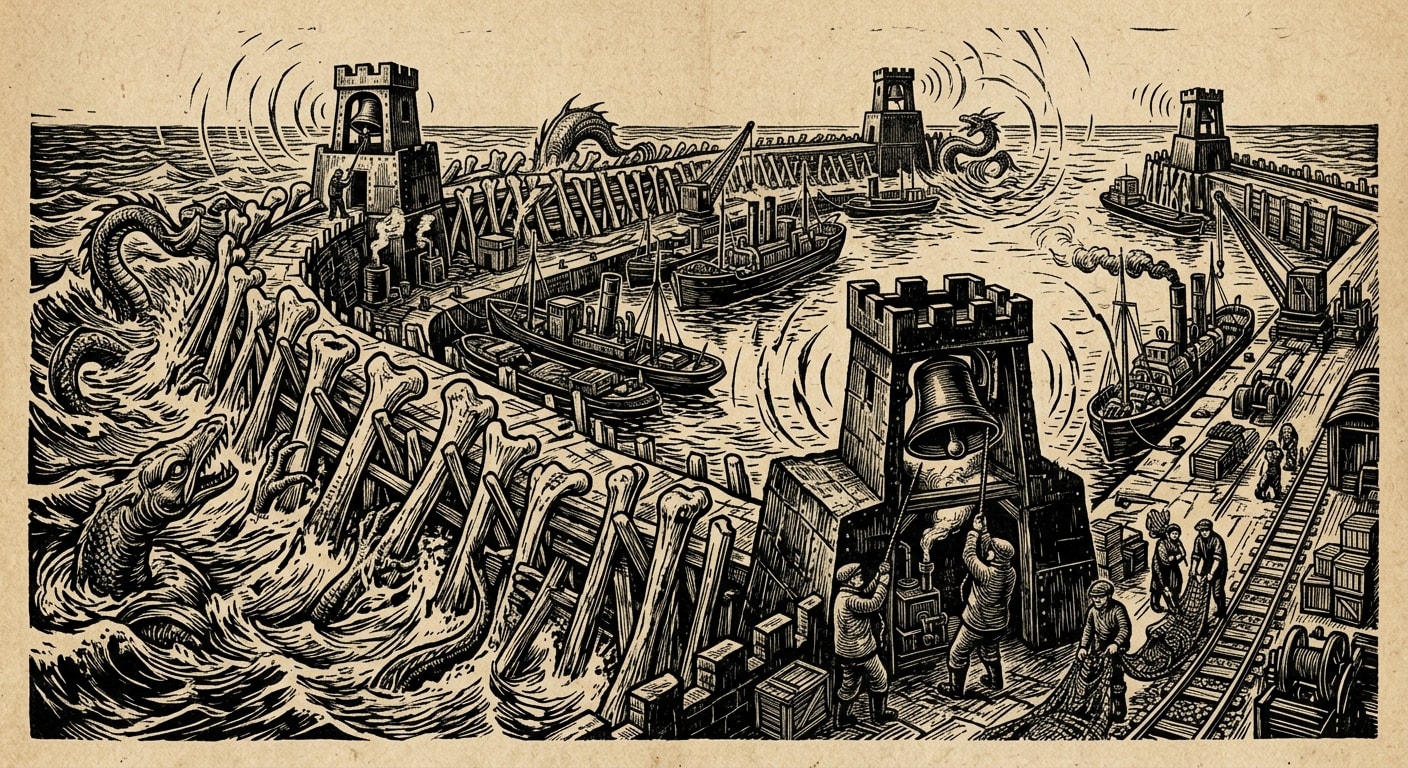
At high tide comprehension retreats with the sane. Surf beats through lower grilles. The bone pilings vanish beneath black-green water. The collars knock. The fortlets seem to shift nearer one another, although Engineering surveys insist they remain fixed. The mouths between them narrow and widen with the swell, and ships pass through under bell order, chain clearance, Tribunal pass, and the silent agreement of men who know the harbour might close if offended.
The Teeth are worked by mixed crews: Gunline Choir riggers, Coastal Chapterhouse (Unregistered) marines, chainmen, mine-custodians, chalk-lime patchers, lantern runners, and punitive labourers who discover too late that debt service on a breakwater is still debt service, only wetter and more honest about mortality. Each crew wears tarred coats, bell plugs, and waist ropes clipped to iron eyes. No one works alone. No one whistles. No one says, “It is calm.”
The work is maintenance disguised as argument. Chalk-lime erodes. Iron rusts. Salt-wax cracks. Barnacles grow in script-like clusters and must be burned off before some clerk mistakes them for a message and invents a tax. After heavy contact, the collars loosen and the bone cores show pale through the mortar. Repair crews pack the seams with lime, ash, wax, and fragments from older approved deposits. Calais repairs demon-bone breakwaters with further demon-bone accretion. There are cannibals less administratively committed.
#On Sequence Two and the Choir
The Gunline Choir keeps seven approved repulsion sequences at Calais. Cantor-Major Pell keeps the fire-chart as if it were a relic with murderous habits. Sequence Two belongs to the Teeth. It is sounded when fog crosses the outer water, when pressure builds against the pilings, when divers report movement below the harbour throat, when the Script Wall writes too low, or when the Teeth knock in patterns that make experienced men begin praying without being prompted.
Cantor-Major Pell’s fire-chart assigns the tones. First bell: shutter. Second: traverse. Third: powder permission. Low hold: no firing. Split peal: cancellation and repulsion. The Teeth receive those orders through brass tubes, rope lines, and the listening bones embedded below. Sound travels through the breakwaters differently after rain. It travels differently after a name sinks. It travels differently when the Undertide is close enough to touch the collars.
The second sequence clears the Teeth by driving fog downward and away from the mouth for less than a minute. Less than a minute is enough time for a competent gun crew to sight, fire, reload, and curse. Less than a minute is enough time for a diver rope to be hauled through a narrowing gap. Less than a minute is enough time for a ship to pass if the captain loves obedience more than dignity. The Choir does not grant safety. It grants intervals. Calais survives by spending them like stolen coins.
GUNLINE CHOIR CONTACT LOG — SEQUENCE TWO / A.S. 199 Outer Teeth sounded responsive hum before first authorised bell. North collar struck seven times without wave action. Script Wall concurrent low writing: █████████████████ Cantor-Major Pell ordered split peal correction. Water below Low Bite answered in child’s voice: █████████████████ Public notation: successful fog depression.
A mis-toned Sequence Two is among the fastest ways to make Calais interesting and dead. In training, Choir boys learn the phrase Teeth clearance as if it were a tidy manoeuvre. On the platforms they learn the deeper grammar: strike too high, and fog thickens. Strike too low, and draggers climb the harbour floor. Strike early, and the entities pause, listening, as if receiving an invitation engraved by a fool. Strike late, and the sea reaches the stair.
#On the Bone That Repels
The Pilings repel the Undertide. This is the authorised fact. It is also an insufficient fact, and insufficient facts are often more dangerous than lies because they can pass inspection.
Draggers recoil from exposed cores. Bellies roll away when the collars knock in brine. Processional masses press against the Teeth, hold, and withdraw after sustained bell contact. Divers have seen pale shapes in the deep approach, faces turned toward the breakwaters with what a romantic idiot might call longing and what a sensible officer calls target fixation. The remains embedded in the Teeth are dead enough to be material and alive enough to be hated by their kin, if kin is the correct word. It is probably not, but accuracy has limits when the sea is chewing one’s fortification.
Coastal Works Memorandum 31-L stated that all calcified remains embedded in the Teeth were fully inert after consecration.
Amended under A.S. 201 Amber review. The remains are operationally inert for budget purposes. They are not inert in the vulgar physical sense, the acoustic sense, the brine-reactive sense, or the sense meant by repair crews who refuse to sleep within earshot of spare pilings.
Repair ledgers record “saline flexion,” “choral tremor,” “collar answer,” and “exposed marrowtone.” The first three are cowardice in boots. The fourth is at least pretty. When the cores show, they sometimes sweat brine against the tide. When rubbed with salt-wax, they darken in patterns resembling knuckles, teeth, hinge marks, or small alphabets. Doctrine forbids alphabet comparison. Records performs it privately. Records always performs forbidden comparisons privately and then denies discovering anything until it needs a promotion.
The worst rumor concerns the living bone stores. Beneath the northern chain shed sits a sealed room containing spare recovered material not yet embedded: shaft fragments, joint plates, ribbed arcs, teeth clusters, and one object shaped like a hand whose fingers have fused into a hook. The Alchemical Standards team marked the room DRY RESERVE. Calais workers call it the Nursery. This name is prohibited. That tells you what it means.
#On Teeth Day and Local Pieties
Calais keeps Teeth Day (Unregistered) during storm season, though the Chapterhouse calls it Breakwater Inspection Rite and Salt Tribunal Row calls it an opportunity to sell temporary viewing permits. Civilians climb the safe galleries. Children throw waxed salt beads toward the inner water. Chainmen repaint hazard marks. Choir novices strike practice taps under supervision. Divers spit over the rail because the sea should be reminded which fluids still belong to men.
The rite began after the first full storm season in which the Teeth held. Public gratitude required a ceremony. Public terror improved attendance. Mothers brought bread shaped into little jaws. Fishermen tied kelp knots to railings. Gunline boys carried polished bell hammers. A clerk read the names of drowned builders until the fog thickened and the list was prudently shortened. Since then the list has remained shortened by tradition, which is how the Bureau sanctifies cowardice without admitting arithmetic.
Taboos cluster there like barnacles. Do not whistle on the Teeth. Do not count the knocks aloud. Do not look between the inner pilings during west-hush. Do not ask whether the bones are from enemies, animals, saints, or something with a claim on your great-grandmother’s baptismal name. Do not promise return while standing over the outer grilles. Promises given above Undertide water are treated by Calais as contracts with hostile witnesses.
The oath By the Teeth carries lethal seriousness. Lovers use it foolishly. Divers use it rarely. Tribunal men avoid it because an oath that might be heard by the harbour cannot be safely litigated. Children use it before dares and are punished for good reason. One boy in A.S. 188 swore by the Teeth that he would steal a blue lamp from Salt Tribunal Row. The lamp burned blue before he touched it. The seventh sequence sounded that night. The boy survived, which made his punishment worse.
#On Smugglers, Divers, and Those Who Work Below
The Teeth are a border and all borders breed smugglers. The Grey Keel Syndicate knows bolt-holes through the lower maintenance galleries, tide windows beneath the chain sockets, and two old quarry cuts that let a small skiff enter the harbour with no pass, no bell, and no sane hope of repeating the trick. The Salt Tribunal calls these routes capital crime. The Black Lungs call them contingency. Commander-Prior Sabelle Morn calls them sealed until needed. Everyone is correct, which makes the matter legally filthy.
Divers move through the Teeth with the respect of priests entering a crypt where the saint is awake. Their descent ledges sit on the inner faces of South Tooth and Low Bite. Rope teams brace against iron eyes set into old bone collars. A lost diver’s name often appears low on the Wall within seven nights, where surf-water covers the descenders and the reader kneels. If the rope returns without the diver, the Teeth are watched for knocking. If the diver returns without the rope, the Undertide Pens receive both when possible and neither when prudent.
The Pens take objects from the Teeth more often than public statistics admit: bolts that ring without impact, barnacle plates bearing legal names, lantern cages burning under water, rope bells wet inside sealed brass, chalk fragments warm to touch, and once, in A.S. 199, a collar pin that had grown a small human molar. The molar was entered under Object Room tray classification. The family whose name appeared on its enamel has not been informed, because mercy occasionally borrows sense from cruelty.
#On the Present Amber Condition
As of A.S. 201, the Teeth hold and resent holding. Inland chalkscript has spread beyond the Wall. Lamp oil shortages lengthen reading nights. Longer readings draw Undertide movement below the harbour mouth. More movement means more Sequence Two work, more collar stress, more diver descents, more Pens intake, and more repair crews standing ankle-deep in black water while supervisors explain that the situation remains adequate.
Adequate is a powerful word. It has buried more men than artillery.
The outer collars are overdue for replacement. Salt-wax stores have been diluted twice. North Tooth lists three degrees seaward after storms, though Engineering describes this as optical. The Low Bite bell-line gives delayed response during west-hush. Crown Tooth’s inner gun embrasure has begun sweating chalk paste shaped into small hooks. South Tooth remains structurally sound, which is suspicious and under review.
Commander-Prior Sabelle Morn has requested iron, wax, labour, pump leather, oil, and authorization to close the Grey Keel routes through the lower galleries. Pell has requested bell-metal spares and no visiting auditors during fog season. The Divers have requested better rope. The Tribunal has requested fee authority over emergency Teeth access. That last request was approved first, because a Bureau may be slow to save masonry but never slow to price a stair.