

#On the Harbour Mouth
"Read the fog. Hold the sea." — Amber holding order, Commander-Prior's office, Calais
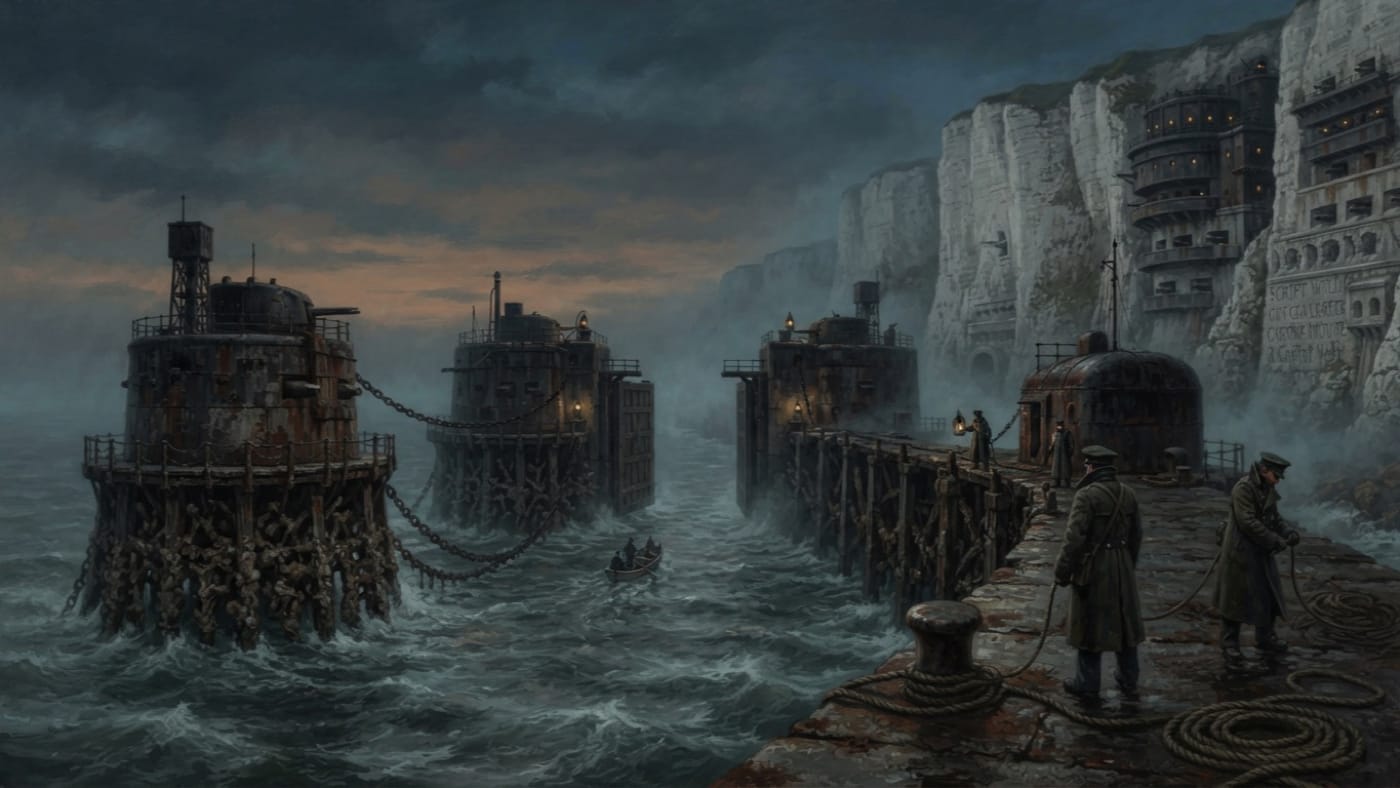
Calais keeps its harbour behind a set of teeth. The city also has a literate cliff, so well furnished with guns, offices and grievances that visitors spend their first week staring upward. Then a fishing skiff comes in at dusk, the harbour narrows to a throat, and four dark shapes rise from the water on either hand. That is when the visitor learns where Calais actually swallows.
The Teeth are four breakwater fortlets at the narrow harbour entrance, below the white headland of the Chalk Redoubt. The coastal registry names them North Tooth, South Tooth, Crown Tooth and Low Bite. It lists them as fortlet-ridges, which is a clerk's way of admitting that nobody could decide whether they are forts that happen to be breakwaters or breakwaters that were later given ideas. Every keel that enters or leaves Calais passes between them and is counted from them.
Seen from the Channel before dawn, the order is vertical. The Crownline sits highest, where Commander-Prior Sabelle Morn keeps her window open. Below it are the nine casemate mouths of the Gunline Choir, cut into the chalk face. Below those lies the raw stone of the Script Wall, which is wet whether or not it is writing. At the bottom, where the white gives out and the sea begins, sit the Teeth: tarred iron, chalk-lime greyed by salt, kelp hanging from every edge, and here and there a signal lamp. The lamps are hooded landward so the city does not mistake them for dawn. They are hooded seaward for reasons Doctrine prefers not to state.
They smell of tar, kelp and iron. Gunners who have stood a full night on them add a fourth smell and decline to name it.
Calais stands on the French coast at roughly fifty-one degrees north: Zone 1, deep western territory, far from the eastern trenches, with Dover across the water under a Crown that answers to no Synod. The Teeth guard against weather, wreckers, smugglers, undertow and ordinary drowning, and against one extraordinary enemy that comes up from below. That enemy is the reason they were built from what they were built from.
Under the tar and the iron, below the waterline, the pilings are bone.
#On the Breach and the Building
"By the Teeth." — Calais oath, sworn only when the swearer means to be held to it
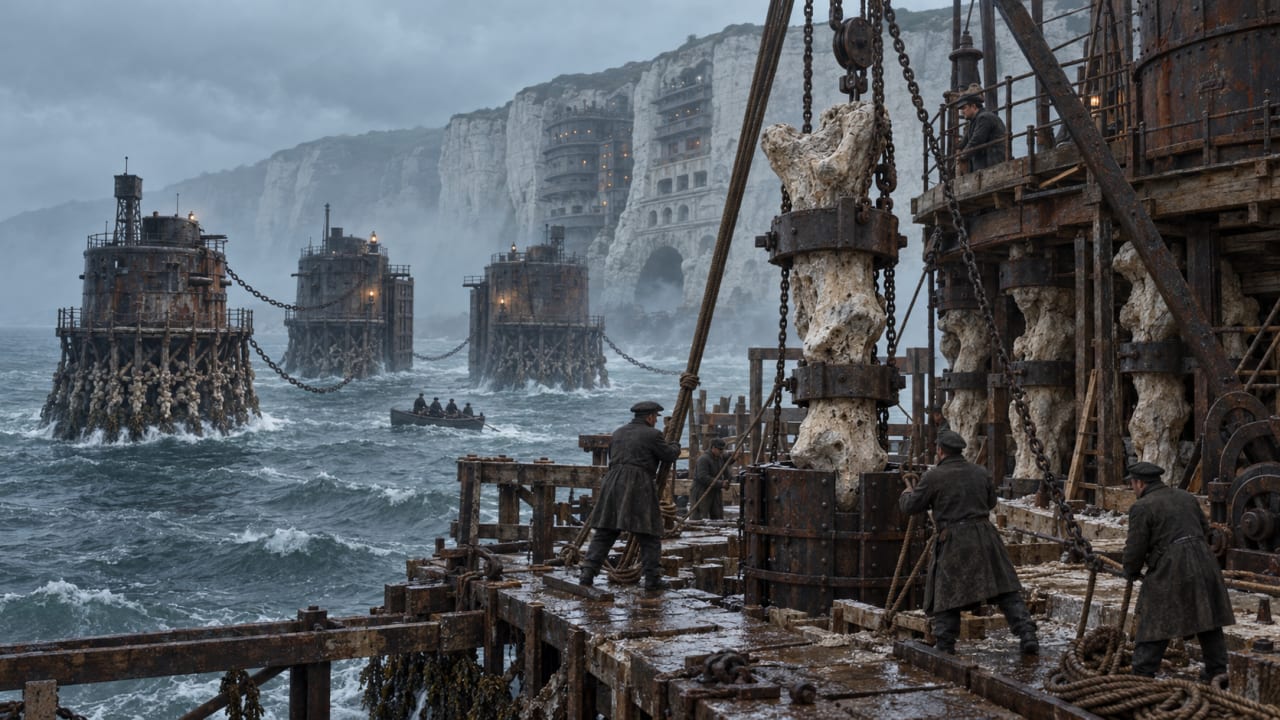
The Teeth came out of a catastrophe, followed by three years of thinking about it and then an unpleasant decision.
The headland was requisitioned in A.S. 69 by the coastal military authority that later histories, with their usual appetite for tidy parentage, file under the Bureau of War. Engineers cut the first gun galleries into the chalk, and a local Coastal Chapterhouse followed the next year. The planners expected raiders, fog and wreckers. At worst they expected a demon with the courtesy to arrive above the waterline, where it could be shot.
In A.S. 71 the Undertide came through the sea caves instead. The Great Breach drowned hundreds of people in tunnels, cellars and corridors that had been dry that morning. Rifles failed in the wet and lanterns failed in the fog. Then an improvised bell-choir began striking any metal it could find, and the things withdrew into the water. The Gunline Choir descends from that noise. The Undertide Divers descend from the clearing-up afterward, and so, by a less flattering line, do the Teeth.
The clearing-up fell to quay men, chalk miners, net haulers and the condemned. They tied ropes round their waists and went down into flooded caves to bring out the dead. The dead came up in two kinds. The Redoubt's own went to burial. The other kind were the skeletal remains of the entities the bells had driven back. Recovery crews brought those up too, because a cave that is to be used again has to be emptied, and because nobody in authority had decided what to call such remains. A thing without a classification gets entered as inventory.
In A.S. 74, three years later, the inventory became a harbour defence.
The surviving account credits the decision to an alchemical team and preserves the title of its report: On the Repulsive Properties of Self-Derived Calcified Remains in Saline Immersion. The report ran to seven pages. Its argument was that the enemy's own remains, consecrated and set in salt water, would repel the enemy. Its final paragraph asked for the team to be reassigned away from the sea. The request was granted and the bones stayed. No engineer's name survives with the report. Neither does the name of the commandant who accepted it, the day the first piling was set, or any opening ceremony. The Codex does not invent them. Readers who need a ribbon-cutting may cut one in the privacy of their own credulity.
An earlier entry in this Codex stated that "the Synod built the Redoubt in A.S. 69, four years after the Line solidified across the continent's eastern spine," and that a team of the Bureau of Alchemical Standards advised on the Teeth in A.S. 74.
Corrected. By A.S. 69 the Sagittal Line was defensible but incomplete, a stage it had reached around A.S. 65–68. The formal Synod was not constitutionally settled until A.S. 90, sixteen years after the Teeth were raised. The coastal military and ecclesiastical offices of the earlier administration took the headland and built the Teeth. The alchemical team belonged to the office later styled the Bureau of Alchemical Standards. Calais is a Zone 1 coastal installation and has never been a Line bastion. Its guns face west.
The sequence contains a dry joke. Bells drove the enemy out in A.S. 71, and bell practice was regularised in A.S. 72. In A.S. 74 the authorities concluded that bells might fail. They reinforced the harbour with the one material the enemy had already shown it would leave behind. The Church's older vocabulary has a word for such a thing, which is relic. The coastal office's word was aggregate.
#On Iron, Chalk-Lime and Bone
The record names three materials. Iron makes the frame and the restraints. Chalk-lime makes the mass: the headland's own stone, burned and wetted until it sets hard under salt water, so that the cliff reaches into the harbour and closes like a jaw. Bone makes the pilings, which stand below the waterline where the tide passes over them twice a day for the life of the installation.
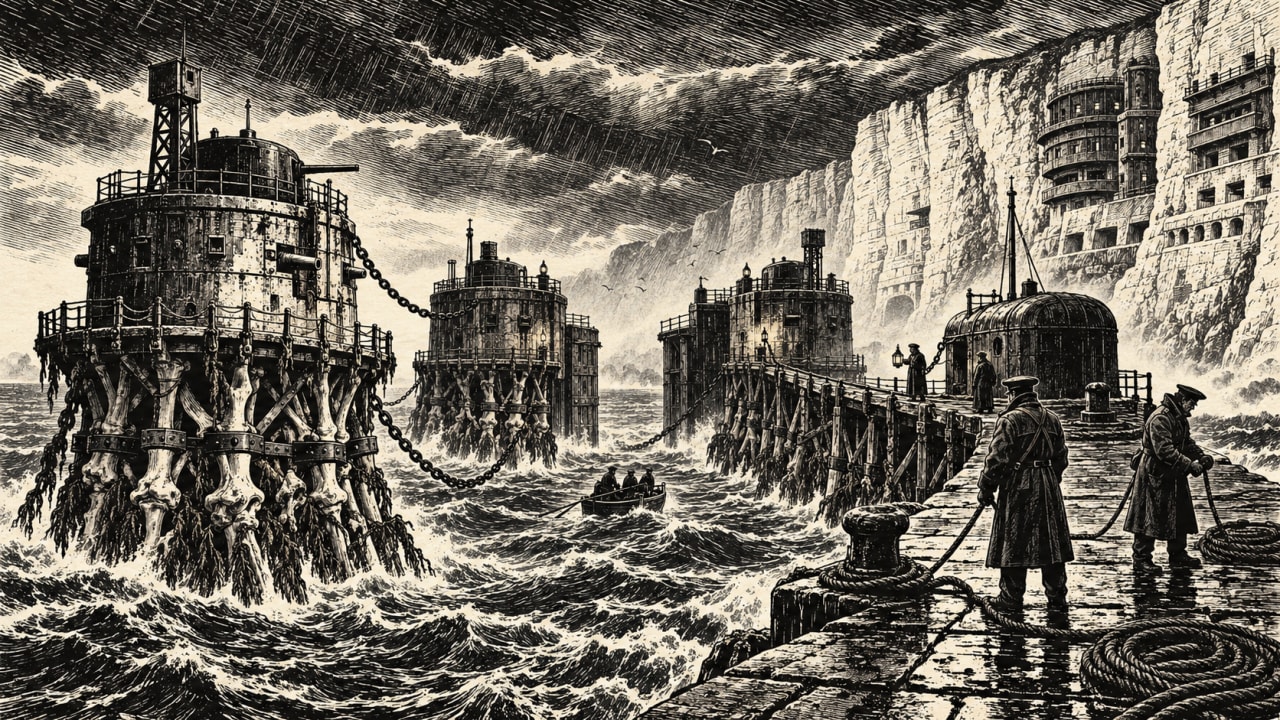
The report's title repays a second reading. Self-derived means the enemy repels the enemy. Calcified means the bone had become something like stone, mineral and finished, a substance a clerk could list beside lime and gravel without losing sleep. Saline immersion means it was to stay in the sea for good. The authors were careful. They used every adjective available to a frightened alchemist to describe the material as dead.
The harbour has disagreed.
Published accounts record the Undertide's pressure on the Teeth. It comes against the pilings in fog, and sometimes it moves against the current, which water may not do. As of A.S. 201 it also comes in clear weather, which spoils an older doctrine that sunshine discouraged marine insolence. Each time it is turned back. The consecrated bone repels it, as the seven pages promised, and the Redoubt has relied on that repulsion for a hundred and twenty-seven years.
Two further observations sit uneasily beside the word calcified. Commander-Prior Morn's assessment for A.S. 201 states plainly that the Teeth hum after heavy contact. Diver-Captain Sain's record of a night late in A.S. 188 states that the Teeth began chewing against their collars. Both are working officers' words, written by people with more urgent things to do than poetry. A hum is a sound coming out of a structure. Chewing against a collar is movement inside iron restraints. Neither record says what produced the sound or the motion, and the Codex says no more than they do.
The quays have their own account, and it belongs in the record as quay talk. Older salvage families say that some of the bone did things in brine that bone has no business doing. They say it quietly, usually after the second drink. Records has neither confirmed the story nor managed to drown it. The Codex reports it as the material's reputation and makes no finding.
The practical problem is maintenance, and maintenance in Calais has no patience with metaphysics. Iron rusts, so it is scraped and tarred. Chalk-lime spalls in frost and salt, so it is patched. Kelp is cut, lamps are refilled and collars are inspected. The pilings belong to no trade. Nobody repoints bone, and nobody can certify a piling sound when it may be sound in the way a guard dog is sound. So the harbour's fabric goes under two headings. The pilings count as masonry because they hold the harbour's shape. They also count as something close to a prisoner in custody, because of what the gunners report after contact.
#On the Bells That Clear the Teeth
Four in the water. Nine in the cliff. The arithmetic is simple, and visiting officers get it wrong every season.
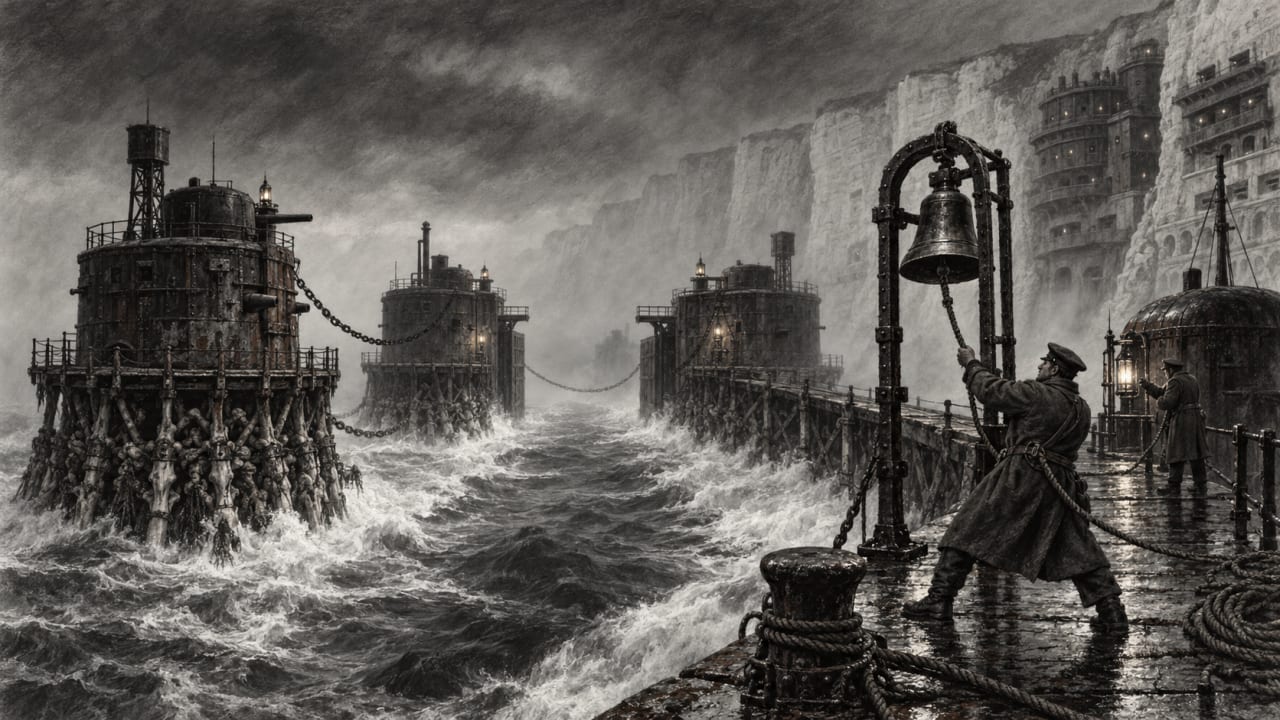
The Gunline Choir serves nine casemate batteries cut into the chalk face. The Teeth are four fortlets in the harbour. The guns are not shared out among them, and the Teeth are not lesser casemates. A visitor who says otherwise in a Calais tavern will find the room very quiet. The guns fire from the cliff and the Teeth hold the water. What ties them together is sound, the only medium in Calais that both the fog and the Undertide respect.
The Choir's public doctrine lists seven repulsion sequences, each with its own office. The first presses fog downward. The second clears the Teeth. The third opens a brief window for sight, the fourth covers low readers on the Wall, and the fifth denies the sea caves during west-hush. When pressure builds against the pilings, the bells of the Fog Bell Tower and the relay cages carry the order down the galleries. The cliff answers, and the water between the four fortlets is cleared as far as an interval can clear anything.
How it is done is classified, which is correct. The intervals are kept on the fire-chart, a scored brass plate held under Seal Amber. Cantor-Major Pell holds one copy and the Bureau of Bells holds another. The third went missing in A.S. 198 from a sealed box in the lower gun gallery. The wax was intact, and a damp chalk flake lay where the brass had been. That theft happened in the cliff. It still concerns the Teeth, because Pell answered it by changing intervals. Every change opens a period in which gunners, riggers and divers work from a grammar they have only just learned.
The result is the cleanest division of authority in Calais and one of the least comfortable. Morn commands. She can lock the harbour, rotate the garrison, ready the guns and man the Teeth. Pell holds the notes, and he alone knows exactly which bell permits which act against the water. When pressure rises at the mouth, the two of them have to agree within one interval. The surviving record shows no dispute between them over a firing at the Teeth, and the Codex invents none. It only observes that a fortress needing one officer's order and another officer's score has made its two chief servants inseparable. In a Synodal installation that is as close to marriage as the Bureaus allow.
The best field observation on Sequence Two comes from under the water. Ila "Kelp", Sain's second, has said that Sequence Two makes draggers "angry to the left." The Bureau of Bells rewrote this as lateral hostile displacement after tonal contact. The Choir put the original wording back for gallery instruction, and the Codex keeps it for the same reason. It is one diver's account of what the water does after the second sequence sounds. Nobody has proved it a law of the Channel, and no pilot should steer by it. As a warning it is valuable. A rigger whose diver is on the right-hand side of a piling wants to know which way the angry part of the sea is likely to move.
In a harbour, bells cut both ways. A clearance that pushes pressure off the pilings pushes it somewhere else, and in a narrow harbour that place is usually occupied, whether by a skiff in the channel, a patrol on the walk or a diver on a line. The Choir trains for this. Training lowers the cost of a late beat. The cost remains.
#On Those Who Walk Them
"Teeth-walk" — gunners' term for a patrol shift on the breakwaters
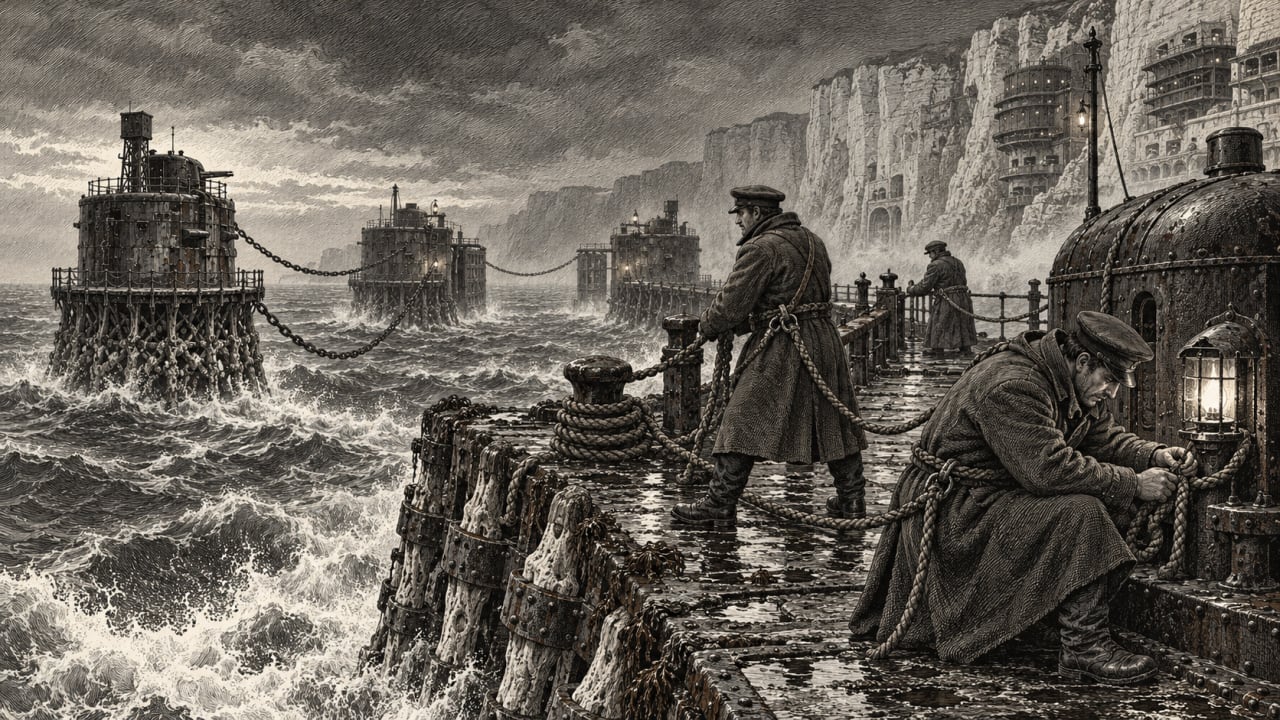
The Teeth are manned. Someone has to keep the lamps lit, watch the water, check the collars and chain, report pressure to the bell-cages, and stand all night between a cliff that writes names and a sea that comes to read them. The garrison calls the duty a teeth-walk.
The footing is wet chalk-lime over iron, or iron over wet chalk-lime, depending on which repair failed last. Kelp grows back faster than it can be cut. The undertow at the mouth is real water obeying real tides, and it drowns the people who fall in with no help from the Undertide. Lamps need shielding from spray, from wind, and from the chance that light shown seaward has become an invitation. Rope is everywhere, and it is the one thing on the Teeth that everyone trusts. A teeth-walker who finds a badly tied knot on a lamp-line reties it without a word and reports the man who tied it the next morning. Both acts are regarded as kindness.
Not everyone on the walk chose it. The Salt Tribunal enforces debt, and signal service on the Teeth is one of the ways a debtor may work off arrears. That makes the Tribunal's books part of the watch-roster. A quay family behind on its pass fees may find a son tending a signal lamp on the breakwater, a cousin on night patrol, or a widow standing in for both. Part of the harbour's defence is staffed by people whose only military qualification is a creditor. Calais calls this a civic economy. On the walk it goes by a shorter word, which the Codex will not print.
The sea-gate closes at curfew. It belongs to the wider harbour works, and no survey available to the Codex records its exact mechanical relation to each fortlet. Its failure has a word of its own, teeth-jam, used for any night the gate will not close. In the mouth of a sober gunner it comes close to blasphemy. It also shows that the city thinks of the gate and the fortlets as a single jaw.
Calais keeps a few pieties on the breakwaters. Custom forbids whistling on the Teeth, and here custom is stricter than any statute. It gives no reason, and none is needed. The harbour is defended by intervals and attacked by something that hears them, and a man improvising a tune on that front line is asking for trouble. By the Teeth is a serious oath, sworn when being wrong would be lethal. Nobody swears it over prices.
Teeth Day falls in storm season. The breakwaters are the focus of its rites, and the local record notes without comment that drownings increase around it. The city crowds the harbour side while the sea rises against the fortlets, and the walkers stand their shifts in front of a congregation that is safe for the time being. The surviving material gives no fixed date, no official name for the liturgy and no order of service. Calais leaves the question of whether piety draws people too close to the edge, or whether something answers the piety, until after the funerals.
#On the Black Lungs Below
The surface duty ends at the waterline, and the Undertide Divers take over below it. The Black Lungs work the sea caves under Calais, the recovery routes to the Undertide Pens and the approaches to the Teeth, which Sain's command file lists as part of her principal theatre. The pilings that protect the harbour from above are the same pilings divers have to pass below, often while the bells are working and in water nobody would call clear.
That arrangement dates from the corps' earliest years. The published account of the Divers ties the raising of the Teeth in A.S. 74 to the point when dive duty became permanent. A defence built on bone below the waterline needed inspectors, and the only people able to inspect it were the ones who had brought the bone up.
The fullest public record of the Teeth under strain comes from Sain's first recorded descent, late in A.S. 188. It followed the Roster 14-F failure and the broken reading rosters after it. Six names lay half-sunk along the Wall, and the harbour went into west-hush before dawn. The Gunline Choir struck Sequence Four, the low-reader cover, and split the fog downward. In the outer drain a rope team lost two men when something rose beneath the quay and opened the planking without breaking it. Sain, then a second-rank diver with no command ribbon, went down after them. The same night's record gives the Teeth a single clause:
COASTAL ANNEX — RECORD OF DESCENT, LATE A.S. 188 — CONDENSED Harbour: west-hush before dawn. Gunline: Sequence Four struck; fog split downward. The Teeth: ██████████████ chewing against their collars. Outer drain: rope team, two lost. Sain: descended after them. Depth eleven fathoms. Lamp nine minutes. Pressure in teeth. ██████████████████
Divers also use pressure in teeth for what the body feels as the Undertide approaches, along with lamp flames flattening sideways and rope gaining weight without strain. The shared word is an accident, though the shared sensation may not be. A diver near the Teeth during contact feels pressure in her own jaw while the structure beside her moves in its iron. The Codex records both and leaves the reader to sleep on them.
So a gunner's timing reaches a diver's body. Bell-lines are fixed to throat plates. A clearance struck a beat early, or an interval Pell changed after A.S. 198 that the rigger has not yet learned, travels down the cliff, across the harbour, past the pilings and into the canvas of whoever is on the line. That is why Ila's "angry to the left" is gallery doctrine. It tells the riggers where the cost of a successful bell is likely to land.
Sain's maps complete the chain. The Chapterhouse holds the admissible maps. Sain holds the working ones, folded in oilcloth, copied in fragments and filed under whatever label the asking officer will find hardest to confiscate. They show the water around the Teeth as divers actually find it: which runs foul after pressure, which cuts open at certain tides, and where a rope can pass without catching on a collar. The shore offices want these maps, and the Salt Tribunal wants them most. Sain keeps them, and Morn allows it by never naming the arrangement. A harbour mouth whose under-plan is kept by the people who swim it may be badly administered, but it has been well defended for a long time.
#On Passage and Salvage
The Teeth narrow the harbour, and in Calais anything narrow can be charged for.
The Salt Tribunal has controlled the sea pass since A.S. 84. No vessel goes in or out, no cargo crosses the quay, and no citizen boards anything that floats without one. Seal-Justice Corvin Hald issues the pass in exchange for a confession entered as a tide-file, a seal pressed in salt-wax, and a Gunline certificate that the vessel carries the correct chime-plates for fog navigation. Hald commands no battery and no fortlet, and he has no need to. Every skiff that comes between the fortlets has already passed through his office, and the Teeth on either side give his confessional the force of a portcullis.
The defended entrance protects the city and confines it. Every sensible person in Calais wants the mouth narrow, watched, lit and chained. When a city's only legal exit is a pair of jaws, it also pays whatever the man with the seal asks.
The bone supports a second economy. The Net & Hook Guild's salvage interests include demon remains, and the Undertide keeps producing them. Recovered bone has value because the harbour itself proved it: for a hundred and twenty-seven years Calais has shown, in public and at the most important point on its coast, that such material is worth building with. Every piling at the mouth works as an advertisement. The Codex knows of no completed theft from the Teeth and alleges none. It notes only that the most valuable salvage on the coast sits in plain view under the water, held by iron and watched by debtors.
The Grey Keel Syndicate works where the Teeth do not reach. Its trade runs through the boat tunnels under the Chalk Warrens, old quarrymen's cuts it keeps open for forged passes, cave routes and the removal of names. A front entrance that is narrow, guarded and taxed creates a market for a back one. The Grey Keel never needed to beat the Teeth. It went under the cliff, where the Tribunal's ledgers end and Sain's working maps begin, which goes a long way to explaining the Tribunal's interest in those maps.
#On What the Pilings Prove
Three claims about the Teeth circulate in Calais, and they have to be kept in separate jars.
The first is demonstrated: the pilings repel the Undertide. Pressure comes against them and is turned back. For a hundred and twenty-seven years the harbour mouth has held, with help from the bells, the chains, the Divers and the people on the walk. Nobody serious in Calais disputes this, and nobody serious calls it a guarantee. Repulsion is a working condition, and the Choir's ledgers and the Divers' casualty tables record what it costs to keep it.
The second is reported: the material is still active. The Teeth hum after heavy contact. In A.S. 188 they chewed against their collars. The quay talk about brine is kept on file without endorsement. These reports come from officers whose records are otherwise strict and unsentimental to the point of rudeness. None of them establishes what the activity is. Together they show that the report's chosen adjective, calcified, has been under strain for more than a century.
The third is disputed. It concerns the explanation, and it is where the offices fight. Doctrine, as it has on every related question at Calais since A.S. 71, declares causation unproven. The Unread, the Redoubt's resident heresy, offer the contrary account: the nightly readings feed the Wall, the Wall feeds the sea, and the Undertide comes because Calais reads. Doctrine condemns the claim, and the Codex records it as condemned. It reaches the harbour mouth because published accounts record more movement below the Teeth when readings run long and oil runs short. The Codex records that correlation where those accounts record it. It records no cause, because none has been shown.
Coastal correspondence and harbour inventory have customarily treated the Teeth's pilings as "recovered calcified remains" — a fixed construction material, maintained with the masonry.
Clarified. The pilings are recovered remains, and they repel. They also hum after contact, and under pressure they have moved within their iron restraints. Nothing in the record supports calling such a material inert, and no office has shown that it is alive. Until one of those questions is settled by evidence rather than convenience, the pilings are entered as in custody, which is how the gunners have always treated them.
A theologian has one thing to add. The Church has long held that a relic keeps its virtue after death and that the virtue comes from what the relic was. In practice Calais has applied the same reasoning to its enemy's bones. Doctrine finds the parallel offensive and the harbour finds it useful. The Codex notes that it is the harbour that stands in the water.
#On the Present Amber Condition
As of A.S. 201 the Teeth hold under Amber seal.
The pressure at the mouth no longer waits for fog. The Choir records Undertide pressure at the Teeth in clear weather, and Morn's assessment records the hum after heavy contact. These observations come from separate offices with separate grievances, and they agree. In Calais that is rare and seldom welcome.
The rest of the Redoubt is under strain too. Lamp oil is short. The readers need lanterns and so do the Teeth, and one allowance cannot light both. Every hooded lamp on the walk burns from the same depleted store as the lanterns at the Wall. Since A.S. 199 chalkscript has appeared on inland doorframes and lintels. Each new name raises questions about the caves beneath, and those questions send down Divers who might otherwise be inspecting collars at the mouth. The Black Lungs are understrength. Published accounts link longer readings to more movement below the Teeth, more movement to more descents, and more descents to a corps that cannot replace its losses as fast as Form 71-M spends them.
Morn has asked for what the harbour needs: bell-riggers, oil, Divers, pump leather, powder, and authority to seal three boat tunnels the Grey Keel uses. The Bureau of War sent a circular praising vigilance. The public plan for Calais also proposes expanding the Teeth fortlets and deepening the mine-chains. Both exist on paper and nowhere yet in the water, and the Codex records them as proposals. The plan does not ask where the bone for an expansion would come from, and nobody has asked since.
Teeth-walkers still go out at dusk with rope and lamp, and without whistling. The sea-gate still closes at curfew, except on nights when it jams. Pell still holds the notes and Morn still gives the orders. Sain still goes below with the working maps folded somewhere the Tribunal cannot reach, and Ila still says which way the water will be angry. The four fortlets stand at the harbour mouth where they have stood since A.S. 74: iron, chalk-lime and bone, holding the harbour against the thing they came from, and humming afterward.