

#On the Present Compilation
This is a documentary survey, compiled in A.S. 201 for the Bureau of Doctrine. The year belongs to the compilation and nothing else. It does not date the booths, the first night they wrote, or any crossing they have entered. This office knows no founding year, no maker, and no single building that can be blamed for the phenomenon. The subject is plural and inconvenient: certain tollhouse booths of Rheinscarp which, on certain night shifts, produce entries that no one made.
A crossing ledger records a passage. The stair records no one climbing it. Between those two facts sits the entire problem, and the Bureau has filed it there.
#On the Crossing as Registration
"Coin, verse, stamp." — the tollhouse formula, Rheinscarp
To understand why an empty booth's handwriting should frighten anyone, you must first accept what a crossing is in Rheinscarp. Nine terraces climb the cliff above the Rhine, and roughly two hundred and forty thousand souls are registered on them. Between each terrace stands a window. At each window a traveller pays in clipped brass stair-tokens, each good for one crossing exactly. The traveller recites the authorised verse and receives a stamp. Then the clerk writes them into the book.
In this city, to cross is to be registered. Movement is incidental. A missed word at the window can render a person "absent" until confession repairs them, and confession, in Rheinscarp, comes with a fee schedule. The ledger line is the citizen. The body that walked up the stair is supporting evidence, and it is regularly outranked.
The Bureau of Tithes collects the coin. The Bureau of Records keeps the entry. The Ledger Cloister on the fifth terrace holds the archive, and the Registry Choir chants it into order. Each of these offices depends on one assumption so basic that no one has ever bothered to write it into doctrine: that an entry in a crossing book was made by a clerk, about a traveller, at a window, while both were present.
The booths have withdrawn that assumption without the courtesy of a memorandum.
#On What the Night Shifts Report
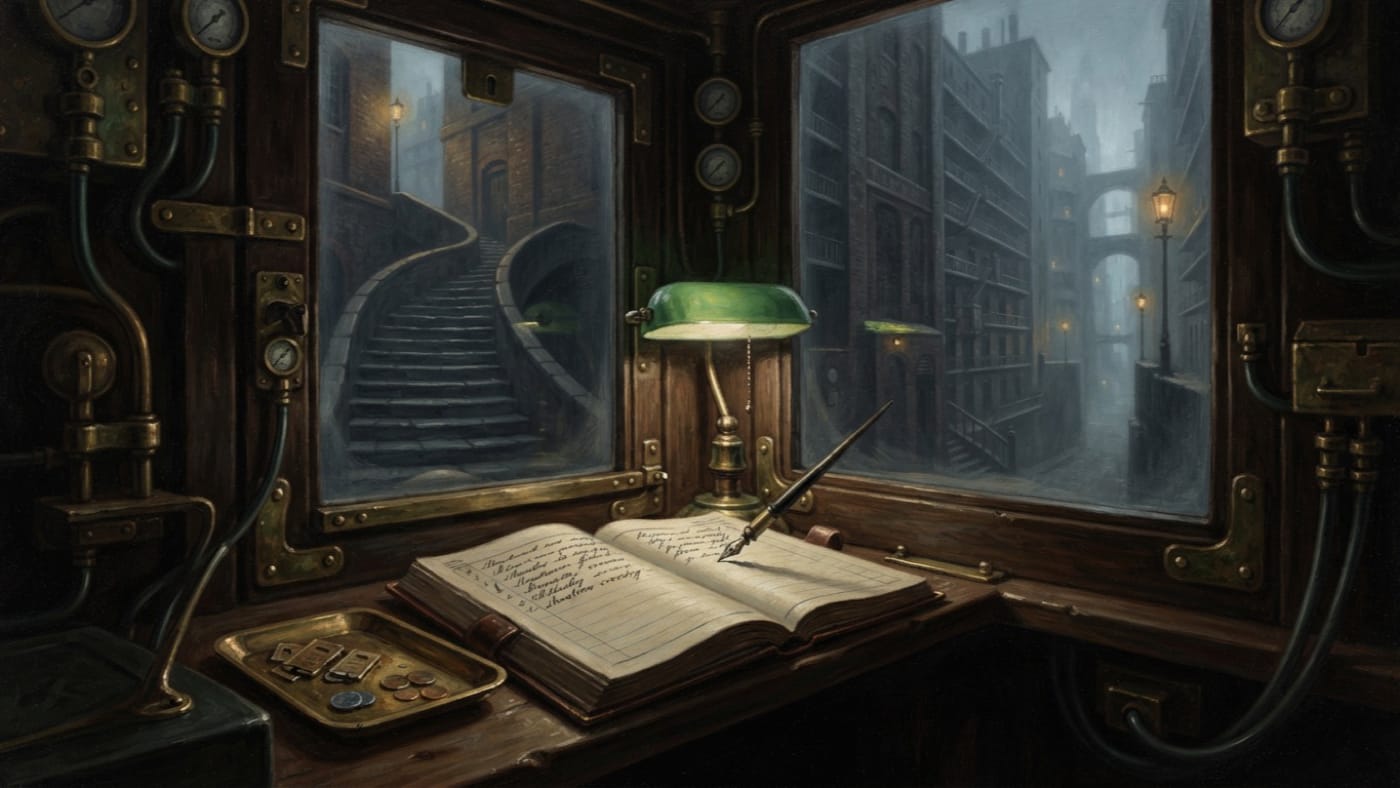
The local accounts are consistent in their particulars and vague about everything else. On certain night shifts, entries appear in booths where no clerk is on duty. They are perfect entries, correctly ruled and correctly spelled, with not a blot on them. The quills move in the empty booths. Ink appears on the page. Coins vanish from the collection trays. In the morning ledger, travellers stand recorded as "processed" even when they are missing, and the published city account adds that no traveller crossed during the shift at all.
The street word for the writer is quillghost. The toll-provosts, who prefer a schedule to a spook, call the event "the night the booth writes." The Bureau of Bells has filed it, according to the published account, as a Category Two Localized Scribal Anomaly. All three names are honest. None of them explains anything.
Self-writing tollhouse booths: three confirmed, nine estimated.
Withdrawn as a settled figure. The Codex's published city account gives the count two ways. Its abstract reads "three confirmed, nine estimated." Its body reads "three confirmed, an estimated nine more unconfirmed." It cannot be determined from that account whether nine is the whole or the remainder. Three confirmed stands. The estimate is held open.
The same account reports what follows the entries. Within a week of a name appearing in a phantom crossing, the person named meets misfortune: illness, accident, audit, or that particular Rheinscarp catastrophe of finding their ration card reassigned to someone who does not exist. "The names written are never lucky," say the local accounts. This survey records the report. It does not certify a cause.
The published account also observes that the booths keep the city's hours. They write on schedule. They observe the curfew and do not write in a crisis. If that account is correct, whatever moves the quills has learned the bell-hours more faithfully than the living staff, who misspell names and accept bribes and fall asleep over the trays. The survey also notes that the city account reports self-writing instruments at bridge crossings along the Line and at the tollhouses of Latchford. Similar handwriting does not prove the same hand. No common origin is established, and none is asserted here.
#On the Quota and the Sequence
A word of background, since the booths did not grow frightening in a vacuum.
The Absence Quota is Rheinscarp's procedure for making insufficient grain appear sufficient by correcting persons out of the ration, terrace and stair-token records. Tithes calls it variance management. Records calls it provisional identity adjustment. The street says one in forty per quarter. No official table carries that figure, and this survey does not either. The double-entry famine of A.S. 198 made the Quota visible, when the Mill-Crown and the Widowlight Quarter both received the same grain shipment on paper and the grain existed once. Forty-one people died, according to the published accounts. That famine is the Quota's public debut. It is no evidence about the booths, and nothing here treats it as their beginning.
Here is what the parent account records for the present year. As of A.S. 201, the self-writing booths have begun entering phantom crossings against persons later marked absent.
The order matters. First the entry, then the absence. That sequence is the entire evidence. The parent account says it "suggests the city's anomaly has learned to assist or accuse the mechanism." Both readings follow, with the warning that neither is proven and that the word learned already assumes an agent this office has never met.
The reading of assistance. On this view, the booth files the paperwork the correction will later need: a crossing no body made, a passage already "processed," a line that agrees with absence before the clerks have arranged it. The street uses processed for the dead who are still counted. A booth that writes the word in advance would be doing the Quota's work early and neatly.
The reading of accusation. On this view, the booth writes the names before Records removes them. It would then be a list kept in a hand no Choir can correct and no provost can bribe, entered in the very books the Quota depends on. A witness of that kind would be most unwelcome to the offices whose ledgers it would be writing in.
The survey cannot choose between these readings and declines to pretend otherwise. It cannot say whether a booth causes absence, foretells it, or happens to write alongside it. It cannot say whether the Quota's officers read the phantom entries and act on them, ignore them, or fear them. It holds the sequence and leaves the motive with the Creator, who has not filed one.
For the corrected, the distinction matters less than it does to doctrine. A person refused at the flour window already has a register line that disagrees with their body. A phantom crossing adds one more. To appeal absence they must go before the Tribunal of Stairs on the High Step Precinct, and each terrace on the way up requires tokens, verse and a valid present-status mark at a tollhouse window. They must climb past the booths to contest what the books say of them. The Bureau of Mercy's hunger-waiver advocates argue that bodies should be fed when papers fail. Whatever the booths are, they are one more paper that can fail.
#On the Countermeasures
Three countermeasures appear in the local accounts. This survey has validated none of them.
Salt lines, laid across the booth threshold. The accounts record the practice, not its results.
Double-witness crossings, in which two persons attest a passage so that the book holds more than one hand's word. They are sensible as an administrative measure. As a defence against a writer who needs no hand, they are unproven.
Burning the page. The local accounts say this often backfires. The published city account is more specific: the burned entries reappear the following shift in duplicate, corrected and countersigned. If that report holds, the booth answers destruction with a second copy, which is how a Records office answers it too. The survey records the report without confirming the duplicates.
There is also a proverb: "Don't cross while the fog climbs upward — your name slides off." The dawn fog in Rheinscarp climbs the terraces, and the locals treat it as a census sweep. The Bureau's assessment is that they are probably wrong, and the locals' experience is that the Bureau's assessments are probably incomplete. Both positions are entered here without endorsement.
#On the State of the Record
The A.S. 201 compilation closes on the following holdings. There are three confirmed booths, and the estimate beyond them is unresolved. The night-shift entries are attested: clerkless, travellerless, and perfect. Coins disappear from trays. Misfortune is reported to follow the named within a week, and that remains a report. Phantom crossings are reported against persons later marked absent, in that order, with nothing proven about the link between the entry and the absence. Two interpretations are on file, assistance and accusation, and neither is established. A referral to subcommittee is on record. This compilation contains nothing further from it.
No booth in this survey has a number, no victim a name, no night a date. That is the honest condition of the evidence. The Bureau's ink does not run thinner for it, though it does run slower.
The booths still write on the night shift, and the subcommittee has not yet answered the referral. The absent are entered in both records, and they are not present in either.