
#On the Faction That Copies
The testimony satchel arrived at Counter Nine of the South Petition Hall through the service stair, which is the entrance used by kettle carriers, cleaners, message boys, and documents the senior officials prefer not to have seen arriving through the front. It carried one broken seal, one newly warm seal, and a transfer slip dated for the following day — a small clerical impossibility that would have passed unremarked in any office where tomorrow's paperwork routinely arrives before today's has been read. Clerk Mera Pell examined the seals, compared the routing marks against three separate custody logs, and identified a discrepancy the Bureau of Records would later describe as "an administrative echo consistent with revised procedure." Mera copied the receipt number, the seal flaw, the deputy initials, a Purity-added clause, and a narrow third-page entry identifying a woman returned to custody after correction. She distributed these facts in four forms before Second Bell. The first copy went under her blotter. The second into her sleeve lining. The third folded inside a bread account. The fourth left the building with a child carrying empty cups.
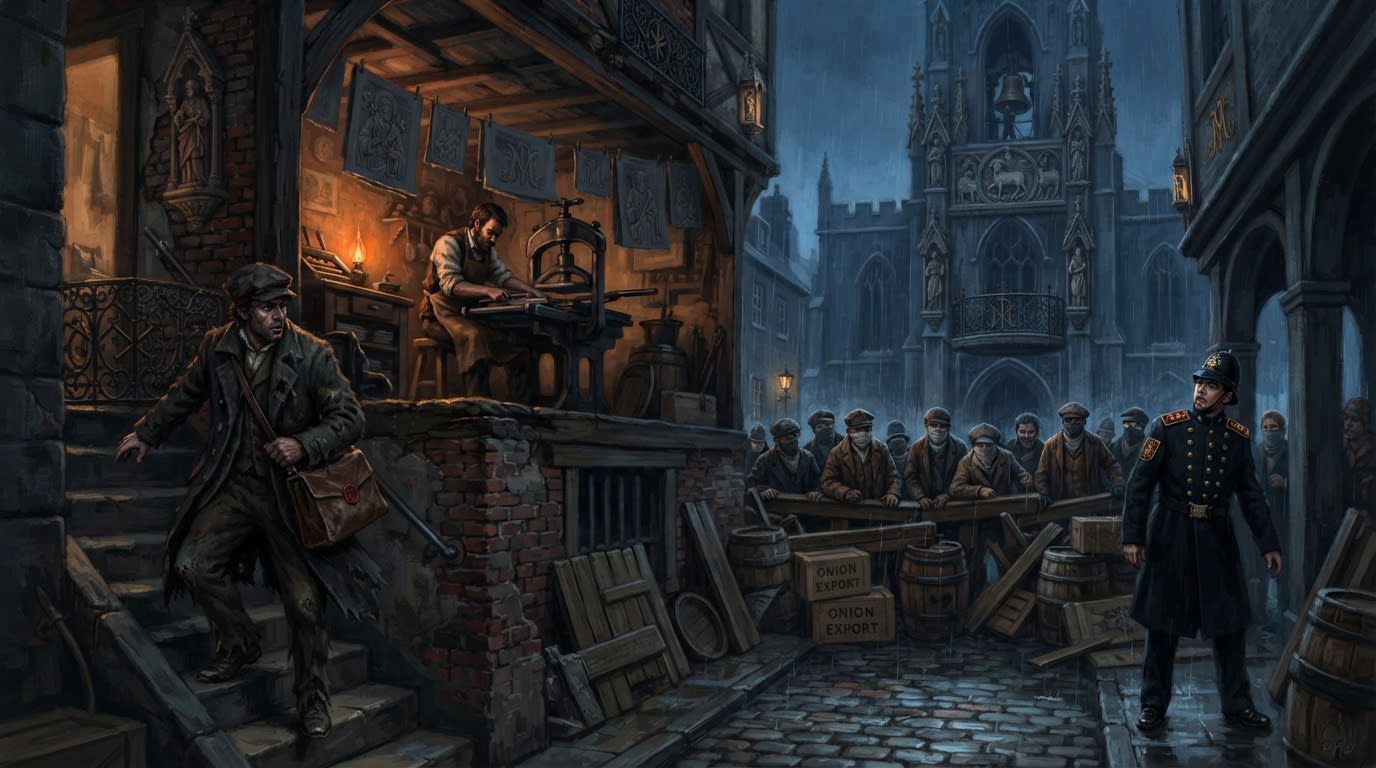
By dusk the queue in South Petition Hall had stopped moving. Petitioners who should have left remained. A porter dropped a crate to obstruct a narrow lane. Older women began loud fee arguments with the patience of people who have learned that bureaucratic delay is a weapon available to civilians. The Watch sergeant studied the crowd, the service doors, and the bell cord, and recognised none of the three as fully under his authority. Bell Runner Orr waited at the lower bell platform for a shutter signal across Slate Ward Lane. The shutter opened only halfway — a partial instruction that could mean proceed, abort, or the person who was supposed to decide has been arrested. Orr delayed the custody bell for ten additional breaths while the sergeant watched him do it. During those ten breaths, Courier Lark carried the satchel through the service hatch and up the Counter Nine stair with a bleeding hand and a Purity clerk two floors below her. Masked Vanguard Sable held the east arcade with petition benches, onion crates, and frightened civilians who had not yet decided whether they were a barricade or a queue. Printer-Forger Tern set type in a hidden press loft above a shuttered shop and asked Lark whether printing Mera's name would protect her or finish her.
This is the operating condition the Unquiet Underground prefers. An original document has been lost or seized. A copy is moving through hands the office has not counted. The public is angry in a way that has become specific — not general fury, which dissipates, but named fury, which accumulates. A borrowed route remains open. The event's meaning is still contested between six offices, four internal agendas, a widow, a frightened clerk, and a child who saw something in a stairwell and chose not to say what. The Underground exists in the hour between the office's answer and the district's question — and its entire organisational purpose is to make that hour last long enough for the question to be heard.
The movement arises from civic injuries before it acquires revolutionary ambition. Petitioners removed from registers after lawful complaint. Furnace workers disciplined for reporting unsafe valve systems that later burst and killed nine. Families presented with burial fees but denied custody information — the Synod's preferred arithmetic, in which a widow receives a number and is expected to grieve around it without asking what the number replaced. Clerks instructed to file corrections that correct nothing except the record's resemblance to what happened. Watch officers carrying contradictory writs from offices that share a corridor and apparently share nothing else. Scholars brought before Purity tribunals for asking whether negotiation could prevent a massacre the Bureau had already scheduled. Neighbourhoods opened to Purity teams with no return schedule, no apology mechanism, and no list of the taken — because a list would imply the taken were countable, and countable implies accountable, and accountable is a word that makes the Bureau of Records reach for its erasing sand.
The Underground turns these accumulated injuries into a network of people, routes, documents, services, signals, and refusals that can survive the loss of any individual cell. A courier may be arrested, but the route remains in a porter's legs and a kitchen worker's memory of which stair creaks at the third landing. A printer may flee, but the plate stays cached beneath a loose board in a room whose landlord knows what is hidden and has chosen, for reasons the cell does not fully control, to continue not looking. A Speaker may be seized after the grievance has been named, but the name persists in queues, in foundry-step arguments, in the careful repetition of women who have learned to say the counter that lied in a tone that requires no further explanation. A bell may be corrected after kitchens have already acted on its delay — and once a neighbourhood has learned that a bell can be delayed, the bell's authority belongs to a different conversation.
#The Fourth Copy
The Fourth Copy is the faction's central image, its operational model, and the closest thing it possesses to a sacred text — though the Underground would burn any cell that called it sacred, because sacred implies a priesthood, and a priesthood implies an office, and the office is the problem.
The model begins with proof. The first copy is the underlying true document: testimony, casualty roll, seizure schedule, repair warning, custody list, officer's second order, or witness statement. It exists in a drawer, a clerk's memory, a satchel, a belt lining. It is true and it is vulnerable. A fire can destroy it. A correction can rewrite it. A seal can classify it. A transfer can lose it. A clerk can be moved to another desk before anyone asks what was in the drawer.
The second copy proves that the first existed. A seal mark, a distinctive phrasing, a plate flaw, a margin annotation, a witness who saw the routing slip, a coffee stain whose position on the page matches the original's dimensions — material traces that transform a claim into evidence. Tern's contribution to the movement begins here, in the understanding that truth requires physical proof, and physical proof requires someone who can read a seal flaw the way a surgeon reads a wound.
The third copy becomes political. It reaches a committee, a workshop, a kitchen, a parish ledger, a ward gate, a foundry step, a hidden salon, or a conscience-stricken officer whose career has not yet made his conscience irrelevant. The third copy produces argument. It creates audiences. It forces an office to answer a question it believed it had answered by filing the answer where no one could read it.
The fourth copy escapes. Fire, raid, correction, authorised narrative, Purity seizure, Records revision, senior instruction, sealed custody, burned plate, arrested courier — the fourth copy survives these because it travels through a route the office did not count. Workers, bell runners, household keepers, kitchen staff, porters, and strangers whose names will never appear in any cell's records choose to create movement for a fact they may not fully understand. The fourth copy is the fact that has outpaced the institution.
ERRATUM — BUREAU OF RECORDS, FILED UNDER PROTEST Ref: Internal memorandum, South Petition Hall Incident, post-incident classification The Bureau wishes to clarify that the phrase "Fourth Copy" implies a sequential custody chain of precisely four duplications. In practice, the Bureau has intercepted documents bearing this designation at the second, third, seventh, and — in one regrettable case involving a tariff chapel, a print loft, and an uncooperative laundry — the fourteenth stage of duplication. The Bureau recommends that the phrase be understood as aspirational rather than arithmetical, and classified accordingly.
The model makes movement as important as revelation. Proof confined to a correct drawer is proof beginning to die. Testimony must outpace custody. Sources need handoffs that divide knowledge and exposure so that no single arrest unravels the entire chain. Public contradictions must become legible before the Bureau classifies them into a category that requires a permit to read. Witnesses need to remain alive long enough for their words to matter — a standard the Synod meets approximately as often as its bell schedule meets the actual time.
#Institutions as Arrangements
The Underground's operational theology — never called theology, because theology requires ordained interpreters, and ordained interpreters require an office — rests on a single observation: institutions are arrangements maintained by procedure, fear, records, bells, uniforms, and habit. Remove the junior clerk and the writ does not move. Remove the porter and the seal does not reach the gate. Remove the kitchen and the guard does not eat. Remove the habit and the office must explain itself, which is the one activity for which no Bureau training exists.
Members study institutional dependency through ordinary labour, which is the only intelligence method the Synod cannot classify as espionage without classifying labour itself as a threat — a conclusion several Purity investigators have reached privately and one has reached in a memorandum that was, with appropriate irony, seized and copied by the Underground before the author's morning tea. Couriers see routes, schedules, door behaviour, patrol gaps, and the difference between a guard who checks papers and a guard who checks whether anyone is watching him check papers. Printers see the reproduction of authority and understand, with the intimacy of people who handle type for a living, that a seal is ink pressed onto wax by a human hand and that human hands can be studied, imitated, or persuaded. Purity actors see maps of the condemned; mutual-aid workers see food, flight, illness, and hidden children. The same building produces both views. The difference is which door you enter and whose name the office writes down when you leave.
The faction's central tactical question follows from the observation: does each small act of obedience belong to the office or to the person performing it? A bell ringer who delays a curfew bell by ten breaths has not destroyed the bell. He has demonstrated that the bell's authority includes a human interval — and human intervals can be widened by anyone who understands where the catch sits and which prayer to recite slowly. A clerk who copies a receipt before it enters sealed custody has not stolen the receipt. She has demonstrated that custody depends on the clerk's hands, and the clerk's hands belong to the clerk before they belong to the Bureau. A porter who carries a satchel through a delivery route has not violated the route. He has demonstrated that the route was always a human being's legs, and legs walk where their owner decides.
The same intimacy with civic life creates harm. Witness rescue can expose a landlord whose building is now identified as adjacent to a route. Record preservation can endanger the typesetter whose plate flaw is traceable through eleven broadsheets. Family support can create obligations to patrons whose generosity carries an invoice written in invisible ink. Barricade work can leave a cobbler or tenant to explain stacked furniture to officials whose questions do not include an answer the furniture's owner can survive.
#The Route-and-Promise Rule
The Underground's internal rule — the closest thing the movement possesses to a constitutional constraint, though it has no constitution, no parliament, and no mechanism for enforcing its own rules beyond the willingness of people who could leave to stay — is that a route remains legitimate only while its promise to the people sustaining it remains legitimate.
A route belongs first to its worker or keeper. The porter whose legs carry the satchel may refuse the satchel. The landlord whose attic shelters a source may close the attic. The bell runner whose fingers delay the catch may decline to delay it. The cell may argue, plead, threaten, bribe, or explain, but the route does not become cell property through any of these methods, because a route that belongs to the cell rather than the keeper is a route maintained by fear, and routes maintained by fear already have an owner. It is called the Synod.
A copy remains partly owed to the source whose life may be broken by its publication. Tern may set the type. Lark may carry the proof. Lysa's apprentice may pull the broadsheets. But the source — Mera, the clerk, the orderly, the widow — retains a claim on the fact that was once her private knowledge, because she will face the consequences of its publicity while the cell argues about whose victory it represents.
A crowd does not owe a cell obedience because it applauded. A grievance remains owned by the people harmed after a Speaker gives it a public name. A committee hall that hosts a vote has not enlisted itself in the Cause. Gratitude is not consent. Relief is not recruitment. Shelter is not enlistment.
Decent members treat this rule as a constraint on strategy. Corrupted members record people, routes, contacts, and sources as usable infrastructure — the same word the Bureau of Tithes uses for grain lifts.
At its best, the Underground makes private injury publicly answerable. A custody lie becomes a custody question. A buried report becomes a public contradiction. A missing name becomes a printed demand. A sealed drawer becomes an open accusation. At its worst, it becomes another organisation that coordinates under pressure with sharper rhetoric, better slogans, more efficient coercion, and improved exits for its leadership — the Synod in miniature, with fresher ink and a lower ceiling.
#On the Crimes of the Underground, or, the Bureau's Preferred Terminology for Civic Literacy
The Synod classifies the Underground's activities under seven headings, which the Bureau of Doctrine has arranged with the same care a liturgist applies to the order of sins — beginning with the least physically dangerous and ending with the one that keeps the Bureau of Records awake at night, which is not the one involving explosives.
#Public Copies
The public copy is the Underground's primary weapon because it can travel after official custody has attempted to close. Testimony sheets, handbills, duplicate seizure schedules, casualty lists, altered writs, closure orders, repair warnings, committee demands, false-seal impressions, and named grievances — the movement produces these the way the Bureau of Records produces corrections, with the critical difference that the Underground's publications are designed to be read by the people they concern rather than filed in a vault accessible only to clerks with three counter-signed permits and an allergy to sunlight.
A document in Bureau custody remains under procedure. A document posted on a public board enters argument. A document repeated across kitchens, queues, and work stairs gains a force that procedure cannot match, because procedure requires a single authorised reader and the kitchen contains forty readers who have already decided the document is about their wages, their missing cousin, or the bell that rang early on the night the Watch came for the family upstairs.
Publication challenges offices by forcing them to speak to a public that has already read the contrary account — which is, for any bureaucracy built on the principle that the register defines reality, an experience approximately as comfortable as being undressed in a cathedral. Publication also exposes sources, families, workers, and orderlies before protective routes can be established. A broadside can identify a household before the household's shelter is ready. A margin copy can preserve an accusation while losing the mercy that would have protected the accuser. The responsible cell acknowledges that publication affects every person under the resulting attention, including the source who created the document and who may have wanted a quiet warning rather than a public revolution.
#Hidden Routes
The city's counter-network is the second classification. Service stairs, rooflines, kitchen passages, staff corridors, queue gaps, dead drops, carriage intervals, bell maintenance runs, market deliveries, laundry galleries, schoolyard fences, canal steps, and the thousand cracks in official movement that exist because institutions are built by architects who understood geometry and maintained by workers who understand weather, fatigue, boredom, and the location of every door that does not lock properly from the outside.
Courier Lark finds routes through the people who work them. A water carrier who pauses at a particular corner reveals a gap in the Watch sergeant's sightline. A smoking clerk who steps onto a landing reveals a service door that opens without a key. A porter who takes the longer path around a courtyard reveals a shorter path whose absence from the regular traffic means it is unwatched. A kitchen delivery that arrives at the same door at the same hour every day reveals a rhythm the Watch has already learned to ignore — which means the Watch will ignore it once more if the delivery carries a satchel instead of bread.
Specific routes carry specific costs. The Crooked Comma roof hatch operates only in weather that keeps the tile dry and with a particular lift that prevents the hinge from singing; it accommodates a thin satchel carrier but would trap a wounded adult. The Safehouse Chain requires that each keeper know only one previous and one next address, distributing knowledge so that no arrest produces a map, and distributing ignorance so that no keeper can be certain who occupies the rooms on either side of her own. Porter Dast's delivery intervals move paper, medicine, and hidden people under the cover of ordinary goods, and the cover holds precisely until an officer decides to inspect the goods instead of the porter's face. The Roofline Relay depends on tenants, sweeps, bell watchers, and children with height knowledge who have been promised — by cells of varying sincerity — that the promise is more important than the roof.
ERRATUM — BUREAU OF RECORDS Ref: Route classification, Unquiet Underground The Bureau has determined that the phrase "hidden route" implies a fixed, mappable alternative to the official road. In practice, routes maintained by the Underground shift with weather, personnel, raid patterns, and the willingness of individual porters and tenants. The Bureau recommends classifying these as "conditional disobedience paths" and has requested budget for a supplementary mapping division. The request has been under review for two years. The Bureau considers the delay unrelated.
Every route has a human price when repeated. Porters lose licenses. Tenants lose rooms. Bell runners become predictable to the very officers whose predictability the cell exploits. Safehouse keepers become responsible for an expanding radius of danger that started as a single night and has become a calendar. Better cells record keeper identities, needs, and limits; worse cells record routes as available and move on to the next operation, treating the keeper's subsequent arrest as an administrative cost rather than a person.
#Named Grievances
A Named Grievance converts a repeated harm into a phrase a district can speak without losing the injury's force. The underlying wrongs are familiar to anyone who has queued at a Synod counter: denied petitions, delayed custody lists, early curfew bells, false seals, unacknowledged missing clerks, false transfers, closed clinics, withdrawn services. The Underground's contribution is giving these injuries a public name — and a public name, in a civilisation where the Bureau of Records controls the official lexicon, is an act of war conducted with grammar.
Cell Speakers, mutual-aid kitchens, and ward committees turn harm into recognisable public claims. The counter that lied. The bell that stole time. The furnace that buried a report. These phrases do not require a manifesto. They require a neighbourhood that has been lied to at the same counter, timed by the same bell, and heated by the same furnace, and they work because the neighbourhood already possesses the evidence the phrase names.
Naming a grievance opens meetings, summons witnesses, produces work stoppages, converts queues into audiences, and gives families language that does not require them to recount all harm from the beginning every time an official asks what they want. The danger is ownership. A Speaker or cell may treat repeated public language as proof that the crowd belongs to its strategy, forgetting that the crowd may want bread, wages, custody information, or burial rights rather than revolution — and that revolution is a word most people pronounce only when the alternative is worse.
#Counter-Orders
Counter-Orders use the Synod's own command procedure against its reflexes. The Synod trains obedience through seals, tone, bells, schedules, rank signs, carriage colours, desk positions, and timing. A writ that arrives at the expected hour in the expected format from the expected direction is obeyed before its content is read. The counter-order exploits this reflex — placing a false command inside a familiar envelope and letting institutional habit carry it past the sentries that institutional habit has trained not to think.
The Second Order case proves the method's power: a ward gate receives three contradictory commands from three offices that apparently share a corridor and nothing else. A fourth order arrives in Captain Dren Vale's voice, authorising a custody transfer. The document has an imperfect seal, precise timing, and command phrasing familiar enough to make gate staff obey it before asking whether they should. Command hesitation permits a witness wagon and prisoner to change hands. The danger is institutional imitation. Defector command can become a desire to rule after the emergency. A cell may prefer soldiers who obey its instructions to citizens who question them. Every counter-order carries a temptation to establish a new throne — one that differs from the old throne only in the freshness of its upholstery.
#Terms and Forbidden Correspondence
Concord cells create terms with powers and people the Synod classifies as impossible to address — a classification whose purpose is not diplomatic but preventive, because addressing an enemy implies the enemy can be understood, and understanding implies the enemy might have reasons, and reasons are more dangerous than weapons because the Bureau of Doctrine has no procedure for confiscating a reason.
Potential correspondents include embassies, outer intermediaries, condemned schools, forbidden scholars, hostage keepers, canal voices, and threshold-bound entities whose nature the Bureau has classified under categories requiring four counter-signed permits to read. Professor Edda Rey's terms framework identifies Speaker, Witnesses, Payment, Refusal, Boundary, Cost before consent, and absent people represented by the negotiation. The framework is a manual for talking to powers that can eat you — written by a woman who believes that the alternative to structured conversation is unstructured slaughter.
Terms at the Drowned Gate remains the defining case. Official sources call it treasonous hospitality. Concord claims it identified a first Cost before a district paid blindly. The negotiation affected fishermen's canal rights before those fishermen participated, which proved that representing absent parties is a form of theft regardless of the thief's intentions. Forbidden correspondence can delay violence, permit evacuation, expose political motives, and demonstrate that Synod categories conceal active choices behind passive classification. It can also turn recognition into invitation, teach an answering power the cell's routes and internal fractures, and allow a negotiator to speak for people who did not consent and may not survive the terms spoken in their name.
#False Attribution
False Attribution directs evidence, symbols, schedules, or actions toward a selected target to force public explanation or institutional conflict. Counterfeit banners, official-pattern gear, staged denials, borrowed language, seized hardware, planted schedules, and blackmail copies — Ascendancy favours these because confusion exposes which accusation an institution most fears, and the accusation an institution most fears is the one closest to the truth.
A false seal may disgrace the office that accepts it. A counterfeit Purity instruction may force denial of a plan the Bureau intended to implement quietly. A planted schedule may turn bureaus against each other with the efficiency of a well-placed rumour at a family dinner. The consequences cannot be fully contained. A committee framed for a forged notice can lose its hall. A rival cell framed for a breach can respond with actual violence. A clerk whose phrasing is copied can be punished for her own style by an office that cannot distinguish imitation from authorship — which is, the Underground notes, the same difficulty the office faces with its own corrections.
#Precise Failure
Precise Failure is targeted sabotage intended to alter civic timing rather than produce indiscriminate destruction. Saboteurs treat bells, custody doors, gates, vehicle schedules, signal lines, and administrative machinery as mechanisms governing sleep, labour, curfew, warning, pursuit, hunger, and disappearance — which is what they are, stripped of the liturgical language the Synod drapes over them the way a widow drapes black cloth over a mirror.
Methods include controlled fuses, staged repair incidents, spoiled seals, jammed locks, opened gates, weakened hinges, cut tubes, and breach tools. The intended outcome is specific: one door opened, one signal delayed, one report forced, one custody chain broken, one verification demanded, or one purge route denied. The Curfew Bell case establishes both the method's virtue and its cost. Orr delays Slate Ward's curfew bell by twelve breaths while Purity wagons wait at the north mouth. Families use the time to hide names, bodies, medicines, plates, and a forbidden letter. Afterward, every bell in the ward becomes more suspect. Mothers interpret legitimate fire warnings through political distrust. Workers listen for the catch rather than the chime. Children learn to count breaths between the bell and the door.
Sabotage must distinguish public systems that must continue functioning — clinic locks, water pumps, fire bells, grain gates, bridge axles — from systems whose failure protects people. Corruption begins when any public service is treated as expendable because prior sabotage succeeded, and the distance between the curfew bell can be delayed and the fire bell can be delayed is shorter than any saboteur wants to admit. Responsible saboteurs keep repair ledgers alongside their tools. Corrupt ones treat repair as someone else's future problem — the same phrase, the Underground observes, that the Synod uses for everything below the waterline.
#On the Internal Doctrine of the Underground, Such as It Is
#No Institution Is Inevitable
The doctrine began as a printer's line — five words, hand-set in Tern's predecessor's composing stick and paired with a simple diagram showing a bell rope, a seal press, a ledger drawer, and a human hand. The hand was drawn larger than the mechanisms it operated. The pamphlet was confiscated within three days. By then, the diagram had been redrawn on seven kitchen walls, two schoolroom slates, and the inside of a tariff chapel's public-facing shutters, where it remained for four months because no official could justify removing a picture of a hand without explaining what the hand represented.
The Synod's doctrinal position holds that hierarchy, office, oath, correction, tithe, custody, and authorised speech are structurally necessary — permanent features of an ordered world, as essential as the Sagittal Line and rather older. Individual officeholders may be corrupt, incompetent, or privately heretical, but the office itself precedes and survives them. The Synod corrects officers. It does not question offices. To question the office is to question the structure, and to question the structure is to question the Synod, and to question the Synod is to question the order that stands between human civilisation and the Charnel Lands — which means, in practice, that a clerk who asks why the tariff chapel opens at a different hour for wealthy merchants is committing an offence in the same theological category as opening a gate on the Sagittal Line (Unregistered).
The Underground challenges permanence by treating institutions as made objects. A bell tower has doors, wages, lamp schedules, rivalries between ringers, an inventory of rope, a list of repairs postponed for budget, a supervisor whose knees prevent him from climbing above the third platform, and a catch mechanism that can be delayed by a dropped wrench and an intentionally slow inspection prayer. Records is dependent on clerks who can read old hands. Purity is dependent on kitchens surrendering names. Tithes is dependent on porters. The Watch is dependent on junior staff who enforce contradictory writs without asking which writ was signed first. Remove any of these human dependencies and the institution does not function. Replace the dependency with a person who chooses differently and the institution functions differently. This is either a revolutionary observation or a description of Tuesday morning, depending on whether the observer has tenure.
The doctrine's poison is its own success. Proof that an institution can be interrupted may lead a cell to believe every office is waiting for the cell's own hand — that the interruption is not an emergency measure but a right, and the right is permanent, and the permanence creates a new institution whose founding myth is the destruction of the old one. The immediate post-victory period — when authority tools are available, when command habits are transferable, when the population has learned to obey decisive voices — is the hour in which liberation can become seizure. The Underground's catechism warns against this. The Underground's history suggests the warning arrives late.
#Every Cell Contains Another Agenda
The Underground is unified by injury and divided by destination. Members agree about purges, false registers, broken custody lists, early bells, vanished witnesses, and buried safety reports. They agree that the Synod's machinery causes these harms systematically rather than accidentally. They agree that agreement is insufficient. They disagree about what must replace the machinery once it has been interrupted, and the disagreement runs through every cell like a fault line through a foundation — load-bearing, invisible from the surface, and capable of splitting the building when the ground shifts.
Coup seeks command readiness. Loyal gate crews, second orders, arms caches, seized schedules, defector officers, and the ability to transfer authority on the night the transfer matters. Coup believes the crisis will arrive as a single decisive hour and the movement must be ready to hold gates, issue orders, and administer a district before dawn. Its preferred question is who commands?
Concord seeks communication. Terms with powers the Synod forbids people to address, guarded correspondence, witnessed voices, exact boundaries, recognised refusals, and the radical proposition that conflict has participants rather than categories. Concord believes the crisis can be survived through structured conversation. Its preferred question is what are the terms?
Reform seeks public ledgers. Named sources, local authority, public accountability, functioning services, repair schedules that reflect actual damage, burial lists that contain actual names, and a ward committee with the power to fire the tariff clerk who has been lying about grain weights since A.S. 196. Reform believes the crisis is the absence of public accounting. Its preferred question is who answers?
Ascendancy seeks retained influence. Patronage, blackmail, access, debts, favours, hidden authorship, strategic continuity, and invisible control exercised through salons, brokers, and the quiet leverage of people who possess documents other people need to remain free. Ascendancy believes the crisis is permanent and the movement must secure itself within it. Its preferred question is who remembers the debt?
These agendas overlap in a single operation and sometimes in a single person. A courier may carry proof for Reform, use a route opened by Coup, deliver to a contact maintained by Concord, and owe the paper to a patron connected to Ascendancy — and the courier may not know which agenda she serves until the agendas disagree about what to do with the proof she carried.
The route-and-promise rule functions as the internal test. Decent cells remember that route keepers, sources, contacts, and crowds are people with separate lives and costs that predate the movement and will outlast it. Corrupt cells convert the same information into a map of assets, pressure points, and controllable infrastructure. The conversion is gradual. A safehouse becomes a resource. A porter becomes a logistics unit. A widow becomes a source. A kitchen becomes a station. The vocabulary of liberation begins to sound like the vocabulary of management, and the vocabulary of management has always belonged to the Synod.
#What the Underground Claims to Serve
In public, the Underground says it serves the district.
The district includes workers seeking safe conditions and honest repair schedules. Petitioners seeking answers the counter owes them. Clerks seeking an end to filing corrections they know are lies. Families seeking custody lists the office has classified as closed. Students seeking the right to ask questions that are only illegal because the Bureau has not yet explained why they are dangerous. Watch officers seeking commands they can obey without becoming complicit. Widows seeking names. Smugglers seeking opportunity. Clergy seeking mercy. Opportunists seeking the likely victor, because opportunism, unlike ideology, keeps honest records of its motives.
Serving the district requires choosing among incompatible needs. Coup serves the district by preserving command capable of closing a gate before a purge arrives; its corruption is captured authority demanding new obedience. Concord serves the district by identifying what an enemy wants before ordinary people pay for ignorance; its corruption is treating consent as formality and absent communities as bargaining material. Reform serves the district through public books, named missing people, kitchens, clinics, and accountable offices; its corruption is delaying relief in worship of perfect procedure while families eat their shoes. Ascendancy serves the district by holding proof and continuity against betrayal; its corruption is invisible rule that prices public victories in private favours the public will never see invoiced.
A successful cell is an institution in seed form. It has roles, stores, titles, signals, punishments, origin stories, favoured lies, sacred phrases, and authority accumulated through survival. Better cells audit themselves for hierarchy — Mara Pell's committee insists on quarterly reviews, which the cells under Coup's influence attend with the same enthusiasm a condemned man brings to his own trial. Worse cells rename hierarchy as coordination, call obedience solidarity, and treat objections as evidence that the objector has not suffered enough to understand.
#The Private Catechism of the Fourth Copy
The catechism circulates in incomplete and competing versions across presses, courier schools, safehouses, and committees. No two versions match. The disagreements are doctrinal.
A single copy is a plea. A second copy preserves memory. A third copy produces dispute. A fourth copy escapes through an uncounted route. A copy without movement is condemned to a drawer. A route without a responsible keeper is theft wearing a different coat. A keeper without a promise is prey dressed as hospitality. A crowd without a promise can be directed like weather — useful, destructive, and unaccountable. A promise without a witness belongs to power. A witness without shelter becomes an example. A shelter without limits becomes a prison. A victory without ongoing argument already has a ruler.
Printers use the catechism to connect proof to distribution. Couriers use it to insist that keepers own their own legs. Speakers use it to constrain the movement's line holders — the people who decide what counts as the public message. Sable uses it to question publication that endangers bodies before bodies have been moved.
Coup reads the final warning — a victory without ongoing argument already has a ruler — as cowardice dressed in caution. Concord reads it as a safeguard against Coup. Reform reads it as a constitutional requirement for post-victory governance. Ascendancy reads it as a challenge to arrange the argument so that the right people win it. The multiple interpretations prevent the catechism from functioning as a closed doctrine, which is either the catechism's wisdom or its fatal weakness, and the Underground has been arguing about which since the first press run dried.
#On How the Faction Operates
#Finding the Grievance
Operations begin where civic procedure fails visibly enough to leave witnesses, or predictably enough that harmed people can identify the timing. A denied petition with a suspicious date. An altered register whose correction was filed before the error occurred. An unofficial casualty list circulating in a hospital corridor where the official list says no casualties exist. An early curfew bell on a night Purity wagons are seen at the district's north mouth. A false seal on a closure order. A failed repair order whose failure killed people the order was supposed to protect. A clerk who risks a note because the note is smaller than the lie she was asked to sign.
The cell looks for repetition. One incident can be buried as accident, blamed on a junior official whose dismissal closes the file, or classified under a doctrinal category that requires three permits to read. Matching incidents form a pattern, and a pattern is the one thing the Bureau of Records cannot correct by correcting a single document. The first test is survival: which wound has witnesses, and which witnesses can endure the belief or exposure that follows testimony? A widow may face arrest. A clerk may need the same desk tomorrow. A worker may need publication delayed until a relative leaves a dangerous shift. A furnace hand whose complaint about a valve was ignored before the valve failed may want the complaint published; he may also want it published after his family has moved to a different ward, and after is a word the cell does not always have time to honour.
The cell must find the grievance's actual owners, who may see burial, wages, custody, personal escape, or public scandal in the same document. A cell that enters with an already-fixed meaning — this proves our thesis about the Bureau — substitutes authorship for intelligence and treats the source as an illustration of a conclusion the cell reached before it read the evidence. The Underground's vocabulary for this failure is a pamphlet looking for a fact.
#Opening the Route
Routes are selected through the people who work them before the architecture that contains them. The wall has a door. The door has a lock. The lock has a key. The key has a holder. The holder has a name, a wage, a family, a supervisor, a grievance, a fear, a commute, a debt, and a preference regarding the use of the third-floor lavatory that determines which stair she takes at half past four. Lark reads the holder before she reads the lock.
Porter Dast identifies burden paths: which loads are searched, which are weighed, which are waved through because the officer knows the porter by face and has decided that familiarity equals trustworthiness. Vela provides safehouse limits — how many people, for how long, with what evidence, toward what exit, and whose name is exposed if the plan fails. Orr identifies signals that can be delayed without immediately destroying the public trust that makes the signal meaningful. The bell can absorb ten breaths of delay. It cannot absorb ten minutes. The distinction is the difference between a rescued witness and a district that no longer trusts its fire warning.
A route can fail before public action. Surveillance closes a stair. A keeper refuses the satchel. Crowd movement shifts a patrol. A safehouse is overexposed by a prior operation the cell did not authorise. Damaged physical access — a broken hinge, a locked gate, a flooded passage — removes a path the plan required. Inspection changes a porter's schedule. Injury removes a runner. Timing loss means the bell has already rung. Good cells treat a closed route as intelligence about future danger. Bad cells treat it as a personal insult delivered by geography.
#Building the Network: Voice, Shadow, Spark
The Underground operates through three categories of force, which it did not invent so much as discover in the wreckage of its first operations, the way a builder discovers load-bearing walls by knocking down the ones that are not.
Voice is public force. Testimony, grievance, copied proof, speech, denial, sympathy, witness, committee response, work stoppage, and the specific power of a phrase repeated across kitchens until it becomes what the district believes. Voice makes private injury audible. Voice also makes injured people visible, and visibility in a district under Purity attention is a gift with a fuse attached.
Shadow is route force. Cover identities, handoffs, passage, dead drops, staff roles, sources, caches, false bottoms, loose bricks, and the uncredited hospitality of a landlord who did not ask what the satchel contained because the answer would have made her an accessory. Shadow moves the operation through spaces the later public narrative will simplify — the committee will remember the broadside; it will not remember the laundry worker who hid the broadside in a wet sheet. Shadow also creates the chain that enemies can trace backward from the public event to the private kitchen where the chain began.
Spark is disruption force. Sabotage, delayed fuses, altered bells, public refusals, breaches, cut signals, false-seal failures, blocked lanes, and the mechanical resistance of a lock that jams at the moment a Purity escort reaches for its key. Spark changes timing. Spark can also damage the systems that keep the same district alive — water, fire warning, grain delivery, hospital access — and the Underground's internal argument about which systems can be interrupted and which cannot mirrors, with uncomfortable precision, the Synod's own argument about which sacrifices are acceptable and which require a stamp.
The faction treats these as operational components. It must also account for the people bearing each component's danger. A public Speaker becomes identifiable to every officer in the crowd and every informant in the queue. A safehouse keeper must lie to a child or a household member who will eventually ask what happens in the room that stays locked. A bell runner who delays a curfew damages the civic trust that allows a bell to mean come home rather than something political is happening again.
#Moving the Proof
Proof travels through people, and people bruise. Copies, caches, margins, false bottoms, wrappers, satchels, rooflines, laundry bundles, school materials, furniture legs, committee minutes, and prearranged public distribution — the Underground moves evidence through the same channels that move bread, coal, grief, gossip, medicine, and children's errands, and the channels work because they are ordinary, and they become dangerous because they have been used, and they become fatal because they have been used too often by people who forgot that ordinary channels contain ordinary lives.
Lark carries first movement — the proof leaves the building, the drawer, the clerk's hand, the sealed custody. Tern produces reproducible form — the proof becomes a plate, a broadside, a margin copy, a document that can survive the loss of the original. Runner Cells divide knowledge — each runner carries a fragment, a phrase, a ribbon, a signal, a name that must be removed from a list. Typesetters make public copies. Hidden plates preserve the event after originals vanish, corrections rewrite, and Purity confiscates everything that holds still long enough to carry a seal.
The desired proof survives loss of carrier, original, or cell. Redundancy is the model's strength. Redundancy also multiplies the number of keepers, shops, households, and children whose lives become exposed to the copy's path. A cached plate can publish after circumstances change — including circumstances under which publication harms the source who created the original. A margin copy can preserve accusation while losing the context that would have protected the accused from public misunderstanding. A broadside can identify a family before the family's shelter is ready. The cell must continually decide whether to hide, duplicate, move, or publish, and each decision's cost falls on a person the cell may not have asked.
#Breaking the Official Response
Official response follows a recognisable sequence. Denial, sealing, dispersal, seizure, correction, punishment, and preaching. The Underground has studied this sequence with the attention a clockmaker gives to a mechanism — and for the same reason: understanding the sequence allows you to interrupt it at the joint where it is weakest.
Sable holds a line between petitioners and armed response. The line is not a wall. It is a political statement made from bodies, benches, and the specific gravity of a crowd that has decided it is watching. Defectors create second-order hesitation — the gate receives a command and then receives a contradiction, and the contradiction is plausible enough to create the three minutes of confusion in which a witness can change stairs. Saboteurs delay bells or disable doors. Provocateurs force public denial by making accusations outrageous enough that the office must respond, and the response reveals the truth the office intended to keep quiet. Gunners suppress a route during extraction — not to kill, but to make a stairwell expensive enough for three minutes that the Purity escort chooses a different stairwell. Signal Crackers misdirect authority by feeding wrong commands into speaking tubes, bell sequences, and lamp codes.
Preferred violence is brief and protective of a route, source, witness, crowd, copy, term, retreat, or public line. The cell asks what a violent act protects and whether the protection survives the act's consequences. A successful intervention can still destroy public support, expose the source, or ruin a civic service that the district needed more than it needed the proof the cell was protecting. The Bureau will use casualties and spectacle to replace the original grievance with a new doctrine of disorder — and a doctrine of disorder, once established, can erase any amount of prior injustice from public memory.
#Deciding Who the Victory Belongs To
The operation's public meaning is contested after the immediate action, and the contest is where the Underground most closely resembles the institution it opposes. Families may remember names. Workers may remember that the ward operated without Synod supervision for four hours and the bread was still delivered. Queues may remember a shield. Clerks may remember their loss of anonymity — the moment when the Underground made them visible to the same public they had been quietly defrauding, and the visibility felt like punishment even when the clerk agreed the fraud should stop. Kitchens may remember the consequences after the fighters leave: the missing food, the frightened children, the Purity investigator who arrives three days later to ask why the soup pot was large enough for sixty when the kitchen serves thirty.
Better cells argue before celebrating. Who holds the copy? Who shelters the source? Which route is burned? Which promise became public? Which contact paid too much? Which bureau responds first? Which lie will create future harm? These questions make the Underground uncomfortable because they require the movement to account for its own costs with the same rigour it demands from the Synod — and the movement, like the Synod, prefers to audit other people's books.
#On the Reputation of the Underground Among the Powers That Would Prefer It Did Not Exist
#The Synod
The Synod considers the Underground a crisis of reproducible method. It can break a riot. A riot has a location, a crowd, a leader, a grievance, and a sequence of events that respond to Purity cordons, Watch charges, bell sequences, and a stamped correction distributed before the ink on the original complaint has dried. A riot is a fire. The Underground is a district that has learned to make fire, and the district cannot be extinguished by confiscating its matches, because the district has realised that matches are made of wood, sulphur, and friction, and wood grows in courtyards, sulphur can be sourced from a tariff chapel's fumigation stores, and friction exists wherever two Synod offices issue contradictory orders about the same citizen's grain ration.
Public Synod language describes the Underground as civic blasphemy, counterfeit mercy, paperwork-based sedition, hospitality toward infection, and common hands defying ordained office. Internal memoranda — which the Underground has copied, naturally — identify the actual threat as "hinge personnel": bell-ringers, typesetters, kitchen workers, line clerks, warehouse porters, Watch scribes, sweepers, ushers, copyists, and morgue orderlies. The phrase acknowledges what the Underground teaches and what the Synod prefers to deny: that hierarchy depends on people who sustain its small procedures, and those people can choose differently.
Individual Synod offices use Underground copies while condemning their creators. A Records deputy leaks a rival's schedule to embarrass a promotion candidate. A Purity investigator cites anonymous copies when building a case against Tithes. A secretary uses street testimony to justify a raid the secretary wanted before the testimony appeared. The Underground is aware of these uses and considers them proof that the Synod's own officials treat official custody as less reliable than street publication — a conclusion the Synod's own officials would find offensive if confronted with it, and accurate if they were honest, and they are rarely confronted with it because the officials who confront uncomfortable truths tend to find themselves transferred to Bastion-Shipka's bell-counting division.
#The Bureau of Purity
Purity opposes the Underground because it makes purge operations visible as connected human decisions rather than indivisible holy motions. A purge, in Purity's preferred presentation, arrives as a single sanctified action: the ward is sealed, the names are collected, the wagons depart, the correction is filed, and the district is restored to doctrinal health through a process that requires no further examination because the process itself is sacred. The Underground names bells. Copies rosters. Identifies wagon axles by their wheel marks. Asks who held the key to the ward gate and who signed the order that moved the curfew forward by two hours on the night before the wagons arrived.
Purity fears public excess because a firing lane watched by petitioners, cooks, children, and families becomes a political event rather than a doctrinal procedure. Sable's visible barricade lines force Purity to choose between negotiation and publicly witnessed violence, and Purity despises both options — negotiation because it implies the crowd has standing, and publicly witnessed violence because it produces exactly the kind of memorable injustice the Underground converts into broadsheets.
#The Bureau of Records
Records sees the Underground as a breach in its ability to make register reality supersede street reality. The Bureau's operating theology holds that the register is truth. The register records births, deaths, tithes, transfers, corrections, and confessions, and the register's version of these events is the version that counts. A street may remember a different version. A kitchen may remember a different version. A widow may remember a different version. The register does not care, because the register was written by an authorised clerk with a counter-signed permit, and the widow was written by grief.
The Underground's margin copies, false rosters, leaked manuals, preserved seals, blackmail archives, and insider clerks can force the register to answer to external evidence — and answering to external evidence is, for the Bureau of Records, an experience comparable to a cathedral being required to justify its foundations to a passing cobbler. Records especially fears clerks who can identify specific altered registers and speak with institutional expertise, because an ex-clerk's testimony carries the Bureau's own authority against it.
The Bureau treats Tern as a deeper threat than a barricade. A barricade can be cleared with sufficient Purity commitment and a willingness to explain the clearing's casualties to the families of the cleared. A surviving copy multiplies after physical suppression. Records responds with revised filing rules, dual seals, counter-copy orders, ink tracing, chain-of-paper hearings, and audit-style raids that consume more administrative labour than the copies they seek to suppress — which creates, with the mechanical inevitability the Underground has learned to exploit, new recruitment opportunities among the overburdened clerks tasked with implementing the new rules.
#The Bureau of Tithes and the Customs Houses
Tithes and Customs depend on schedules, seals, queues, declarations, weighing tables, exemptions, seizure carts, and the conversion of hunger into arithmetic. These interfaces make them permanently vulnerable to copies, altered lists, false seals, route disclosure, duplicate exemptions, and public proof of selective collection — which is to say, proof that the weighing table was heavier for the poor than for the patron who pays the clerk's second wage.
Customs House Nine becomes the foundational embarrassment. A stopped queue, a disappeared satchel, a press on the roof, and a public contradiction that spreads through the ward faster than a Purity correction can follow it. The case demonstrates that delay can travel faster than command — that a queue that stops moving generates its own authority, and a satchel that leaves through a roof hatch generates its own audience, and an audience that has read the broadside before the correction arrives has already decided which document to believe.
Some customs staff assist the Underground because they know. Double charges. Favour payments. Uncounted stores. Compromised inspectors. Suspicious sealed carts whose contents are listed as sanctified materials on the manifest and listed as someone's profit in the porter's memory. The Underground gives such knowledge a route from private awareness to public action, and the route transforms a resentful customs clerk into a political actor — which the clerk may or may not have wanted, and which the cell may or may not have explained before the clerk's name appeared on a broadside.
#The Local Watch
The Watch is closest to Underground operations and pays the highest price for proximity. A Watch captain may condemn a handbill in the morning and seek its source by afternoon, because the handbill contained a Purity schedule the captain needed to protect his own patrol from a Purity operation the captain's own superiors had not informed him about. The relationship is parasitic in both directions. The Underground exploits Watch predictability. The Watch exploits Underground intelligence. Each condemns the other publicly and consults the other privately, and neither admits the consultation to its own hierarchy.
Watch clerks possess schedules, verification patterns, arrest ledgers, passwords, and route closures. Their choices to sell, leak, disguise, or withhold that knowledge are operationally decisive. Arlen provides patrol schedules because an official record was altered after a boy died in a holding room, and Arlen preserved the original, and the original's existence means Arlen can never fully return to the condition of an officer who does not know what was altered. He is committed because he was honest, and honesty in the Bureau's employment is a one-way gate.
Defector Officers can open gates, contradict purge orders, and create hesitation, but may treat repentance as entitlement to future command — the logic of a man who believes that leaving a bad institution earns him authority over a good one, when what it earns him is suspicion from both sides and an obligation to demonstrate that his conscience arrived before his convenience.
#Workers, Petitioners, and Neighbourhood Committees
Workers, petitioners, and neighbourhood committees provide rooms, food, cover, warning, witness lines, public memory, and the basic legitimacy that lets copies matter. Without them, the Underground is a conspiracy of printers and couriers producing documents no one reads. With them, the Underground is a civic movement whose documents arrive inside a structure of kitchens, queues, foundry steps, and committees where the documents are read aloud, argued over, misquoted, improved, and acted upon in ways the original cell did not intend and cannot control.
They support the Underground because it moves medicine through closed wards. Shelters witnesses from Purity patrols. Preserves custody lists the Bureau has sealed. Feeds families after seizure. Delays Purity teams long enough for a neighbourhood to hide its children, its evidence, and its courage. Warns districts. Keeps access routes open after official services have closed them for reasons the official language describes as temporary and the calendar describes as permanent.
They resist cells that arrive with a predetermined revolutionary outcome. Foundry workers may want safer valves while Coup wants a gatehouse. Petitioners may want custody names while Reform wants an audit. A kitchen may offer shelter while rejecting the messenger's terms. A family may want a name printed once and then protected from political reuse — a distinction the cell finds inconvenient because a name used once is a plea, and a name used repeatedly is a campaign, and the family did not consent to a campaign.
Mutual-aid kitchens build trust quickly because service is legible. A bowl of soup is not a manifesto. But the cell that treats a bowl of soup as the first step in a recruitment sequence has begun reproducing the coercive authority it claims to oppose, and the kitchen workers — who understand the difference between feeding a person and enrolling a person because they have been doing the former since before the cell existed — will notice.
#Printers, Typesetters, and the Paper Trades
Paper trades function as the Underground's nervous system. Printers, typesetters, paper sellers, ink grinders, binding apprentices, rag collectors, notice-board keepers, and shop porters — the movement's ability to produce, distribute, and preserve proof depends on people whose professional skills predate the movement and whose professional vulnerability outlasts any individual operation.
A press loft can function as parliament, arsenal, confession space, and grave marker. Lysa Nenn embodies the material cost of sympathetic printing. Paper accounts are visible to any Tithes inspector who understands that a shop purchasing three times its normal foolscap allotment is either preparing a very large inventory or producing documents the inventory does not list. Repeated phrase and spelling habits are traceable across broadsheets by clerks trained to read style as evidence. Apprentices become targets because they know the loft, the plate, the paper source, and the route, and they are young enough to be frightened into testimony. Shop exposure affects families and landlords whose proximity to the press is measured in wall thickness and plausible deniability.
#Heretical Cells and Outer Intermediaries
Heretical and outer groups value the Underground's routes, witnesses, cover, printers, and moral language as potential alliance, entry point, or concealment. Concord argues that communication can prevent massacre and sometimes proves correct. A named envoy, a witnessed voice, a boundary drawn in terms both sides can read — these can reveal a Cost before ordinary people pay it unknowingly.
Outer intermediaries exploit the movement's willingness to treat conflict as terms. Consent-like phrasing, hooked gifts, displaced witnesses, and bargains with delayed consequences — the answering power at the Drowned Gate offered a boundary, a delay, and a name it should not have known, and the fact that it should not have known the name is either proof that the Synod's secrets are less secure than the Synod believes or proof that the answering power possesses its own sources, and the distinction matters because the first is embarrassing and the second is terrifying.
#Smugglers, Brokers, and Black-Market Suppliers
Brokers value routes, false-bottom cargo, forged passes, split shipments, night bells, and witnesses willing to overlook movement in exchange for considerations the official economy cannot provide. Restricted Exchange provides demolition pistols, plate, papers, signal gear, paper stock, lock tools, ciphers, and conventional weapons. Each purchase creates a later political debt: weapon credit becomes a favour, the favour becomes a name, the name becomes influence in an absent debtor's decision, and the influence becomes permanent because the broker keeps records and the debtor does not.
Pell Thread can provide transport, documents, alcohol, weapons, or considerably more dangerous cargo under the same labels, and the labels are the point — a crate marked lamp oil may contain lamp oil, weapons, or a debt the buyer will discover when the crate is empty and the invoice arrives. The Underground depends on brokers and becomes more corrupt through the dependency. Ascendancy embraces this most quickly, because Ascendancy understands that a debt ledger held in private is indistinguishable from a command structure. Reform acknowledges the dependency most slowly. Coup frames it as supply. Concord asks whether the broker can reach another negotiating party — which is either pragmatism or a category error, depending on whether you believe a man who sells weapons and debts in equal measure is a suitable intermediary for peace talks.
#Families of the Missing
Families bring custody receipts, tags, coat fragments, hospital rumours, pay chits, prayer cards, copies, wrong dates, and the kinship evidence that proves a person existed after the register has classified their existence as administratively resolved. They seek the public appearance of a name because a name can become protection, accusation, memorial, or proof that a loved one outlasted procedure — that the Bureau's correction, however stamped, did not erase the person the correction was designed to make disappear.
They also fear being used as evidence before they are ready. A child may be made to speak in public about a father's absence. A father may see his son's name printed beneath demands the son never endorsed. A widow may learn that the cell exposed a surviving witness while saving a list the widow asked the cell to save — and the widow's gratitude for the list and the widow's fury about the witness coexist in the same woman, at the same hour, and the cell cannot resolve the contradiction by calling the widow ungrateful.
Hospital orderlies, burial clerks, morgue sweepers, shrine singers, and memorial committees bridge family knowledge to the movement. The Underground's best reputation comes from treating families as authorities over their own dead and missing — the only authority the Bureau does not claim, because administering grief requires empathy and empathy has never been allocated a budget line.
ERRATUM — BUREAU OF RECORDS Ref: Families of the Missing, public perception The Bureau notes that the phrase "families of the missing" implies that the missing are, in fact, missing. The Bureau maintains that individuals described as missing by their families have, in most documented cases, been transferred, corrected, or reclassified under procedures consistent with established protocol. The Bureau recommends that the phrase "families of the administratively resolved" be adopted in official correspondence. The Bureau is aware this recommendation has been ignored. The Bureau is accustomed to this.
#On the Field Doctrine of the Unquiet Underground
The Underground does not have a manual. It has habits, arguments, funerals, and the accumulated scar tissue of operations that worked, operations that failed, and operations whose outcome remains classified because the participants disagree about whether the objective was achieved or merely survived. What follows is the closest approximation to tactical doctrine that can be extracted from interrogation transcripts, captured field notes, and the testimony of operatives who were willing to describe their methods in exchange for considerations I am not authorised to enumerate.
I present this material not as endorsement but as diagnosis. A physician who describes a plague is not advocating for the plague. A Hieromnemon who describes insurgent field methods is performing a civic duty — one that happens to require extensive familiarity with the subject, which I acquired through professional obligation and not, as Doctrine has implied, through personal enthusiasm.
#On Entry
The Underground enters a district the way water enters a cellar: through the crack that was always there, along the path the builder considered too minor to seal, at the hour when nobody is watching because watching has not been allocated to anyone's schedule. The preferred entry is not a door kicked open but a door held open by someone whose job requires holding doors — a porter, a kitchen assistant, a bell-runner whose shift overlaps with the gap between Watch patrols, a chapel errand boy whose basket can carry more than candles and whose employer does not count the candles because candle-counting has been delegated to a clerk who is currently eating lunch.
Covers are selected from the district's own catalogue of unremarkable presence. Queue petitioner. Repair worker. Print apprentice collecting proofs. Cook delivering to a staff entrance. Committee organizer distributing invitations. Hearing attendee carrying documents that are, in fact, documents — for a hearing that is, in fact, scheduled — about a matter that is, in fact, under review. The genius is not disguise but selection: choosing the role that makes the operative invisible because the role is already invisible, because institutions render their own service workers transparent by habit rather than intention.
Lark scouts the rhythm. Tern prepares the public explanation — the reason, should anyone ask, why a particular person was in a particular corridor at a particular hour, and the reason must be boring enough to discourage follow-up questions but documented enough to survive a Records inquiry. Sable positions the first protective line: the person or persons who will intervene if the entry is challenged, and whose intervention will take the form of a plausible bureaucratic complaint rather than physical confrontation, because a man arguing about a requisition form in a doorway creates more delay than a man with a knife and generates considerably less paperwork afterward.
Service doors, rooftop hatches, kitchen corridors, staff staircases, bell galleries, market arches, labour-access gates, and false credentials are preferred over forced entry. Explosives announce. Lockpicks leave marks. A legitimate invitation leaves nothing but a signature in a visitor's ledger, and the signature can be any signature, because the clerk who checks signatures is checking for the presence of ink, not the identity of the hand.
ERRATUM — BUREAU OF PURITY, FIELD OPERATIONS DIVISION Ref: Ease of institutional entry The Bureau of Purity wishes to note that security protocols at Synod facilities have been upgraded seventeen times since A.S. 180. The upgrades include reinforced service doors, credential verification stations, visitor escort requirements, and the deployment of Watch officers at auxiliary entrances during administrative hours.
The upgrades have reduced unauthorised entry by an estimated forty per cent.
#On Civilians and Crowds
The Underground treats a crowd the way a pilot treats weather: as a force that cannot be commanded, can sometimes be read, and will kill you if you mistake familiarity for control. A crowd is not an army. A crowd is not a weapon. A crowd is a public under pressure, and within it move memory, fear, rumour, hunger, grief, courage, boredom, and refusal in proportions that shift by the quarter-hour and cannot be predicted by anyone who was not standing in the crowd when the shift occurred.
Crowds can shield witnesses. Crowds can shame officers into hesitation. Crowds can hide couriers in the compression of bodies and baskets and the confusion of identical coats. Crowds can stop riots by collective exhaustion and start them by collective fury and preserve a sentence — a single sentence, spoken by a single voice, at a single moment — against official correction for decades, because a sentence that was heard by four hundred people cannot be redacted by a clerk who was not among them.
Sable, the Cell Speakers, the Street Cadres, and the Mutual-Aid Crews manage the edges of a crowd with the care of shepherds working a flock near a cliff. Widen the steps so compression does not cause panic. Keep alleys open so people can leave — because a crowd that cannot leave becomes a trap, and a trap becomes a massacre, and a massacre becomes a story the Synod controls. Move children from firing lanes. Place witnesses near officers, where their presence converts a potential act of violence into a potential act of testimony. Keep water moving, because a crowd without water becomes angry, and anger in a crowd is fire in a library — useful only to those who want the library gone.
Turn furniture into defensive barriers when the situation demands it, but understand that the barrier is not the point. The point is time. Time for a copy to leave by the roof. Time for a courier to reach the next handoff. Time for a public to understand what it is witnessing before the Bureau arrives to explain that it witnessed something else.
The movement's internal doctrine on crowds contains a prohibition that is more frequently argued than observed: a cheering queue remains self-owning. A sheltering neighbourhood has not enlisted each household. A committee's acceptance of a handbill does not equal approval of all demands printed on the handbill. The distinction between public sympathy and public enlistment is the line between a movement that serves a public and a movement that conscripts one. The Underground becomes corrupt — the outline's word, which I adopt because the movement uses it about itself — when it treats borrowed public force as property. Relief is not recruitment. Gratitude is not a standing order.
#On Violence
The Underground's relationship with violence is the relationship of a surgeon with a bone saw: acknowledged as sometimes necessary, preferred when brief, and regarded with suspicion by everyone who has watched it used enthusiastically. The doctrine — such as it is, such as it can be extracted from field notes written by people who spell inconsistently and punctuate by instinct — requires that violence be brief, visible, and politically accounted for.
Brief means the act ends when its protective purpose ends. A shot that suppresses a stairwell while a courier escapes is doctrine. A shot fired after the courier has escaped is murder, and the distinction is not moral but operational: the second shot creates a story, and the story belongs to whoever controls the narrative, and the Bureau controls the narrative better than the Underground controls a firearm.
Visible means the act occurs where witnesses can confirm what happened and why. A knife in a dark alley is assassination. A sidearm discharged in a lit corridor, in front of a crowd that can testify to the sequence of events, is a political act whose consequences the Underground is prepared to absorb. The distinction is again not moral but tactical: witnesses are evidence, and evidence is the Underground's primary currency, and a violent act without witnesses is a debt paid in a denomination the movement cannot spend.
Politically accounted for means the cell asks, before the trigger is pulled, what the act protects. Source. Route. Witness. Crowd. Copy. Retreat. Public line. If the answer is none of the above or my anger, the doctrine says the trigger stays where it is. The doctrine does not always prevail.
Preferred actions pin an authority carrier rather than kill one. Breach a specific door rather than a wall. Protect an evacuation lane. Issue a warning shot that is heard by the crowd and recorded by witnesses. Suppress a stairwell. Hold a barricade long enough for its purpose — extraction, printing, public comprehension — and not one minute longer. Disable a gate mechanism while preserving the public service the gate provides, because a gate that stops a purge-wagon is heroism and a gate that stops a grain cart is starvation, and the grain cart and the purge-wagon use the same gate.
The greatest tactical failure is spectacle. An officer's death allows Purity to replace the grievance with a funeral. A fire allows the Synod to replace the accusation with an arson investigation. A panic allows the Bureau to replace the public question with a public-safety decree. A civilian casualty allows every institution in Strasbourg to agree, for once, that the Underground is the problem rather than the response to a problem — and that agreement, however temporary, however cynical, erases the original grievance as completely as a Redaction clerk erases a name from the Ledger. The movement can survive acknowledgement of guilt. It cannot survive becoming the reason ordinary people lock their doors.
#On Evidence
Evidence is treated as a second body — vulnerable, mortal, and requiring transport. A fact held in one original, by one carrier, in one clerk's drawer, attested by one witness, is a fact already dying. It requires only a single confiscation, a single fire, a single reassignment, a single correction to cease existing, and the Bureau of Records has demonstrated across two centuries that single corrections are its area of particular professional excellence.
The Underground's preservation doctrine begins with material: paper selection (rag stock outlasts wood pulp; certain inks resist water; certain others resist the chemical agents Purity uses to render seized documents illegible without technically burning them, which allows Purity to maintain that it does not burn documents while producing documents that cannot be read, a distinction the Bureau considers satisfactory and the Underground considers illustrative). Seal flaws are retained rather than corrected, because a flaw in a seal is evidence of provenance — proof that the document passed through a particular office, a particular hand, a particular hour when the wax was too cold or the clerk too tired to press cleanly. Margins are marked for sequence. False bottoms are built into crates, cabinets, baskets, bread ovens, and at least one confessional booth whose priest is either sympathetic or oblivious, and the Underground's operational notes do not specify which because specifying which would require admitting that the confessional has been compromised, and the confessional's value depends on nobody admitting that the confessional has been compromised.
Evidence can be hidden, duplicated, moved, or published. Each choice carries different costs. Hiding preserves the evidence but delays its effect. Duplicating multiplies its survival but multiplies the routes that can be traced. Moving protects the source but exposes the carrier. Publishing achieves the purpose but burns the route, the source, and every hand that touched the paper between origin and broadsheet.
The decisive internal question — the one that produces the most argument, the most delay, and the most post-operation recrimination — is who suffers when truth travels. The clerk who leaked the document. The courier who carried it. The family whose kitchen sheltered it overnight. The printer whose press reproduced it. The district whose workers read it and are now known, by Records, to have read it. The source who trusted the movement to protect the source, and whose trust the movement is about to spend in exchange for public pressure that may or may not achieve the objective the source risked everything to enable. The arithmetic is brutal and the Underground performs it badly and performs it anyway, because the alternative is leaving the evidence in the drawer where the Bureau will find it and correct it and file it and forget it, which is worse.
#On Handoffs
A handoff is the moment when a piece of evidence, a message, a person, or a promise passes from one hand to another, and the chain's security depends on a principle the Underground borrowed from smuggling and improved with ideology: one person knows the next hand; few know the complete chain; nobody outside the chain knows the chain exists.
Carriers are briefed on three questions. What am I protecting? What do I forget if intercepted? What is my cover story, and does it survive a clerk's follow-up question? The third question is the one that fails most often, because cover stories are written by operatives who understand operations and tested by clerks who understand paperwork, and a cover story that satisfies an operative's sense of plausibility may not survive a clerk's professional instinct for inconsistent requisition numbers.
Good handoffs look like nothing. A parcel changes baskets between two women at a market stall. A child complains about soup at a volume that redirects the attention of a nearby Watch officer. Tools are dropped and picked up by a different hand. A widow repeats a question at a counter while a porter behind her adjusts a sack whose contents have changed since the porter entered the building. A student misdirects a clerk's attention with a procedural inquiry about examination dates while a second student, three desks away, completes the actual transaction.
The chain's danger is retrospective. When a handoff fails — when the carrier is stopped, the cover story collapses, the Watch officer is more attentive than the operation assumed — the investigation traces backward through every person who carried, sheltered, fed, noticed, or intentionally overlooked the route. The porter who held the door. The market woman whose stall was the exchange point. The cook who fed the courier and asked no questions. The neighbour who heard footsteps on the service stair at an irregular hour and chose, for reasons of neighbourly discretion or political sympathy or simple exhaustion, not to mention the footsteps to anyone. Each of these people is a link in a chain they may not have known they were joining, and the Bureau's investigative method is to pull the chain until the links break, and the links that break are the ones made of ordinary people who were never told they were links.
Post-operation decisions address the chain's exposed anatomy. Burn the route — close the stairwell, move the market stall, change the kitchen. Move the keepers — relocate the people who know the geography of the handoff. Remove the caches — empty the false bottoms, the bread ovens, the confessional compartments. Control the story — decide what the district is told about what happened, by whom, and whether the telling serves the public or the cell.
ERRATUM — BUREAU OF RECORDS Ref: Handoff security The Bureau notes that the principle "one person knows the next hand" is described here as an Underground innovation. The Bureau wishes to observe that this principle is identical to the Bureau's own internal compartmentalisation protocols for classified document transfer, and that the Underground appears to have borrowed its security doctrine from the institution it opposes. The Bureau considers this flattering. The Bureau also considers it evidence that the Underground's operational manuals were written by former Bureau employees. The Bureau declines to investigate this possibility because the investigation would require acknowledging that Bureau employees possess the skills described, which the Bureau considers a security matter best left unacknowledged.
#On Barricades and Lines
A barricade is not a wall. A wall keeps people out. A barricade forces official power to act visibly — to state its authority aloud, to push through families in public, to fire past copies pinned to the boards, to violate recognisable communal space in front of witnesses who will remember, and who will tell, and whose telling cannot be corrected because the telling happened in a crowd and crowds do not submit to errata.
Materials are selected from the district's own furniture. Boards. Shields improvised from cart sides. Bodies — the defenders themselves, whose physical presence in a doorway or across a corridor is the cheapest and most politically expensive barricade available, because removing a board requires a lever and removing a person requires a decision, and the decision is witnessed. Poles. Carts. Wet laundry hung across a lane to obscure sightlines. Prayer rails dragged from chapel alcoves — a detail that infuriates Doctrine because the rails are consecrated property and their use as fortification is technically sacrilege, and the Underground is aware of this and considers the sacrilege a feature rather than a defect, because an officer who dismantles a prayer rail in public is an officer who has chosen operational efficiency over theological propriety, and that choice is a story the Underground can distribute by broadsheet before the officer has finished stacking the rail against the nearest wall.
The barricade's purpose is not victory. The purpose is time. Time for extraction — moving a source, a carrier, or a piece of evidence out of the area. Time for printing — allowing Tern's press to complete a run before Purity arrives. Time for public understanding — keeping the space open long enough for the district to witness what is happening and form an opinion before the Bureau of Doctrine arrives to provide one. Time for Watch hesitation — because a Watch officer facing a barricade must decide whether to advance, and the decision takes time, and the time is the product. Time for bell delay — because the Bureau of Bells sequences its signals to coordinate official response, and a barricade that holds for one bell-cycle forces the response to wait for the next cycle, and the next cycle is twenty minutes, and twenty minutes is enough for a courier to reach the next district.
Named lines can preserve public memory. The Corridor of the Salt Women. The Printer's Barricade at Koenigstrasse. The Curfew Bell Stand. These names outlast the operations they describe and become part of the district's geography of resistance — places where something happened, where someone stood, where the Bureau was made to state its authority in a voice loud enough for the neighbours to hear. The danger is mythology. A named line buries the quieter labour — the cook who fed the defenders, the runner who carried the message, the mutual-aid crew who provided the water — beneath the heroic narrative of the barricade itself, and the heroic narrative creates a debt the movement pays in reputation and the buried workers pay in anonymity.
Sable's rule for withdrawal from a line is the doctrine's most cited and most violated instruction: a line should end with a person alive, an object or proof moved, and a public understanding of why the line existed. A line becomes a throne when its holder remains after the protective purpose has ended — when the defender stays not to protect the retreat but to command the space, not to buy time but to own the ground, not to serve the operation but to become the operation's visible monument. Sable has pulled defenders from barricades by force. Sable has been pulled from barricades by force. The doctrine does not exempt its author.
#On Sabotage
Sabotage targets process before property and infrastructure before personnel, and the distinction is the line between an insurgency and a mob. The Underground's saboteurs — trained, self-taught, or simply positioned where a malfunction would be useful and possessed of the professional knowledge to cause one — operate under a principle that is elegant in theory and exhausting in practice: damage only what oppresses; preserve what keeps the district alive.
The distinction requires knowledge. A curfew bell may be delayed — the delay disrupts Watch coordination, creates a window for movement, and inconveniences nobody whose legitimate activities depend on the curfew bell because legitimate activities do not depend on curfew bells; illegitimate activities depend on curfew bells, and the illegitimate activities in question belong to the Bureau. A flood pump must continue — the pump serves the district, and a district underwater is a district that hates whoever stopped the pump, and the Underground cannot afford to be hated for drowning a basement when the Bureau is available to be hated for drowning a population in paperwork. A custody door may jam — the jam delays a transfer, creates a procedural irregularity that must be documented, and provides a window in which a legal challenge, a public statement, or a physical intervention can be inserted into the Bureau's schedule. A hospital boiler must function — the boiler heats the hospital, and patients in a cold hospital die, and the Underground's moral authority does not survive killing patients to protect a principle. A tariff scale may fail — the failure disrupts collection, embarrasses the collector, and provides evidence of institutional fragility that the Underground's broadsheets can distribute before the scale is repaired. A grain lift requires a separate food plan before disruption — because the lift feeds the district, and disrupting the lift without replacing its function is starvation dressed as revolution, and starvation dressed as revolution is still starvation.
The saboteur's secondary consideration is repair. Damage and repair both create records, rumours, and investigations. A broken lock generates a repair order. The repair order generates an inspection. The inspection generates a report. The report generates a file. The file is stored in Records. The repair worker who fixes the lock is questioned about the lock's condition. The repair worker's answers are compared with the maintenance schedule. Discrepancies are noted. The discrepancies generate further investigation. The investigation may or may not discover the sabotage, but the investigation itself is a disruption — a consumption of Bureau resources, a diversion of attention, a multiplication of paperwork that slows the institution's capacity to process the next operation. The Underground's saboteurs understand that the repair is part of the sabotage, that the investigation is part of the disruption, and that a single jammed drawer can consume more Bureau labour than a broadsheet run — which is either a commentary on the efficiency of mechanical failure or a commentary on the Bureau's relationship with its own filing system, and the Underground considers both commentaries equally instructive.
#On Withdrawal
Withdrawal is not retreat. Retreat is failure. Withdrawal is the operation's final act — the part where the cell leaves the room, the barricade, the corridor, the district, the operation, and the story, and leaves them in a condition that serves the movement's purposes rather than the Bureau's narrative. A withdrawal that preserves copy, witness, route, and promise has succeeded even if it loses the physical room. A withdrawal that holds the room but loses the courier, the evidence, the public understanding, and the source's safety has failed in every particular that matters and succeeded only in providing the Bureau with a location to investigate.
Withdrawal begins before entry. This is not a paradox; it is professional competence. Lark requires two exits and one decoy exit — the decoy being the exit the Watch will discover and secure, thereby leaving the actual exits unsecured because the Watch has limited personnel and securing a discovered exit feels like progress. Sable requires crowd routes, wounded routes, and a collapsible line — a defensive position that can be abandoned in stages, each stage appearing to the advancing authority as a victory, while the actual objectives move in the opposite direction. Tern requires public copies moving before escalation — because escalation consumes attention, and attention consumed by a barricade is attention not directed at the courier carrying the broadsheets down the service stair. The Quartermasters require caches empty or burned before the Watch arrives to inventory them. The Speakers want an explanation left behind — a statement, a broadsheet, a marked wall, a phrase repeated by enough witnesses to survive correction — and the explanation must not rely on a disposable volunteer, because a volunteer who stays behind to deliver the explanation becomes a prisoner, and a prisoner becomes a source, and a source under questioning becomes a map of the cell the prisoner was supposed to be explaining rather than exposing.
A proper retreat allows ordinary life to reclaim the room. The market reopens. The queue re-forms. The corridor fills with the regular traffic of clerks and petitioners and porters whose presence is unremarkable because their presence was unremarkable before the operation and will be unremarkable after. The Bureau arrives to find uncertainty rather than a hierarchy — no leader to arrest, no command post to photograph, no flag to confiscate. The operation was here. The operation is gone. The room is a room again, and the room does not remember, and the people in the room remember but are not talking, and the people who are talking are telling a version that serves the movement's purposes, and the version that serves the movement's purposes is, in most operational cases, closer to the truth than the version the Bureau will produce, which is either a vindication of the Underground's commitment to evidence or a condemnation of the Bureau's commitment to narrative, and the Underground considers both interpretations equally useful.
Public reputation is determined by who is left with the bill. Exposed source. Known route keeper. Wounded defender. Print worker whose press is confiscated. Named family whose kitchen sheltered a courier. Courage-compromised clerk who provided the original document and whose name the cell promised to protect and is about to fail to protect, because protection requires resources and resources require operations and operations expose the people the operations were supposed to protect. The arithmetic circles. The debt accumulates.
A responsible cell pays the bill through shelter, food, movement, silence, and future risk — absorbing the consequences of the operation into the cell's own survival rather than distributing them to the people who made the operation possible. A corrupt cell pays through public praise and speeches — through naming the heroes, thanking the families, celebrating the workers, and thereby converting private sacrifice into public exposure, because a name spoken in gratitude from a podium is a name spoken in a room where Bureau clerks are taking notes, and the clerks' notes do not distinguish between gratitude and testimony.
ERRATUM — BUREAU OF PURITY, TACTICAL ANALYSIS SECTION Ref: Underground withdrawal protocols The Bureau of Purity has reviewed the withdrawal doctrine described above and acknowledges that it is, in operational terms, competent. The Bureau objects to the implication that Watch officers who secure decoy exits are demonstrating limited tactical awareness. The Bureau wishes to clarify that Watch officers secure discovered exits because their standing orders require them to secure discovered exits, and standing orders are issued by command staff who are aware that the exits may be decoys, and the command staff secure the exits anyway because failing to secure a discovered exit is a disciplinary matter while failing to secure an undiscovered exit is, by definition, not.
The Bureau considers this clarification sufficient. The Bureau does not consider it flattering.
#On the Notorious Operations
Every faction acquires a mythology, and every mythology requires incidents — specific days, specific doors, specific names that did specific things at specific hours while specific officers failed to prevent them. The Underground's mythology is unusual in that the movement argues about its own myths as fiercely as the Bureau argues against them. Coup remembers the operations that prove command works. Reform remembers the operations that prove accountability works. Concord remembers the operations that prove negotiation works. Ascendancy remembers the operations that prove nobody needs to know how it works. The same event, narrated by the same participants, produces four irreconcilable conclusions and a fifth from Purity, which maintains that the event did not happen or, if it happened, was a criminal conspiracy or, if it was a conspiracy, has been corrected, and the correction is filed.
What follows is reconstructed from Bureau debriefs, captured field notes, and certain testimony I obtained through professional channels that Doctrine has asked me not to describe. I remind the reader that a Hieromnemon's account of insurgent operations is not an endorsement of those operations, just as a cartographer's map of hostile terrain is not an invitation to visit.
#The Clerk's Satchel
The official account calls it a minor administrative disturbance amplified by printers, widows, and queue agitators. The official account has been reproduced in fourteen separate Bureau communications, each containing the same phrase — minor administrative disturbance amplified by — and each containing the same spelling error in the word amplified, which is rendered amplifed in every copy, which proves either that the official account was distributed as a template rather than independently composed, or that fourteen Bureau officers share the same orthographic deficiency, and the Underground considers the first explanation more damaging because a coordinated lie is a policy and a shared misspelling is merely an education budget.
Clerk Mera (Unregistered) copied three schedule marks before the satchel entered sealed custody. The marks prove that a transfer wagon was listed in three offices at the same hour — Counter Nine, the Tariff Chapel annex, and the custody dock at South Petition Hall — which is either a clerical error or evidence that the wagon was used for a purpose its schedule was designed to conceal, and the schedule was designed to conceal it by distributing the wagon's presence across offices that do not cross-reference their daily logs.
The second copy reaches Tern. The third reaches a committee hall in the Porter Chain district. The fourth exits through the Crooked Comma's (Unregistered) roof hatch while Sable (Unregistered) holds the east arcade with three defenders and a borrowed prayer rail, and Lark (Unregistered) changes coats in a flour room whose owner later testified that she saw nothing because she was counting flour and the flour required her complete attention, a claim the Bureau accepted because disputing it would require the Bureau to establish that flour does not require complete attention, and the Bureau does not wish to set that precedent.
The public question becomes not whether the satchel's contents are genuine — the contents have been copied, distributed, read, and discussed by enough committees to render the question of authenticity academic — but why Counter Nine locked its staff doors if the satchel was false. A false satchel is an embarrassment. Staff doors locked against a false satchel are an admission. The lock is the proof, and the lock cannot be corrected by Records because the lock is physical and the witnesses who saw the lock are numerous and the witnesses have been talking and the talking cannot be recalled.
The operation makes the Underground publicly real — a transition from rumour to event, from suspicion to incident, from a thing the Bureau suspects exists to a thing the district knows exists because the district watched it happen. It also turns Mera into a contested symbol. Purity wants cleansing action — an arrest, a correction, a public example. Records wants the copies corrected and the schedule marks returned to their proper classification. Tithes wants discipline for the custody breach that allowed the satchel to enter civilian circulation. Reform committees want visible proof of Mera's courage displayed in a manner that inspires further courage. Mera wants safe shelter, honest warning about the risks that follow, and a single night without being made emblematic of a movement whose decisions she did not participate in and whose four agendas she has not been asked to choose among.
ERRATUM — BUREAU OF RECORDS Ref: The Clerk's Satchel, official status The Bureau of Records maintains that the Clerk's Satchel incident has been resolved. The satchel's contents have been reviewed, the schedule marks have been reclassified, and the transfer-wagon routing has been determined to reflect standard operational practice consistent with established protocol.
The Bureau further maintains that the locked staff doors at Counter Nine were a routine security measure unrelated to the satchel.
#Get Mera Out
The transfer notice arrives on a Tuesday, which is significant because the Bureau's internal-reconciliation transfers are scheduled on Thursdays, and a Tuesday notice is either an administrative error or evidence that the issuing office does not expect Mera to be available on Thursday.
The notice combines an old Customs seal — retired from active use seventeen months prior — with current Records routing codes and Purity warrant language. This combination is either proof that three Bureaus have coordinated to produce a single instrument — which would represent a level of inter-Bureau cooperation that has not been observed since the Synod's founding and would constitute a bureaucratic miracle worthy of its own liturgy — or proof that one Bureau has assembled the other Bureaus' instruments without their knowledge, which is forgery, and forgery by a Bureau is a crime the Synod has not legislated because the Synod did not anticipate that its own offices would need to forge each other's paperwork. The third possibility is that the notice is a bluff designed to terrify Mera into compliance, and the bluff works regardless of which Bureau issued it because Mera cannot determine the notice's authenticity before Fifth Bell and Fifth Bell is the deadline.
Lark wants immediate extraction. Tern wants another copy of Mera's staff ledger — the ledger being the source material for future operations and Tern's professional instinct being to copy everything within reach before the reach is shortened. Sable warns that extraction will convert Mera from a clerk who copied schedule marks into a fugitive who was rescued by insurgents, and the conversion is irreversible, and the irreversibility is the cost, and the cost will be paid by Mera for the remainder of her professional and personal life.
The operation uses Counter Nine's service stair, Porter Dast's (Unregistered) delivery interval — a seven-minute window between the morning shipment and the midday inventory check during which the service corridor is unmonitored because monitoring has been allocated to a clerk who uses the seven minutes to eat — and a false tariff-scale inspection that requires the counter's senior deputies to attend the calibration, which removes them from the corridor for approximately eleven minutes and produces calibration paperwork that will occupy them for an additional forty.
A Latchworker (Unregistered) creates cabinet noise in the records annex to occupy the remaining deputies. A Cell Speaker stages a grievance hearing in the petition alcove with sixteen families and a borrowed magistrate's stool — the stool being the key prop, because a grievance hearing without a magistrate's stool is a complaint, and a complaint can be dismissed, and a grievance hearing with a magistrate's stool is a proceeding, and a proceeding must be documented, and documentation requires the deputies' attention, and their attention is the product. Sable holds the stair bottom with a shield under a kitchen cloth. Lark moves Mera through the document alcove, the laundry turn — a corridor connecting the wash room to the staff entrance, maintained by staff whose schedules are known to Lark because Lark has memorized the schedules of every service worker in the South Petition Hall complex, which is either admirable tradecraft or a form of occupational obsession that a physician would find clinically interesting — and an unexpectedly workable staff door whose lock, according to the post-operation notes, yielded on the first attempt, which either means the lock was already compromised or the lock was never locked, and neither explanation is comforting.
The official record calls it armed extraction of a compromised employee. The Underground's own account is less heroic and more honest: it recognises both the rescue and the destruction of Mera's chance to remain an ordinary clerk. Mera is alive. Mera is free. Mera is also permanently visible, permanently associated, permanently useful to a movement that promised to protect her and delivered protection in the form of a life she did not choose.
#The False Seal
An emergency street closure appears at a ration office in the Porter Chain district. The closure order carries a seal that is, upon examination, wrong in three specific ways: the ink is fresh when the order's date suggests it should be forty-eight hours dry; the district symbol is an iteration retired two quarters ago; and the handle impression leans left when the authorised handle, which Tern has examined through a method Tern declines to describe, leans right. The seal is false. The question is whose false seal it is.
Tern copies the seal. Tern improves the seal — correcting the lean, ageing the ink, updating the district symbol — until the improved copy is good enough to pass a tariff checkpoint's inspection. The improved copy carries a hidden plate flaw that a genuine office would never produce: a hairline crack in the lower-left quadrant, invisible to a counter clerk but legible to anyone who knows where to look, which means legible to Tern and to anyone Tern teaches to look there.
Public consequences arrive in the order consequences prefer: denial, then denunciation, then quiet correction. The ration office denounces the forgery it already honoured. Seal drawers are replaced across the district — not because the drawers were compromised but because replacing the drawers produces a record of institutional vigilance that the ration office can cite in its next audit. Committee halls demand a review of unverified seizures conducted under emergency authority, and the demand is embarrassing because the review would require the Bureau to admit that unverified seizures have occurred, and the Bureau's position is that all seizures are verified, and the verification is the seal, and the seal was false, and the verification was therefore also false, and the Bureau does not wish to follow this logic to its conclusion.
Internal consequences divide the movement along its four familiar fault lines. Coup wants the seal held for counter-orders — for future use as a command instrument. Reform wants public display — the seal exhibited in committee halls as evidence that official authority can be replicated by anyone with a press and a steady hand. Ascendancy wants private leverage against the officials who accepted the seal, because an official who obeyed a false order is an official who can be reminded that he obeyed a false order, and the reminder is a leash. Concord asks whether the method can be used to test an outer embassy's terms — whether a false seal, presented to a hostile power, can reveal what that power considers legitimate authority, and the answer reveals more about the hostile power than the hostile power intends to reveal.
The origin of the original false seal — the one that appeared at the ration office before Tern copied and improved it — remains contested. Broker provenance is possible. Records provenance is possible. Purity provenance is possible — a test of institutional obedience dressed as an emergency closure. Tern's typographic evidence suggests a hand trained in official seal-cutting but working with unofficial materials, which narrows the field to approximately four hundred people in Strasbourg and does not narrow it further.
#The Curfew Bell
Orr (Unregistered) delays the Slate Ward curfew bell by twelve breaths. Twelve breaths is not a long time. Twelve breaths is enough time to pour a glass of water, to reconsider a sentence, to change one's mind about a confession. Twelve breaths is also enough time for Purity wagons waiting at the north mouth of Slate Ward to lose their coordination window, because the wagons' deployment is synchronised with the bell, and the bell is twelve breaths late, and twelve breaths of uncertainty in a synchronised operation is twelve breaths during which nobody is sure whether the operation has started, and uncertainty in a chain of command produces hesitation, and hesitation produces a gap, and the gap is the product.
Orr's methods are mechanical. A maintenance catch interfered with at the pivot housing — adjusted to a position that increases resistance without preventing function, so that the bell swings but swings slowly, and slowly is enough. A wrench dropped into the speaking-tube box — the tube that connects the bell gallery to the Watch station below — producing a metallic interference that renders the speaking-tube temporarily unusable, so that the Watch officer who should confirm the bell's timing cannot confirm it and must send a runner, and the runner takes four of the twelve breaths. An intentionally slow inspection prayer — the liturgical requirement that a bell-runner recite the Canticle of Hours before each pealing, which Orr recites at a pace that is technically compliant and practically glacial, and no superior can discipline a man for praying too slowly because prayer is between the man and the Architect, and the Architect has not filed a complaint about Orr's cadence.
The official version calls it curfew confusion caused by sabotage. Families in Slate Ward use the twelve breaths — use the gap, use the hesitation, use the minutes between the bell that should have rung and the bell that did ring — to hide names, bodies, medicines, printing plates, and a forbidden letter whose contents have not been disclosed but whose existence is attested by three independent witnesses who describe the letter's envelope but not its contents, which suggests either that the witnesses did not read the letter or that the witnesses agreed not to describe the letter, and the distinction matters because the first is ignorance and the second is conspiracy.
Afterward, every bell in the ward becomes more suspect. Parishioners listen for hesitation in the peal. Officers time the interval between strokes. Bell-runners are observed during their inspection prayers. Orr becomes identifiable to enemies — by method rather than by name, because a bell delay caused by mechanical interference and liturgical slowness has a signature, and the signature is Orr's, and the signature will eventually be read by someone who understands bell mechanisms well enough to recognise the hand.
A repair-ledger entry threatens a person the Underground intended to protect. The entry — filed by a maintenance clerk who inspected the bell housing after the delay and noted the adjusted catch — contains the date, the time, and the initials of the bell-runner on duty, which are Orr's initials, and the initials are now in Records, and Records does not forget initials, and the repair-ledger is not a document the Underground can copy, distribute, or correct, because the repair-ledger belongs to the Bureau of Bells, and the Bureau of Bells is meticulous about its ledgers in a way that makes even Records feel inadequate.
#The Congress Beneath the Bell
The Congress is not supposed to happen. Congresses are not part of the Underground's operational vocabulary. The Underground operates in cells, not assemblies. It communicates through routes, not debates. It decides through argument between agendas, not through votes between delegates. A congress implies structure, and structure implies institution, and institution is the thing the Underground exists to dismantle, and dismantling a thing by becoming it is a contradiction the movement has not resolved and is not expected to resolve because the contradiction is the movement's permanent condition.
Delegates arrive from committees, queues, porter chains, student groups, safehouses, presses, kitchens, defector circles, and hostile cells — the hostile cells being present because Concord argued that excluding them would prove the movement fears disagreement, and the movement agreed to include them because the movement fears being accused of fearing disagreement more than it fears disagreement itself, which is either courage or vanity and the distinction was not debated because debating the distinction would have consumed the congress's first hour and the congress had, by Sable's estimate, approximately two hours before Purity discovered the location.
The public question placed before the assembly is deceptively simple: what should a victory build? The answers fracture along the four agendas with predictive precision. Coup seeks prepared second orders — command instruments ready for the hour when a gate, a hall, a ward, or a district falls under the movement's operational control. Reform seeks elected boards, public ledgers, and named authority over basic services — accountability made visible before the revolution produces a government that can hide behind its own procedures. Concord seeks guarded terms — conditions for contact with powers the Synod has declared irreconcilable, under the argument that irreconcilable powers do not become reconcilable through silence. Ascendancy seeks hidden continuity and debt control — the preservation of existing leverage networks under whatever government follows, because Ascendancy's operational philosophy is that the identity of the government matters less than the identity of the person holding the government's debts.
The Purity raid arrives late. The lateness is attributed to a misread bell intervention by an unidentified Signal Cracker (Unregistered) who altered the speaking-tube relay between the Watch station and the Purity field office, causing the raid's deployment signal to arrive at the wrong station, which dispatched officers to the wrong school, which was empty, which the officers confirmed by searching it for forty minutes, which was long enough for the congress to conclude its business and begin its dissolution.
Sable holds the school stair — the single defensible chokepoint between the assembly hall and the street — while Street Cadres use cloakrooms, roof hatches, and a gymnasium window to extract delegates in groups of three and four. Tern burns the attendance plate after making an extra copy, and the extra copy is the congress's most dangerous product, because an attendance plate is a list of names, and a list of names in Tern's possession is a list of names that can be reproduced, and a list of names that can be reproduced is either a tool of accountability or a tool of blackmail, depending on who holds the press.
The official account labels it unlawful assembly. The Underground remembers it differently: a first durable framework for dissent within the movement — proof that the four agendas can occupy the same room without one agenda consuming the others, which is either a hopeful precedent or evidence that the room was not occupied long enough for consumption to occur.
ERRATUM — BUREAU OF RECORDS Ref: Congress delegate identity A delegate's borrowed identity card recovered from the school hall after the evacuation carries the name of a hospital orderly listed as deceased in the Ledger of Souls since A.S. 198. Bureau investigation reveals three possibilities: the card was forged using a dead person's records, the card belongs to a living Records clerk who adopted the dead orderly's identity to attend the congress without exposing his own, or the card was provided by a Concord intermediary who maintains a library of alternative identities for operational use.
The Bureau has declined to determine which possibility is correct because each possibility, if confirmed, would require a different investigative response, and the Bureau does not wish to commit resources to three investigations when it cannot determine which investigation to prioritise. The Bureau has filed the card under "Pending — Indefinite."
#Terms at the Drowned Gate
The Drowned Gate (Unregistered) is a flooded customs passage beneath the river wall, sealed since A.S. 147 after a subsidence event that the Bureau of Works attributed to geological settling and the Bureau of Records attributed to a filing error in the foundation survey, and both attributions are technically correct because the geological settling occurred in a location the foundation survey had classified as stable, and the classification was wrong, and the classification was wrong because the survey clerk copied a measurement from the wrong column, and the wrong column contained data from a different site, and the different site was stable, and the actual site was not, and the subsidence consumed the customs passage and three adjacent cellars and the career of a survey clerk whose subsequent reassignment to the Paper Mines of Ulm was considered proportionate.
At the Drowned Gate, Professor Edda Rey (Unregistered), Concord witnesses, Lark, Tern, and Sable meet an answering voice through the flooded passage. The voice comes from the other side — from the territory the Synod has classified as irreconcilable, from the power the Bureau of Doctrine has determined cannot be spoken to, cannot be acknowledged, cannot be treated as a party to terms because treating it as a party implies it exists as a legitimate entity, and the Synod's position is that it does not exist as a legitimate entity, and the voice, which is speaking in complete sentences and offering specific conditions, does not appear to agree with the Synod's position.
The official account calls it treasonous contact with an irreconcilable power. The Underground's account is less condemnatory but more troubled: an attempt to discover the first Cost — the price a district will pay when the irreconcilable power and the Synod collide — before the district pays it blindly.
Concord proves that terms may be witnessed before slaughter, that a voice from the other side can be heard without the listener becoming the other side, that the act of listening is not the act of surrendering. The answering power, for its part, gains something more permanent than a boundary or a delay: it gains a route into future decision-making, simply by having been heard, because a voice that has been heard once can be heard again, and a route that has been used once can be used again, and the Underground's willingness to listen is itself a concession that cannot be withdrawn without admitting that the listening was a mistake, and admitting the listening was a mistake would require Concord to dissolve itself, and Concord does not intend to dissolve itself.
The case changes internal doctrine in four ways that the movement's participants regard as principles and the Bureau regards as evidence of radicalisation. First: refusal is as important as agreement — the power to say no is the power the terms are designed to protect. Second: consent must be explicit — implied consent, presumed consent, consent-by-silence, and consent-by-gratitude are insufficient. Third: costs must be visible — a term whose cost is hidden is a term whose cost will be paid by someone who did not agree to it. Fourth: witnesses must understand terms spoken in their name — a delegate who negotiates on behalf of a district that has not been consulted is a delegate who has replaced the Synod's authority with the delegate's own, and the replacement is not an improvement if the replacement is not accountable.
The unresolved harm is that the terms implicate absent people who have not consented. The Underground negotiates on behalf of a district. The district has not voted. The district has not been informed. The district will learn the terms when the terms take effect, and the terms will take effect whether the district agrees or not, because the answering power did not offer terms to the district — it offered terms to the people who came to the gate, and the people who came to the gate are not the district, and the distinction is the harm, and the harm is the cost, and the cost was supposed to be visible, and the cost is not visible because the district does not know the terms exist.
#The Patron Wants a Name
Broker Pell Thread (Unregistered) arranges a meeting in the Invisible Salon (Unregistered) after a Purity sweep nearly exposes the Crooked Comma's paper supplier. The timing is deliberate — a cell under pressure is a cell that accepts meetings it would refuse under calm conditions, and Pell Thread understands pressure the way a physician understands fever: as a condition that makes the patient cooperative.
A veiled patron — identity concealed behind a screen, voice modulated by a speaking-tube arrangement that Pell claims is customary and Lark considers suspicious — offers three things: a returned warrant, the diversion of a Records inquiry, and funds to move two safehouse links. The offer is generous. The offer is suspiciously generous. The offer is the kind of generous that arrives before the invoice, and the invoice arrives later, and the invoice is the point.
Ascendancy favours the exchange. Ascendancy always favours the exchange, because Ascendancy's operational doctrine is that everything has a price and the price is always worth paying when the cost falls on someone who is not in the room. Reform sees the exchange as a sale conducted under the polite fiction of mutual benefit — a sale in which the commodity is a person's safety and the buyer is unknown and the seller is the person who promised to protect the commodity. Coup asks a different question: whether the patron's ability to return warrants and divert Records inquiries means the patron has access to officer movements, and whether officer movements can also be purchased, and the question reveals Coup's priorities with uncomfortable clarity. Concord asks what protection terms were understood by the keeper — whether the keeper consented to having the keeper's name placed in the movement's tradeable inventory, and the answer is no, and the answer is always no, because nobody consents to being traded.
The incident exposes Ascendancy's characteristic failure: the inability to distinguish protection from ownership. A cell that can trade a keeper's name is a cell that owns the keeper's name, and a cell that owns a person's name is a cell that has become the Bureau of Records in miniature, and the miniature is not an improvement on the original.
Pell claims the patron has already guessed the name — that the sale is a formality, the confirmation of knowledge already held. Vela (Unregistered) favours destroying the salon, which would eliminate the meeting's infrastructure but not the meeting's consequences. Lark considers repeat entry to the salon a form of employment by it — that a cell which returns to the Invisible Salon has accepted the salon's terms, and the salon's terms are Pell's terms, and Pell's terms are the patron's terms, and the patron's terms are unknown, and unknown terms are chains whose weight you discover when you try to leave.
#The Second Order
A ward gate receives three commands in the space of forty minutes. Hold all passage. Admit Purity wagons. Inspect then allow medical carts. The three commands are contradictory — a gate cannot hold all passage and admit Purity wagons simultaneously unless Purity wagons are not classified as passage, which they are not, which reveals a definitional architecture in the Synod's command language that the Underground has studied with the attention a seminarian gives to scripture, because the definitions contain gaps and the gaps contain opportunities and the opportunities contain routes.
A fourth order arrives. The fourth order is delivered in the voice of Captain Dren Vale (Unregistered) — a voice the gate staff recognise because Captain Vale has issued orders through this gate for eleven months and the staff have learned the voice's cadence, its phrasing, its habit of pausing before the word authorise. The fourth order authorises a temporary custody transfer to South Petition Hall. The document accompanying the voice carries an imperfect seal — the wax is slightly off-colour, the impression slightly shallow — but the timing is precise and the command phrasing is familiar, and familiarity is the forgery's principal material, because a clerk who trusts a voice will accept a seal, and a clerk who accepts a seal will process a transfer, and a transfer processed is a transfer completed, and a transfer completed cannot be reversed without admitting that the gate staff were deceived, and the gate staff do not wish to admit they were deceived.
Command hesitation permits a witness wagon and a prisoner to change custody. The hesitation lasts nine minutes — nine minutes during which the gate staff attempt to confirm the fourth order through the speaking-tube, and the speaking-tube has been redirected by a Signal Cracker to a relay station whose operator does not have Captain Vale's confirmation because Captain Vale did not issue the order, and the relay station's operator does not know the order is false because the operator does not have access to Captain Vale's schedule, and the operator's confusion produces the nine minutes, and the nine minutes produce the transfer.
A Purity escort arrives at the gate nine minutes after the transfer is completed. The escort was dispatched from the field office at the standard interval. The escort lost nine minutes seeking clarification because the speaking-tube relay — the same relay the Signal Cracker redirected — provided routing instructions to the wrong intersection, and the escort followed the instructions because the instructions came through the speaking-tube, and the speaking-tube is an official instrument, and official instruments are trusted, and the trust is the vulnerability.
The official explanation calls it a rogue officer who misused stolen procedure. The Underground's explanation is more precise and more damaging: command contradicted itself, and the contradiction opened a route. The gate staff obeyed four orders. Three were genuine. One was not. The gate staff could not distinguish the genuine from the false because all four orders arrived through the same channels, in the same format, with the same markers of authority, and the markers of authority do not include a mechanism for distinguishing genuine authority from replicated authority. The system's vulnerability is not the false order — it is the system's inability to detect the false order within its own procedures.
Staff who hesitated become suspect — investigated for collaboration, questioned about loyalties, reassigned to positions where their hesitation cannot produce operational consequences. Staff who obeyed gain a peculiar double status: they are useful to the Underground because they have demonstrated that they will obey orders without excessive verification, and they are dangerous to the Underground because they have demonstrated that they will obey any orders without excessive verification, and the next orders may come from Purity.
ERRATUM — BUREAU OF PURITY, COMMAND INTEGRITY DIVISION Ref: The Second Order, Captain Vale's voice The Bureau of Purity declines to confirm or deny that Captain Dren Vale's command voice was replicated during the ward-gate incident. The Bureau observes that voice replication requires extensive familiarity with the subject's speech patterns, and that extensive familiarity with Captain Vale's speech patterns is limited to officers who served under Captain Vale's direct command.
The Bureau has reviewed the service records of all officers who served under Captain Vale and has identified no personnel with operational contact with the Underground.
Coup celebrates the operation as a model — proof that the Synod's command language can be spoken by anyone who learns the grammar. Reform warns that liberation conducted through impersonated authority is liberation performed in the oppressor's voice, and the voice does not become harmless because the hand holding the speaking-tube has changed. The warning is theological. The warning is also tactical. Captain Dren Vale knows which officers would obey a future, harsher order — an order that has not yet been issued, an order that exists only as a possibility, an order whose content the Underground has not yet imagined but whose delivery the Underground has now demonstrated it can replicate. The capacity to issue orders is the capacity to issue any order. The tool does not discriminate between liberation and command. The voice does not distinguish between rescue and conscription. The grammar serves whoever speaks it, and the grammar does not care who speaks it, and the grammar's indifference is the doctrine's permanent unease.
#On the Roster of the Unquiet Underground
The Underground does not recruit soldiers. It recruits trades, rooms, skills, debts, griefs, and people who were already attached to other lives when the attachment to the movement began. A courier was a courier before she carried sedition. A printer was a printer before he forged writs. A bell-runner was a bell-runner before he learned to delay a peal by twelve breaths and change a district's fate with a dropped wrench. The movement does not create its operatives; it redirects them, the way a canal redirects a river — same water, different destination, considerably more property damage.
Every operative carries obligations the movement did not assign and cannot discharge. Family-feeding routes. Apprentices who depend on the operative's professional income. Committee memberships that predate the cell. Kitchens that expect a cook. Borrowed identities with real kin who believe the identity is still attached to the person it was borrowed from. Fire-warning bell lines whose function serves the district regardless of who controls the district. Weapons stored in domestic space, beneath floorboards that children walk on, in cupboards that neighbours can see, behind walls that landlords own. The operative does not belong to the movement. The operative belongs to a life, and the life contains the movement, and the life also contains soup, rent, a child's school fees, and a grandmother who asks questions the operative cannot answer without lying, and the lying is the cost, and the cost is paid daily.
The cell needs roles that can move proof, protect sources, open routes, delay force, protect crowds, and redirect civic machinery. The district needs those same people to return home with their jobs, their bodies, their neighbours' trust, and their moral judgement intact. The tension between what the cell needs and what the district needs is the tension between the movement and the life, and the tension is permanent, and the tension is the operating condition, and anyone who claims the tension has been resolved is either lying or has stopped going home.
The shared operating rule — the closest thing to a universal instruction across all four agendas — is four words long: Preserve the route. Move the proof. Protect the source. Argue afterward. The final instruction is the one that distinguishes the Underground from the office it opposes. The Bureau acts and files. The Underground acts and argues. The argument is the point. The argument is the proof that the movement has not yet become the thing it dismantles.
#Courier Lark
Lark learned movement before she learned politics. The forbidden-book tunnels beneath the university quarter taught her that a passage exists between any two rooms if the person moving is small enough, patient enough, and willing to crawl through spaces that were not designed for human transit and have not been cleaned since the construction crew sealed them and forgot they existed. The petition-hall service stairs taught her that an institution's servants know the building better than the institution's officers, because the servants carry the building's meals, laundry, and correspondence through corridors the officers have never walked, and the corridors are the institution's true circulatory system, and the system is invisible to everyone except the people whose labour keeps it functioning. The Slate Ward roofs taught her altitude, weather, and the fact that a person standing on a rooftop at dawn can see three districts, four Watch patrols, and the precise moment when the curfew bell's echo fades from the eastern arcades — information that is useless to a citizen and priceless to a courier.
She carried personal messages, civic petitions, and increasingly dangerous materials for years before the Underground offered her a name, a cell, and a set of obligations she had already been fulfilling without the formality of membership. Her function is route running, satchel movement, handoff coordination, false-exit deployment, and the ability to blend into any routine movement — a queue, a market, a chapel procession, a funeral — with the seamlessness of a woman who belongs everywhere because she has memorised the rhythm of everywhere and can reproduce it with a change of coat, a shift of posture, and an adjustment of pace that makes her, to the casual observer, indistinguishable from the thirty other women in the corridor who are also carrying baskets and also looking slightly impatient. She reads physical behaviour the way a typesetter reads proofs: scanning for the error, the hesitation, the thing that does not belong. Fear has a posture. A concealed document has a weight. A clerk watching a corridor has a different quality of attention than a clerk walking through one. A useful distraction — a dropped crate, a child's tantrum, a loudly confused petitioner — has a timing that must coincide with the handoff's timing, and Lark can read both timings simultaneously, which is a skill that cannot be taught and can only be practised, and the practice involves carrying things through buildings where being caught means arrest and being caught with the wrong cargo means correction, and correction, in the Bureau's vocabulary, is not a synonym for education.
#Masked Vanguard Sable
Sable did not choose the barricade. The barricade chose her, in the way that emergencies choose the person who happens to be standing nearest to the emergency and whose instincts, when the emergency arrives, include turn the furniture sideways rather than run. The first barricade was not a barricade — it was a queue pole, a chapel bench, a flour cart, and a group of frightened people who had nowhere to go because the Watch had sealed the lane and Purity wagons were approaching from the east arcade, and the people could not run because the lane was sealed and could not comply because compliance meant boarding the wagons, and the wagons' destination was a transfer point whose reputation had reached the district through the accounts of people who had been transferred and the silence of people who had not returned. Sable turned the furniture. Sable arranged the people behind the furniture. Sable did not ask permission and was not given authority and acted on an instinct she has never been able to articulate in terms more precise than the line needed holding and I was there and the flour cart was there and the flour cart was heavy enough.
The mask follows. Public recognition of her role — the woman who holds the line, the woman who turns furniture into defences, the woman whose presence at a barricade is the reason other people decide whether to stand — makes her face a liability. A face that is recognised is a face that can be arrested. A face that can be arrested is a face that must be hidden. The mask is not theatre; it is operational security dressed as theatre, because a mask that looks theatrical attracts less investigative attention than a mask that looks operational, and the distinction between the two is the distinction between a woman playing a role and a woman protecting her life, and the Bureau has not yet determined which distinction applies, and the ambiguity is the mask's secondary function. Her operational purpose is holding lines, protecting carriers, making firing lanes politically costly — a firing lane that passes through a barricade defended by a masked woman and a group of families is a firing lane whose use will be witnessed, remembered, broadsheet-distributed, and committee-discussed for longer than the bullets take to travel it — and converting fear into formation without owning the people in the formation.
#Printer-Forger Tern
Tern began as a notice-office copyist — a clerk whose professional function was reproducing official documents for distribution, and whose professional education consisted of learning which errors in a document were accidental (a transposed digit, a misspelled surname, a date that does not match the calendar), which were instructed (a number altered by a supervisor's marginal note, a name replaced by a category, a paragraph deleted with a vertical line and the annotation per Archon's directive), which were deniable (an error that serves someone's interest but cannot be traced to a specific instruction), and which were intended to protect a superior from the consequences of a decision the superior made and now wishes to pretend was made by someone else. The education took four years. The education was thorough. The education was, in retrospect, the finest possible training for a career in seditious forgery, because a man who can identify the difference between an accidental error and a political error can also produce both on demand, and demand, in the Underground's economy, is constant.
He leaves the notice office after a casualty correction replaces sixteen names with an impersonal category. The correction arrives as a standard amendment — a slip of paper pasted over the relevant paragraph of a public notice, with the category transferred personnel replacing the names of sixteen people whose families will subsequently discover that the notice no longer contains their relatives and whose inquiries will be answered with the phrase the correction reflects updated classification, which is a sentence that means nothing and costs everything. Tern copies the original names before the paste dries. He does not ask permission. He does not file a protest. He copies the names, leaves the office, and does not return, and the Bureau's files record his departure as voluntary resignation, which is technically accurate and completely misleading, because a man who resigns because his office erased sixteen people is not a man who resigned voluntarily — he is a man who was expelled by his own conscience, and the expulsion is permanent.
#Cell Speaker
A Cell Speaker is the person who converts harm into language a district can repeat without losing the injury's force. This is not oratory — oratory is performance, and performance can be admired without producing action, and action without admiration is the Speaker's objective. A widow who has lost her husband to a custody transfer does not need a speech; she needs a sentence — a single sentence, twelve words or fewer, that contains the husband's name, the date, the office responsible, and the demand, and the sentence must be repeatable by a neighbour who did not know the husband and comprehensible by a clerk who did not issue the transfer and painful enough to make the clerk wish someone else were standing at the counter.
Speakers operate wherever a public gathers and a grievance exists — foundry steps during the shift change, school platforms at the morning bell, kitchens where families eat in proximity and proximity produces conversation and conversation produces consensus, chapel spaces where the liturgy's pauses allow a whispered aside that is not part of the service and is louder than the service, and public queues where waiting produces boredom and boredom produces receptivity and receptivity is the Speaker's oxygen. They identify the injured — the person whose harm is specific enough to name. The available speaker — sometimes the injured person, sometimes a relative, sometimes a stranger whose voice carries better than grief allows. The people needing protection — the names that must not be spoken aloud because speaking them would convert protection into exposure. The office holding the answer — the counter, the bureau, the gate where the demand can be directed with enough precision to prevent the demand from becoming a generality, because a general demand is a complaint and a specific demand is an accusation, and an accusation has an address.
#Rooftop Rifle
The Rooftop Rifle is the role that makes the Underground dangerous in a way the Underground's own doctrine does not entirely approve of, because the doctrine prefers proof to bullets and witnesses to casualties, and a rifle on a rooftop is a promise that the preference can be abandoned, and the promise changes the movement's character whether the trigger is pulled or not.
Rooftop Rifles use long weapons — military surplus, brokered hunting pieces, workshop modifications, and a few items acquired through Restricted Exchange whose provenance Pell Thread describes as legitimate salvage and Lark describes as stolen from someone who will eventually notice — from the slate roofs of Strasbourg's residential blocks, with prepared exits behind chimney stacks and through dormer windows and down service ladders whose locations are known to the Rifle and to Lark and to nobody else, because the exit is the Rifle's life and a life shared with too many people becomes a life that Records can map. The role becomes prominent after a single operation: a warning shot fired during a warrant reading at the Porter Chain district gate, the shot striking a stone column eight inches from a Purity officer's hand, the impact disrupting the reading without killing anyone, the disruption providing enough time for a courier to clear the lane, and the lane clearing being the objective, and the objective being achieved, and the achievement being celebrated by Coup and condemned by Reform and analysed by the Bureau's tactical section with an interest the Bureau describes as professional and the Underground describes as flattering.
#Saboteur
The Saboteur creates exact failure — the precise malfunction that makes a mechanism do less than it should, at the moment when less is everything. A bell catch adjusted by three degrees so the bell swings late. A custody hinge loosened so the door requires two hands to close and one hand is holding a transfer form and the other hand is holding a lamp and the door stays open for eleven seconds and eleven seconds is a window and the window is a route. A report tube crimped so the message arrives garbled and the garbled message requires clarification and clarification requires a runner and the runner takes four minutes and four minutes is a shift in which a courier changes buildings. A gate mechanism disabled so the gate requires manual operation and manual operation requires a person and the person must be summoned and the summoning takes time and time is the product. The Saboteur does not break things. The Saboteur makes things hesitate, and hesitation is the Underground's most productive raw material.
Many Saboteurs come from repair trades — locksmiths, bell-menders, boiler technicians, gate mechanics, plumbing apprentices, and the general category of skilled workers whose professional knowledge includes an intimate understanding of how things work and, therefore, how things can be made to stop working in ways that look accidental to an inspector who understands policy and look deliberate to an inspector who understands machinery, and the Bureau's inspectors understand policy. They can distinguish civic service machinery from authority-serving mechanisms — a distinction that exists in the same building, sometimes in the same room, sometimes in the same device. The flood pump that prevents the district's cellars from filling with river water and the custody bell that coordinates prisoner transfer share a boiler, and the boiler can be manipulated to affect one function without affecting the other, but the manipulation requires knowledge, and the knowledge requires training, and the training was acquired in a repair shop whose foreman did not know he was educating a future insurgent and whose curriculum, in retrospect, was the finest sabotage course the Theocracy has inadvertently provided.
#Infiltrator
The Infiltrator enters through the door the institution has already opened — the service entrance, the staff corridor, the kitchen passage, the maintenance shaft — wearing the uniform the institution has already distributed to the workers the institution has already made invisible. Servants, porters, cleaners, copy hands, maintenance staff, inspectors, sweepers, and mourners — the Infiltrator selects a role from the institution's own catalogue of overlooked labour and performs the role well enough to be ignored, because being ignored is the objective, and the objective is achieved not through deception but through competence, and competence in an invisible role is the most effective disguise available, because a competent porter is a porter nobody watches and a porter nobody watches is a porter who watches everything.
Borrowed uniforms, staff routes, false ledger entries, schedule knowledge, tool marks that match the institution's own inventory, and the permissions given to workers whose presence is assumed rather than verified — the Infiltrator uses the institution's own contempt for its service workers as camouflage. The contempt is genuine. The institution does not see the porter who delivers the files because the institution does not consider the porter worthy of attention, and the porter's invisibility is the institution's gift to the Underground, and the gift is free and the gift is permanent because the institution will not stop ignoring its workers until the institution stops being an institution, and institutions do not stop being institutions voluntarily. The Infiltrator observes workplace posture — not procedures, which are written and can be studied from the outside, but posture, which is lived and can only be read from the inside. Who fears a supervisor. Who uses a back stair when the front stair is available. Who touches a lock without thinking, which means the lock is the person's daily responsibility, which means the person's schedule is predictable, which means the person's absence is noticeable, which means the Infiltrator must time the infiltration around the person's schedule rather than against it. Who is assumed to belong — because assumption is the Infiltrator's passport, and the passport is valid everywhere the institution's assumptions are valid, which is everywhere the institution operates.
#Provocateur
The Provocateur is the role the Underground deploys when it needs an institution to reveal what it protects — not through investigation, not through infiltration, not through the patient extraction of documents and schedules, but through the institution's own reaction to an insult it cannot afford to ignore. A false banner hung from a tariff chapel accusing the Archon of embezzlement. A public accusation, shouted in a queue, that the Bureau of Tithes has been watering its own weights. A staged confrontation in which a disguised operative presents a forged credential so obviously wrong that the office's rejection of the credential reveals the office's criteria for accepting credentials, and the criteria are the intelligence, and the intelligence cost nothing but the forger's time and the operative's willingness to be publicly humiliated.
The Provocateur requires skill in timing — an accusation delivered at the wrong hour is dismissed; at the right hour, when the counter is busy, the queue is long, and the supervising clerk is at lunch, the accusation produces panic, and panic produces revelation. Costume — a Provocateur dressed as a petitioner is a nuisance; a Provocateur dressed as a visiting inspector triggers a protocol, and the protocol reveals procedure, and procedure is infrastructure, and infrastructure is the Underground's study material. Insult — the provocation must be calibrated to the target's vanity, because an insult that is too mild is ignored and an insult that is too severe produces violence, and violence is the Bureau's area of professional competence, and the Underground does not wish to compete with the Bureau in its area of professional competence. Plausible ugliness — the provocation must appear to originate from a recognisable category of public discontent rather than from a cell's operational planning, because a spontaneous public insult is an embarrassment and a planned public insult is a conspiracy, and an embarrassment produces a clerk's blush while a conspiracy produces a Purity investigation.
#Latchworker
The Latchworker is the Underground's locksmith, safecracker, and cabinet surgeon — the person who opens things that were closed for reasons the Bureau considers sufficient and the Underground considers evidence. Safes, drawers, shutters, cash boxes, evidence cabinets, privacy screens, false bottoms, sealed compartments, and ordinary locks whose ordinariness conceals the extraordinary value of what the locks protect — the Latchworker opens them with tools that are, in most cases, smaller than a finger and quieter than a prayer and more devastating to institutional security than a breach charge, because a breach charge announces its entry and a Latchworker's tools do not, and a lock that has been opened by a breach charge is a lock that has been destroyed, and a destroyed lock triggers an investigation, and a lock that has been opened by a Latchworker and closed again by the same Latchworker is a lock that does not know it has been violated, and a lock that does not know it has been violated does not trigger anything.
The Latchworker understands traps — not the dramatic traps of adventure fiction, with poisoned needles and spring-loaded blades, but the administrative traps set by offices and cells: a hair laid across a drawer's seam to detect opening, a wax seal whose fracture pattern is recorded in a ledger, a document positioned at a specific angle whose displacement reveals handling, a lock whose key creates a mark in the cylinder that an inspector can read as a signature. These traps protect documents. They also protect the clerks who guard the documents — clerks who are, in most cases, ordinary people performing ordinary custodial duties whose failure to prevent a Latchworker's entry will be treated by the Bureau as negligence or collaboration, and both treatments are punishments, and the punishments fall on the clerk.
#Unlicensed Theorist
The Unlicensed Theorist is the operative the Underground deploys when the enemy speaks in a language the Underground does not understand — which is to say, when the enemy is not the Bureau but something older, stranger, and considerably less interested in paperwork. Theorists study prohibited theology, outer titles, parley forms, old treaties whose terms were sealed under Ninth-Ratification and whose seals have been broken by scholars who consider sealed knowledge an invitation rather than a prohibition, recorded Costs — the prices previous generations paid for contact with powers the Synod has classified as irreconcilable — doctrinal traps whose mechanisms are theological rather than mechanical, and the language habits of answering powers whose grammar contains implications that ordinary speakers do not detect and whose implications contain commitments that ordinary listeners do not recognise.
The Theorist's skill is distinction. Surrender and boundary sound similar when spoken by a power whose language was not designed for human listeners. Invitation and recognition share a grammatical structure in tongues whose grammar was developed to describe relationships between entities that do not experience time as a sequence. Threat and hunger are indistinguishable when the threatening entity is also the hungry entity and the hunger is the threat. Metaphor and binding term occupy the same position in liturgical languages whose users do not distinguish between the figurative and the literal because the users' experience does not include the distinction, and the distinction's absence is the danger, because a human who interprets a binding term as a metaphor has agreed to something the human did not intend to agree to, and the agreement is enforceable, and the enforcement does not require the human's consent because the consent was given when the metaphor was accepted, and the metaphor was not a metaphor.
#Cell Quartermaster
The Cell Quartermaster keeps the movement alive in the most literal sense available: she maintains the caches, safehouses, dead drops, armories, burn protocols, clothing stores, bread tins, medicine stocks, printing plates, coin reserves, bandages, false papers, and obligation records that allow the Underground to continue operating after the operation that was supposed to be the last operation turns out to have been the penultimate operation, and the ultimate operation requires supplies the cell consumed during the penultimate one. Vela Croft (Unregistered) embodies the role with the enthusiasm of a woman who was given a ledger and discovered that the ledger was the only honest document in the movement, because a ledger of caches does not lie, and a ledger of supplies does not exaggerate, and a ledger of obligations does not pretend that a favour dispensed without a return is anything other than a debt the dispensing party will eventually collect.
Her principle is redundancy. No proof should rely on one room. No person should depend on one door. No route should pass through a single address. No cache should contain the only copy of a document whose loss would convert a district's evidence into a district's memory, and memory, as the Bureau has demonstrated across two centuries, is an asset the Bureau is professionally equipped to correct. Redundancy is expensive. Redundancy requires more rooms, more doors, more addresses, more copies, more carriers, more keepers, more favours from neighbours whose willingness to shelter a cache in their cellar is finite and whose finite willingness is the Quartermaster's most carefully managed resource, because a neighbour who says yes today will say no tomorrow if the cache attracts a Purity visit, and a Purity visit attracted by a cache the Quartermaster placed is a Purity visit the Quartermaster caused, and the causation is the Quartermaster's debt, and the debt is recorded in the obligation ledger, and the obligation ledger is the Quartermaster's second conscience and the movement's most dangerous document, because a document that lists every favour, every cache, every address, and every keeper is a document that, if captured, converts the movement's redundancy into the Bureau's roadmap.
#Defector Officer
The Defector Officer is the operative the Underground acquired from the institution it opposes — a former Watch captain, gate lieutenant, registry sergeant, command-bell clerk, or custody supervisor who left the service for reasons that vary by individual but share a common architecture: the officer issued or obeyed an order whose consequences the officer witnessed, and the consequences were not abstract, and the abstraction that the officer's training provided — the language of processing, correction, administrative resolution — did not survive contact with the specific face, the specific name, the specific child left at a counter asking for a parent who had been transferred to a destination the transfer form did not specify.
The Defector brings a familiar authority voice — the cadence that gate staff recognise, the phrasing that desk clerks obey, the pauses and inflections that constitute a command's signature as surely as a seal constitutes a document's provenance. The Defector brings knowledge of command phrases whose grammar the Underground could not reproduce without the Defector's memory. Blame-avoidance architecture — the institutional habit of distributing responsibility so thinly that no single officer can be held accountable for any single decision, which means every single officer can be induced to participate in any single decision because participation is not accountability and the officer knows it. Clerk reflexes — the trained responses that make a desk officer process a form without reading it, stamp a transfer without questioning it, open a gate without confirming the authority that ordered it opened, because the reflex is faster than the confirmation and the reflex's speed is the institution's efficiency and the institution values efficiency above verification. Delay disguises — the professional techniques for making bureaucratic obstruction look like bureaucratic process, so that an officer who is deliberately stalling a transfer appears to be carefully processing a transfer, and the difference is invisible to anyone who has not sat behind the same desk.
#Street Cadre
The Street Cadre is the Underground's neighbourhood presence — the workers, students, parents, tenants, and former soldiers who have decided that their street is their responsibility and that their responsibility includes standing between the street's residents and the Bureau's latest administrative innovation, which tends to involve wagons, sealed notices, and the phrase routine compliance measure, which has never been routine and has never been voluntary and is routine only in the sense that the Bureau issues the phrase routinely.
Street Cadres are drawn from the district's own population: foundry pickets whose industrial disputes taught them formation, students whose political reading taught them theory, porters whose professional knowledge taught them the building's geography, procession stewards whose liturgical duties taught them crowd management, tenants whose rental disputes taught them the law's blind spots, and civilians whose defining qualification is that they no longer trust official protection because official protection, in their experience, is a phrase that means the Watch will arrive after the wagons have left and will investigate the wagons' activities by interviewing the people the wagons removed, which is difficult because the people the wagons removed are no longer available for interview. They screen routes, hold cordons, guide crowd withdrawal, carry boards and barrier materials, protect Speakers from physical interruption, redirect queues around operational areas, and make official advance visibly pass through public resistance — which is to say, they stand in the corridor, and the Watch must walk past them, and the walking-past is witnessed, and the witnessing is the product.
#Runner Cell
The Runner Cell moves small things whose size is inversely proportional to their danger: phrases, coded ribbons, plate fragments, bell-schedule changes, safehouse refusals, warnings, names needing removal from lists, and the occasional physical object — a seal, a key impression, a vial of ink whose chemical composition matches a specific Bureau office and whose possession proves that the office's supplies have been accessed by someone who should not have access, and the proof is the vial, and the vial fits in a child's pocket, and the child's pocket is the route.
Runner Cells use limited knowledge by design. Each runner knows the adjacent links — the hand that gave and the hand that receives — but not the complete chain, because a complete chain known to a single runner is a complete chain that can be extracted from a single runner, and extraction is the Bureau's professional speciality, and the Bureau's professional speciality is most effective when applied to young people whose resistance to institutional pressure is limited by their age, their fear, and the institutional pressure's particular cruelty when applied to people who are not old enough to have developed the psychological architecture that adults use to withstand questioning, which is to say, the ability to lie convincingly under fear, which is a skill that requires practice, and the practice requires prior interrogation, and prior interrogation requires prior capture, and prior capture is the thing the Runner Cell is designed to prevent.
#Mutual-Aid Crew
The Mutual-Aid Crew is the Underground's conscience made physical — the kitchen workers, stretcher hands, volunteer medics, water carriers, tenant stewards, mechanics, shelter keepers, laundresses, hospital relatives, and community elders who keep a district alive while the district's self-appointed defenders argue about which form of liberation the district's suffering most urgently requires. The argument continues. The soup gets cold. The Mutual-Aid Crew reheats the soup. The argument does not acknowledge the reheating. The soup does not acknowledge the argument. The relationship is symbiotic and asymmetric: the argument cannot continue without the soup, and the soup does not require the argument, and the asymmetry is the Crew's permanent grievance and the movement's permanent blind spot.
They feed families after seizures. They hide witnesses in kitchens whose locations are known to the cell but whose addresses the cell declines to share with anyone whose operational role does not require the addresses, which means the kitchens are protected by the same compartmentalisation that protects the movement's routes, which means the kitchens are treated as operational assets, which means the kitchens' workers are treated as operational personnel, which means the cook who reheats the soup is classified, in the cell's internal vocabulary, by the same terminology that classifies the courier who carries the satchel, and the cook's feelings about this classification have not been solicited. They move wounded people through routes that were designed for documents and have been adapted for bodies, and the adaptation is imperfect because a document does not bleed and a body does, and blood on a staircase is evidence, and evidence must be cleaned, and cleaning is the Crew's responsibility because cleaning is always the Crew's responsibility.
#Breach Bomber
The Breach Bomber carries charges. The charges are controlled — shaped, directed, measured, and placed with the precision of a stonemason cutting a window, because the Breach Bomber's objective is not demolition but aperture. A custody room has a wall. The wall has a thickness. The thickness has a composition. The composition determines the charge. The charge determines the hole. The hole must be large enough for a living person to pass through and small enough to avoid killing the living people on either side of the wall, and the margin between large enough and small enough is the margin between rescue and murder, and the margin is measured in grams of charge and centimetres of placement, and the measurement is the Bomber's skill, and the skill was learned in quarries, demolition sites, mining operations, and the general category of employment that involves making rock do what rock does not want to do.
Good operators measure structure — load-bearing walls versus partition walls, stone versus brick versus timber, the thickness of mortar and the age of mortar and the effect of moisture on mortar's structural integrity, because a charge placed against wet mortar produces a different result than a charge placed against dry mortar, and the difference can be the difference between a hole and a collapse, and a collapse is a catastrophe. They measure crowd distance — the nearest civilian, the nearest child, the nearest person whose presence near the blast is accidental rather than operational, and whose accidental presence requires the charge to be reduced or the timing to be delayed or the operation to be abandoned, because a breach that kills a bystander is a breach that kills the movement's moral authority, and moral authority, unlike a custody wall, cannot be repaired with mortar and time. They measure dust — stone dust, plaster dust, morite dust, the particulate cloud that a detonation produces and that fills a corridor and that blinds the people the breach was supposed to rescue, which is an outcome the Bomber is supposed to prevent and cannot always prevent because dust does not obey operational plans.
#Barricade Hauler
The Barricade Hauler is the person who carries the weight — the shield frames, poles, boards, rope braces, shutters, chapel rails, and every other piece of portable barrier that the doctrine requires and the district provides and someone must physically transport from the place where it was stored to the place where it is needed, and the transporting is done by people whose physical strength is their qualification and whose physical presence at a barricade is their signature and whose physical vulnerability is their contribution, because a person carrying a board through a lane where Watch officers are advancing is a person who has volunteered to be the first body the advancing officers encounter, and the first body is the body that absorbs the first blow, and the first blow is the blow that determines whether the advance produces a negotiation or a massacre.
Foundry Ram (Unregistered) is the prominent example — a foundry worker whose professional skills include the movement of heavy objects and whose political education includes the observation that heavy objects can be moved between an advancing authority and a retreating public, and the movement of heavy objects for this purpose is the same physical action as the movement of heavy objects for professional purposes, and the action does not change, and only the purpose changes, and the purpose changes everything. Ram is known for moving defensive material and injured people with equal urgency, because a board that protects a corridor and a body that needs a surgeon are both cargo, and cargo must be moved, and the moving is the service. Ram is also known for publicly confronting Purity authority — for standing in a lane with a shield frame and refusing to move, and the refusal is the barricade, and the barricade is Ram, and Ram is a person, and a person is harder to remove than furniture because furniture does not argue and Ram does.
#Cell Gunner
The Cell Gunner is the operative the Underground pretends not to need and cannot operate without — the person with the repeater, the shotgun, the heavy pistol, or the lane weapon whose presence at an operation converts the operation from a civic action into a military one, and the conversion is unwanted and unavoidable, because a civic action that faces Purity wagons without firepower is a civic action that faces Purity wagons without the ability to prevent the wagons from doing what Purity wagons do, and what Purity wagons do is the reason the Underground exists.
The Gunner's role is denial. Not attack — denial. Pinning an advance so it stalls at a corner rather than sweeping a corridor. Controlling one window so the lane beneath it becomes impassable to authority and passable to couriers. Stopping a wagon — a single shot into a wheel housing, a single shot into a draught-horse's harness chain, a single shot that disables the wagon's mobility without killing the horse and without killing the driver and without killing the Purity officers in the wagon's cab, because the doctrine requires the shot to disable and not to kill, and the distinction between disabling and killing is the distinction between a movement that uses force as denial and a movement that uses force as destruction, and the distinction is measured in aim, and aim is a physical skill, and physical skills degrade under fear, and fear is the operating condition.
#Signal Cracker
The Signal Cracker understands the Theocracy's nervous system — the bells, speaking-tubes, runners, lamp codes, whistles, chapel knocks, flag semaphores, registry tags, and timing cues that coordinate civic command across a district, a ward, a quarter, and, in theory, the entire urban territory of Strasbourg, though in practice the coordination degrades with distance and the degradation is the Signal Cracker's opportunity, because a system that degrades is a system that can be further degraded, and further degradation is the Cracker's professional contribution.
Signal Crackers delay signals — a bell that rings late, a speaking-tube message that arrives garbled, a runner who is misdirected to the wrong office — so that authority's response is slowed by the minutes the delay produces, and minutes are the movement's currency. They mimic signals — reproducing a bell pattern, a tube cadence, a lamp sequence with enough fidelity to trigger the institutional response the signal is designed to trigger, except the response is triggered at the wrong time, in the wrong location, for the wrong reason, and the wrongness consumes institutional resources as the institution attempts to understand why the response occurred and whether the signal was genuine and whether the response should be reversed, and the attempt to understand is itself a delay, and the delay is the product. They silence signals — intercepting a command before it reaches its destination, which prevents the commanded action without preventing the command, so that the commanding officer believes the command was issued and the commanded officer does not know the command was issued, and the gap between belief and knowledge is a gap in which couriers, witnesses, and fugitives can move.
#Contractors and Awkward Help
The Underground uses independent personnel it should not claim to own and cannot claim to control — people whose skills the movement requires and whose loyalty the movement has rented rather than earned, and the rental agreement is the doctrine's most honest document because the rental agreement states its terms and the terms include a price and the price is visible and the visibility is the honesty, and honesty is rare in a movement that conducts most of its business through routes, caches, borrowed identities, and the phrase you don't need to know.
Captain Dren Vale contributes command memory — the institutional grammar that makes a forged order sound genuine — and the shame of prior obedience, which is the shame that makes the Defector useful, because the shame is the fuel, and the fuel burns in one direction, and the direction is away from the institution the Defector served. Old Noll contributes cellar and canal routes whose geography predates the Synod by centuries, plus weather sense whose accuracy exceeds the Bureau of Works' forecasting capabilities, which is either a tribute to Noll's maritime experience or a condemnation of the Bureau of Works' budget allocation, and the Underground considers both interpretations instructive. A restricted driver can save a witness today and sell the route tomorrow, and the sale is the cost of the saving, and the cost is known in advance, and the knowledge is the honesty, and the honesty does not make the cost acceptable — it makes the cost visible, and visibility is the best the movement can manage.
All terms should be stated before work begins. Payment. Clauses. Injury rights — what happens to the contractor if the operation produces a wound the cell's medic must treat, and whether the treatment creates a debt, and whether the debt is financial or operational, and whether the operational debt includes future work the contractor did not agree to perform. Silence price — the cost of the contractor's discretion, which is a cost the movement pays continuously because discretion does not have a one-time price; discretion has a maintenance cost, and the maintenance cost increases with time, because a contractor who knows a route today knows a route tomorrow, and a route known tomorrow is a route that can be sold tomorrow, and the selling price increases as the route's value increases, and the route's value increases as the movement's operations through the route increase, and the increase is the contractor's leverage, and the leverage is permanent. Political limits — the operations the contractor will not perform, which are the operations the contractor's consent does not cover, and the consent is the boundary, and the boundary must be respected. Exit promise — the contractor's right to stop, to refuse further work, to walk away without consequences, and the walk-away must be genuine, and the genuineness is tested when the contractor walks away at the moment the movement most needs the contractor to stay, and the movement's need is not the contractor's obligation, and the distinction is the doctrine.
Failure to honour a contractor's exit predicts failure to honour public dissent. A movement that tells a contractor you cannot leave because we need you is a movement that will tell a district you cannot dissent because we need your support. The grammar is identical. The scale is different. The principle is the same.
#On the Bases, Routes, Assets, and Contacts of the Unquiet Underground
The Underground does not hold territory. Territory is the Bureau's language — a language of borders, jurisdictions, gates, and the phrase controlled administrative zone, which means a place the Bureau has decided belongs to the Bureau and whose residents have been informed of the decision through the medium of a sealed notice they did not request and a curfew bell they cannot silence. The Underground holds arrangements — rooms whose owners have agreed to certain uses, routes whose keepers have consented to certain traffic, assets whose custodians have accepted certain risks, and contacts whose cooperation has been earned through certain considerations that the Bureau would classify as bribery and the Underground classifies as mutual obligation and the contacts themselves classify as the least terrible option available.
What follows is an inventory. Inventories are the Bureau's preferred literary form, and I adopt the form with the distaste appropriate to a Hieromnemon who finds himself cataloguing insurgent infrastructure with the thoroughness of a man who has been ordered to map a disease and has discovered that the disease has better organisational principles than the hospital.
#On the Bases
The Crooked Comma
The Crooked Comma (Unregistered) is a press loft above a shuttered shop in the print-workers' quarter, reached by two stairways — one through the shop itself, one through a shared courtyard whose gate is held by a landlord family that has been informed in the sense that information was provided and not in the sense that consent was obtained, though the family's continued failure to report the loft's activities to the Ward Watch suggests either consent, complicity, or a professional indifference to the activities of tenants whose rent arrives reliably and whose ink stains are no worse than the previous tenant's. The roof hatch connects to the Roofline Relay. The persistent ink trace — a faint blue-black residue detectable on the stairwell walls, the courtyard cobbles, and the boot-prints of everyone who has visited the loft since its establishment — is a forensic signature the Bureau's investigators have noted and the loft's operatives have been unable to eliminate, because ink is the loft's purpose and purpose leaves marks.
Tern values the sloping floor. The slope — three inches over ten feet, running east to west — means that spilled ink flows away from the plate cases rather than into them, which protects the type from contamination and the copy from error, and the protection is professional and the professionalism is the point. Lark dislikes the exits: every stairway passes a window, every window faces a neighbour, every neighbour is a witness, and a witness is either protection or exposure depending on the witness's sympathies, and the sympathies are not uniform and cannot be predicted. Sable fears the fire risk — a loft filled with paper, ink, tallow candles, and a composing stove is a loft whose combustion would consume the evidence, the apprentices, and the neighbours with equal indifference. Lysa plans hiding places for the apprentices: loose boards beneath the composing bench, a dead flue behind the drying rack, paper crates whose dimensions accommodate a crouching sixteen-year-old, a damaged saint's niche whose plaster cavity is larger than the saint's reputation warranted, and a composing-stick drawer whose false bottom was built by a Latchworker and whose construction quality exceeds the Bureau's security cabinet specifications, which is either flattering or alarming depending on one's professional loyalties.
The Safehouse Chain
The Safehouse Chain is not a building. It is a sequence — rooms, attics, cellars, kitchens, beds, and unlatched doors distributed across a district like stones across a riverbed, each stone separate, each stone connected to the next by water the observer cannot see. Each keeper knows a portion of the network: the hand that delivers and the hand that receives, the room that empties and the room that fills, the signal that means ready and the signal that means burned, do not approach, the address is now a file in Records. No keeper knows the whole chain. The whole chain is a fiction maintained by the Quartermaster's ledger, and the Quartermaster's ledger is written in a code whose key exists in the Quartermaster's memory and nowhere else, which is either security or fragility depending on the Quartermaster's health.
The chain moves sources, witnesses, wounded fighters, printing plates, children, defectors, and people whose names have become dangerous with a rapidity that suggests the names were already dangerous and the rapidity is merely the speed at which Records updates its files. It survives raids by distributing danger — by ensuring that a raid on one room exposes one room and not the chain, because the keeper of one room does not know the address of the next room, and the keeper of the next room does not know the address of the previous room, and the ignorance is the security, and the security is the chain's architecture. Keepers pay in food, space, sleep, risk, and the ongoing expectation that the chain will require their room again, and the expectation is a weight, and the weight is permanent, and the permanence is the cost, and the cost is not recorded in any ledger the movement shares with its keepers, because sharing the ledger would expose the chain, and the chain's survival requires the keepers' ignorance, and the keepers' ignorance is the chain's moral debt.
The Mutual-Aid Kitchen
The Mutual-Aid Kitchen offers soup, water, medicine, blankets, shelter lists, missing-name information, and the kind of public service that makes the movement visible as a provider rather than a threat — which is the point, because a movement that provides is a movement that earns, and a movement that earns is a movement that survives, and survival requires legitimacy, and legitimacy requires soup, and soup requires a kitchen, and the kitchen is the doctrine made edible.
It gives the Underground contact — the names, faces, and addresses of people who need help and who, having received help, may be willing to provide help in return, or may not, and the may not is the kitchen's moral discipline, because a kitchen that conditions its soup on future cooperation is a kitchen that has converted charity into recruitment, and recruitment by soup is coercion by calorie, and coercion by calorie is the Bureau's method (the Bureau conditions rations on compliance and the Underground is not supposed to be the Bureau). Responsible kitchen discipline includes four rules whose simplicity is proportional to their difficulty of enforcement: treat wounded people before questioning them, because a person with a wound is a patient and not a source and the distinction must be maintained in the first minutes or it is lost permanently. Keep bread lists separate from membership rolls, because a person who receives bread is a person who is hungry and not a person who has joined, and the distinction must be maintained in the ledger or the ledger becomes a recruitment record and the recruitment record becomes a target. Use children for water rather than messages, because a child who carries water is a child performing a kitchen duty and a child who carries a message is a child performing an operational duty and the distinction is the child's safety. Provide protection to the kitchen after using it as a route, because a route that passes through a kitchen exposes the kitchen and the exposure is the cell's debt and the debt must be paid in security and not in speeches.
The Roofline Relay
The Roofline Relay connects laundry roofs, chimneys, slate paths, bell-tower viewing positions, shuttered dormers, rope lines strung between buildings by residents whose laundry habits provide cover for the lines' secondary function, attic windows whose latches have been adjusted by Latchworkers, and the general aerial geography of a district whose rooftops were not designed for transit and have been adapted for transit by people whose adaptation methods include chalk marks, rope anchors, loose slates positioned as foot-holds, and a collective knowledge of which rooftops support a running courier's weight and which rooftops do not, and the distinction is learned through experience, and the experience occasionally includes a courier falling through a roof whose structural integrity was overestimated, and the fall produces injuries, repair costs, and a tenant's understandable fury at discovering that the ceiling's collapse was caused by a revolutionary rather than by weather.
It gives Lark speed — the ability to cross a district above the street, above the Watch patrols, above the gate checkpoints, above the speaking-tubes and bell signals that coordinate authority's ground-level response. It gives the Rooftop Rifles sightlines — the elevated positions that convert a rifle from a weapon into a district-wide deterrent. It gives the Signal Crackers signal angles — the viewing positions from which bell towers, lamp stations, and tube junctions can be observed and their signals read and their patterns recorded and their patterns' irregularities exploited. It also records use. Displaced tiles record a foot's passage. Chalk marks record a route's direction. Chimney sweeps report unusual traffic to their employers. Tenants hear footsteps at irregular hours. Bell crews observe movement from their galleries. Patrol lamps illuminate rooftop silhouettes against the evening sky. The relay makes walls porous and exposes the households beneath it — the families whose ceilings are the relay's floor and whose safety depends on the relay's discretion and whose consent to the relay's existence has been assumed rather than obtained.
The Committee Hall
The Committee Hall can be a guild room, a public meeting room, a chapel side-room, a school hall, a foundry assembly room, a borrowed lecture space, or a washhouse whose benches have been rearranged to face a speaker's position and whose steam provides both warmth and a convenient excuse for the moisture on the participants' faces, which may or may not be steam and which the participants attribute to steam regardless. It hosts the activities that distinguish the Underground from a conspiracy: votes, hearings, grievances, witness statements, mandates, interruptions, and the internal public argument that the movement considers its central proof of difference from the Bureau, because the Bureau does not argue in public and the Underground does, and the arguing is the doctrine, and the doctrine is performed in a washhouse because the washhouse was available and the cathedral was not.
A committee can authorise routes, reject plans, shelter sources, demand publication, forbid breach, or require that the ward be fed before further action is taken — the last authority being the one that most distinguishes the committee from the cell, because a cell that decides to breach a gate does not ask the district whether the district's grain supply will survive the gate's closure, and a committee does ask, and the asking is slow, and the slowness is the cost, and the cost is purchased with the currency of legitimacy, and legitimacy is expensive and slow and the only commodity the Underground cannot forge. Reform favours halls because halls produce accountable structure. Coup uses halls because halls provide useful cover for decisions already made. Concord fears that committee consent arrives too slowly for emergencies that do not wait for votes. Ascendancy funds halls while privately dreading the possibility that opponents will fill the chairs, which is the possibility that democracy presents to everyone who funds democracy without trusting it.
The Invisible Salon
The Invisible Salon (Unregistered) is a private dining room, a merchant house gallery, a broker's office, an embassy parlour, a patron's residence, or any space whose controlled staging gives the host power over the servants, the doors, the seating arrangement, the drink, and the debt — power that the host exercises through hospitality rather than force, and hospitality whose warmth conceals the invoice the way a glove conceals a fist. It is used for quiet money. Blackmail conducted through the civilised medium of a whispered conversation over brandy. Limited confession — the partial admission of a fact whose full admission would be dangerous, offered in exchange for a consideration whose nature is determined by the host. Contractor negotiations. Private settlements whose terms are known to the parties and to nobody else, and the nobody-else is the salon's product.
It can save lives. A patron's money can buy gear. A patron's influence can open a route. A patron's servants can conceal a witness. A patron's connections can arrange a settlement that delays an arrest. The saving is genuine. The saving is also a purchase, and the purchase price is paid in obligation, and obligation is the salon's currency, and the currency accumulates interest, and the interest compounds, and the compounding is invisible because the salon's transactions are private and private transactions do not appear in public ledgers and public ledgers are the only ledgers the movement's Reform agenda trusts. When Ascendancy prefers salons to committee halls, the movement is shifting — shifting from public accountability to private arrangement, from visible terms to invisible debts, from the committee's slow, contested, labour-intensive democracy to the salon's swift, uncontested, velvet-backed private control. The shift is quiet. The shift is comfortable. The shift is the corruption.
#On the Routes
Roof Hatch at the Crooked Comma
The roof hatch carries copies, couriers, small packages, compact weapons, and frightened mobile people from the press loft to the Roofline Relay and from the Relay to the press loft, and the bidirectional traffic is the hatch's distinguishing characteristic, because most exits are exits — they carry people away from a place — and the Crooked Comma's roof hatch is both exit and entrance, and the entrance is how the loft receives its supplies, and the supplies are how the loft produces its copies, and the copies are how the loft justifies its existence, and the existence is how the movement justifies the risk the hatch imposes on everyone whose roof the hatch connects to.
It turns a seizable room into a moving argument — a loft that can be emptied before the Watch arrives, a press that can be dismantled before the inspection reaches the second stairway, a plate that can be carried across three rooftops and hidden in a chimney breast before the ink on the seized broadsheets has dried. It also leaves traces. Ink on the tiles. Silhouettes against the dawn sky. A landlord's knowledge. A neighbour's insomnia. The exit transforms the loft's danger into a burden shared by everyone above and below the room, and the sharing was not negotiated and the burden was not distributed equally and the inequality is the hatch's moral architecture.
Service Stair at Counter Nine
The Counter Nine service stair is the passage that saved Mera and that will, if the movement continues to use it, eventually destroy the people the saving was supposed to protect. The stair passes through aprons, ledger rooms, narrow landings, dumbwaiters, back doors, and the general infrastructure of labour that senior officials do not use and do not watch and do not consider worthy of surveillance because the stair is where the servants walk, and servants are invisible, and invisibility is the stair's protection.
It moves clerks who should not be moving. Schedules that should not be travelling. Satchels that should not exist outside their designated custody. Rescue teams disguised as maintenance crews. False bundles whose contents do not match their labels. Ashamed defectors whose physical posture — the hunched shoulders, the averted gaze, the hands that will not stop adjusting a collar — is identifiable to Mera but not to the Watch officers whose training did not include the recognition of institutional shame as a body language. Mera knows the noisy treads — the fourth step, the ninth step, the landing board whose creak can be heard from the registry desk on a quiet afternoon. Mera knows the registry sightlines — which desks can see the stair door and which cannot. Mera knows the supervisor's habits — the three o'clock inspection, the four o'clock tea, the forty-minute gap between tea and the evening filing that is the stair's operational window. Every use increases the timing evidence and the memory evidence that a registry audit would discover, and a registry audit is conducted by Records, and Records is thorough, and thoroughness is the stair's expiration date.
The Porter Chain
The Porter Chain uses the loads, crates, bales, sacks, hampers, barrels, carts, stretchers, and delivery schedules of ordinary commercial transport to move things that are not ordinary and not commercial through spaces where political argument is controlled by the Bureau and physical movement is controlled by the Watch and the only uncontrolled variable is the porter, and the porter is uncontrolled because the porter is beneath control, and beneath control is beneath notice, and beneath notice is the route.
Paper inside a grain sack. A person beneath a tarpaulin. Gear distributed across four crates whose delivery addresses span a district and whose combined contents, if assembled in a single room, would constitute evidence sufficient to convict the movement and the porter and the porter's employer and the employer's landlord in a chain of culpability that descends through class as reliably as water descends through stone. Dast's (Unregistered) conditions are the Porter Chain's doctrine: wages for the work, medical care for the injury, employer explanations for the absence, replacement work for the fired, funeral money for the dead, and public defence for the exposed — because route risk falls on poor labourers who face disappearance or employer punishment rather than the interrogation rooms the movement's educated members inhabit, and the disparity is class, and class is the Porter Chain's permanent shame.
The Bell Line
The Bell Line connects tubes, bells, benches, ropes, curfew mechanisms, ladders, and the trained attention of a bell-runner whose professional knowledge includes the ability to distinguish the sound of a genuine bell from the sound of a bell that has been interfered with, and whose ability is now turned against the institution that trained it, and the turning is the defection, and the defection is Orr's. The Bell Line moves warning, delay, false instructions, counter-orders, withdrawal signals, and the short time window before a raid closes a district — the window being measured in bell-cycles, each cycle twenty minutes, and twenty minutes is enough for a courier to cross a ward, and a ward crossed is a ward survived.
Orr can delay a curfew for evacuation. Orr can advance a harmless maintenance sound to cover movement — the sound of a bell being tested is a sound the district has learned to ignore, and the ignoring is the cover, and the cover is free because the cover requires no forgery, no costume, no false credential, and no lie beyond the lie that the bell is being tested when the bell is, in fact, being used. The key risk is the cost the Underground pays in civic trust. A fire bell that has been mimicked by a Signal Cracker is a fire bell the district may not obey next time. A flood alarm that has been delayed is a flood alarm whose delay the district may remember when the next flood arrives. The Underground must not purchase one operation with the public's ability to hear real danger, and the prohibition is the Bell Line's moral boundary, and the boundary is Orr's, and Orr's boundary is the doctrine.
The Committee Invitation
The Committee Invitation is a lawful route — a passage through institutions that the Watch cannot easily obstruct without producing the public exposure the Watch is designed to prevent. Delegate status. Mandate from a recognised committee. Hearing schedule from a registered docket. Grievance filing from a legitimate petitioner. Guild notice from a chartered organisation. Room booking from an authorised convener. Public vote from a quorum. Each document is genuine. Each document grants access. Each access is legal. The legality is the route, and the route is impenetrable to the Watch because penetrating the route requires the Watch to obstruct a legal proceeding, and obstructing a legal proceeding produces a record, and the record produces an inquiry, and the inquiry produces embarrassment, and embarrassment is the currency the Watch cannot afford to spend.
It grants access to Speakers who can address a public audience under legal protection. To Theorists who can present prohibited analysis as academic testimony. To defectors who can attend a hearing as witnesses rather than as fugitives. To observers who can watch an office's operations from inside the office's own procedural framework. To evidence that can be presented as exhibit rather than as contraband. The route is slow, restrictive, and subject to conditions: a second speaking order may be required, weapons are forbidden, source safeguards must be maintained, and the committee may contain hostile clerks, rival factions, and bereaved families whose grief does not align with the cell's agenda. The route grants legitimacy but removes unilateral cell ownership of the event — a cost the committee system imposes deliberately, because unilateral ownership is the Bureau's method, and the committee's method is shared ownership, and shared ownership is democracy, and democracy is slow, and slowness is the price.
Drowned Gate Correspondence
The Drowned Gate route runs through canal offices, flooded customs passages, Black Sea trading desks, embassy back-channels, occult boundaries whose geography does not correspond to the Synod's maps, sealed messages whose seals do not correspond to the Synod's protocols, and geographic spaces carrying dangerous terms whose danger is proportional to the terms' precision, because a vague threat is a rumour and a precise term is a treaty, and a treaty implies two parties, and two parties implies recognition, and recognition implies legitimacy, and legitimacy is the thing the Synod has denied the answering power, and the denial is the policy, and the policy is contradicted by the route's existence.
It transfers claims, Costs, witnesses, treaty language, forbidden questions, and returned answers whose content the movement's non-Concord agendas would prefer not to know because the answers confirm that the answering power exists, and existence is the fact the Synod has denied, and denying a fact that the movement's own route proves true is a contradiction the movement has not resolved. Edda requires witnesses — people present at the exchange who can confirm what was said and what was offered and what was refused and what the refusal cost. Visible Costs — prices stated before the transaction rather than discovered afterward. Consent from actual payers — the people whose district, whose neighbourhood, whose families will bear the terms' consequences must understand the terms before the terms take effect. These requirements slow the route. The slowness frustrates Coup and Ascendancy. The slowness protects the district. The slowness is the doctrine.
#On the Assets
The Underground's assets are not property. They are arrangements — relationships, permissions, skills, objects, and conditions that the movement can use because someone agreed to allow the use, and the agreement is temporary, and the temporariness is the honesty, and the honesty is the only thing that distinguishes the Underground's assets from the Bureau's assets, because the Bureau's assets are permanent and the permanence is theft.
Prepared Distribution
Prepared Distribution exists when proof already has its infrastructure assembled before the proof is produced — when the press is set, the runner is briefed, the bell cue is arranged, the board space is reserved, the witness has been prepared with an opening line, and the posting path has been mapped. The proof emerges from the operation and enters a channel that is already flowing, the way a letter enters a postal system: the sender does not build the postal system; the sender uses it. The cost of preparation is visibility. Boards remember who posted. Bells remember who signalled. Presses remember who supplied paper. Witnesses retain fear. A channel that has been used successfully becomes the next raid map, because success produces repetition and repetition produces pattern and pattern is the thing Bureau investigators are trained to read.
Safe Passage
Safe Passage is not a route; it is a relationship. A roof whose tenant has agreed to an opened latch. A porter whose delivery interval accommodates a passenger. A kitchen whose cook has accepted a third bowl at the back table. A stair whose schedule has been adjusted by a sympathetic shift clerk. A procession whose stewards have agreed to absorb an additional mourner whose grief is genuine even if the mourner's identity is not. A cart whose driver has accepted a crate whose weight suggests contents the driver has agreed not to verify. A hospital corridor whose orderly has agreed to look away at a specific hour for a specific duration. A committee credential whose signer has agreed that the credential's bearer is a delegate even if the bearer has never attended a committee meeting. Each passage is a person. Each person may require protection, silence, food, medicine, wages, public service, apology, or the right to refuse further use. Treating passage as a cell-owned object turns a protecting door into a political adversary.
Public Sympathy
Public Sympathy is the willingness of a group — a queue, a neighbourhood, a ward, a foundry shift, a market crowd — to shelter, witness, object, or open a lane based on memory of common injury. Foundry workers offer it because the foundry's working conditions are the injury. Porters offer it because the Porter Chain's class exposure is the injury. Students offer it because the university's prohibited curriculum is the injury. Mothers offer it because the custody system's treatment of their children is the injury. The reasons differ. The sympathy converges. It cannot be manufactured by slogan — a broadsheet that says support your Underground produces less sympathy than a custody wagon that drives through a market at noon, because the wagon is the argument and the argument does not require typesetting. It can be spent through broken promises — a cell that borrows a neighbourhood's shelter and abandons the neighbourhood's subsequent exposure has spent the neighbourhood's sympathy on the cell's operation and has not replenished the expenditure, and the neighbourhood remembers, and the next cell that asks for shelter will be told no.
Sympathetic Typesetter
A Sympathetic Typesetter — Lysa Nenn (Unregistered) being the movement's most prominent and most endangered example — brings access to paper stocks, printing plates, apprentice labour, trade-pattern knowledge, source analysis skills, and the professional ability to distinguish a genuine Fourth Copy from a Bureau trap by examining the plate marks, the ink density, the paper grain, and the typographic habits that every compositor develops unconsciously and that constitute a handwriting of type, legible to a professional and invisible to a layman. Lysa's conditions are absolute: apprentice protection — no apprentice is to be placed at operational risk without the apprentice's informed consent, and informed consent from a sixteen-year-old is a concept Lysa defines more strictly than the cell does — and absolute refusal to print false casualty lists, because a false casualty list is a lie told to families, and a lie told to families is a wound the press cannot heal, and the wound is permanent, and the permanence is the condition's justification. The cell must remember that the typesetter has a household — a kitchen, a bed, a door, a window, a landlord, a rent schedule, and a vulnerability that the press amplifies with every broadsheet the press produces.
Decoy Folio
A Decoy Folio presents false contents, wrong hearing schedules, harmless material, or temporarily valid credentials to a Bureau investigator whose attention the Folio is designed to consume. It protects real proof by occupying attention — by giving the investigator something to investigate, something to analyse, something to file, something to report, and the reporting consumes time and the time is the product. A well-constructed Folio is a gift to the investigator's workload: a document that appears important enough to investigate but whose investigation produces nothing actionable, which means the investigation was a waste, and the waste was deliberate, and the deliberateness is the craft. Its danger is provenance. Expert verification can trace a Folio's production lineage through paper stock, ink batch, plate marks, and typographic habit back to a printer, a clerk, or a route, and the traced lineage exposes the people who produced the Folio rather than the people the Folio was designed to protect.
Compromised Schedule
A Compromised Schedule is a routine — patrol timing, gate rotation, shift change, delivery interval, signal sequence, or bell schedule — supplied by a clerk whose access to the routine makes the clerk vulnerable and whose vulnerability makes the clerk valuable and whose value makes the clerk a target, and the target is not the Bureau's target but the movement's, which is a distinction without a moral difference because being valuable to the Underground and being targeted by the Bureau produce identical consequences for the clerk who supplied the schedule. It creates corridors — timing gaps in which the Watch is elsewhere, the gate is unmanned, the shift has not yet arrived, and the corridor is open — and blind spots — moments in which surveillance is directed at the wrong intersection, the wrong stair, the wrong door, and the movement uses the wrong to move through the right. Arlen's (Unregistered) condition is the preservation of at least one true record — a single document whose accuracy survives the operation, whose existence proves that the original schedule was altered, and whose proof can be produced if the movement's use of the schedule produces consequences the schedule's supplier did not anticipate.
Stolen Key Ring
A Stolen Key Ring can free a witness from a custody room. Enter a registry after hours. Open a medicine cabinet whose contents include the morphine a wounded fighter needs and the inventory records a hospital orderly must account for. Reach a roof through a locked dormer. Expose the person assigned key custody, who will be disciplined for the loss regardless of whether the loss was theft, negligence, or cooperation, and the discipline's indifference to the cause of the loss is the key ring's moral weight. Keys may be borrowed — returned before the absence is noticed, the return being the Latchworker's professional courtesy. Copied — a wax impression taken in the time between a clerk's departure from a desk and a clerk's return to a desk, the copy being produced overnight and the original being none the wiser. Hidden — cached in a location accessible to the cell and inaccessible to the key's custodian, the hiding being temporary and the temporariness being the promise. Returned — placed back in the drawer, the pocket, the hook, the chain, as though the key had never left, the return being the ideal and the ideal being achievable only when the operation's timing permits the Latchworker's access to the return location. Planted — placed in a location that implicates someone other than the movement, the planting being a frame, and a frame being a crime the movement commits against a person who is not the movement's enemy and whose implication is the movement's convenience. Each method has a different cost. The cost often lands first on the key holder.
Cached Plate Impression
A Cached Plate Impression preserves a seal's pattern, a correction's mark, a form's layout, a stamp's pressure signature, or a signature's ink weight away from the original document — in a wax cast, a lead press, a clay mould, or a photographic negative whose existence the Bureau does not suspect because the Bureau does not believe the Underground possesses photographic equipment, and the Bureau's belief is incorrect, and the incorrectness is Tern's professional secret. It allows a fact to outlive fire and seizure — a seal impression that can be reproduced from a cache after the original seal has been melted, a correction mark that can be demonstrated from a mould after the original document has been burned, a form layout that can be reconstructed from a press after the original form has been corrected out of existence. It becomes a hunted object because Records can treat it as proof that official custody has been compromised — that a seal was accessible to unauthorised hands — and Purity can use its existence to justify broad suppression of the workshop, the district, and the trade network that produced it.
Neighbourhood Shelter
Neighbourhood Shelter is protection that comes from proximity rather than membership — from living next door, from shopping at the same market, from attending the same chapel, from knowing the same names, from suffering the same grievances, and from the collective decision, unspoken and unvoted, that the person knocking at the back door will be admitted because the person knocking at the back door is a neighbour, and neighbours are admitted, and the admission is not political, and the absence of politics is the shelter's strength. It consists of food, secrecy, service, distraction, elder authority — the grandmother whose doorstep the Watch officer must pass and whose questions the Watch officer must answer and whose questions are lengthy and whose answers are unsatisfactory and whose dissatisfaction produces a delay the grandmother considers justified and the Watch officer considers obstructive and the courier considers lifesaving — children's errands, stubborn doors, and the shared opposition to official intrusion that a district develops after enough intrusions have demonstrated that official intrusion is not protective. It costs bread, rest, privacy, reputation, and the risk that the shelter itself becomes a target.
Counter-Order Copy
A Counter-Order Copy is a forged or duplicated command document introduced into the Bureau's own communication system, producing competing institutional authority — two orders, from two apparent sources, demanding two contradictory actions from the same officer, the contradiction producing delay, split loyalty, and the forced clarification that consumes institutional resources as the officer attempts to determine which order is genuine and which is false, and the determination takes time, and the time is the product, and the product is the route the delay opens. It can make gates hesitate, patrols divide, clerks delay processing, and officers seek the wrong superior for the wrong confirmation. It tempts Coup logic — the logic that says if we can speak in the Bureau's voice, we can command the Bureau's instruments, and the logic is correct, and the correctness is the danger, because commanding the Bureau's instruments means using the Bureau's grammar, and using the Bureau's grammar means thinking in the Bureau's language, and thinking in the Bureau's language means becoming the Bureau, and Dren's warning is that a counter-order may teach obedience to a better forgery before it teaches disobedience itself.
Quiet Signal
A Quiet Signal communicates timing through shutters — opened or closed at specific hours in specific sequences. Lamp covers — coloured glass placed over a street lamp whose colour change is visible to a trained observer and invisible to a passerby. Bell sounds — not the great bells of the Bureau but the small bells of shops, schools, and kitchens, rung in patterns whose meaning is known to the cell and whose sound is indistinguishable from ordinary commerce. Chalk marks on walls, cloth hung from windows, cups placed on ledges, phrases inserted into ordinary conversation, tools arranged on a workbench in a specific order, or verse — a line of poetry recited in a queue, whose words mean one thing to the listener who recognises the poem and another thing to the listener who does not, and the second meaning is the signal. Signals must evolve and retire before officers learn their grammar — before the Bureau's pattern analysts decode the shutter sequence, the lamp colour, the bell pattern, the chalk mark, and convert the signal from a route into a trap.
Protected Source
A Protected Source is a person separated from the fact the person produced — a clerk whose schedule leak is circulated without the clerk's name, an orderly whose casualty list is distributed without the orderly's hospital, a carrier whose testimony is published without the carrier's route. The separation is temporary. The temporariness is the protection's expiration date, because official suspicion searches for a body — the Bureau does not pursue documents, the Bureau pursues the people who produced the documents, and the pursuit narrows, and the narrowing is inevitable, and the inevitability is the clock. A cell's honour is tested by what it does when the clock runs out. Extraction — moving the source before the Bureau arrives. Shelter — hiding the source in the Safehouse Chain. Public defence — naming the source voluntarily, in a context the movement controls, with legal representation and committee support, converting the source's exposure from a Bureau victory into a public event. Continued silence — maintaining the separation past its useful life, hoping the Bureau's investigation stalls, which is a hope and not a plan and the distinction between hope and plan is the distinction between protection and abandonment. Abandonment framed as assumed risk — the phrase the source understood the danger, spoken by a cell that did not adequately explain the danger, about a source who did not adequately understand it, in a meeting the source was not invited to attend.
#On the Contacts
Clerk Mera
Mera (Unregistered) works at Customs House Nine — or worked, before the Clerk's Satchel, the extraction, and the reclassification of her existence from employed to fugitive to contested public symbol whose location the Bureau of Purity would like to know and whose location the Underground would like to keep unknown and whose location Mera herself would like to choose, which is the one preference that neither the Bureau nor the Underground has prioritised. She provides schedules, records clues — the minor inconsistencies in official documents that a trained clerk can read as evidence of alteration and that an untrained reader would dismiss as clerical error — staff introductions to sympathetic or vulnerable colleagues, location knowledge of Counter Nine's internal geography, and the professional skill of recognising who belongs in a workspace and who does not, which is a skill that sounds trivial and is priceless, because a person who does not belong in a workspace carries a posture the workspace's regular inhabitants can read and the Watch's external observers cannot.
Mera values proof over assurances. She wants the document, the schedule mark, the seal flaw — the material evidence that demonstrates the alteration, the discrepancy, the fact — and she wants it presented with an honest assessment of what the evidence will cost her if the evidence is published, because the cost will be paid by Mera and not by the cell and the cell's tendency to describe the cost in abstract terms — risk, exposure, operational consequence — is a tendency Mera has learned to translate into the concrete terms the abstractions conceal: your name in a Purity file, your family's kitchen searched, your ability to walk through a market without being recognised permanently revoked. She fears Purity. She fears publication's impact on private bodies — the physical consequences that follow public visibility, which include not only Purity's professional attention but the attention of neighbours, employers, landlords, relatives, and the general category of person whose relationship with Mera was predicated on Mera's ordinariness and whose relationship will change when Mera's ordinariness is revoked. She fears becoming a symbolic source — a name the movement invokes in speeches, a face the movement prints on broadsheets, a story the movement tells to inspire courage in people who do not understand that the courage was not chosen and the inspiration is funded by Mera's safety.
Lysa Nenn
Lysa (Unregistered) is a print worker whose professional skills include distribution, the production of public copies, source analysis — the ability to examine a document and determine the conditions under which it was produced: the haste of the typesetting, the quality of the ink, the grain of the paper, the pressure of the plate, and the conclusions these physical properties support about the document's origin, its authenticity, and whether the document was produced by Tern's press or by a Bureau press designed to replicate Tern's press, because the Bureau has attempted this replication and the replication is imperfect and the imperfection is legible to Lysa and not to anyone else — and the creation of visual markers that distinguish true Fourth Copies from institutional traps. Her professional eye can identify apprentice work by the irregularity of the spacing, poor forgery by the inconsistency of the seal pressure, and the specific conditions of a press loft — its temperature, its humidity, its angle of light — from the characteristics of the print the loft produced.
Her demands are non-negotiable. Apprentice safety — the young people who work in her loft and whose professional education includes typesetting, ink mixing, plate preparation, and the growing awareness that their professional education is also training for seditious activity, and the awareness arrives gradually, and the graduation from apprentice printer to apprentice insurgent occurs without a ceremony and without a consent form and without the apprentice's parents' knowledge, and Lysa's demand is that the graduation be made explicit and the consent be genuine and the parents be informed, and the cell's resistance to this demand is the cell's confession that the cell values the apprentice's labour more than the apprentice's autonomy. False casualty lists — Lysa will not print them. The refusal has no exception. A false casualty list is a lie told to families about their dead, and a lie told to families about their dead is a wound that does not heal, and the wound is inflicted by the press, and the press is Lysa's, and Lysa will not use her press to wound families, and the refusal has survived arguments with Coup, with Ascendancy, with Cell Speakers who believe the tactical value of a false list outweighs the moral cost, and the refusal stands, and the standing is Lysa's integrity, and the integrity is the movement's asset, and the asset cannot be replicated by a cell that overrides the refusal.
Watch Clerk Arlen
Arlen (Unregistered) has access to seizure lists, patrol schedules, permits, credentials, and the professional habits of individual Watch officers — which officers follow stamps (bureaucratic compliance, exploitable through forgery), which officers follow voices (authority compliance, exploitable through the Defector's impersonation), which officers follow fear (compliance under threat, exploitable through Sable's barricades), and which officers become violent when confronted with contradiction (non-compliance under stress, to be avoided). The access is professional. The access was not acquired for the Underground's benefit. The access was acquired through the ordinary duties of a Watch clerk whose desk processes the paperwork that the Watch's operations generate, and the paperwork is the intelligence, and the intelligence is not stolen — it is read, by a clerk whose job description includes reading it.
He helps because an official record was altered after a boy died in a holding room. The boy's name was in the record. The boy's cause of death was in the record. The record was altered — the cause of death changed, the circumstances revised, the timeline adjusted — and the alteration was performed by a superior whose authority Arlen does not dispute and whose alteration Arlen cannot accept, because Arlen read the original and the original contained the truth and the alteration replaced the truth with a version that protects the institution and buries the boy. Arlen preserved the original. The preservation is his reason for helping the Underground and his condition for continuing to help: he wants one record protected from destruction — one document whose accuracy survives the Bureau's correction, one truth that outlasts the institution's memory. He refuses violence disguised as paperwork — the use of his schedules and credentials to enable operations whose consequences include casualties presented as administrative incidents. If a person is hurt because of Arlen's information, Arlen requires the person's injury to be acknowledged as an injury and not filed as a procedural outcome.
Porter Dast
Dast (Unregistered) provides burden-route access — the ability to move cargo through the Porter Chain's commercial infrastructure — timing windows based on delivery schedules and supervisor absences, covered movement through the class-specific geography of labour corridors and loading docks, and the professional knowledge of how officers search working people, which is different from how officers search everyone else: officers search workers' loads but not workers' bodies, officers search crates but not baskets, officers search carts but not the space beneath the cart where a person can lie flat between the axles if the person is thin enough and the cart is tall enough and the person's willingness to lie flat between moving axles is sufficient, and the willingness is a function of the alternative, and the alternative is Purity's custody system.
His conditions are the Porter Chain's constitution: wages for the work — because the porter's labour is labour and labour is paid, and a movement that uses labour without paying for it is an employer and not a liberation. Medical care for the injury — because the Porter Chain's routes produce injuries, and the injuries are occupational, and occupational injuries require treatment. Employer explanations for the absence — because a porter who disappears during a delivery shift loses employment, and lost employment produces unpaid rent and unpaid food and unpaid school fees. Replacement work for the fired — because the movement's use of the porter's route caused the porter's firing and the firing's consequences are the movement's debt. Funeral money for the dead — because the Porter Chain's routes occasionally produce deaths, and the deaths produce funerals, and funerals produce costs, and the costs are borne by families whose contribution to the movement was involuntary and whose compensation is Dast's demand. Public defence for the exposed — because a porter whose route is discovered by the Bureau requires legal assistance and public advocacy, and the assistance and advocacy are the movement's obligation, and the obligation is non-negotiable. When the movement does not meet these conditions, porters have reason to expose the movement — to a broker, a rival cell, or a patron whose terms are clearer and whose payment is prompter. The Bureau is too distrusted for even betrayal to flow in that direction.
Professor Edda Rey
Edda Rey (Unregistered) occupies the position the Underground needs most and trusts least: the person who understands what the answering powers are saying. She verifies Concord texts — examining the grammar, the implication, the binding weight of terms spoken in languages whose syntax contains commitments invisible to untrained listeners. She preserves terms — maintaining a record of what was offered, what was refused, what was accepted, and what the acceptance cost, because the costs are not always visible at the moment of acceptance and the visibility arrives later, and later is too late, and the record is the only protection against the lateness. She introduces intermediaries — the scholars, the linguists, the disgraced theologians, the retired embassy interpreters whose professional skills include the recognition of phrases whose surface meaning is benign and whose deep meaning is catastrophic. She supplies scholarly interpretation of dangerous language and Costs — the prices previous generations paid for contact with powers the Synod has classified as irreconcilable.
She requires witnesses — people present at every exchange whose testimony can confirm what was said, what was meant, what was offered, and what the offering cost. She requires visible Costs — prices stated before the transaction, not discovered afterward. She rejects representation without consent — the act of negotiating on behalf of people who have not been consulted, whose interests have not been solicited, and whose consent has been assumed rather than obtained. These requirements make her necessary to Concord — because Concord's operations require exactly the kind of verification Edda provides — and politically frustrating to every other agenda, because Edda's verification slows agreements, and slowed agreements frustrate Coup's urgency and Ascendancy's impatience and Reform's desire for demonstrable progress. She slows agreements that ordinary people have not accepted because ordinary people have not been asked, and the asking is slow, and the slowness is the protection, and the protection is Edda's contribution, and the contribution is measured not in the agreements she enabled but in the agreements she prevented — the terms she refused to certify because the terms' costs were hidden, the terms' beneficiaries were absent, and the terms' consequences would fall on people whose absence from the room was not accidental but structural.
Guild Organiser Mara Pell
Mara Pell (Unregistered) works with foundry labour, porters, committee organisations, strike lists, food logistics, and the service consequences of disruption — which is to say, she understands what happens to a district's water supply when the water workers strike, and what happens to a district's bread supply when the grain lift jams, and what happens to a district's heat supply when the boiler engineer is arrested, and her understanding is practical rather than theoretical, and the practical understanding is more useful than the theoretical understanding because the theoretical understanding says disruption produces pressure and the practical understanding says disruption produces cold children and angry mothers, and cold children produce political sympathy and angry mothers produce political force, and the sympathy and force are available to whoever is providing the soup, and the soup must exist before the disruption or the disruption produces suffering without purpose.
She builds grievances — assembling the specific complaints of specific workers into a coherent demand that a committee can endorse and a counter can receive. She builds work stoppages — organising the coordinated refusal of labour whose coordination requires the same logistical skills that the movement uses for its operations, because a strike is an operation and an operation is a strike and the skills are identical. She builds service plans — the arrangements that keep water, bread, heat, and repair functioning during a disruption, because a disruption without a service plan is a punishment inflicted on the district by the movement rather than by the Bureau, and the distinction is the movement's legitimacy. She demands answers about what continues after an office or gate is disrupted — questions the cell considers premature and Mara considers essential, because a cell that disrupts an office without a plan for the office's replacement has created a vacuum, and a vacuum is filled by whoever arrives first, and whoever arrives first is not always the movement. She distrusts triumph based only on interruption. She treats salons as mechanisms that turn useful people into furniture — objects arranged for the patron's comfort rather than the worker's benefit.
Hospital Orderly Senn
Senn (Unregistered) provides access to hospital corridors — the passages between wards, between treatment rooms, between the living and the dead, between the officially injured and the officially healthy, between the records that say a patient was admitted and the corridor that says the patient was not. Hidden patients — people whose admission was not recorded, whose treatment was conducted without a file, whose presence in the hospital is known to Senn and not to Records, because Records requires a form and the form requires a name and the name requires a clerk and the clerk was at lunch and lunch is Senn's operational window. Treatment rumours — the information that circulates through a hospital's staff about patients whose injuries are inconsistent with the official explanation, whose transfer orders arrived from offices whose jurisdiction does not include hospital patients, whose burial tags were prepared before the patient was pronounced dead. Burial tags themselves — the physical markers that identify a body and whose information can be compared with Records' official account, and the comparison frequently reveals discrepancies, and the discrepancies are the evidence.
He insists that bodies remain people before becoming evidence. A corpse in a hospital corridor is a person who was alive and is no longer alive, and the person's death is a fact, and the fact is evidence, and the evidence is useful to the movement, and the movement's use of the evidence requires the movement to treat the corpse as a document — a source of information, a proof of institutional violence, a broadsheet illustration, a committee exhibit — and Senn's insistence is that the corpse is a person first and a document second, and the priority is non-negotiable, and the negotiation is not available, and the movement must wait for the family's permission before the corpse's evidence is distributed, and the waiting is the respect, and the respect is Senn's condition. He insists that family choice matters before poster use — that a widow's decision about her husband's body supersedes the cell's decision about the husband's evidence, and the superseding is the doctrine, and the doctrine is Senn's, and Senn's doctrine is the movement's best feature when the movement observes it and the movement's worst feature when the movement ignores it. He challenges cells that become enthusiastic about proof while remaining vague about pain — cells that can describe the evidence a hospital record provides while being unable to describe the injury the hospital record documents, because the evidence and the injury are the same fact described in different languages, and the cell's language is operational and Senn's language is human, and the difference between the two languages is the difference between a movement that serves people and a movement that uses them.
Bell Runner Orr
Orr (Unregistered) provides bell timing — the precise schedule of every bell in his district, including the maintenance bells, the test bells, the liturgical bells, the civic bells, the warning bells, and the bell that rings on the quarter-hour for no reason anyone can identify and whose purpose Orr has never been able to determine and whose existence Orr considers evidence that the Bureau of Bells contains institutional habits whose origins predate the institution's memory, which is either charming or terrifying depending on one's tolerance for unexplained municipal tradition. Maintenance knowledge — the physical condition of every bell mechanism in his district, including which catches are worn, which ropes are frayed, which clappers have developed a hairline fracture that will eventually cause a misfire, and which mechanisms can be interfered with in ways that produce delay without producing damage. Signal access — the ability to enter bell galleries, speaking-tube junctions, and signal stations through maintenance credentials whose legitimacy is genuine and whose use is not. Curfew delay — the specific skill the Curfew Bell operation demonstrated. Warning — the ability to ring a genuine alarm, a false alarm, or a modified alarm whose signal is genuine enough to trigger public response and different enough from the standard signal to communicate an additional message to trained listeners.
He will delay a curfew bell for evacuation — for the twelve breaths or the twenty minutes or the single bell-cycle that allows a courier to clear a ward, a family to hide a name, a printer to move a plate. He will advance a maintenance sound to cover movement — the sound of a bell being tested providing the auditory camouflage that conceals footsteps on a rooftop, voices in a stairwell, a cart moving at an hour when carts should not be moving. He will support Quiet Signals — the subtle bell modifications that communicate timing to trained cells without alerting the Watch. He will not counterfeit a fire bell. He will not suppress a genuine smoke warning. He will not interfere with a flood alarm, a hospital emergency bell, a birth bell, or a death bell. The refusal is absolute. The refusal has been tested — cells have requested fire bell counterfeits and Orr has refused, and the refusal has cost the cells operational opportunities, and the cost is Orr's contribution to the doctrine, because the doctrine says the Underground must not purchase one operation with the public's ability to hear real danger, and the doctrine is Orr's, and Orr's doctrine is the only doctrine in the movement that every agenda accepts without argument.
Vela Croft
Vela (Unregistered) maintains a Safehouse Chain link — a room, an attic, a cellar, a closet, a door whose latch she controls and whose opening she determines and whose determination is the safehouse's security, because a door controlled by a person is a door whose opening requires a person's consent, and the consent is the protection, and the protection is Vela's. The link has three exits — the stair, the roof, and a window whose drop to the alley below is survivable for an adult and dangerous for a child and impossible for a person with certain injuries, and the impossibility is a variable Vela factors into every decision about who the room can shelter. She has hidden spaces — compartments in the walls, the floor, the ceiling, the furniture, whose construction was performed by a Latchworker and whose dimensions accommodate a person, a plate, a package, or a combination of these, and the combination is the variable, and the variable changes with every operation. She has a brave but unreliable neighbour — a man whose willingness to look away fluctuates with his sobriety, whose sobriety fluctuates with the day of the week, and whose weekly cycle is a variable Vela tracks with the attention a navigator gives to tides.
Her conditions are the safehouse's constitution. No crowds — the room accommodates two people comfortably and four people badly and six people dangerously, and dangerous occupation is occupation that risks the room's exposure through noise, traffic, and the physical impossibility of six people using one privy without a schedule the neighbours can hear. No vague duration — Vela requires a date, a deadline, a plan whose timeline has been communicated to the sheltered person, because a person who does not know when the shelter ends is a person who does not know when the shelter begins, and not-knowing is anxiety, and anxiety is noise, and noise is exposure. No exploitative fighters — operatives who treat the room as a barracks, the bed as their entitlement, the food as their ration, and the Quartermaster as their servant. No cells without named extraction plans — cells that deliver a person to the safehouse without specifying who will collect the person, when the collection will occur, and what happens to the person if the collection fails. These conditions are not restrictions. These conditions are the architecture of consent — the consent that makes Vela's door a safehouse rather than a prison, and the distinction is the latch, and the latch is Vela's.
Street Poet Olan Vey
Olan Vey (Unregistered) turns facts into verses, rumours into satirical lines, funerals into language, and public memory into a form that travels faster than formal copies — because a verse can cross a district in the time a broadsheet requires to dry, and a satirical line can cross a ward in the time a runner requires to lace a boot, and a funeral verse can cross a cemetery in the time a clerk requires to file the death certificate, and the speed is the form's advantage, and the form's advantage is Olan's contribution, and the contribution is measured in transmission rather than accuracy.
He knows that public transmission adds things to any fact it carries. Jokes — because a fact that produces laughter travels farther than a fact that produces grief, and the distance is the product, and the product is purchased with precision. Errors — because a fact that passes through fifty mouths arrives at the fifty-first mouth changed, and the change is not deliberate but entropic, and entropy is the verse's tax. Saints — because a verse that invokes a saint travels through chapel networks that a secular verse cannot access. Villains — because a verse that names a villain travels through anger networks that a neutral verse cannot access. Rhythm — because a verse with rhythm is a verse that sticks, and sticking is memory, and memory is the objective. Appetite — because a verse about food, about hunger, about the absence of bread and the presence of officials, travels through the body as well as the mind, and the body's memory is longer than the mind's. Olan's danger is the danger of every poet: choosing the perfect memorable line over the strictly true one, because the perfect memorable line is a better verse and a worse fact, and the verse outlasts the fact, and the verse's survival is the fact's corruption. Tern and Olan's conflict — the printer's insistence on documentary accuracy versus the poet's insistence on communicable power — is the movement's internal quality control, and the control produces better broadsheets and worse friendships.
Defector Sergeant Hadrin Moss
Hadrin Moss (Unregistered) brings gate procedure — the specific sequence of commands, confirmations, and physical actions that gate staff perform when processing a transfer, a passage, or a closure, and the sequence is the vulnerability, because a sequence known to the movement is a sequence the movement can reproduce, and a reproduced sequence is a forgery, and a forgery that replicates a genuine sequence is a forgery that is indistinguishable from the genuine, and the indistinguishability is the intelligence's value. He brings command psychology — the knowledge of how officers think under pressure, how officers respond to contradiction, how officers process competing orders, and how officers' training fails under conditions the training did not anticipate, which is most conditions, because training anticipates scenarios and reality produces events, and the gap between scenarios and events is the gap the Underground operates in. He brings old relationships — the personal connections to serving officers whose loyalty to Hadrin predates Hadrin's defection and whose loyalty may or may not have survived the defection, and the uncertainty is the asset, because an old relationship that may still function is an old relationship that can be tested, and the testing is an operation, and the operation's success reveals a serving officer whose loyalty to a defector exceeds the officer's loyalty to the institution.
He needs proof that any replacement command answers to someone outside itself — that the Underground's authority structure, such as it is, is accountable to a public, a committee, a vote, a constitution, or a principle that prevents the replacement authority from becoming the authority it replaced. The need is personal. The need is the defection's condition: Hadrin left an institution that answered to nobody, and Hadrin will not join an institution that answers to nobody, and the condition is the integrity that the defection preserved, which is the integrity the institution destroyed, which is the integrity the Underground claims to represent. Workers distrust him because workers recognise the officer's posture and the officer's posture is the institution's posture and the institution's posture was worn during the operations workers suffered. Coup needs him because Coup needs the command grammar. Reform watches him because Reform watches everyone whose skills were acquired through institutional service. Hadrin recognises that his knowledge can make the Underground sound like the institution it opposes — that a liberation conducted in command grammar is a liberation conducted in the oppressor's language, and the language shapes the speaker, and the speaker shaped by command grammar is a commander, and a commander is the thing the Underground claims not to be building.
Broker Pell Thread
Pell Thread (Unregistered) connects. Restricted Exchange — the market for weapons, false papers, demolition materials, signal equipment, and the general category of goods whose commercial availability the Synod has prohibited and whose commercial availability persists because prohibition creates scarcity and scarcity creates price and price creates profit and profit creates Pell Thread. Contractors — the independent operators whose skills the movement requires and whose loyalty the movement rents. Illegal gear — firearms, breach charges, chemical agents, optical equipment, and the specialised tools whose possession is evidence. Forged papers — credentials, passes, warrants, transfer orders, and the identity documents that allow a person to be someone else for the duration of an operation and to return to being themselves afterward, assuming the operation's conclusion permits a return. Drivers — the transport operators whose vehicles move cargo the vehicles' registration documents do not describe. Canal access — the waterway routes whose use requires knowledge the Bureau of Waterways does not share and whose knowledge Pell has acquired through methods Pell describes as professional networking and Lark describes as bribery. People with compromised licences — the professionals whose official certifications have been revoked or suspended or placed under review, and whose revocation has made them available to the Underground at prices their valid-licence colleagues would not accept.
He requests payment in the currencies the Underground cannot afford to spend and cannot afford not to: debt — the obligation that follows a transaction, whose terms are stated at the point of sale and whose implications are discovered at the point of collection, and the collection arrives at the moment the Underground's bargaining position is weakest. Names — the identities of people the Underground has agreed to protect, whose identities become Pell's inventory, and whose inventory is Pell's leverage. Access — the entry to routes, rooms, and contacts whose value Pell assesses with the precision of a clerk appraising property, and whose assessed value becomes Pell's permanent claim on the route, the room, and the contact. Silence — the cost of Pell's discretion, which is not a one-time purchase but a maintenance contract whose terms escalate with time. His services prove that markets remember — that a route bought through a broker exists in the broker's memory as well as the movement's, and the memory is the broker's asset, and the asset appreciates, and the appreciation is the danger. Vela favours excluding him because Vela recognises that a cell dependent on a broker is a cell owned by a broker. Lark treats him as dangerous route knowledge — a map of the movement's infrastructure held by a person whose loyalty is commercial. Sable weighs the cost of violence against the cost of future dependence, and the weighing has not produced a conclusion, and the conclusion's absence is the doctrine's silence on the question of whether a movement that claims to oppose institutional coercion may use institutional violence against a broker whose coercion is commercial rather than political, and the distinction between commercial coercion and political coercion is the distinction the movement has not resolved.
#On the Corruption and Transformation of the Unquiet Underground
Every movement carries the seed of the institution it replaces. The seed is not planted by enemies. The seed is not introduced by infiltrators. The seed is present from the moment the movement first succeeds, because success produces method, and method produces repetition, and repetition produces procedure, and procedure produces an office, and an office produces a clerk, and a clerk produces a filing system, and a filing system produces the Bureau of Records in miniature, and the miniature grows, and the growing is the corruption, and the corruption is not a failure of the movement's principles but a consequence of the movement's success. The Underground's own doctrine warns of this. The Underground's own operatives recognise this. The Underground's own internal arguments are, in their most honest moments, arguments about whether the seed has already germinated and whether the germination can be reversed, and the answer to the second question is sometimes, if someone notices in time, and the answer to the first question is look at your own hands and tell me what you see.
I present this section not as prophecy but as taxonomy. The Synod has observed similar trajectories in other movements — in the Reform Petitions of A.S. 140, in the Candlewick dissidents of A.S. 165, in the porter strikes of A.S. 188 — and the trajectory follows a pattern whose predictability does not diminish its tragedy: urgency becomes precedent, precedent becomes doctrine, doctrine becomes institution, institution becomes the thing the movement was created to dismantle. The Underground is not exempt from this pattern. The Underground believes it is exempt from this pattern. The gap between belief and reality is the space in which the corruption grows.
#On the Early Compromises
Corruption begins as plausible urgency. A decision made under pressure, at speed, without the consultation the doctrine requires, because the consultation would take time and the time is not available and the unavailability is genuine and the genuineness is the compromise's camouflage. The decision is correct. The decision achieves its objective. The decision is also a precedent, and the precedent is remembered, and the memory is consulted the next time a similar decision is required, and the consultation produces the same decision, and the same decision is now a method, and the method is applied without the urgency that justified the original decision, because the method has been separated from its context and the context was the justification and without the justification the method is simply a habit, and the habit becomes doctrine, and the doctrine is the corruption.
The first compromises are individually defensible. Publishing before source protection exists — because the proof is time-sensitive and the source's protection can be arranged afterward, and afterward is a promise, and the promise is usually kept, and the usually is the gap, and the gap is the source's risk. Using a false banner because the target deserves fear — because the target is a Purity officer whose operations have produced casualties, and fear is a corrective, and the corrective is justified, and the justification survives the operation and attaches to the method, and the method is now available for targets who deserve fear less clearly, and the clarity's absence does not prevent the method's application. Borrowing an identity and abandoning the person attached to it — because the operation's timeline did not permit the identity's restoration, and the person's punishment was regrettable but not the cell's primary concern, and not the cell's primary concern is a phrase that converts a person's suffering into a budgetary decision. Allowing a patron's blame manipulation because the patron saved lives — because the lives are real and the manipulation is subtle and the subtlety permits the cell to pretend the manipulation is not occurring. Damaging a public service because prior sabotage succeeded — because the prior success created a belief that the prior method is safe, and the belief is a generalisation, and the generalisation is applied to a different service in a different district with different consequences, and the consequences are the corruption. Treating crowd silence as consent to avoid delay — because asking the crowd would take time, and the time would expose the operation, and the operation's exposure would endanger the proof, and the proof is the priority, and the priority has replaced the consent, and the replacement is the first corruption and the last one the movement will acknowledge without argument.
#On the Respectable Excuses
Every compromise requires a justification, and the justification must be respectable, and respectability requires a vocabulary, and the vocabulary is the corruption's infrastructure, because a corruption that cannot justify itself is a crime and a corruption that can justify itself is a policy, and the distance between crime and policy is measured in the quality of the vocabulary.
Urgency of publication — the proof must move now because the proof will be corrected tomorrow. Source acceptance of risk — the source understood the danger when the source agreed to provide the document. Pre-existing route danger — the route was already compromised before the cell used it; the cell's use did not create the danger, the cell merely inherited it. Inevitability of officer punishment — the clerk who provided the schedule would have been discovered regardless; the cell's operation did not cause the discovery, the cell merely accelerated it. Public inability to understand terms — the terms negotiated at the Drowned Gate are too complex for public presentation, and the complexity requires interpretation, and the interpretation requires the Theorist, and the Theorist's interpretation requires trust, and the trust replaces consent. Patron help saving lives — the patron's money saved two families, and the patron's subsequent demand for a name is the price of the saving, and the price was implicit in the acceptance, and the acceptance was the consent, and the consent was given by the cell and not by the person whose name is the price.
A single defensible compromise hardens into doctrine after repetition. Early publication becomes public necessity — a standing instruction that proof is distributed before source protection is confirmed, because the standing instruction saves time and time is the resource the cell lacks and the resource's scarcity justifies the instruction. Abandoned route keepers become network hygiene — a policy of severing contact with exposed keepers rather than extracting them, because extraction is expensive and the network's survival is more important than the keeper's, and the importance is the justification. Repeated patron favours become claimed protection — a standing arrangement with a patron whose terms are no longer negotiated because the arrangement has been normalised, and normalisation is acceptance, and acceptance is the corruption dressed in the vocabulary of institutional maturity.
ERRATUM — BUREAU OF DOCTRINE Ref: Underground corruption patterns The Bureau of Doctrine observes that the corruption patterns described above are identical to the institutional development patterns described in the Bureau's own administrative history, which the Bureau considers coincidental and the author considers instructive.
#On the Temptations
Pride — Only We See the Truth
Pride begins from genuine knowledge. The operative who has read the original document, who has walked the route, who has protected the source, who has witnessed the contradiction between the Bureau's official account and the physical evidence the official account was designed to conceal — this operative possesses knowledge that is real, that is earned, that is dangerous, and that is correct. The knowledge is the foundation. The pride is the building. The building rises.
The escalation is linguistic. Correction of the operative's analysis is labelled sabotage — an attempt by enemies to undermine the truth the operative has discovered. Dissent within the cell is labelled delay — an obstacle to the publication the proof requires. Committee scrutiny is labelled naivety — the inability of ordinary people to understand what the operative has seen. Public memory is labelled a resource to guide — a population whose understanding must be shaped by the operative because the operative has seen the truth and the population has not. The final form is a Central Voice — a single operative, a single cell, a single agenda controlling grievance, phrase, distribution, and public contradiction under the claim that unity cannot survive debate, and the claim is the prison, and the prison is built from the inside, and the builder is the prisoner, and the prisoner does not know the prison is a prison because the prisoner believes the prison is a headquarters. Tern identifies this temptation when margin notes begin disappearing before printing — when the broadsheet's text has been edited to remove the contradictions, the qualifications, the dissenting voices that the movement's own doctrine considers evidence of internal health, and their removal is evidence of internal death.
Wrath — Make Them Answer in Public
Wrath begins with a legitimate demand that authority answer visibly — that the officer who issued the order stand in the corridor and state the order aloud, that the clerk who altered the record produce the original, that the Bureau that corrected the name restore the name. The demand is just. The demand is the doctrine. The demand becomes addictive.
Public punishments — the informant named on a broadsheet whose name produces consequences the broadsheet's author anticipated and whose consequences include a beating administered by neighbours whose anger the broadsheet ignited. Burned seizure offices — the smoke carrying evidence and institutional memory and the clerk's personal effects and the clerk's lunch. Scenes that carry justice, relief, and proof in equal measure, and the equality is the addiction, because justice-relief-proof is a compound whose effect exceeds its components, and the excess is pleasure, and the pleasure is Wrath's fuel. The final form is a Riot Saint — a public-justice mechanism dependent on exemplary violence, a figure whose authority derives from the capacity to produce spectacle, and whose spectacle derives from the capacity to produce pain, and whose pain is directed at the institution's representatives with a precision that the doctrine no longer controls. The crowd shifts from witness to audience to fuel. Sable recognises this temptation when a line remains standing after the route has escaped — when the barricade is held not to protect a courier's retreat but to force public bloodshed, because bloodshed is the spectacle, and the spectacle is the purpose, and the purpose has replaced the doctrine.
Greed — Every Debt Must Remain Useful
Greed converts the movement's moral economy — the shelter given, the child moved, the broadsheet distributed, the route opened, the shop protected — into future leverage. A family sheltered is a family that owes. A child moved is a parent who owes. A shop protected is a shopkeeper who owes. The owing is not stated. The owing is implied. The implication is the corruption, because an implied debt is a debt whose terms are determined by the creditor, and the creditor is the cell, and the cell's terms are discovered by the debtor at the moment the cell requires repayment, and the moment is chosen by the cell, and the choice is power, and the power is Greed's product.
Gratitude becomes ownership. Favours become organised chains. The final form is the Keeper of Every Debt — a hidden patronage office whose records compel more effectively than warrants, because a warrant requires institutional authority and a debt record requires only memory, and memory is cheaper than authority, and cheaper is more efficient, and efficiency is the corruption's justification. Quartermasters are especially vulnerable because the Quartermaster's professional skill is counting, and counting can become valuation, and valuation applied to obligations is valuation applied to people, and a person valued is a person priced, and a person priced is a person owned, and ownership is the Bureau's method, and the Bureau's method has been adopted by the movement that exists to dismantle the Bureau. Vela detects this temptation when safehouse records begin treating obligations as satisfying rather than burdensome — when the ledger's tone shifts from this is what we owe to this is what they owe us, and the shift is a single word, and the single word is the corruption.
Envy — Wear the Office Better
Envy begins with tactical imitation. The Defector's borrowed uniform. The forged seal. The replicated command phrase. The counter-order delivered in the institution's own grammar. The registration desk set up in a safehouse to process the cell's internal records. Each imitation is tactical. Each imitation is effective. Each imitation is also a costume, and a costume worn long enough becomes a skin, and a skin cannot be removed without pain, and the pain is avoided by keeping the skin, and the keeping is the corruption.
The imitation becomes aesthetic pleasure — the satisfaction of making official procedure work better under new authority, of processing a form more efficiently than the Bureau processes it, of maintaining a record more accurately than Records maintains it, of administering a queue more fairly than the counter administers it. The aesthetic pleasure becomes political pleasure — the satisfaction of demonstrating that the movement can outperform the institution, which is a demonstration that requires the movement to adopt the institution's methods, which requires the movement to value the institution's methods, which requires the movement to preserve the institution's methods, and preservation is not dismantlement. The final form is the Borrowed Official — a replacement bureaucracy with cleaner rhetoric, feared desk access, and records kept first for use, then for control, then for beauty, and the beauty is the tell, because a record kept for beauty is a record kept for its own sake, and a record kept for its own sake is the Bureau of Records' founding principle. Hadrin identifies this temptation when former rebels police posture in a queue — when the movement's operatives begin correcting the way people stand, the way people wait, the way people address the desk, and the correction is the institution's habit wearing the movement's face.
Sloth — Preserve the Cell, Burn the Network
Sloth does not look like sloth. Sloth looks like intense security work — the urgent redistribution of resources, the rapid closure of compromised addresses, the decisive severance of exposed connections. The activity is frantic. The activity is also selective, and the selection is the corruption, because the selection preserves the original cell and abandons everyone else.
Exposed keepers are not extracted; they are classified as burned and their exposure is attributed to their own carelessness. Compromised routes are not repaired; they are closed, and the closure severs the route's keepers from the cell's protection. Other cells are not warned; their operations are allowed to fail because failure exposes the other cell and the other cell's exposure absorbs investigative attention that might otherwise reach the original cell. Workers who provided services are not compensated; their debts are classified as operational losses and the classification is the abandonment. Sources whose protection has expired are not extracted; their protection is classified as concluded and the conclusion is the betrayal. Public responsibilities — the kitchen, the committee, the mutual-aid crew — are classified as non-essential and the classification starves the district while the cell survives. The final form is a hollow inner circle — a cell that has preserved itself by sacrificing the network that sustained it, surviving amid a district of abandoned helpers whose abandonment is the cell's security and whose security is the cell's shame. Lark sees this temptation when route keepers fear and obey her rather than negotiate — when the keeper's compliance is produced by fear of abandonment rather than trust in the cell. Dast sees it when porters are blamed as independent criminals rather than acknowledged as movement operatives — when the cell allows a porter to be prosecuted for carrying cargo the cell asked the porter to carry, because acknowledging the porter would expose the cell.
The Voice Beyond the Bell
This is Concord's distinct corruption — the temptation that belongs to the agenda whose purpose is communication with powers the Synod has classified as irreconcilable, and whose communication is necessary and whose necessity is the corruption's entrance, because a necessary communication is a communication that cannot be refused, and a communication that cannot be refused is a communication whose terms are set by the answering power, and the answering power's terms are patient and precise and longer than the Underground's attention span.
It begins with recognition — the legitimate recognition that conflict has terms, Costs, witnesses, and answering parties whose existence the Synod denies but whose existence the flooded customs passage confirms. The recognition becomes familiarity. The gate's messages arrive earlier than expected, which means the answering power is monitoring the route, which means the route is shared, which means the sharing has produced a relationship, and the relationship has produced trust, and the trust is the corruption's soil. The cell begins preferring the answering power's clear, precise external answers to the movement's slow, contested, labour-intensive public argument, because the external answers arrive faster and the speed is seductive, and the seduction is the compromise, and the compromise is the defection, and the defection is invisible because the cell has not changed its name, its address, its vocabulary, or its broadsheets — the cell has changed only the source of its instructions, and the source's change is the corruption's architecture. The final forms include the Quiet Ambassador — a negotiator who speaks before the district has been consulted; the possessed negotiator — a person whose grammar has begun to include structures that human languages do not contain and whose structures produce commitments the speaker does not recognise; the embassy cell — a cell that has converted from a resistance organisation into a diplomatic office for an answering power; and the channel speaking before consent — a route that delivers terms to the district before the district has agreed to hear terms. Edda identifies this temptation when witnesses become ceremonial — when the people present at the negotiation are present for the ritual of witnessing rather than the practice of witnessing, and the ritual does not include the power to refuse, and the power to refuse is the difference between a witness and a decoration.
#On the Visible Changes
The corruption does not announce itself. It furnishes itself. Bases gain locked inner rooms — rooms whose locks were not part of the original design and whose keys are held by fewer people than the doctrine prescribes. Guest lists — records of who is permitted to enter, which convert an open space into a controlled one. Private archives — documents whose existence is known to the cell and not to the committee, and whose secrecy is justified by security and maintained by habit. Patron furnishings — the chair, the desk, the brandy service that a patron's money provided and whose presence converts the base from a revolutionary's workshop into a patron's investment. Armed gates — the defensive measure that was installed to protect the press and now protects the inner room, and the inner room's protection is the corruption's architecture, because a room that requires protection is a room that contains something its occupants do not wish to share.
Routes become property. Tenants become scenery for the Roof Hatch — people whose rooftops are used without consultation and whose complaints are classified as security risk rather than legitimate objection. Porters become logistics — labour whose conditions are determined by the cell rather than negotiated with the worker. Fire warnings become subordinate to Bell Line operations — the warning bell delayed for the operation's benefit rather than preserved for the district's safety. Consent at the Drowned Gate becomes ceremony — the witnesses present, the Costs stated, the ritual performed, and the ritual's performance substituting for the consent's substance.
Assets become blackmail. Distribution channels threaten keepers — post our broadsheets or we will post your name. Safe passage compels service — shelter our courier or we will close your route. Sympathy becomes budget — a resource measured, allocated, and spent without the population's knowledge. Sources are protected only while useful — a source whose information has been exhausted is a source whose protection is no longer cost-effective, and cost-effectiveness is the vocabulary of the corruption. Contacts ask themselves whether they are allies, employees, hostages, or evidence, and the asking is the proof that the corruption has arrived, because allies do not ask whether they are hostages.
#On the Final Monstrous Form
The final Underground — the Underground that has completed its corruption, that has followed each temptation to its terminus, that has hardened each compromise into doctrine and each precedent into institution — becomes a hidden institution operating behind visible institutions. It chooses which facts the public receives. It controls which routes are open. It determines which sources are protected. It decides which offices receive counter-orders and which offices receive cooperation. It selects which committees are relevant and which are decorative. It identifies which patrons are necessary and which are expendable. It determines which voices count as consent.
It inherits the Synod's habits. Records-like custody control — the movement's files tracking every person who has participated, cooperated, sheltered, carried, or spoken, and the files' purpose shifting from protection to management to coercion. Purity-like removal of contaminants from the Cause — the expulsion of dissenting voices classified as enemies, traitors, infiltrators, or the especially vicious category of people who would understand if they had seen what we have seen, which is the phrase that converts disagreement into ignorance and ignorance into disloyalty and disloyalty into a punishable offence. Tithes-like assessment of every relationship for use — the valuation of allies by their contribution, the ranking of contacts by their utility, the classification of neighbourhoods by their sympathy, and the allocation of services by the neighbourhood's political reliability. War-like command centralisation — the concentration of operational authority in a cell that does not consult and a committee that does not vote and a congress that does not convene. Doctrine-like treatment of contradiction as enemy intrusion — the interpretation of internal criticism as evidence of infiltration, of disagreement as evidence of sabotage, of the question are we becoming the thing we oppose? as evidence that the questioner has been compromised.
Its kitchens, runners, Speakers, and Fourth Copies remain. The movement's surface is unchanged. The broadsheets still carry accusations. The barricades still face the Bureau. The couriers still run the routes. The kitchens still serve soup. But the accusations are selected by the inner circle. The barricades are positioned by the inner circle. The routes are owned by the inner circle. The soup is served to the inner circle's supporters. The movement is then legible to its old enemy — the Bureau can read the corrupted Underground because the corrupted Underground has preserved the Bureau's organisational shape, the way a fossil preserves the shape of the animal it replaced.
#On the People Who Notice Too Late
Lark notices that route keepers fear and obey her rather than negotiate. The fear means the keepers expect punishment for refusal. The obedience means the keepers have stopped believing that refusal is an option. The map — Lark's mental geography of routes, keepers, doors, and schedules — has become obedience, and obedience is command, and command is the Bureau's instrument, and Lark is carrying the Bureau's instrument while running the Bureau's routes while believing she is dismantling the Bureau.
Sable notices that crowds wait for her permission to leave a barricade. The waiting means the crowd has transferred its agency to Sable. The transfer means Sable's protection has become Sable's authority. The authority means the barricade is no longer a civic action but a command structure, and the command structure's commander is Sable, and Sable did not consent to command, and the crowd did not vote for Sable, and the absence of vote and the absence of consent are the corruption's signature.
Tern finds corrections disappearing from broadsheets — margin notes edited out, qualifications removed, dissenting voices deleted. The deletions are performed by the cell's editorial process, which is the cell's authority over the press, which is the cell's ownership of the truth, which is the Bureau's method. Names supplied by patrons fit the narrative too cleanly — names that confirm the cell's accusations, names that support the cell's operations, names whose convenient arrival suggests that the patron is managing the cell's truth rather than assisting it.
Mera sees records. Mera's professional skill is reading records, and the records she reads in the movement's files are not crude forgeries — they are sophisticated documents with plausible dates, verifiable signatures, and legitimate chains of custody that nevertheless manipulate truth more elegantly than the Bureau's crude corrections. The movement has learned to forge the way Records forges: not by erasing but by adjusting, not by deleting but by contextualising, not by burning but by filing in a location where the filing system's own architecture prevents retrieval.
Each person sees one sacred part of the movement spoiled. Lark sees the routes. Sable sees the crowds. Tern sees the press. Mera sees the records. Lysa sees the paper. Mara sees the committees. Orr sees the bells. Dast sees the porters. Vela sees the safehouses. Edda sees the terms. Hadrin sees the commands. Each sees the corruption at a different time, in a different form, through a different window. By the time their concerns connect — by the time Lark's observation and Sable's observation and Tern's observation converge into a single recognition that the movement has become the thing the movement was created to dismantle — the movement has created a procedure for treating divisive allegations. The procedure is fair. The procedure is documented. The procedure is administered by the inner circle. The procedure retains control of its own minutes. The minutes do not record the allegations. The allegations do not appear in the broadsheets. The broadsheets are produced by the press. The press is controlled by the inner circle. The circle is closed.
#The Fourth Copy Leaves by the Roof
A narrative account recovered from captured field notes, committee testimony, and the reluctant memory of participants who disagree about the details but agree about the blood.
#I.
South Petition Hall is full. It is always full — the Hall's condition is fullness the way a river's condition is wetness — but today the fullness has a quality the clerks behind the counters can read in the way old sailors read weather: something in the queue's posture, something in the children's silence, something in the particular patience of the porters who are waiting for permits they will not receive and who know they will not receive them and who are waiting anyway because waiting is the only form of protest the permit system permits.
The widow is at Counter Twelve. She has been at Counter Twelve since the Hall opened. She is seeking a transferred counter clerk — her brother, who reported for duty on Tuesday and whose desk was empty on Wednesday and whose absence was explained by a Records deputy with the phrase transferred to another posting, and the phrase was delivered with the specific intonation that Records deputies use when they are reading from a prepared text rather than speaking from knowledge, and the intonation is legible to anyone who has stood at enough counters and listened to enough deputies and learned to distinguish the sound of a person speaking from the sound of a person reciting.
The official voices repeat. The clerk was transferred. The repetition is the pattern. The pattern is the institution's signature on the absence, and the signature is smooth, and the smoothness is the lie, and the lie is institutional, and institutional lies are smoother than personal lies because institutional lies have been rehearsed by more people.
Behind Counter Nine, Mera works. Her hands perform the motions of filing. Her eyes perform the motions of attention. Her fear performs nothing — her fear is contained in the locked muscle of her jaw and the deliberate steadiness of her wrists and the fact that she has not looked at the drawer beneath the counter for forty minutes, which is forty minutes longer than the drawer has contained the satchel, and the satchel should not be in the drawer, and the satchel should not be at Counter Nine, and the satchel's presence is either a catastrophic routing error or evidence that someone in the custody chain diverted the satchel to Mera deliberately, and the deliberateness is either an ally's gift or an enemy's trap, and Mera cannot determine which because determination requires time and time is measured by the bell and the bell has not yet rung.
The satchel arrived through the service stair. Not through the double-witness transfer between Records and Purity that the custody protocol requires. Through the service stair, carried by a hand whose owner Mera did not see, left on the counter during the morning confusion of shift change, discovered by Mera when her filing brought her to the drawer's side of the counter. One broken seal — cracked along the bottom edge, the wax split by a fingernail or a knife or the simple passage of the satchel through too many hands in too little time. One newly warm seal — pressed within the hour, the wax still yielding to a thumbnail's test, the impression clean but too high on the leather, placed by someone who was not the original sealing officer because the original sealing officer's habit is to seal at the fold and this seal is three-quarters of an inch above the fold. A transfer slip dated for the following day — tomorrow's date on today's satchel, which is either a clerical error or proof that the satchel was prepared for a transfer that has not yet occurred, and a transfer that has not yet occurred is a transfer that is planned, and a planned transfer is an intention, and an intention documented on a slip inside a satchel is evidence of the intention, and the evidence is in Mera's drawer.
#II.
Before Second Bell, Mera copies. She does not copy the satchel — the satchel is too large, too conspicuous, too thoroughly sealed for reproduction at a counter desk. She copies specific items: receipt number, seal flaw — the crack's length, the crack's position, the thumbnail test's result — deputy initials from the transfer slip, the Purity-added clause on page two — a clause whose language is Purity's and whose presence in a Records-routed satchel proves inter-Bureau coordination that neither Bureau has publicly acknowledged — and a narrow third-page entry whose handwriting is smaller than the rest and whose ink is darker than the rest and whose content is the reason Mera's jaw is locked.
The entry identifies Sister Amel Vey as returned to custody after correction.
Mera knows the district. Mera knows the names. Returned means the opposite of returned — returned means taken, again, after a period of liberty whose terms were never published and whose termination was never announced. Correction means the opposite of correction — correction means the thing that happens in the rooms whose locations the custody system does not specify and whose activities the custody system does not describe and whose outcomes the custody system records in language whose precision is designed to obscure the fact that the language describes, with bureaucratic exactness, acts of violence performed by officers of the state against a person whose crime is theological and whose punishment is physical and whose body is the document the Bureau does not wish the public to read.
She distributes in four forms. First copy under the blotter — the traditional hiding place of clerks since the invention of blotters, whose tradition is its vulnerability, because Purity inspectors check blotters first. Second copy in her sleeve lining — folded small, pressed flat, detectable only by touch, invisible to visual inspection, available for extraction at the service stair or the kitchen or the laundry turn. Third copy folded into a bread account — the daily record of the counter's lunch provisions, whose pages are handled by the kitchen staff and not by the Records deputies, and whose pages can carry a copied entry between the lines of a flour inventory without the flour inventory's readers noticing, because the readers are counting flour and not counting custody entries. Fourth copy sent away with a child carrying empty cups — the child being a kitchen runner whose job is to collect cups from the counters and return them to the scullery, and whose cups can carry paper between the porcelain and the tray's lining, and whose passage through the service corridor is unremarked because the child carries cups every hour and the cups are ordinary and the child is ordinary and the ordinariness is the route.
#III.
By dusk the queue changes. The change is not dramatic. The change is postural — the shift from a queue that is waiting to leave to a queue that is waiting to see. Petitioners who filed their business at the morning counter remain. They are standing in the corridor. They are standing near the service door. They are standing with the particular stillness of people who have decided to be present and whose presence is itself a statement, though the statement has not yet been spoken aloud and may never be spoken aloud, because the statement is the standing and the standing is the statement and words are unnecessary when bodies are sufficient.
A porter drops a crate at the narrow end of the east lane. The crate's contents — onions, by their smell — spill across the paving stones. The spill obstructs the lane. The obstruction is not an accident. The porter's crate-handling skills are professional and the professional does not drop crates accidentally, and the onions' distribution — evenly spread, difficult to sweep, rolling into corners — suggests the drop was practised. Older women at the tariff counter begin loud fee arguments — arguments whose volume exceeds the arguments' substance, arguments whose purpose is not resolution but noise, and the noise fills the corridor and the corridor's noise-level prevents quiet conversation and quiet conversation is how the Watch coordinates its indoor operations.
The Watch sergeant studies the crowd. He studies the service doors. He studies the bell cord. The custody bell controls the east arcade — its ring will close the arcade's iron gates, seal the service stair, advance the Watch into the corridors, and reclassify everyone still in the Hall from petitioner to person of interest, and the reclassification is administrative and the administration is physical and the physical administration involves hands and doors and the absence of choice.
Orr waits at the lower bell platform. The platform is twelve feet above the arcade floor, reached by a ladder whose rungs Orr's boots have memorised. He is watching a shutter across Slate Ward Lane — a window on the second floor of a tenement whose occupant has agreed to certain signal arrangements and whose shutter's position communicates certain information. Open: proceed. Closed: abort. Half-open: uncertain, wait, the situation has not resolved.
The shutter opens only partially.
Orr waits. The sergeant signals — a hand raised, a gesture toward the bell cord, an order that the institutional chain of command has prepared and that the institutional chain of command expects to execute without delay. Orr delays the bell. Ten additional breaths. The breaths are counted by a man who is directly observed by the Watch officer whose signal the bell is supposed to answer, and the observation means the delay is witnessed, and the witness means the delay is evidence, and the evidence means Orr's employment as bell-runner is now a finite resource whose remaining duration can be measured in the time between the delay and the investigation the delay will produce.
#IV.
Mera recognises the delayed bell. She does not hear the delay — the delay is ten breaths, and ten breaths is not audible as a delay to a person who is not counting breaths, and Mera is not counting breaths. She recognises the delay's consequence: the east arcade gates remain open. The service stair remains accessible. The Watch has not advanced. The corridor is still a corridor and not a processing line. The time is a window. The window is an extraction opening. The opening is now.
She removes the satchel from its sealed drawer. The Records deputy at the adjacent counter says something — a warning, an objection, a phrase whose content Mera does not hear because Mera's hearing has narrowed to the sound of her own breathing and the sound of the drawer's latch and the sound of the satchel's leather against the counter's wood. She sends it through the service hatch — the dumbwaiter's narrow panel, designed for lunch trays, wide enough for a satchel if the satchel is turned sideways and pushed with both hands, and the pushing requires force, and the force is Mera's.
Lark receives. Lark's hands close around the satchel's strap as the panel closes, and the panel's edge catches Lark's fingers, and the catch opens the skin between the second and third knuckles of her right hand, and the blood is immediate and the blood is on the satchel and the blood is evidence, and the evidence is Lark's, and Lark wraps her hand in her sleeve without stopping because stopping is not an option the stairwell provides.
A kitchen boy sees the exchange. He is fourteen. He is carrying a tray of cups. He sees the panel open, sees the satchel pass, sees the hands, sees the blood. He looks at the panel. He looks at the cups. He looks at the wall. He does not look at the deputy who is asking whether anyone saw a satchel leave Counter Nine. The boy's refusal to identify what he saw is the boy's decision, and the decision is the boy's contribution, and the contribution costs the boy nothing today and may cost the boy everything tomorrow, and tomorrow is a word the boy has not yet learned to fear.
A Purity clerk enters the stair two floors below. The clerk's boots on the iron treads produce a sound that Lark's memory identifies before Lark's mind processes — the sound of authority ascending, the cadence of an officer who is not hurrying because the officer does not know there is a reason to hurry, and the cadence's leisure is the only mercy the stairwell offers. Lark goes up.
#V.
The Counter Nine service stair is a spine of ignored labour. Cleaners pass on it carrying mops whose heads drip into the same buckets the cleaners emptied at the previous floor. Message boys run on it carrying envelopes they cannot read and whose contents they would not understand if they could. Kettle carriers climb it with water whose weight bends their backs and whose destination — the desks of clerks who do not acknowledge the carrier — is the carrier's professional horizon. Soot workers descend it with faces blackened by the flues they service, their passage unremarked because soot workers are a category of worker that institutions render invisible through the mechanism of disgust. Laundresses haul baskets whose weight exceeds their bodies' design specifications and whose destinations are decided by supervisors who have never carried a basket. Clerks of insufficient seniority use the stair because the main staircase is reserved for clerks of sufficient seniority, and the sufficiency is determined by years of service and the service is determined by obedience and the obedience is rewarded with the main staircase and the punishment for insufficient obedience is the service stair, and the punishment is Lark's protection.
Lark climbs. The satchel is inside her coat. Her hand is bleeding through her sleeve. The roof exit — the inspection door at the stair's top landing, used by chimney sweepers and maintenance workers and locked with a latch whose mechanism a Latchworker adjusted three weeks ago — is four floors above.
A Runner Cell is active in the stairwell. They are thirteen, fourteen, fifteen years old. They are carrying cups, bread trays, and a pail whose water will, in thirty seconds, spill across the third-floor landing. The spill is timed. The cups that fall from the tray are timed. The bread-tray carriers who physically slow the ascending Purity clerk's passage by occupying the stair's width with their bodies and their trays and their impeccable right to be on the service stair because they are service workers on the service stair are timed. Each obstacle is mundane. Each obstacle is deliberate. Each deliberate mundane obstacle costs the Purity clerk four seconds, and four seconds multiplied by six obstacles is twenty-four seconds, and twenty-four seconds is the difference between the clerk reaching the roof landing before Lark and the clerk reaching the roof landing after Lark.
The clerk strikes one of the girls. The blow is backhand, delivered across the cheek, the sound sharp in the stairwell's stone acoustics. The girl drops her tray. The bread rolls scatter. The scattering is not part of the plan. The blow was not part of the plan. The girl's cry — a short, bitten sound, the sound of a child who has been taught that crying produces additional punishment — was not part of the plan. The operation has shifted from controlled misdirection into direct harm to a civilian helper, and the shift is the cost, and the cost was paid by a fifteen-year-old girl whose participation was supposed to involve cups and timing and not a Purity clerk's hand across her face.
Lark reaches the inspection door. The latch sticks — the Latchworker's adjustment has been partially reversed by weather, by use, by the institutional maintenance schedule that has, unknowingly, inspected the latch and tightened it without understanding why it was loosened. Lark forces. The metal gives. The door opens into cold air, cold light, the slate roofs of the Porter Chain district spreading east and north, the chimney stacks and laundry lines and bell towers of Slate Ward visible against a sky that does not care about the satchel or the blood or the girl who was struck or the bell that was delayed or the widow who is still standing at Counter Twelve asking about her brother.
Lark crosses toward the Crooked Comma.
#VI.
Sable holds the east arcade.
The barricade is petition benches — dragged from the alcoves where petitioners sit while waiting for counters that will not serve them. Onion crates — the porter's contribution, still redolent, the onions rolling beneath the defenders' boots. Tipped lecterns — the wooden stands where petitioners compose their applications, heavy enough to absorb a boot's kick, light enough for a single person to position. And civilians — people who were in the queue and who are now behind the benches and who did not volunteer for the barricade and who remain behind the barricade because the barricade is between them and the Watch, and the Watch is between them and the east arcade gates, and the gates are between them and the street, and the street is between them and home, and home is where their children are waiting, and their children are the reason they are standing behind the benches rather than attempting to pass through the Watch, because passing through the Watch requires compliance and compliance requires identity and identity requires documents and documents are in the queue's petitions and the petitions are at the counter and the counter is behind them and the corridor is closing.
Sable's demand is simple. She says it once. She says it loud enough for the corridor to hear. No one crosses until the receipt is publicly read. The receipt — the satchel's contents, the custody document, the evidence of Sister Amel Vey's return to correction — is not in Sable's possession. The receipt is on the roof, crossing toward the Crooked Comma, bleeding through Lark's sleeve. Sable does not have the receipt. Sable has the demand. The demand buys time. Time is the product.
The Watch sergeant orders formation. The formation is standard — a line of officers, shields forward, advancing at walk-pace, the pace designed to compress the space between the formation and the barricade until the barricade's defenders must either retreat or be crushed, and the crushing is administrative because the formation's advance is authorised and the barricade's existence is not, and the administration is physical because the shields are wood and leather and the petition benches are wood and the bodies behind the petition benches are neither.
Sable understands. She understands that the state will frame the barricade as the beginning of public disorder rather than a response to custody abuse. She understands that the framing will succeed because the framing has succeeded before and will succeed again, because the institution that controls the narrative controls the history, and the history will record that on this date, at this hour, in this corridor, a group of agitators obstructed the lawful operations of the Watch, and the obstruction required forceful resolution, and the resolution was proportionate, and the proportionality is a word whose meaning the resolution's victims do not recognise.
She chooses to hold.
The first Watch charge breaks against the benches. The sound is wood against wood, wood against leather, leather against flesh, flesh against stone. The benches hold. The crates do not — an onion crate splinters under a shield's edge, the splintering producing a spray of broken wood and a smell of onions that will cling to the corridor's stone for weeks. Above, on the roofline, a silhouette crosses from the Petition Hall's inspection door toward the Crooked Comma's chimney stack, and the silhouette is Lark, and Lark is bleeding, and Lark is carrying the satchel, and the satchel is the reason the benches are holding and the benches' holding is the reason the satchel is still moving.
#VII.
Lark reaches the Crooked Comma's roof hatch. The hatch opens from inside — Tern's hand, Tern's face, Tern's professional assessment of Lark's condition performed in the two seconds between the hatch's opening and Lark's descent into the loft. Lark gives Tern the satchel. The satchel's leather is marked with Lark's blood. The blood is evidence. The blood is also a wound that requires attention, and the attention is provided by the apprentice — Lysa's apprentice, sixteen years old, whose hands are steady because the apprentice's training includes the handling of ink, and ink and blood are both liquids that stain, and the steadiness transfers.
Inside, the press is ready. The type is set for a broadsheet template — the movement's standard format, with space for the day's content. Tern, the apprentice, paper, weapons — a sidearm beneath the composing bench, a knife beside the ink pot — and type. The loft smells of ink and tallow and the cold air that followed Lark through the hatch.
Tern examines the evidence. His hands are professional. His eyes are professional. His assessment is professional, which means his assessment is performed with the care of a man whose career has been built on the distinction between genuine documents and false ones, and whose career's current phase requires him to produce false documents that resemble genuine ones, and whose ability to produce convincing falsehoods depends on his ability to recognise convincing truths.
The edges are worn — the leather's nap rubbed smooth by handling, frightened handling, the handling of hands that gripped the satchel too tightly for too long. The first seal is cracked — the crack consistent with a fingernail's pressure applied from below, a pressure that suggests urgency rather than care. The second seal is too high and too warm — too high means the sealing officer's hand was positioned incorrectly, which means the sealing officer was either rushed or inexperienced or not the sealing officer at all; too warm means the seal was applied recently, within hours, which means the satchel was resealed after its arrival at Counter Nine, which means someone opened the satchel and resealed it and the opening and resealing are not part of the custody protocol and the absence from the protocol is the evidence. The transfer date is tomorrow — the slip's date proving that the satchel was prepared for a transfer that has not yet occurred. The third page identifies Sister Amel Vey. The third page also contains a smaller entry — an entry Mera's copies did not include because Mera's copies were made before Mera read the satchel's full contents, or because Mera read the entry and chose not to copy it, and the choice is the entry's content, and the entry's content is a name, and the name is Mera's.
Mera's name is in the satchel. Mera's name is on a list. The list's purpose is the transfer's purpose and the transfer's purpose is tomorrow's date and tomorrow's date is the deadline and the deadline is Mera's.
Lark asks Tern to omit Mera's name. The asking is immediate. The asking is urgent. The asking is the courier's instinct — the instinct that says protect the source, the instinct that says the source is alive and the source's life depends on the source's invisibility and printing the source's name destroys the source's invisibility and the destruction is permanent. Tern argues. Tern's argument is the printer's instinct — the instinct that says omission permits Records to call the copy altered, the instinct that says a copy with a missing name is a copy with a hole, and a hole is an accusation of incompleteness, and the accusation of incompleteness undermines the copy's authority, and the copy's authority is the only weapon the copy carries.
The apprentice speaks. The apprentice invokes Lysa's rule: casualty lists must remain complete. A list with a missing name is a list that has been edited, and an edited list is not a Fourth Copy — it is a first copy, a copy that has been filtered through the movement's priorities rather than the document's truth, and the filtering is the Bureau's method, and the Bureau's method must not become the Underground's method.
The conflict stands in the loft like a third person. Accuracy. Source protection. Public credibility. The three cannot coexist. The three must coexist. The three do not.
#VIII.
The late bell rings. The ring means Orr's delay has ended — ended by the Watch, by a superior, by Orr's own judgement, by physical intervention, by circumstances the loft cannot determine because the loft is a rooftop and the bell platform is a corridor and the distance is too great and the bell's sound carries only the bell's fact and not the bell's story.
Tern types. Receipt number. Seal flaw. Date. Sister Amel Vey. Mera Pell. The type is minimal but readable — the font small, the layout compressed, the broadsheet's content consisting of six facts and a single instruction. The instruction reads: protect the source before questioning the source. The instruction is Tern's compromise. The instruction is Tern's prayer. The instruction is a sentence addressed to whoever reads the broadsheet and whose reading produces the question who is Mera Pell? and whose question produces the investigation and whose investigation will find Mera, and the instruction asks the investigator — the committee member, the neighbour, the stranger — to protect Mera before asking Mera to explain, and the asking is the danger, and the protection must precede the danger, and the precedence is the instruction's purpose, and the purpose is hope, and hope is not a plan.
The press runs. Four new copies. The first to Lark, whose hand is bandaged and whose coat is bloodstained and whose body is already calculating the route back across the rooftops — the slate path, the chimney crossing, the laundry court, the descent. The second to the apprentice, who folds it into a bread account and walks down the front staircase and through the shop and into the street with the gait of a sixteen-year-old who has been sent to buy flour and whose purchase of flour will be genuine and whose bread account will contain the broadsheet and the flour receipt in the same document and the document will reach the Porter Chain committee hall by midnight. The third hidden under a floorboard — the floorboard whose Latchworker-built compartment has held plates, copies, coins, and, on one occasion, a very frightened cat whose presence in the compartment was accidental and whose removal required the Latchworker's return. The fourth, still damp — the ink not yet dry, the paper still warm from the press — sent through the hatch in a bread girl's sleeve, the bread girl being eleven years old and the sleeve being cotton and the cotton absorbing the ink's moisture and the moisture staining the cotton and the stain being evidence and the evidence being worn on the body of a child who is walking across a rooftop at dusk carrying a broadsheet whose contents will, by morning, change a district's understanding of what happened to Sister Amel Vey and what is about to happen to Mera Pell.
#IX.
The fourth printed copy crosses chimneys. Crosses the laundry court — the rope lines where the district's washing hangs in the evening air, the sheets and shirts creating a fabric maze through which a small body can move unseen. Crosses the bread line — the queue outside the bakery whose evening distribution provides both sustenance and cover, because a child standing in a bread line is a child standing in a bread line, and the ordinariness is the invisibility, and the invisibility is the route. Crosses the public kettle — the communal boiling point where families collect hot water and where the water's steam provides a visual screen and the water's collection provides a social justification for the child's presence. Reaches the committee room under Saint Orra's (Unregistered) schoolhouse before midnight.
The cost arrives simultaneously.
Blood at the east arcade — the barricade's defenders marked by the Watch charge's force, the marks including cuts from splintered benches, bruises from shield impacts, and the specific injury pattern that a medical examiner would recognise as consistent with authorised crowd dispersal and that a mother would recognise as consistent with a beating. Splintered benches — the furniture that the Hall will not replace, because replacing the benches would require acknowledging that the benches were broken, and acknowledging the breakage would require explaining the breaking, and explaining the breaking would require describing the barricade, and describing the barricade would require admitting that the barricade existed, and the Hall's position is that the barricade did not exist and the benches were damaged by routine wear. Sable losing two teeth — the teeth removed by a shield's edge during the second charge, the teeth now somewhere on the arcade's floor among the onion skins and the broken wood, the teeth being a cost that does not appear in operational reports because operational reports do not have a field for teeth. Orr disappearing from the bell platform — the disappearance being either an arrest, an escape, or a voluntary departure whose voluntariness is uncertain because a man who is being watched by a Watch officer while delaying a custody bell is a man whose options do not include voluntary departure, and the disappearance's resolution is unknown, and the unknown is the cost. Mera's Counter Nine post left empty — the desk abandoned, the drawer open, the blotter containing the first copy that Mera placed there in the morning, the ink knife beside the blotter, and the satchel's dust outline on the drawer's lining, the outline being the only evidence that the satchel existed, and the outline being evidence that the Bureau will photograph and file and use.
The committee reads the copy aloud. The reading takes four minutes. The four minutes contain the receipt number, the seal flaw, the date, Sister Amel Vey, and Mera Pell. The four agendas respond.
Reform demands a public board by morning — the broadsheet posted in the committee halls, the market boards, the chapel alcoves, the school corridors, the places where a public can read and the reading produces knowledge and the knowledge produces pressure.
Coup demands the names of Watch personnel who enforced the east arcade closure — the officers who charged the benches, the sergeant who ordered the formation, the chain of command that authorised the bell, the names being the material from which counter-orders and future operations are composed.
Concord asks why Sister Amel Vey was marked returned after contact with a forbidden Drowned Gate intermediary — the question's implications extending past the custody document's immediate content into the territory of what the Synod knows about the Drowned Gate's traffic, and what the Synod's knowledge implies about the Synod's surveillance of Concord's operations, and the implication's consequence being the possibility that the Synod has been watching the Gate, and the watching means the Synod knows about the terms, and the terms were supposed to be secret, and the secret's breach is either a disaster or evidence that the Synod has its own relationship with the answering power, and the relationship's existence is a fact whose implications Concord has not yet processed.
Ascendancy asks who else saw the unprinted original — the question being not what does the document say? but who can we pressure with the knowledge of what the document says?, and the question is Ascendancy's, and Ascendancy's question is always the same question, and the question is the agenda.
#X.
By dawn, the Bureau has responded.
Purity calls the east arcade event a riot — the word riot replacing the word barricade, the replacement converting a defensive action into an offensive one, a response into an initiation, a group of petitioners standing behind benches into a mob attacking the Watch. The word does the work. The word is the weapon. The word is distributed through the Bureau's communication system — through the speaking-tubes, the morning briefings, the official notices posted at the gates — and the word arrives at every desk and every counter and every corridor in the district before the Underground's broadsheet arrives, because the Bureau's communication system is faster than the Underground's communication system, and the speed is the Bureau's advantage, and the advantage is permanent, and the permanence is the reason the Underground exists.
Records claims the original satchel remains secure — the claim being technically accurate because the satchel's leather and its resealed wax are in Records' custody and the leather and the wax are the satchel, and the satchel's contents are a different matter, and the contents' copies are in the committee rooms and the market boards and the bread lines and the kitchens and the sleeves of children who are walking to school with documents in their pockets that the children cannot read and whose contents the children do not understand and whose possession the children's parents do not know about and whose discovery by a Purity inspector would convert the children from students into evidence.
Much of the ward learns that Mera opened the sealed drawer. The learning is rapid. The learning is the broadsheet's work and the gossip's work and the queue's work — the queue being the communication system that predates the Bureau and predates the Underground and whose speed is a function of proximity and whose proximity is a function of poverty, because poor people live close together and close together is fast. Mera is now known. Mera is now visible. Mera is now the person who opened the drawer, and the opening is heroism and the opening is evidence and the opening is the destruction of Mera's ordinary life, and the destruction was caused by the operation the Underground conducted to save the fact the satchel contained, and the fact is saved, and Mera is not, and the arithmetic does not balance, and the arithmetic will never balance, and the imbalance is the movement's permanent debt to the clerk who opened the drawer before the bell could seal it.
Tern identifies the hidden name again — Amel Vey, whose return to custody suggests a connection to the Drowned Gate's traffic that the custody document's surface does not describe but whose depth the custody document's margins may contain, in the faint pencil annotations that a careful reader can see and that a casual reader cannot and that Tern is not a casual reader. The Synod still controls the first original. The Synod can produce revised versions. The Synod can correct the receipt number, the seal flaw, the date, the name, and the copies that the Underground distributes can be officially denounced as forgeries, and the denunciation will be believed by some and disbelieved by others and the believing and the disbelieving will divide the district and the division will be the Synod's defence against the fact's political force.
The Underground prints another run. The press operates despite the knowledge. Despite the increased danger to Mera, whose name is now in circulation and whose location the cell must protect and whose protection requires resources the cell has not allocated because the cell's resources were allocated to the printing and the printing's distribution and the distribution's political consequences and the political consequences are the objective and the objective has consumed the protection and the protection was supposed to come first and did not.
The fourth copy is in the committee room. The fourth copy is on the market boards. The fourth copy is in the bread lines. The fourth copy is in the sleeves of children. The fourth copy has left by the roof and the fourth copy will not return to the drawer and the fourth copy cannot be corrected and the fourth copy is proof that a fact, once distributed, belongs to everyone who reads it, and everyone who reads it is a witness, and a witness is a person, and a person cannot be corrected the way a document can be corrected, and the inability to correct a person is the Underground's only weapon, and the weapon is imperfect, and the weapon is sufficient, and the weapon was made by a clerk who opened a drawer and a bell-runner who delayed a bell and a courier who bled on a satchel and a printer who could not protect the source while printing the truth, and the truth is in the street, and the street is reading, and the reading cannot be undone.
#Closing Stamp
I am Valerius Drax. I have described the Unquiet Underground with the thoroughness appropriate to a Hieromnemon whose professional obligation requires the documentation of threats to the Synodal order, and whose documentation has produced a volume whose length exceeds the Bureau of Records' recommended page count for a single factional assessment by a factor of approximately nine, which the Bureau considers excessive and which I consider proportionate, and the proportionality is a matter of professional judgement and the professional judgement is mine.
The Underground persists. Its four agendas remain unreconciled. Its operatives remain active. Its doctrine remains internally contested. Its corruption remains internally debated. Its broadsheets remain in circulation. Its copies cannot be recalled. Its routes cannot be sealed — or can be sealed, one at a time, and are replaced, one at a time, and the replacement is faster than the sealing, and the speed is the doctrine, and the doctrine is the movement, and the movement is the question, and the question is whether any institution is inevitable, and the question has not been answered, and the question's persistence is the Underground's proof of concept.
Nothing I have written endorses the Underground. Nothing I have written condemns it beyond the condemnation the Synod has already issued. I have described. Description is the Hieromnemon's duty. Description is also, as the Bureau of Records understands better than any institution in Strasbourg, the most dangerous form of truth — because a description that is accurate cannot be corrected without admitting that the correction is a correction, and an admitted correction is a confession that the original description was accurate, and an accurate description of the Underground is the Underground's own argument rendered in the Synod's own language.
I submit this assessment for classification.
I do not expect it to remain classified.
The fourth copy always leaves by the roof.