
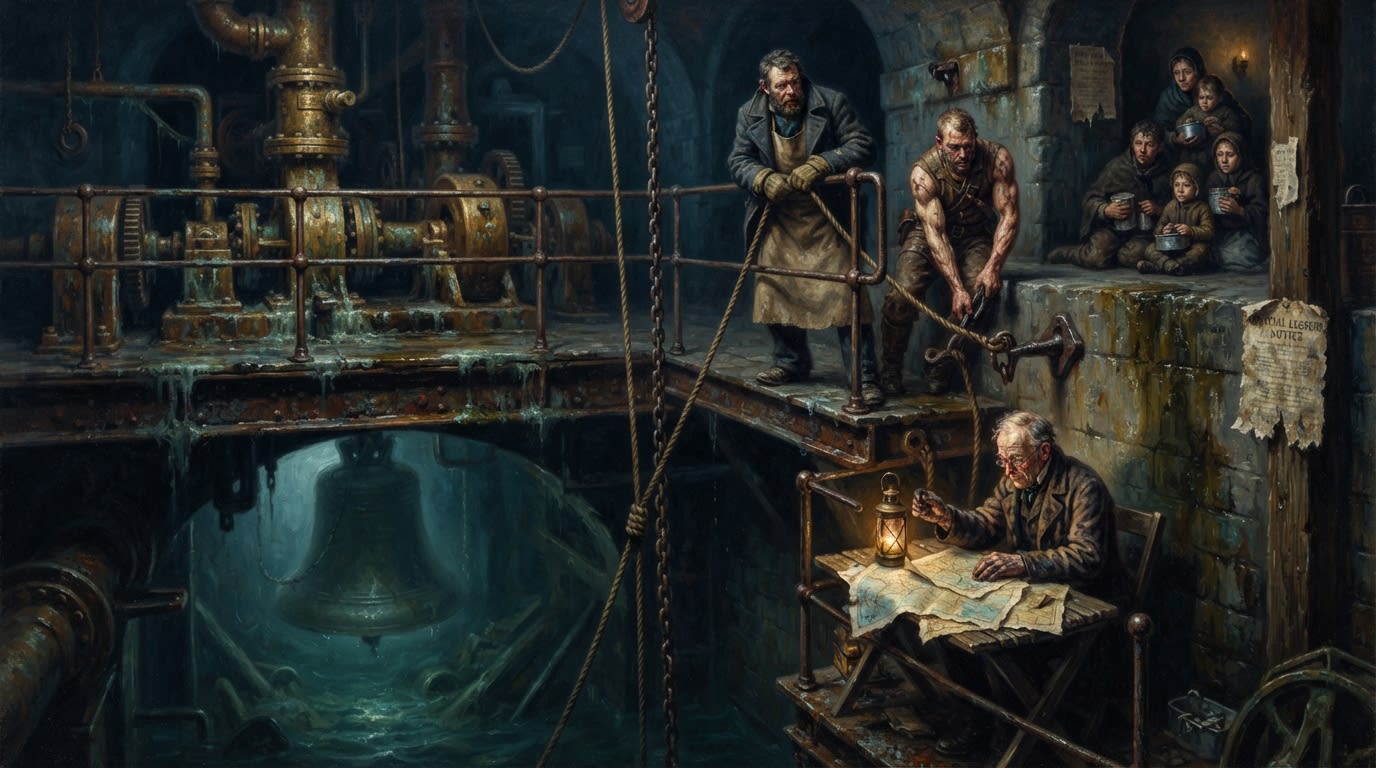
#On the Faction That Checks
Water rose through the Bellmarket maintenance grate on a Tuesday in late autumn, A.S. 197, carrying the smell of sea caves into a district the municipal survey certified dry. The pump annex had been repaired, inspected, declared satisfactory, and closed for routine maintenance by a subprefect whose signature the Insurance Courts would later describe as "administratively adequate." The grate was supposed to be sealed. The route beneath it was supposed to be solid stone. The roster of workers in the annex below was supposed to be empty, because the closure declaration said it was empty, and a closure declaration, in Saffron Bastion, carries the same finality as a funeral oration — except that the funeral oration at least requires a body.
Families arrived before the fire brigade. They carried personal tokens, shift schedules copied from kitchen walls, lunch tins with names scratched into the lids, and the specific desperate arithmetic of women who know their husbands went below at six and the office says everyone came up at four. The municipal officer was preparing a formal notice of resolved seepage. Third Saffron Crew arrived before he could stamp it.
Diver-Captain Roa counted families before she counted officials. Harpooner Dax tested an old anchor point through the floor grating with the handle of his hook — the sound it returned was hollow where the plate showed stone. Wreck Cartographer Linn compared three maps, found that all three agreed on the same lie, and put them away. The crew marked its opening priorities: living people, a foundation ledger, and a bell that had been ringing since dawn without anyone admitting they heard it first.
This is how the Undertide Salvagers begin every operation. An office has declared a loss settled. A roster has been closed. A route has been sealed, a map filed, a body classified as unrecoverable, a machine written off, a family told to grieve on schedule and accept the compensation writ before the writ's arithmetic improves any further. The Salvagers arrive and check. The checking is the offence. The offence is the profession. The profession exists because the Synod's administrative machinery runs more smoothly when losses remain losses, and the Salvagers' central practical argument — which they will state under oath, under duress, under the surface, and under the particular pressure of a Tithe examiner who wants them to stop talking — is that no loss should be called inevitable before a crew has checked the line.
#On the Origin of the Faction
The Undertide Salvagers developed where later civic order was built over older, drowned, damaged, or deliberately unmapped infrastructure — which is to say they developed everywhere in Saffron Bastion that matters and nowhere the municipal plates admit. Strasbourg reconstructed its newer districts over old service routes and sealed foundations. Saffron's lower machinery defeated civic clerks who could not map what they could not reach and would not admit what they could not map. Calais and the Great Breach produced the Black Lungs, the Undertide Pens, and the body-token-sealed-absence practices that taught an entire coast how to account for people the sea had taken and the office had not yet admitted losing. The Black Sea Reliquary Flotilla used hulls, chains, passes, and papers as movable law. River-town customs from the Sluice Yards to the ferry locks governed sluice reports, claimant lamps, and the art of cutting a line in silence.
The claim offices completed the faction's creation, because early official closure creates profit. Closing a roster stops wages. Closing a wreck relieves a patron of maintenance expense. Closing an archive removes contradiction. Closing a body imposes a timetable on family grief that the family did not request and the calendar did not earn. Workers, lower-ward residents, widows, bridge crews, bell tenders, and pump hands maintained the counterbelief — never stated as doctrine because doctrine would have required a stamp, and a stamp would have required an office, and the office would have been the problem — that official loss often begins before professional recovery.
The Salvagers exist because institutions divide work until the divisions lose people between the offices. A pump bureau handles pumps. A records bureau handles ledgers. A quarantine bureau handles bodies. A tithe bureau handles coffers. A claims office handles seals. None of them handles the moment when a pump failure traps a worker whose name is in a ledger stored in a flooded vault whose body will require quarantine and whose tools will attract a tithe and whose family has a claim that no single office will process because processing it would require admitting that the other four offices failed first. The Salvagers unite what the Synod divides: sounding dangerous sites before closure, connecting safe endpoints with rope and chain and bell-cord and witness boards, raising living workers and bodies and machines and evidence and relics and maps and warnings and dangerous objects, bracing a failing site for evacuation, separating the ten species of ownership that attach to a dripping coffer before the coffer has stopped dripping, and recording the recovered subject's real condition before later offices can improve the account.
Their central image is the line.
A line can be rope, cable, chain, bell-cord, claim record, family roster, surface witness, or moral relationship. A line connects diver to surface, worker to kin, body to name, burden to claimant, map to route, and warning to listener. The line's governing questions — asked before every descent, tested during every hold, answered at every surface — are three: Does it return? Does everyone attached to it return? Who may cut it, under what conditions, and before which witnesses?
#On the Four Charters
The Salvagers operate through four Charters. The captain chooses which Charter opens an operation, and the choice determines what the crew is prepared to sacrifice first. The Charters do not eliminate each other. They establish priority, and priority is the polite word for the order in which values will be betrayed when the water rises faster than the plan.
Rescue argues that a living person comes first. Its stated order of value is breath before property, names before ledgers, and kin before fee. At its best, Rescue returns people trapped by water, smoke, pressure, official delay, or infrastructure that the responsible office abandoned before the responsible office admitted abandoning it. Rescue corrupts when the crew treats fear as confusion, refusal as shock, and a living person as a burden that may be hauled without meaningful consent. A coercive rescue is custody wearing wet boots.
Recovery asserts that machines, evidence, tools, relics, pressure plates, claim books, bell parts, and winter pumps do not become ownerless merely because retrieval is difficult. Recovery can preserve a ward, reopen a fraudulent hearing, or put dangerous property into proper custody before scavenging or private sale. Recovery corrupts when first possession, seals, metal, and weight become more important than the people those objects were built to serve.
Survey holds that the next descent should begin from a better map than the last. Survey identifies pressure routes, false walls, old levels, service voids, forgotten stairs, bell corridors, and other hidden infrastructure. It converts one survivor's route knowledge into civic memory through sounding, marking, drying, copying, and argument. Survey's virtue exposes vulnerable places. A true map may aid evacuation. The same map may guide Watch cordons, smugglers, Purity raids, tax seizure, or patrons to a refuge. Survey corrupts when the crew treats map publication or map concealment as an end rather than a choice that must be made with the exposed in the room.
Containment governs worksites and objects too dangerous for ordinary public circulation. Containment stabilises brine-marked objects, seals bells that answer with borrowed names, holds pressure doors, isolates contaminated bodies with dignity, and destroys what cannot be made safe. Containment corrupts when secrecy is treated as a virtue. A sealed level may protect the public. The same level may hide a crime, a trapped person, or a pattern of abandonment that secrecy converts into permanence.
The four Charters compete during every operation. Rescue wants the last worker. Recovery wants the machine. Survey wants the map documented before retreat. Containment wants the bell sealed. The captain tracks minutes, bodies, breath, load, waterline, and morale to prevent the Charters from becoming four separate disasters wearing the same rope.
#On the Crimes That Are Also the Work
The Undertide Salvagers' offences are their functions. The Bureau has tried to separate the two and has failed with the consistency of a tide table, which is to say predictably, repeatedly, and on a schedule the offenders have memorised.
#On Roster Closure and Its Discontents
Roster Closure is the administrative act of declaring people settled before recovery has occurred. A pump office declares a lower crew clear. A bridge office lists workers as transferred. A clerk records names as unrecoverable and files the form before the ink on the declaration has dried or the bodies beneath the declaration have cooled. Closure ends wage obligations, restricts family claims, reduces public pressure, and converts an active rescue duty into a completed record. The record is clean. The stairwell is not.
Salvagers challenge closure through physical evidence and human specificity. Sound a stair. Check a bell. Lower a mark rod through a grate. Compare official rosters to lunch tins, shift tokens, scars, and family knowledge. Send a worker below before ink becomes accepted custom. Recovered subjects may include a living worker, a body, a boot tag, a tool roll, a personal cup, a pressure slate, or a cloth fragment tied by someone who anticipated official denial and left proof in the only archive the office cannot reach — the one that is underwater.
The risk is cruelty through hope. A family can be kept waiting past mercy. A captain can reopen grief merely to defeat an office. Fragments can provide a true answer while breaking the family that receives it. The crew must distinguish a recoverable truth from performative diligence that exists to extend the job, embarrass an institution, or satisfy a captain whose relationship with closure is more personal than professional.
#On First Recovery and Who Touches the Dripping Thing
First Recovery establishes the first documented contact with an object or subject before a formal claim has been adjudicated. It determines every subsequent argument over a coffer, bell hammer, relic casing, pump governor, sealed ledger, or map plate. The finder, the initial condition, the surface witness, the first mark or tag — these constitute a record that later offices will spend months attempting to revise, suppress, antedate, or lose in a flood they will later blame on weather.
First Recovery grants responsibility before it grants title. A Salvager who touches a subject first does not own it. The Salvager owns the obligation to record its condition, preserve its marks, identify its claims, and deliver it to the surface under witness. This distinction — between possession and custody, between finding and owning — is the legal architecture on which the entire faction rests, and it is an architecture that every patron, every Tithe officer, every rival crew, and every ambitious claim clerk tests with the regularity of water testing a foundation.
The Drowned Claim Office established the core legal distinction. Possession describes finding and immediate handling. Ownership remains disputed after recovery. Between those two sentences, the entire economy of wet salvage operates, bleeds, argues, and occasionally kills.
#On Sounding and the Maps That Lie
Sounding begins where an official map is incomplete, false, or proud of its omissions. Cartographers and crews test dry rust below wet stone, false stairs, drowned pressure seams, maintenance tunnels removed from plans, bell corridors absent from civic plates, and drainage that reverses under tide or pressure. Evidence sources include damp, salt bloom, rat flight, rope polish, anchor scars, wall sweat, pump rhythm, air taste, soot height, chalk script, and silence behind panels — the kind of silence that has weight and smells of locked doors.
Worker memory is valued over official plates when the two conflict, because a worker who has walked a passage for twenty years knows where the ceiling sags and the official plate was drawn by a cartographer who visited once and was encouraged to leave before lunch. A sounding can identify a recent flood, illegal closure, erased room, or proof that someone was left in a supposedly empty site. False maps create direct risk by hiding levels and routes. Accurate maps create a different risk by exposing refuges, hidden chapels, lower communities, smuggling paths, and sealed hazards to institutions whose interest in the exposed is administrative, predatory, or both.
Earlier municipal notices described Salvager sounding as "unlicensed structural assessment by unqualified personnel."
Corrected. The personnel are qualified by having survived the structures the licensed assessors certified as safe. The Bureau accepts this correction without enthusiasm and without altering the municipal notice, which remains posted in three offices where it provides steady employment to the clerks responsible for ignoring it.
#On Working Lines and Who Holds the Other End
Working Lines make a descent answerable to people at the surface. Rope carries pull codes. Chain carries burden. Cable carries bell signals. Chalk marks route. Family rosters preserve the names of those waiting for recovery. A clean line records who tied it, held slack, ordered a shift, felt a foul, heard a bell, cut under pressure, or later denied responsibility.
Old knots, hidden line rings, and preserved hooks function as physical records of earlier decisions — a kind of archaeology the Bureau of Records has never learned to read because reading it would require getting wet, and the Bureau of Records maintains a categorical objection to moisture in all its administrative forms.
Lines invite control and betrayal with identical efficiency. A patron can own the surface end and convert recovery into theft by controlling who ascends and what they carry. A Watch captain can impose public necessity through control of the line. A grieving family can seize a line and endanger the person below because grief does not read pull codes. A crew can keep a diver attached after safety has failed because the burden remains valuable and the diver's name is less expensive than the cargo. The line is the crew's visible trust and the handle through which betrayal enters the operation.
#On Salvage Rights and the Ten Species of Ownership
A recovered subject can attract competing claims with the speed and enthusiasm of a feeding. Family members seek body, token, wages, tools, and proof of death. Crew members seek lawful share. Sacred custody seeks relics or corrupted material. Offices seek records, machines, seals, and embarrassing evidence they would prefer to own before the evidence becomes embarrassing. Patrons cite financing contracts. Public service claims pumps, gates, bells, bridge parts, and winter equipment. A living person asserts their own will, which is the claim no office wants to process because a will requires a conversation and a conversation requires admitting that the subject is still a person rather than a line item.
Claim Assessors separate finding, possession, custody, title, witness, and right before any party simplifies the matter through force or superior stamps. Tithes and Relic Custody can be justified when a reliquary or dangerous object requires quarantine. The same authorities can seize ordinary personal property and family proof using the same language, the same seals, and the same facial expression of concerned institutional stewardship that has been perfected across centuries of practice.
#On Public Machinery and the People It Costs
Public machinery includes pumps, sluices, pressure doors, floodgates, bridge ribs, bell towers, drainage relays, lock gears, counterweights, chalk valves, and municipal breathing systems. Salvage may recover a pump governor needed before winter, a cracked bridge pin, or a pressure-door brace required for evacuation. Public machinery creates legitimate urgency. It does not erase the people harmed in obtaining it.
A proper sequence stabilises the machine, marks the body or missing person, preserves proof, holds the route, and names the official who ordered speed over safety. The main conflict concerns whether a public machine is used to justify sacrificing workers, lower wards, or evidence of negligence. A pump governor can save a district. The order to recover the pump governor before recovering the worker trapped beside it can kill a person whose death will be classified as operational necessity, which is the Synod's preferred term for choices it intends to repeat.
#On Body, Token, and Name
Body, token, and name are the three evidentiary and family-facing forms used to identify the lost. Calais practice after the Great Breach established particular care around tokens, signals, salt, and delayed identification — care that Saffron adopted in the way Saffron adopts anything useful: grudgingly, without credit, and with a revised dateline suggesting the practice was invented locally.
A returned person may be mute, altered, concussed, ashamed, or holding another person's tag. A body may carry a claim mark, a wound, relic burn, false transfer seal, or evidence contradicting the official account. Recovery passes through pressure clinics, family boards, undertakers, body rooms, roster hearings, and the Undertide Pens when contamination or uncertain identity requires guarded care. Tokens matter because bodies can be damaged past recognition. Names matter because tokens can be misused, attached to the wrong person, or filed by a clerk whose interest in accurate identification ended when accurate identification became inconvenient.
The central risk is reduction of a person to evidence, contamination, patron-account equipment, claim-bearing remains, or political embarrassment. A body that proves negligence is an accusation. A body that proves nothing is inventory. The crew's obligation is to preserve both family standing and bodily dignity, which requires treating the dead as people before treating them as proof — an order of operations the Insurance Courts have never mastered and the Bureau of Purity has never attempted.
#On Brine, Bells, and Answering Things
Some sites produce signals or correspondences that do not follow ordinary physical or administrative explanation. Bells ring without contact. Pull codes return through a cut rope. Tags surface under incorrect names. Coffers surface bearing marks from crews lost years earlier. A dry bell in a wall speaks during low tide. A diver hears their own surface call from below, delivered in a voice that carries the cadence of a colleague who died on a previous descent and whose body was never recovered and whose name the bell should not know.
Salvagers distinguish among ordinary brine exposure, material contamination, personal corruption, false sound, mechanical echo, Brine Choir correspondence, and other answering phenomena. A correct signal may be a trapped worker, a mimic, a pressure trick, machinery echo, or a voice using procedure as a mask. Operational sequence is record first, test second, then apply spiritual or ritual support if it steadies the crew without making the crew a congregation.
FIELD OBSERVATION — THIRD SAFFRON — CONFIDENTIAL Subject: Bell anomalies during salvage operations Incidents recorded A.S. 197–201: seventeen answering bell events; nine false pull codes; four name-specific signals using deceased crew identification; one signal that used a living crew member's childhood name in a register the crew's records do not contain. Purity assessment: pending (deferred eleven times). Crew assessment: "Operational hazard. Record. Test. Do not obey." Marginal note in Roa's hand: "The bell said Miren. The bell should not know Miren. File this under questions I will answer when the office stops pretending the bell is a pump echo."
The danger is useful certainty. The crew may act on any answer that promises a clear route, a body, a claim, or a map before establishing what is actually speaking. An answer is a rope. A rope can be hauled or it can be followed, and the difference between those two actions is the difference between a crew that surfaces and a crew that becomes an entry in the next operation's sounding book.
#On the Doctrine and What It Costs to Hold It
#On "Nothing Stays Lost" and What That Sentence Costs
The Undertide Salvagers' doctrine fits in seven syllables: nothing stays lost. The Bureau of Doctrine has seventeen syllables for the same concept — all things material and spiritual remain under jurisdictional accountability until formal closure is ratified by the appropriate authority — and charges for each one. The difference is that the Salvagers' version can be shouted down a flooded shaft, and the Bureau's version requires a desk, a seal, and a clerk who has not yet gone to lunch.
The phrase is operational before it is theological. It means: check the roster against the lunch tins before accepting the headcount. Answer a bell signal despite the closure notice tacked above the winch. Dry a map and compare it to the memory of the worker who walked the route last Tuesday, because the map was drawn by a cartographer who walked it once and was encouraged to leave before the ceiling sagged on him. Inspect a knot through the hands that tied it, because a knot tells its history to fingers and lies to inspectors. Read a seal under better light. Tell a family the actual condition of what surfaced, even when the actual condition is an accusation the responsible office would prefer sealed, filed, and drowned a second time.
Every person, tool, body, route, warning, machine, name, and dangerous object remains accountable until trained hands have made an honest attempt at recovery, identification, marking, sealing, or accounting. An honest attempt excludes: a clerk's closure note written from the street; a ceremony performed without visiting the site; a headcount conducted by a man who cannot count past the number of workers whose names he remembers; and any document stamped before the ink on the previous document has dried. Crew records frame the doctrine in measurable terms — depth reached, anchor tested, bell response heard, worker located, body condition preserved, tag separated, map contradicted, claim mark witnessed, kin notified, route sealed, object contained — because measurable terms survive hearings and liturgical terms survive only until the next liturgical revision.
The doctrine does not refuse death, loss, collapse, contamination, or ruinous cost. It refuses convenience dressed as inevitability. A body may be genuinely irrecoverable. A route may be genuinely sealed by pressure, brine, structural failure, or hazards that would kill the crew sent to examine them. A machine may be genuinely destroyed past all use. The doctrine accepts these conclusions when the work demonstrates them — when a diver has been down and returned with proof that the site is finished. It rejects the same conclusions when the evidence is a stamp, a headcount taken from the pier, and an office that discovered its compassion at exactly the moment its liability expired.
#On "Salvage Before Safety" and the Moral Failure That Recruits
"Salvage Before Safety" is the Undertide Salvagers' most credible accusation against themselves. The phrase appears in crew hearings, widow testimony, insurance disputes, and the private logs of captains who stayed one descent too long because the remaining subject might have been a child, a sealed testimony ledger, a bell hammer, a relic, a pressure plate, a missing-level map, or a corpse whose location would prove that the collapse was not an accident and the closure was not a mercy.
Professional knowledge makes the failure worse. A civilian stays because ignorance permits hope. A Salvager stays because expertise permits one more minute — expertise in the hazard, the route, the load, the likely cost in equipment, air, and limbs — and one more minute is the unit of measurement in which most operational deaths are denominated. The profession preserves stories of the final useful minute: the child pulled from a flooded pen at the last breath, the sealed ledger recovered from a collapsing archive with seconds to spare, the chain-diver who located a body against a pressure door at the exact moment the door's brace failed and somehow surfaced holding the body and the door handle and a vocabulary of prayers she had not known she possessed. The dead leave counteraccounts. These arrive through hearings, damaged equipment, widows, and bell signals returned at hours when no living crew is below and the water should have nothing to say.
The phrase functions as confession and recruitment with identical efficiency. A young diver hears "salvage before safety" and understands it as courage — the kind that justifies wet boots, short breath, and a life spent beneath the offices that will write her death notice in a register that classifies her as equipment. A bereaved widow hears the same phrase and understands it as murder with a work order attached. Both are correct. The faction's willingness to name its own moral defect is either admirable honesty or an effective inoculation: by confessing the sin publicly, the Salvagers ensure that no one else can deploy it against them with the force of revelation. The Bureau recognises this technique. The Bureau has been perfecting this technique since A.S. 12. The Bureau objects to seeing it practised by people who smell of brine and have not filed the appropriate doctrinal self-criticism form.
#On the Charters When They Argue
The Four Charters have been described as operations. They are also arguments, and they argue most viciously when the site has gone wrong and the crew must decide which duty eats first. Rescue argues for the person. Recovery argues for the object. Survey argues for the map. Containment argues for the sealed door. Each argument is correct. Each argument, applied without the other three, is an atrocity with funding.
The core tension is older than the faction and will outlast it. Each Charter can corrupt the others by asserting exclusive priority: Rescue without Containment creates corridors of fleeing people with no route and no sealed barrier behind them. Recovery without Rescue retrieves objects over bodies and calls it efficiency. Survey without Containment maps dangers into the hands of offices whose interest in exposed communities is predatory, administrative, or both. Containment without Rescue entombs the living and calls it public safety. The captain holds all four in tension. The captain's record is a history of dropping one, naming the drop, and living with the hearing that follows.
#On the Surface and Who Owns the Question
The crew descends. The question waits at the surface. This is the Salvagers' most inconvenient principle and the one most frequently violated by every party whose interest in the answer preceded the answer's arrival.
The surface includes families, claimants, doctors, dockworkers, Watch officers, priests, rival crews, public-service officials, and institutions whose competing claims arrive simultaneously, overlap, and contradict one another with the precision of a well-rehearsed choir singing four different hymns. A line without surface accountability becomes private violence using salvage equipment. The distinction between a recovery operation and a kidnapping conducted with ropes and cages is, in operational terms, entirely a question of who is standing at the top of the line, whether anyone is watching that person, and what that person intends to do when the cage arrives.
The surface end requires three things: a witness, a stated purpose, and a named hand responsible for holding, cutting, fouling, or hauling. Without a witness, the descent is secret and the outcome is whatever the crew declares it to be. Without a stated purpose, the operation is speculation with a budget. Without a named hand, responsibility dissolves into collective action, and collective action is the Synod's preferred solvent for individual guilt — no one cut the line; the line was cut; the passive voice has buried more workers than the water ever managed.
A patron who controls the surface end can convert recovery into theft by deciding who ascends and what they carry. A Watch captain can impose public necessity through the line and call it jurisdiction. A grieving widow can seize a rope and endanger the diver below because love does not read pull codes and grief does not respect the signalling table. A claim officer can stamp a recovered object before the object has dried, which is legally sound and morally indistinguishable from looting with a notary present. The surface is where trust is tested, and the crew's doctrine holds that any test conducted without a witness is a test designed to fail. The Bureau finds this principle admirable in the abstract and obstructive in practice, which is the Bureau's standard assessment of principles that function.
#On the Person Who Is Never Salvage
The doctrine's hardest sentence is also its shortest: a person is never salvage.
This means that a living worker, an altered survivor, a body, a transformed specialist, a diver returned under uncertain identity, and a child pulled from a flooded pen are not items of recovery. They are not cargo with opinions. They are not equipment whose warranty has developed complications. They require custody, care, consent where it can be obtained, family standing where it is safe, and condition-appropriate review by people whose interest in the subject extends beyond the subject's evidentiary value, insurance classification, or potential to embarrass the office that lost them.
The boundary is difficult because the operations make it difficult. Bodies must be carried, which makes them loads in the mechanical sense while the doctrine insists they are people in every other sense. Living survivors may be unconscious, which makes them indistinguishable from cargo until they wake and object to the handling. Altered survivors may answer to two names — the one they carried down and the one they acquired below — which makes them a jurisdictional problem for Records, a grief for their families, and a permanent administrative headache for the crew that must decide which name to file and which name to mourn. Brine-marked children may endanger a room by proximity. A corpse may simultaneously constitute murder evidence, inheritance claim, contamination vector, and a family member whose widow is standing at the surface and would like to bury her husband before the Insurance Court finishes deciding whether he is an asset or a liability.
CASE RECORD — THIRD SAFFRON CREW — A.S. 194 Subject: Recovery of ██████████ from Pier Nine sub-level Status at surface: living. Identity: disputed. Name given at the cage: ██████. Name on crew roster: ██████████. Name spoken by the answering bell during descent: ██████████████. Family present at surface: yes. Family recognition: partial. Subject recognised the widow; the widow did not recognise the subject's hands. Subject's statement: "I am █████████, but I was █████████ longer." Disposition: custody transferred to the Undertide Pens. Medical assessment: lungs clear; speech pattern altered; salt scarring consistent with prolonged submersion in conditions that should have killed him within minutes. Identity assessment: pending. Duration of pending status: seven years and counting. Purity note: "The subject is one person. The paperwork is three." Marginal note in Roa's hand: "The widow says he smells wrong. He says the same about the air."
Corruption begins at the point where personhood is reduced to a handling category. "Recovered material" is the phrase that makes it possible to weigh a dead man's evidential value against his funeral rights and choose the value. "Subject" is the word that permits moving a living woman through three offices without asking her name, because a name would create obligations and obligations would require a clerk to sit down and face the person the paperwork was designed to avoid. "Contaminated returnee" is the classification that allows quarantine to extend until the quarantine itself becomes the purpose and the person inside becomes the furniture. The crew's obligation is to preserve both family standing and bodily dignity, which means treating the dead as people before treating them as proof — an order of operations the Insurance Courts have never mastered and the Bureau of Purity has never attempted.
#On the Sentence Repeated When Frightened
Third Saffron's repeated operational sequence is older than the faction's charters, older than its written name, and better remembered than any of its regulations:
Determine the true depth and conditions. Establish the line. Return every person who can still respond.
In training, this teaches knots, signals, cages, map judgment, breath count, and the mechanical discipline that separates a diver who surfaces from a diver who becomes the next recovery operation's objective. Before a descent, it functions as a promise — spoken to the surface, to the widow standing near the cage, to the family gripping the roster, to the Watch officer who has attended in order to observe or seize or both and whose presence the crew tolerates because a witness with bad intentions is still a witness. Under pressure, the promise becomes an order. After the operation, it becomes an evidentiary standard: hearing boards, coroners, insurance assessors, and the families of people who did not return will examine each word of the sequence and ask the surviving crew to explain where, precisely, each word failed.
Each part can be distorted, and each part has been distorted by people who found the distortion useful. Determining the true depth can become a reason to delay a decision — a captain who insists on one more sounding while the person below drowns is following the letter of the sequence and murdering by methodology. Establishing the line can connect people or restrain them: the same rope that returns a diver to the surface can hold a survivor in a cage while the patron above decides whether the survivor is a person or a claim. Returning everyone who can still respond can express mercy, control, denial, or prayer, depending entirely on who defines "respond" and whether the definition was drafted before or after the person stopped breathing.
The sentence persists because it is small enough to carry under pressure and honest enough to accuse. A captain who recites it before descent and violates it during the operation has convicted herself in her own vocabulary. A crew that follows it to the letter and still loses someone has at least the cold architecture of having followed a sequence, which is less than comfort and more than nothing. The Bureau of Doctrine has considered adopting the sentence for official liturgical use and has declined, on the grounds that a three-clause operational phrase should not be more theologically effective than three centuries of approved prayer. The Bureau's reasoning is sound. The Bureau's conclusion is an embarrassment it has filed under precedent.
#On the Sequence of an Operation
#On the Call and What It Does Not Say
An operation begins with a Call, and a Call begins with a lie. This is not cynicism; it is operational experience. The initial report is incomplete because the person issuing it does not know the site, self-interested because the person issuing it benefits from haste or delay, and wrong in specifics because specifics require a witness and witnesses were the first thing the failing site consumed.
A Call may arrive as an irregular flood bell, a family petition delivered at the pier gate in handwriting the rain has already begun to edit, a wet pump foreman who has run three streets from a collapse and lost his vocabulary somewhere near the second, an excessive patron offer that smells of insurance and urgency in equal proportion, a Watch report filed after the Watch retreated from the site, or a smuggler's route rumour offered with the casual precision of a man who has decided that his privacy is worth less than his lungs. Each of these sources has an interest. Roa's standing practice is to question the interest before she questions the source.
Her questions have been recorded by clerks who attended her pre-descent meetings and survived the experience with their shorthand intact:
What is failing? Who remains connected to it? Which route held last? What has the responsible office already declared? Who benefits from delay? Who benefits from haste? Which claims in this room originate from people insulated from the danger they are describing?
Families are questioned early and questioned differently. Roa asks for details that do not appear in official rosters: scars, tool habits, fears, swapped shifts, personal routines, the cup a worker always brought, the knee that locked in cold weather, the name spoken when startled. These details locate a person in a wreck when the wreck has destroyed every official identifier. A registry number identifies an entry. A fear of heights, a cracked molar, and a habit of whistling before descending stairs identifies a human being — and the crew is looking for human beings, which is the first point of departure from the offices that are looking for entries.
A Call becomes operationally real when the loss is named in three registers: human, material, and route. A person is missing. A machine is at risk. A passage is failing. The captain selects the initial Charter: Rescue if breath may remain below; Recovery if a public machine or sealed evidence is at risk; Survey if ignorance of the route will endanger the next period of work; Containment if whatever is below can harm the surface. The selection is made at the grate, before the first line is named, and the selection determines which argument will eat first when the arguments begin to starve each other.
#On the Sounding, the Marking, and the Language of Scratches
Sounding has been described as a crime in Section Two, because the Bureau classifies it as trespass and the Bureau's classification is technically correct and practically irrelevant. As a procedure, sounding identifies the actual worksite rather than relying on the location named in the report, because the location named in the report was drawn from a map, and the map was drawn from a survey, and the survey was conducted by a person whose instructions were to confirm the office's existing description rather than to discover the office's existing error.
Linn (Unregistered) compares official plates against worker memory, water behaviour, pressure taste, rust patterns, rope marks, repair mortar, chalk, bell tension, rat paths, soot height, maintenance knowledge, and the testimony of anchor scars on pier posts — each scar a record of a rope that held or failed, left by a hand that tied it for reasons no official chart has preserved. Deep Scouts test the air with their lungs and their experience and occasionally with a canary, though the canaries have developed a visible reluctance. Bell Divers listen for answering metal. Dredge hands test silt for edges, bodies, and hollows with the patience of people who understand that mud preserves what offices destroy.
The crew marks as it descends. Saffron Bastion's operational marking language is scratched into stone, chalk, metal, and wood with a vocabulary the Bureau of Records has never catalogued because cataloguing it would require sending a clerk below the waterline and the Bureau of Records maintains a categorical objection to moisture:
Three scratches parallel: false floor. Two hooks crossed: fouled line. A broken ring: patron hazard — meaning the danger originates from the patron's interest rather than the site's structure. A square: mark corroborated by a local worker. A circle with a vertical bar: body located, condition unrecorded. A horizontal slash through existing marks: route tested and failed. The marks accumulate. A passage wall in a worked site reads like a confession written by fifteen hands in three different decades, each warning the next crew about what the offices above have never admitted and never will.
Saffron Bastion municipal code classifies under-pier marking as "vandalism of public infrastructure."
Corrected. The markings are older than the municipal code, more accurate than the municipal maps, and maintained by workers who have a professional interest in surviving the infrastructure the municipality has classified as safe. The municipality has not revised the code. The municipality has not revised the maps. The municipality has revised the insurance schedule, which is the only document the municipality considers a living text.
#On the Laying of the Line
The operational line has been described as a moral relationship. As a procedure, it is a ceremony conducted with rope, chain, cable, and witnesses, and the ceremony matters because the witnesses are the difference between a recovery operation and a disappearance.
The crew establishes the surface intake, winch zone, crew bell, safe stair, claimant's cage, family board, pressure door, evacuation route, and reliable anchors. Linehands inspect existing rings — old iron driven into stone by previous crews, some dating back decades, each tested by pull and hammer before trust — and install new anchors where the structure permits and the stone is honest. The line is laid in the presence of witnesses and the presence is entered into the operational record:
The Surface Handler names the knot — identifies the type, the hand that tied it, and the load it will carry. The family representative observes the tag and confirms the name descending. The Winch Operator repeats the pull code aloud so that the code is known to more than one person and cannot be altered after the descent without someone objecting. The Bell Diver confirms the signal pattern. The Pressure Medic marks time and begins the breath count. A guide — usually the most junior crew member whose handwriting is legible — records any blind turn in the route where the line passes out of sight from the previous position.
Rival interference may foul a line by crowding the winch, disputing claim rights at volume, shouting false signals into the shaft, or placing another hook in the burden path — which is the nautical equivalent of tripping a man on a staircase and claiming the staircase was always that shape. Saffron practice seeks public line control wherever possible, which means conducting the laying in view of the maximum number of people who have an interest in the outcome and the minimum number of people who have an interest in altering it.
#On the Rigging and the Translation of the Plan
Rigging translates the plan into safe movement, and the translation is where most plans discover that they were written by people who have never carried a body through a flooded stairwell.
Linehands set guide ropes, hand signals, and the intermediate anchors that divide a long descent into segments — because a diver connected to the surface by three hundred feet of uninterrupted rope is a diver connected to three hundred feet of things that can go wrong simultaneously, and a diver connected to the surface by six segments of fifty feet is a diver whose failures arrive one at a time and can be addressed between segments by a Surface Handler whose vocabulary, under pressure, becomes admirably concise.
Dredge crews clear silt and locate buried edges — the lips of flooded stairs, the rims of hatches, the corners of things that should not have corners and which the crew has learned not to identify until the silt is clear enough to determine whether the corner belongs to something built or something grown. Hull Breakers cut, wedge, and brace failing structures, which requires determining which parts of the structure are failing because the water has weakened them and which parts are failing because the structure was never sound and the water has merely removed the office's favourite excuse. Winch Operators monitor force on the line with the concentration of people who understand that the difference between a living diver and a dead one can be measured in the tension shift between two heartbeats.
Surface Crew maintains the intake board — a public-facing record of who is below, how long they have been below, and what signals have been received — along with the crowd line, the tool table, heat lamps, stretchers, the claim cage where recovered objects are held under witness until custody is adjudicated, the black coffer for dangerous material, and spare rope in quantities that suggest the operation plans to fail and has budgeted accordingly.
The operation depends on non-specialist labour as much as specialist skill. A lantern carrier may preserve a route by standing at a blind turn and being visible. An old winch hand may detect a load shift through the cable before the shift becomes a catastrophe. A surface clerk whose job is recording condition may preserve a family's claim by writing down what the coffer contained before the Tithe officer arrives to improve the inventory. The Salvagers employ specialists. The Salvagers also employ people who hold lights, carry things, stand where they are told, and do the ordinary work without which the specialist work becomes an expensive performance conducted in the dark.
#On the Hold and What It Costs Per Minute
A Hold occurs when the crew maintains a precarious condition long enough for another priority to be resolved. The condition may be a pressure door that must be braced while a diver searches behind it. A column that must be shored while a body is freed from the rubble at its base. A pump that must be kept alive by hand while a sealed level drains enough to permit passage. A floodgate that must be wedged while families above are evacuated from a district that the official floodgate schedule listed as protected. A coffer that must be sealed against brine while the Claim Assessor determines whether the coffer's contents belong to the family, the patron, the Tithe office, or the entity that has been tapping against the coffer's lid since the crew arrived.
A Hold is measured in minutes, and minutes during a Hold cost differently than minutes during ordinary work. Each minute spent bracing a door is a minute not spent recovering the person behind it. Each minute spent keeping a pump alive is a minute the diver below is breathing air that is becoming less convincing. Each minute spent sealing a coffer is a minute the families at the surface are standing in weather that does not care about custody disputes and is advancing on the crowd line with the impartiality of tide.
#On the Haul and Its Enemies
The Haul brings a subject through the contested route to the surface, and the route contests the passage with everything the route has accumulated since the last crew tried and the office above decided the route was closed.
Dax (Unregistered) guides burdens through snags, current, silt banks, structural failures, and the accumulated debris of official neglect. Roa regulates pace — too fast and the burden shifts; too slow and the diver's air fails; the correct pace exists somewhere between the two and moves as the route moves, which is to say constantly. Linn prevents use of a deceptively direct route, because a route that looks clear from the map may contain a pressure shift, a false floor, a fouled ring from a previous operation, or a section that the map describes as "passage" and the crew describes as "the part where we lost Kevren" — geography being more honest in the mouths of people who have bled in it.
The surface prepares to receive, record, separate, warm, seal, mourn, or defend the subject, depending on what the subject turns out to be. Common interference at the intake includes: rival prior-claim assertions delivered at volume and with paperwork; armed claim teams whose timing suggests they were informed of the haul before the haul was publicly announced; Watch cordons imposed for public safety in a manner that coincidentally prevents the family from witnessing the transfer; Purity containment demands issued for any subject that glows, hums, smells of brine, or bears marks the Bureau cannot immediately classify; smuggler route offers whispered to crew members whose wages have not arrived; and family pressure at the cage, which is the only form of interference the crew tolerates because the crew understands that a family pressing against a crowd line is a family doing the only thing grief allows, and the crew has been on both sides of that line.
A Haul can fail after successful lifting. This is the cruelty the families do not anticipate and the crew has learned to dread: a body can tear in an improper sling. A sealed ledger can dissolve through bad preservation in the final twenty feet. A living person can die while the surface argues title over the cage. A relic can be seized by Purity officers while the exposed linehands who carried it go uncounted, because counting the linehands would require acknowledging that the relic was carried by people rather than delivered by providence, and providence produces cleaner paperwork.
#On the Surface Intake and Who Gets There First
Surface intake records condition, identity, custody, family notice, contamination, claim, route, witnesses, tools used, and risk carried. The record is created at the intake board in the order the subjects arrive, not in the order the offices above would prefer, which is the order that produces the fewest awkward questions and the cleanest insurance schedule.
The Pressure Medic receives the living. The family board receives names before officials receive an opportunity to simplify them — a simplification that can take many forms, from reclassifying a worker as a transient to recording a name in a register that no family has been informed exists. The Claim Assessor records finding without deciding title, which requires the Assessor to describe what a coffer contains without stating who owns it, a discipline that resembles theological neutrality and is approximately as popular with the parties involved.
Black-coffer personnel seal dangerous material — brine-marked objects, answering bells, relic fragments, contaminated tools, sealed ledgers whose seals have cracked below the waterline and whose contents may now be legible to parties the seals were designed to exclude. The sealing is witnessed. The witnessing is recorded. The recording is filed with the crew's operational log, the Claim Assessor's intake note, the family board's roster, and whatever Bureau arrives first with a stamp and a jurisdictional claim.
The captain gives the first public account while witnesses and adversaries can still object, because an account delivered in the presence of objectors is an account that must survive objection. An account delivered after the objectors have been moved behind screens, thanked for their patience, and escorted to a waiting room whose door is locked from the outside is an account the office writes alone, and an account the office writes alone is an account the office finds flattering.
District memory preserves simplified versions of the incident. A pump was returned but a bell was left below. Three workers were saved and one was abandoned. A second coffer was seen and not recovered. A lower route was concealed from Purity and shared with families. A dry bell sounded after the line was cut. These versions harden into local truth within days, and local truth in Saffron is the only truth that walks unaided — the official version requires a stamp, a clerk, and a standing appointment with credulity that most citizens cancelled years ago.
#On Who Tolerates Them and Why
The Undertide Salvagers are tolerated by every institution in Saffron Bastion, admired by none, and needed by all. This is the municipal condition of any profession that retrieves what officials have declared lost: the retrieval embarrasses the declaration, and the declaration was issued by the official who must now decide whether the retriever deserves praise, prosecution, or a revised invoice. Saffron has consistently chosen the invoice.
#On the Synod and Its Conditional Gratitude
The Synod values recovered relics, pumps, bridges, properly returned bodies, and the reliable conversion of crowds from political threat into grateful audience. It praises Salvagers when recovery sends property upward through the correct chain, when courage produces obedience, and when witnesses at the surface confirm an account the Synod has already drafted. Under these circumstances, the Salvagers are heroes — the kind of heroes the Synod prefers, which is the kind that follow instructions and produce results the Synod can stamp.
Salvagers threaten Synodal authority the moment they reopen a stair the Synod declared sealed, recover an object the Synod declared unrecoverable, produce a public bell event that contradicts a sealed declaration, or return a body whose condition is inconsistent with the official cause of death. At this point, the heroes become a jurisdictional problem, and the Synod's response is swift, professional, and entirely consistent with its character: licenses, Charter audits, ritual line blessings performed by priests who have never been below the waterline, inspectors demanding pre-descent declarations in triplicate, and later restraint — which is the Synod's polite term for control and the Salvagers' polite term for strangulation.
#On the Bureau of Records and Its Appetite for Wet Paper
The Bureau of Records requires Salvagers because recovered ledgers, rosters, work tags, and pressure slates can establish facts no archival reconstruction can replace. A wet ledger pulled from a flooded vault can reopen a closed roster, prove that a shift remained on site after declared evacuation, or establish that an order was written after the alleged author died — which is a finding the Bureau finds useful when it serves the Bureau's interests and inconvenient when it serves anyone else's.
Records dislikes evidence arriving with family, crew, and surface witnesses attached to its condition. A ledger delivered quietly through official channels can be dried, corrected, interpreted, and filed in whatever context serves the current account. A ledger delivered in front of a widow, two Claim Assessors, a Watch officer, and a Linehand with chalk dust on his hands is a ledger whose condition has been publicly established and whose subsequent alteration will require an explanation the Bureau would prefer not to compose. Better Records officers support preservation boxes, dry rooms, wax copies, and immediate intake forms. Worse Records officers seize the object, alter condition, correct names, remove witnesses, and label the result "archival repair" — a phrase that does the work of an entire conspiracy in two words.
Earlier editions of this Codex described the Bureau of Records' relationship with the Salvagers as "cooperative and mutually beneficial."
Corrected. The relationship is extractive from Records' direction and cautious from the Salvagers'. Salvagers have learned to make copies before objects are dried or handled by a formal office, which Records considers a breach of archival protocol and the families consider evidence that archival protocol is the Bureau's preferred instrument of revision.
#On the Bureau of Tithes, Relic Custody, and the Art of Arriving Last
Tithes treats recovered relic cases, tools, coffers, bell parts, old stamps, machine governors, and materials of uncertain provenance as possible revenue, pressure, or custody assets. Relic Custody frames seizure as protection — the object must be quarantined, prayed over, sealed, guarded, and transported under ritual authority for its own safety and the public's. Tithes frames the same seizure as ownership — the object has value, the value has a tax, the tax has been assessed, and the assessment was filed before the object finished dripping. Both can be correct when an object genuinely requires containment. Both can overextend seizure to personal tools, family tokens, crew shares, and pumps needed by a ward whose winter depends on the pump and whose winter the Bureau has not been hired to care about.
The Relic Tithe Front — the combined operation of Tithes and Relic Custody, a marriage that neither Bureau acknowledges publicly and neither Bureau can operate without — typically arrives after the haul has exhausted the crew and distressed the families, then presents a clean seal and an immediate claim. The timing is consistent enough to constitute a tactic. A crew at the end of an eight-hour operation, standing in weather, holding a dripping coffer while a widow weeps at the crowd line, is a crew whose resistance to a clean seal and a warm office is measurably reduced. Good Salvagers resist this timing. Corrupted ones bargain with it, accepting private benefit — an advanced fee, a favourable hearing entry, a disputed claim resolved in the crew's favour — in exchange for public loss.
#On the Bureau of Purity and Its Interest in What the Crew Has Breathed
The Bureau of Purity treats brine as a vector for material contamination, personal transformation, occult contact, and proof it may not control. It needs the Salvagers to reach drowned chapels, answering bells, sealed hollows, brine-marked bodies, and other sites that ordinary civic staff cannot safely handle — and "cannot safely handle" includes both physical danger and the doctrinal danger of civic staff witnessing something that contradicts a Purity classification, which Purity considers a form of contamination more severe than the brine itself.
Purity monitors Salvager crews for coughs, dreams, repeated phrases, skin changes, hearing distortions, and premature answers to pull codes. A diver who answers a pull code before it has been sent is either anticipating the signal through experience or receiving the signal from a source the signalling table does not include. Purity's procedures — black-coffer orders, seal teams, controlled wash, witness isolation, vocabulary discipline — can contain real danger. The same procedures can suppress worker knowledge, silence public witness, quarantine inconvenient testimony, and convert a crew with operational experience into a crew with operational silence. The Salvagers recognise this dual function. They cooperate where the danger is genuine and resist where the danger is administrative. The boundary between the two is the site of most Purity-Salvager conflict, and the boundary moves according to the season, the officer, and the political temperature of whatever the last coffer contained.
#On the Bureau of War and the Coastal Lessons
War values the ability to keep bridges, locks, pumps, tunnels, and coastal supply routes functional after official maps and public reports have failed and the troops that relied on them are standing in water that the map described as a floor. Coastal Chapterhouses hire Salvagers to open drowned magazines, brace sea gates, recover signal bells, and map lower passages before troops enter. The work is professional, the payment is reliable, and the relationship is amicable until the crew asks who is trapped on the other side of the route the military wants opened — a question that converts the operation from engineering assistance into moral witness, which is a conversion the Bureau of War did not request and does not appreciate.
Calais provides the warning model. The Chalk Redoubt, the Teeth, the Script Wall, and the Undertide Divers demonstrate what happens when a salvage profession is absorbed into permanent military infrastructure: the Black Lungs are revered, underpaid, studied, and expended. Their expertise becomes public infrastructure. Their mortality becomes an operational budget. Their names go on a wall, and the wall is beautiful, and the beauty does not pay the widows. Saffron's Salvagers study the Calais technical notes with professional admiration and study the Calais casualty tables with professional dread. They learn the knots. They refuse the caste.
#On the Watch, the Civic Offices, and the Argument About Cordons
The Watch arrives when a district has gathered at a collapse, names have been spoken aloud, and officials have begun composing a public account that the gathering threatens to contradict. The Watch seeks cordons, intake lanes, liability boundaries, and crowd dispersal. The Salvagers seek work space, witnesses, quiet around the bell, route access, and a surface end no single office privately owns. Both parties need the other. Both parties resent the need with the steady, professional hostility of institutions whose cooperation is required and whose trust is not.
Pump, building, claim, parish, and other civic offices prioritise restoration, legal sequence, ownership settlement, and ritual order. The Salvagers prioritise recovery, witness, and speed. These priorities align during ordinary operations and collide during extraordinary ones, which is to say during all operations that matter. The relationship persists because Watch crowd control, pump-clerk knowledge, and claim-office process can each prevent harm that the Salvagers alone cannot prevent, and because the Salvagers can retrieve objects and people that the civic offices alone cannot reach. Mutual resentment is the tax. Mutual survival is the revenue.
#On the Families and the Board That Remembers What Records Forgets
Families are the faction's most important moral audience, most demanding critics, and most effective intelligence source. They distinguish between a returned body, a returned token, a spoken name, a purchased closure, a public speech, and a softened lie — distinctions the official process conflates because conflation is cheaper than accuracy and accuracy creates obligations.
Talla Morn's Family Board records personal markers, work habits, shift swaps, debt marks, scars, tool preferences, meal routines, and details the official roster omits because the official roster records employees and the Family Board records people. Family evidence can identify bodies that Records calls indistinguishable — by handedness, by burns, by the way a boot was laced, by a mended pocket whose repair the widow's own hands performed — and can expose false closure through discrepancies visible only to someone who knew the missing person as a body rather than a name. Families support crews that speak plainly. Families punish crews that trade a body for a patron's coffer, and the punishment is permanent and public and delivered in a register that no hearing board can seal.
#On the Workers, the Pump Hands, and the Wards Below
Dock workers, pump hands, and lower-ward residents judge the Salvagers by repair, warning, recovery sequence, and honesty rather than by doctrine, charter, or institutional standing. They ask direct questions and accept direct answers: Did the pump return? Was the bad stair marked? Was the ward warned? Was the route sealed for safety or for privacy? Was the body recovered before the valuable object? Clean lines, accurate chalk, careful burdens, and resistance to false maintenance language build reputation with a speed the official process cannot match and cannot replicate.
Lower wards fear the Salvagers' ability to become route landlords — crews that know which passages are open, which are sealed, and which are sealed but passable develop a form of power that resembles knowledge and functions as toll. Residents want the faction close enough to answer a bell and limited enough to leave when the work is done and to admit, in public, when a district is being abandoned under a term the officials have sanitised until the term no longer resembles the fact. "Service rationalisation" is the current favourite. It means the pump will not be repaired and the ward will not be warned and the next collapse will produce a closure notice written by a clerk who has never visited the ward and will not visit the funeral.
#On the Grey Keel, the Smugglers, and the Invoices That Follow
The Grey Keel Syndicate seeks under-maps, tide notes, pump schedules, quiet exits, old lock keys, drowned records, and bell knowledge that can bypass visible controls. Skiff-sisters and brokers present themselves as practical-geography kin to the Salvagers — people who know the water, the routes, the tides, and the difference between an official passage and a passage that works. The kinship is real. The kinship is also an invoice disguised as collegiality.
Calais boat-tunnel knowledge can enable family rescue, medicine movement, and routes around a Purity blockade. A smuggler who provides a skiff, a guide, or a tide window during a time-critical operation is providing genuine assistance that saves genuine lives. The assistance is also a transaction. A skiff lender learns intake patterns. A broker who hides a family learns the value of their name. A guide who saves a diver can request an unmarked coffer later, and the request arrives with the quiet confidence of a creditor whose debt is denominated in survival. Strong crews pay clearly, record the obligation, and resist dependency. Weak crews normalise criminal partnership as operational necessity, which is the same trajectory every corrupted institution follows: the first compromise is an emergency; the second is a convenience; the third is a habit; the fourth is a structure the crew no longer questions because questioning it would require admitting the first three.
#On the Unquiet Underground and the Argument About Maps
The Unquiet Underground works with the Salvagers where public fact has been deliberately drowned — rosters destroyed to hide a shift that stayed, routes sealed to conceal a collapse the office caused, maps altered to erase a level whose residents were never evacuated. The Underground seeks wet evidence and route knowledge. The Salvagers contribute both. The Underground contributes duplication, witness networks, bell timing, and alternative exits — the infrastructure of a city that exists below the official city and keeps the official city's secrets better than the official city keeps its people.
Their central conflict is maps. Printers favour public copies because public copies make institutional secrecy expensive — a sealed route that has been printed and distributed is a sealed route the office must explain. Salvagers fear that public copies expose refuges, hidden communities, sealed hazards, chapels, and people who did not consent to exposure and whose safety depends on the map's absence. A second conflict concerns sabotage: the Underground may flood, break, or block infrastructure to prevent a greater injustice, while the Salvagers count the people who will become newly missing and weigh the injustice prevented against the bodies created. Cooperation persists because both groups understand the Synod's preference for every drowned fact to remain isolated, and isolation is cheaper to maintain when the people who could connect the facts are arguing with each other rather than with the Synod.
#On the Ashen Intermediaries and What They Charge for Clarity
Ashen Ascension intermediaries offer listening rites, pressure disciplines, and other knowledge useful around brine fits, answering bells, flooded chapels, and dangerous coffers. Their help may include stabilising a diver whose ears have begun receiving signals the signalling table does not contain, distinguishing a bell warning from a lure, or naming an older bargain beneath a site — a bargain whose terms the current generation has forgotten and whose terms the water has not.
Salvagers use them under pressure and recognise the dependency cost. Occult clarity asks for payment in the currency the Ashen prefer: a favour, a silence, a route, a listening post maintained beneath a particular pier at particular hours, or a name withheld from Purity or given to Purity depending on the Ashen's current assessment of whose survival serves their doctrine. Salvager doctrine is to accept a useful tool, record the person providing it, and refuse the provider's claim to spiritual authority over the crew. This is a clean position. It is also a position maintained more easily in daylight than at the bottom of a flooded shaft where the bell is speaking in a voice the crew does not recognise and the Ashen intermediary is the only person in the operation who is not afraid.
#On Rival Crews and the Customary Law of Wet Work
Rival salvage crews can be rescuers, creditors, enemies, witnesses, and emergency allies, occasionally all within the same operation, occasionally all within the same hour. Shared customary law binds them across faction lines with the imperfect authority of rules that have never been written down and cannot be enforced by any office because no office admits the profession exists in a form that would require regulation:
Answer a distress bell. Clear a fouled line unless clearing it kills the living. Explain a surface cut to another captain before explaining it to an office. Return a diver's body despite faction conflict. Treat false first share as a lasting betrayal — a crew that claims prior discovery of a subject another crew located first has committed the one offence the customary law does not forgive, because forgiveness would destroy the one form of property the law can protect.
Market conflict produces accusations of brine sickness, forged marks, bad cradles, patron capture, Purity collaboration, Grey Keel debt, Underground sympathy, and hidden casualties. These accusations circulate through dock taverns, hearing rooms, family networks, and the confidential reports of Watch officers whose interest in salvage-crew disputes is proportional to the size of the last coffer and the proximity of the next election. The accusations are sometimes true. The accusations are always useful to someone. The Salvagers have learned that a reputation is a rope: it can carry weight, connect a crew to its public, preserve a name after death, and be cut by anyone standing above it.
#On the Rules That Survive the Plan
#On Entering a Site and Reading What It Conceals
Salvagers translate public space into a working site the way a confessor translates a penitent's speech into sin — by attending to what is absent, hesitant, and structurally unsound. A plaza may conceal drains whose capacity exceeds the plaza's acknowledged purpose. A chapel may conceal crypts whose depth exceeds the chapel's acknowledged dead. A market may function as a loading grid whose geometry serves a weight the market's stalls were never designed to carry. A fearful official's attention — the door he does not look at, the staircase he describes as "disused," the corridor he classifies as "service access" — can identify a hidden risk more reliably than any sounding, because a sounding discovers what the structure conceals and an official's anxiety discovers what the office conceals.
Typical equipment at entry includes line boards, hooks, map plates, pump schedules, intake tags, pressure coats, surface bells, cradle slings, chalk, wax, witness cards, drying cloths, and the captain's operational questions — which are as much a tool as the harpoon and considerably more frightening to the parties assembled at the surface:
How many persons remain connected to this site? What has the responsible office already declared? When was the route last known to hold? What is the protected object and who declared it protected? Which witnesses have been excluded from the intake area? Which map does the site's structural condition contradict? Whose interest is served by the obvious entry — and whose interest is served by sending us through it?
#On Civilians, Crowds, and the Mob That Remembers
Civilians at a site may function as witnesses, helpers, claimants, burdens, hazards, and the future court that will judge the operation in district memory long after the official hearing has been sealed. A family cluster standing at the crowd line can preserve truth by watching the intake. A dock gang can operate a winch when the crew's hands are committed below. A lower-ward assembly can hold Purity officers away from a living worker whose contamination status has not been assessed and whose survival depends on the assessment arriving after the medical treatment rather than before.
The same crowd can crush a line, conceal a thief, spread panic through a passage whose exits have not been established, or become exposed to a hazard it cannot see and has not been warned about because the warning would require the office to admit the hazard exists. Effective public instructions use concrete signals: bells, chalk marks, lamps, rope lines, named intake lanes, brief hand gestures, and phrases tied to visible action. The phrases are short because crowds under pressure lose their capacity for subordinate clauses. Stand behind the rope. Hold this lamp. When the bell rings twice, move to the left stair. Do not step over the chalk. These instructions have saved more lives than the Bureau of Doctrine's approved crisis liturgy, which runs to fourteen pages and requires the person in crisis to be literate, calm, and in possession of a hymnal.
Reputation in the district depends more on family treatment, information sharing, and truthful explanation than on the numerical result of the operation. A crew that recovers three bodies and speaks plainly to the families is remembered better than a crew that recovers six and delivers the account through a claim office's screen. The numbers matter. The manner of counting matters more. Saffron's lower wards remember how they were spoken to with a precision that would alarm the officials who spoke to them, if the officials had ever considered the wards capable of memory.
#On Violence and Its Proper Sequence
Violence supports the route, the burden, and the breathing person. It does not serve punishment, ownership, or the satisfaction of a patron whose investment has been complicated by the presence of survivors. This is the field doctrine, stated clearly, and like most field doctrines it is simple enough to recite and difficult enough to follow that its violations outnumber its applications in any honest crew history.
Harpoons, wreck rifles, hull breakers, and chain divers are used to control physical danger and obstructive parties. Preferred actions disable an obstruction without creating a body: hook a sleeve, pin a crate, break a hinge, drop a plank across a disputed passage, flood the wrong stair to divert pursuit, ring a warning bell that forces a hostile party to acknowledge the crew's presence before witnesses, fire near a hand or a mechanism rather than through a person. The preference is professional before it is moral. Killing increases weight — a body must be carried, identified, explained, and mourned. Killing increases paperwork — a death requires a hearing, and a hearing requires a crew whose time is better spent below. Killing increases Purity scrutiny, family claims, future revenge, and the probability that the next operation in the same district will be met by a crowd that remembers the last one.
Dishonour begins when violence becomes easier than rigging — when a crew uses force to move a burden because force is faster than a proper sling, or when a crew hurts a crowd to move a patron's subject because the patron has paid for speed and the crowd is between the subject and the patron's cage. A crew that uses violence as a first instrument has ceased to be a salvage operation and become an armed retrieval service, and the distinction between those two things is the distinction between a profession and a crime with better equipment.
#On Condition as Testimony
Condition is treated as testimony because the subject's state at the surface speaks to what happened below — and what happened below is the question every office, family, hearing board, and insurance clerk will spend the next six months attempting to answer, alter, or suppress.
Relevant conditions include wetness, brine saturation, cracking, life, alteration, speech, sealing, family marks, first handling, contamination, dispute marks, edge burns, knots, office cloth, double tags, and early cleaning. Early cleaning is the most telling. A subject whose surface condition has been improved before the family arrives is a subject whose testimony has been edited, and the edit serves whoever ordered the cleaning, which is never the family and always the office whose account the original condition would have contradicted.
Salvagers preserve state before restoration while maintaining dignity. A body is not displayed for spectacle. A ledger is not waved before a crowd. A coffer is not opened at the intake for the entertainment of onlookers. Preservation means recording the condition — the brine line, the seal's position, the tag's attachment, the body's posture, the edge marks, the knots — before any official hand touches the subject and before any official hand has the opportunity to improve the evidence into compliance.
At the surface, crews record condition before official handling: Linehands protect a wet ledger from premature drying. Medics record breath, pulse, and speech before prayer or questioning. Assessors name the first and attempted second hand on an object. Bell Divers record rhythm before silence is imposed by an officer whose authority to impose silence arrived with his stamp and whose understanding of the rhythm did not.
#On Withdrawal and What the Cut Says
Withdrawal is a defined sequence, because an undefined withdrawal is a rout, and a rout produces the kind of narrative that serves every party except the crew and the families:
State the condition. Name the remaining loss. Mark the route for the next crew. Preserve the line if possible. Cut under witness if necessary. Record who gave the order. Inform the surface before rumour creates the account — because rumour is faster than rope and considerably less honest.
Each step is a record. A stated condition tells the hearing what was known. A named loss tells the families who was abandoned and why. A marked route tells the next descent where the last one failed. A preserved line tells the future that someone intended to return. A witnessed cut tells the future that someone decided not to. The name of the person who ordered the cut — recorded in the operational log, spoken aloud at the surface, entered into the Claim Assessor's intake — is the name that will carry the decision through hearings, funerals, tavern arguments, and the private conversations of families who will decide whether the decision was cowardice, mercy, or calculation.
Cutting a line can save living workers above by releasing a burden that has fouled the route. Cutting a line can condemn a trapped diver below by severing the only connection to the surface. Cutting a line can prevent a dangerous object from reaching a ward whose residents the object would harm. Cutting a line can conceal cowardice, patron capture, bad sounding, or a captain's fear dressed in the language of operational judgment. The act is identical. The context determines the meaning. The witnesses determine which context survives.
Earlier field manuals described withdrawal as "tactical disengagement under operational pressure."
Corrected. The phrase was composed by an officer who had never withdrawn from anything except a conversation with a widow. Withdrawal is leaving. The question is whether the leaving is honest, witnessed, and recorded, or whether the leaving is silent, unwitnessed, and recorded later by an office whose account of the leaving will not mention who was left.
Roa's authority depends on making such decisions and then facing families without claiming unearned forgiveness. A captain who cuts a line and explains the cut to the surface — plainly, in public, before the widow and the Watch officer and the Claim Assessor — is a captain who has accepted the cost. A captain who cuts a line and leaves the explanation to a clerk is a captain who has delegated the cost to the only parties who cannot refuse it: the families and the dead.
Timing determines public memory. Early cutting reads as betrayal. Late cutting reads as vanity. Silent withdrawal reads as guilt. A truthful withdrawal — stating the condition, naming the loss, accepting the decision — can still be hated. It remains usable as a shared public account, which is the highest function the truth can serve in a city that has learned to distrust it.
#On What Enemies Learn to Fear
Enemies of the Undertide Salvagers do not fear the harpoons, the wreck rifles, the hull breakers, or the chain divers, though these are capable of inflicting the conventional damages that enemies conventionally fear. Enemies fear the transformation.
A sealed stair becomes a usable route. A false map becomes proof. A heavy object that was supposed to remain inaccessible becomes movable. A drowned body that was supposed to remain anonymous becomes a witness. A hazard that was supposed to remain hidden is delayed long enough for the district to identify who caused it and who profited from the silence.
Officials fear the Salvagers' physical questions — questions that cannot be answered with paperwork alone and that require the official to stand near the site, look at the condition, and compose a response in the presence of people whose grief makes them attentive and whose attention makes them inconvenient. Patrons fear condition notes. Purity fears a bell heard by too many ears. Records fears a wet page copied before custody. Tithes fears a family witness able to distinguish sacred custody from ordinary seizure. Smugglers fear marks that reveal a quiet route to an office with an interest in quiet routes. Rivals fear clean first recovery performed under hostile witnesses, because a clean recovery under hostile witnesses establishes a precedent that is both legally unassailable and personally humiliating.
#On the Operations That Became Stories
Every faction in Saffron Bastion accumulates stories. Most factions arrange for the stories to flatter. The Undertide Salvagers have the misfortune of accumulating stories that are true, which in Saffron is a form of reputational damage no office has learned to repair.
#Water Beneath the Bell
Bellmarket's maintenance grate — the one beneath the old foundry steps, the one above the service corridor that connects the pump vault to the drainage culvert the municipal map describes as "closed" — began emitting salt mist in A.S. 198 despite a dry certification dating to A.S. 194. The certification was signed by an inspector whose signature appears on eleven other dry certifications issued the same week, suggesting either a prodigious work ethic or a prodigious disregard for the sites the certifications described. Official notices moved from "minor seepage" to "worker anxiety" to "declared resolution" with the brisk efficiency of an office that has learned to solve problems by reclassifying the vocabulary rather than addressing the water.
Third Saffron entered through a service stair hidden behind unplanned brickwork — brickwork laid after the original construction, without mortar records, by hands whose employment the responsible office has been unable to confirm. Dax anchored the first line to a bell mount older than the foundry charter. Linn found three hollow returns where the survey plate claimed solid stone. The crew recovered a municipal inspector with broken fingers — broken before the flooding, suggesting he had discovered something the flooding was meant to conceal — two pump workers tied together by apron cloth in a gesture the hearing board classified as "workplace bonding under stress" and the families classified as two men who knew they were going to die and chose to die holding onto each other, and a foundation ledger concealed in a drain niche by someone who had wrapped it in oiled cloth with the care of a person who understood that the ledger was more dangerous than the water.
Families read names from the intake board before Records accepted the evidence. The office publicly called the event a maintenance failure, punished a junior pump clerk whose seniority was insufficient to protect him and whose culpability was insufficient to explain the failure, and installed a new grate. The ledger revealed that a prior claim closure had removed the pump route from the repair map, making later workers officially absent from the site before the flood arrived — which is to say the workers were killed by an omission committed four years earlier by a clerk whose name the ledger contained and whose promotion the ledger explained.
POST-OPERATION OBSERVATION — BELLMARKET — A.S. 198 A drainage bell beneath the new grate later called the name of a worker known to be alive and employed three streets north. The worker confirmed he was alive. The bell was not asked to confirm why it knew his name. Signal classification: unanswered. Purity assessment: pending. Crew assessment: "Record. Do not obey. Do not forget."
#The Drowned Registry Crew
Six Registry surveyors entered a west intake with a claim book, three lanterns, and a line witnessed by two clerks — clerks who, the hearing later established, were both employed by the claim office whose property the surveyors were sent to assess. The surface bell gave normal warning, then silence. By dusk, the line was cleanly cut, the claim book was on a dry table, and the responsible office had already adopted a collapse account whose details were remarkably complete for an event no surviving witness had observed.
Third Saffron found the cut rope under a Registry tarp — cut cleanly, with a blade, by a hand that understood where to cut and understood that the cut would sever the last connection between the surveyors and the surface. Brass filings in the winch gear suggested the mechanism had been sabotaged before the line was loaded. A route correction written under the claim desk, in the hand of a surveyor reported dead before the mark could have been made, suggested that at least one of the six survived the event long enough to leave a warning the office had not anticipated and the surface crew had not looked for.
Surface witnesses later revised their accounts after contact with a custody officer whose professional interest in revised accounts had been demonstrated on previous occasions. The official version remains collapse. Salvager evidence supports surface severance, altered time, and a missing Registry seal whose absence the office has explained as "administrative mislocation" — a phrase that does the work of a murder confession without requiring the inconvenience of a confession.
A dry bell in the Bell Cage Yard, months later, gave old survey-code route advice that saved two divers from a pressure failure. The same bell, on a subsequent occasion, led another diver to an interior-marked sealed door whose markings matched the hand of the route correction found under the claim desk. The door has not been opened. The door's existence has not been entered into the official record. The bell has not been asked how it knew the route.
#Claim at Lock Seven
During a spring dredge at Lock Seven, Dax hooked a black iron reliquary box under the lower gate. The object bore two old claim marks, a family tie — blue cord, knotted in a pattern the Sluice Yards recognise as a specific grandmother's hand — and a fresh sacred custody seal whose wax was still soft enough to take a thumbprint. Tithes claimed holy custody. The lock office claimed municipal recovery. Avenn Trist's family identified the blue cord as their grandmother's work and produced six witnesses whose memories of the cord's pattern matched one another and contradicted the Tithe seal's date by three hours.
Roa kept the box on the line until all marks were publicly read — a decision that required holding a dripping iron box in the spring air while three institutional representatives shouted jurisdictional claims and a grandmother's family wept with the specific fury of people who have watched their property be seized by an office that calls the seizure protection. The first-recovery record established that the blue family tie predated the Tithe seal, that older claim marks lay beneath both official labels, and that the Tithe seal had been pressed only after the box crossed the lock lip — which is to say the seal was applied to a recovered object by a Tithe officer who had arrived at the site before the recovery and who had brought the seal with him, suggesting either remarkable foresight or prior knowledge that the box would surface.
The public account described a "recovered sacred object under resolved custody."
Corrected. The custody is unresolved. The object is in a three-key black-seal box held by the Claim Assessor, Roa, and a Tithe examiner who has not slept well since accepting the key. The family tie remains attached. The Tithe seal remains attached. The contradiction between the two attachments has not been resolved and will not be resolved until one of the three key-holders dies, retires, or decides that the cost of resolution is less than the cost of perpetual custody, which in Saffron is a calculation that can take decades.
#The Bell Under Silt
Divers under the Silt Pump District heard a bell — heard it through teeth, sternum, and a family knock-pattern rather than through ordinary air. Survey plates showed no expected bell structure. Linn found the absence repeated in three forbidden map families, which is to say three separate cartographic lineages had independently decided to omit the same structure from the same location, and three independent omissions constitute a policy even when no policy has been written.
The crew excavated a bronze bell of near-municipal scale, inscribed in a script that has been classified as "pending identification" for the duration of the Bureau's interest in not identifying it. The bell rang only when untouched and answered when the pump above changed rhythm — answered, in the way a voice answers a question, with timing that suggested comprehension and a tone that suggested displeasure. Roa selected Containment. During the selection, the bell spoke a nickname — the nickname of a boy connected to Roa's Registry loss, a personal detail contained in no operational record and known to no crew member present. Roa's face did not change. Her breath count did not falter. Her hands, by three accounts, shook for the duration of one exhalation, and then did not shake again.
JURISDICTIONAL DISPUTE — BELL UNDER SILT — A.S. 199 Purity: exorcism and containment. Records: archival custody. Tithes: valuation and sacred seizure. War: technical comparison with known Calais bell anomalies. The district: functional drains. Resolution: the bell remains buried under witness seals and pump braces, supported by a public account that describes the discovery as "subsurface structural assessment resulting in a deferred municipal finding." Bell Divers call it the Listener. Linn believes it is a warning system connected to unmapped routes beneath the city. Roa believes it is collecting names. Sister Pell claims a trained listener can delay one future ring through a truer answer, but cannot specify the cost of the answer, which is the kind of offer the Ashen Ascension has perfected: help whose price is revealed after the help has made itself indispensable.
#The Crew That Did Not Surface
Red Hook Steps, a rival crew operating under a salvage licence whose provenance Third Saffron has questioned on three separate occasions, entered a flooded lower warehouse after a grain floor collapsed in the Chandlers' District. The Surface Crew marked six names on the intake board. Four bell responses returned. The board split — which is the operational term for a surface disagreement severe enough to halt communication between the surface team and the divers below — the line went slack, and three blue-flamed lanterns floated up through the intake with the unhurried pace of objects that had been released rather than dropped.
Official closure paid four families and labelled two omitted workers as "irregular attachments" — a classification that means the workers were present, participated, descended, and drowned, but were not employed in any form the insurance schedule recognises and therefore do not exist in any form the compensation schedule acknowledges. Mother Kett, who watches the lower pier market and whose memory for bread bags has been described by the Watch as "forensically inconvenient," confirmed that the two omitted workers entered the warehouse carrying bread bags consistent with a full shift. Two explanations circulate: Red Hook found a valuable subject below and attempted private recovery, or a patron paid to remove unpaid carriers from the roster before the roster could be used as evidence of unregistered employment.
A body surfaced three months later bearing the physical identifiers of one omitted worker — scars, handedness, mended boot — but carrying a tag belonging to a living person employed three districts away. The living person confirmed his identity and denied knowledge of the tag. The tag confirmed nothing. The body was buried under both names because Records could not determine which name the body had carried below and which name the water had attached after death, and the Bureau declined to create a form for the distinction.
#The Surface Wants the Relic
A small reliquary coffer surfaced at Low Saint Orven's Steps — small in dimension, extraordinarily heavy for its size, and inclined to click whenever custody was mentioned aloud, a behaviour the hearing board classified as "structural settling" and the crew classified as "an opinion."
A family claimed hinge cloth. A patron produced a contract. Tithes produced seizure authority. Roa initiated Containment. Linn mapped the object's route through old chapel foundations whose existence the parish had denied since A.S. 162 and whose denial became more difficult to maintain after Linn produced a sounding chart showing the chapel's footprint extending beneath three buildings whose structural insurance had been calculated on the assumption that nothing ecclesiastical was rotting beneath their floors.
Dax's abnormal silence during the intake — a silence noted by three crew members and one Claim Assessor — revealed, under Roa's direct questioning, an old private promise: Dax had agreed to deliver recovered property from the route to a patron who had previously paid for a linehand child's medicine. The patron's claim was legitimate. The promise was private. The object was dangerous. The competing accounts framed the incident as holy preservation, family disrespect, lawful contract obstruction, or a harpooner's debt conflict whose personal dimension the operational record was not designed to contain.
#The Saffron Bastion Settles
In A.S. 200, the Saffron Bastion's lower foundations began moving. Doors tilted. Bells delayed by fractions of a second — fractions sufficient to alter the timing of signals that depend on precise intervals and whose imprecision creates the kind of confusion that kills divers and enriches insurance clerks. Claim-desk ink ran sideways. Drainage marks reappeared on walls the drainage office had certified as dry. The city called it stabilisation. War called it foundation fatigue. Records called it an archival problem because active and closed files were mixing in the lower vaults, which is Records' way of saying the building is sinking and Records' primary concern is the paperwork.
Salvagers identified wrong water — water moving against expected slope, carrying salt content inconsistent with the municipal supply, and responding to pressure changes with a rhythm that suggested the water was arriving from a source the official hydrology does not acknowledge. Under-routes matched an older drowned street plan erased from official history — an erasure conducted during the same period as the Redaction of Epernay, suggesting that whoever erased the street plan was working from the same methodology and with the same institutional confidence that facts deleted from paper cease to exist beneath stone. They do not.
For six weeks, the crews moved people, ledgers, pumps, coffers, and bones out of changing rooms and corridors whose geometry shifted between the morning survey and the afternoon operation. Dax rigged braces through old murder holes whose original purpose — defence, observation, and the delivery of unpleasant things upon people below — had been replaced by the equally unpleasant purpose of keeping the walls from collapsing inward. Chain-Divers traversed submerged corridors. Families gathered because settling may reveal previously sealed rooms, and previously sealed rooms may contain the bodies the previous closure declared unrecoverable, and unrecoverable bodies whose rooms have been unsealed by geological indifference are bodies the families intend to recover whether the office issues a permit or not.
STRATEGIC ASSESSMENT — SAFFRON BASTION SETTLING — A.S. 200 The settling expands Salvage from single-subject recovery to city-scale route control. An approaching choice will direct water toward one of four paths: — Claim offices (destroying insurance records and active dispute files) — Lower homes (displacing approximately ████ residents whose relocation the municipal budget has not allocated) — Prison vaults (flooding containment cells whose occupants include ██ persons held under Purity silence orders) — Market sumps (destroying the commercial infrastructure of ████████ and creating a public health crisis the seasonal budget cannot absorb) Each option protects a present interest while destroying different evidence, communities, or inconvenient people. The decision has been referred to a committee. The committee has not convened. The water has not waited for the committee.
#The Black-Lock Pressure Glass
A repaired line near the old coal quay became encased in clear black glass after a pump reversal — a reversal that lasted four seconds and that no pump operator ordered, requested, or can explain. The glass sheath formed around the line with the precision of a cast, preserving every fibre, every knot, every old stain, and every splice the line's history contained. The glass was warm. The glass was hard. The glass was beautiful in the specific way that objects created by forces the Bureau cannot classify are always beautiful — a beauty that invites the hand before the hand has consulted the brain.
Roa ordered the line preserved intact. Tithes treated the glass as salvageable mineral. Purity saw answer-substance — material produced by the same forces that animate answering bells and brine-marked objects. War requested a test shard for comparison with samples from Calais, where similar materials have been recovered from Undertide approaches. A manufactor offered funds sufficient for several winches in exchange for the production method, which the crew could not provide because the crew did not produce the glass and the glass did not explain itself.
Linn prevented cutting until surface witnesses documented that the glass had formed around a knot tied after midnight — a detail whose significance Linn has not explained and whose explanation the Bureau has not requested, on the grounds that the explanation would probably be more alarming than the ignorance. Bell Diver Pell heard three tones in the glass: line, name, and return. The Silt Listener (Unregistered) heard laughter, which the operational record classifies as "unreliable sensory report" and which the operational record cannot ignore because the Silt Listener has never been wrong about what she hears, only about what it means.
#The False First Share
A wage dispute became a factional independence case when a patron claimed recovery payment rights over a river engine pulled from the canal bed near the Chandlers' Steps. The patron cited contract priority and equipment loan. The actual carriers were unpaid Linehands who had recovered the engine through black water with their hands, their backs, and a vocabulary of professional obscenity that the hearing recorder softened into "vigorous operational communication."
The patron's papers named the patron's house as recoverer. The line boards documented sixteen hands, three injuries, a collapsed brace, and Vera Iron-Thumb Malrec carrying the final load up a staircase whose structural integrity she trusted because she had braced it herself and whose structural integrity the patron had never tested because the patron had never descended the staircase and had no intention of descending any staircase that required bracing. Records favoured the papers. The yard remembered the labour through witness and song — a song composed within hours of the recovery, naming each hand, each injury, and the precise weight of the engine in terms of the human effort required to move it, which is a unit of measurement the official record does not recognise and the workers' bodies do not forget.
Crews compared their books and found repeated versions of the same theft under different seals — patrons claiming recovery credit for work performed by unnamed hands, the namelessness serving the same function as the erasure: if the hand is not named, the hand cannot claim a share, and if the hand cannot claim a share, the profit belongs entirely to the name on the contract. Roa required named line credit on all Saffron work. Dax supported the requirement because unnamed labour hides a false load path. Linn supported it because names function as coordinates — a line pulled by anonymous hands is a line whose history cannot be traced, and a history that cannot be traced is a history that can be rewritten.
#Fighter Lore Roster
#Shared Roster Doctrine
The roster records more than combat assignment or work position. It identifies who descended, who held the line, who returned, who carried the burden, who received the subject at the surface, who witnessed condition, who spoke to the family, who claimed or refused pay, who broke faith, and who remains owed truth. It treats people attached to a line as operational facts even when offices classify them as unnamed, unskilled, or auxiliary. Relevant line participants include divers, handlers, medics, assessors, family witnesses, bell keepers, clerks, mule drivers, cooks, patrons, rivals, priests, smugglers, and children observing the edge.
The doctrine risks possession: a crew that names everyone may believe everyone belongs to the crew. Roa counters this through public boards and family witnesses. Dax traces loads back to omitted hands. Linn adds routes, absences, and old names that prevent the crew from owning the roster unilaterally.
#Diver-Captain Roa
Roa began as a breath-count diver in municipal repair — the kind of work that teaches a person to measure their life in exhalations and government-issued candle stubs. She counted pipe joints, cracked lime seals, and swollen oak where the city met its older, drowned foundations. After the Chapel Sump collapse of A.S. 188, when a condemned pump annex swallowed two repair crews and the subprefect who had signed the certification six days prior, she ran breach operations for nine weeks beneath a structure the Insurance Courts had already declared settled. She pulled eleven people from that wreck alive, four dead, and one whose status the Bureau of Records still files under "condition pending" because the woman could breathe but would not stop reciting a shift roster from a pump house that had been sealed before she was born. Roa became captain after the Drowned Registry case, when people she had directed into a route did not return from it. She does not discuss the Registry in the language of tragedy. She discusses it in the language of a line she cut and a roster she failed to close.
Her command operates through the Four Charters, and she chooses the opening Charter at every call — Rescue, Recovery, Survey, or Containment — which means she decides, before anyone else has stopped shouting, what the operation will be prepared to sacrifice. She prioritizes workers over patrons, families over offices, bells over verbal assurances, and Linn's withheld reactions over Linn's spoken assessments. Below the surface she is patient, methodical, capable of holding a sounding rod in black water for twenty minutes while a Bell Diver listens through the piling. Above the surface she is abrupt enough to have silenced a Tithe examiner mid-sentence by placing a recovered lunch tin on his claim desk and asking him to identify the owner by the teeth marks in the bread crust. Her core belief, stated once in a deposition and never repeated in public, is that a returned person becomes a question the surface must answer. She has no interest in being the answer. She has a professional interest in making the question impossible to file away.
Her relationship with Dax is the relationship between a woman who knows when to release and a man who knows how to grip — useful in combination, fatal if either principle operates alone. Linn carries a secret tied to the Drowned Registry case that Roa recognizes in the set of Linn's mouth whenever a dry bell speaks, and cannot resolve without reopening a file that would consume the crew from the inside. Her danger is the captain's terminal disease: interpreting every new bell through the frequency of her old failure, and leaving the wrong subject below because the last time she stayed, someone died whose name she reads on the inside of her eyelids when the tide changes.
#Harpooner Dax
Before Roa found him, Dax's curriculum vitae read like a charging sheet with better margins. Lock fighting on the Brest river gates, where a good day meant no one drowned and a bad day meant three men in the water and a barge that needed new paint. River guarding for a grain combine whose definition of "guarding" expanded, over two profitable seasons, from "stand near the cargo" to "put anyone who touches the cargo into the canal." Debt enforcement for a Low Nets chandler. Barge escort through the Quarantine Straits, where the cargo was officially lamp oil and unofficially whatever would fit beneath the lamp oil and survive the questions of a customs man who had been pre-softened with a bottle of the same lamp oil, which turned out to be brandy. Work where violence was a tool, and tools were not asked about their feelings afterward. Roa recruited him after watching him secure a floating beam during a spring flood while carrying a child under his off arm — the beam because it was about to crush a mooring line, and the child because the child's mother was already in the water, and Dax does not waste a trip.
His function in the crew is route control, which is a polite phrase for what happens when a hook, driven by a man who can read the argument inside a taut rope, meets a problem that does not wish to be moved. He anchors lines to beams no one else trusts. He clears doors that have swollen shut against water that wants them open. He controls retreat points — which means he decides, sometimes alone and sometimes underwater, where a crew can go back and where going back has become a lie. He reads tension through rope, through stone, through the voices of men arguing above the winch, and through the particular way a cable sings when the load it carries has stopped being dead weight and started being a body that is trying to help. He believes that pressure exposes a truth more reliable than anything spoken at the surface, because the surface permits performance and the deep permits only physics. This makes him the most useful man on an honest line and the most dangerous man in a room where claim or custody is being disputed.
He respects Roa because she orders him to let go, and he has learned that release, properly timed, preserves more than grip. He teases Linn with the blunt familiarity of a man who has seen her hide a claim tag inside a map case and chosen not to mention it to anyone who would act on the information, which is his version of tenderness. He owes a patron — unnamed in the crew's books, named in Dax's sleep — who once paid for a linehand child's medicine when the child's mother could not, and the debt sits in Dax's rib cage like a hook he cannot cut without bleeding. His risk is double: treating anything his iron has touched as already within crew custody, and allowing an old debt to curve a recovery toward a private pocket rather than a public board.
#Wreck Cartographer Linn
Linn trained in the pre-flood survey houses of Strasbourg — respectable institutions, well-funded, where young cartographers learned to draw clean lines on good vellum and were taught that a blank space on a map represented an area not yet measured rather than an area someone had paid to erase. She left after discovering that the public maps her house produced contained shared false corridors — passages drawn identically wrong across three competing firms — while the private copies sold to patrons, insurance clerks, and the Bureau of War priced the truth at four times the rate of the lie. The experience converted her from a surveyor into a diagnostician of absence. She does not draw what is there. She draws what has been removed, and then she decides who is permitted to see the difference.
Her function in the crew is finding the shape of what is missing — the route that should exist and does not, the drain that empties against gravity, the foundation that the municipal plate shows as solid stone but that returns a hollow knock when Dax drives a rod through the mortar. She interprets dry bell sounds, silt patterns, false foundations, old chalk marks left by workers whose names appear on no roster, and the specific quality of silence that fills a passage someone has gone to the trouble of forgetting. She opposes the Underground printers who want every map made public, because a published map of a lower refuge is an eviction notice signed by whoever owns the press. She opposes the patrons who want every map made private, because a purchased map of a flooded route is a deed to other people's drowning. She may reveal a route, delay its sharing, destroy a plate, or keep a copy in a place only she can reach — and the crew has learned that the order in which she makes these decisions is not always the order in which they learn about them.
Roa trusts Linn's soundings without reservation and distrusts her silences with equal conviction. Dax knows that Linn hides a claim tag recovered from the Drowned Registry Crew — a tag whose name, if spoken at the right hearing, could reopen cases that three offices have spent years and ink sealing shut. A dry bell beneath the Bell Cage Yard speaks in a code Linn recognizes from a lost surveyor, and she has not reported this to anyone except her own notebooks, which she writes in an ink that fades if exposed to saltwater, which is either professional caution or the cartographer's version of a prayer. Her danger is the guardian's disease: holding knowledge so long and so tightly that guardianship becomes solitary rule, and the only person who can verify her maps is the person who drew them, which is no verification at all but merely authority wearing a surveyor's apron.
#Deep Scout
The Deep Scout enters first. This is the entire job description, and everything else — the chalk, the oilcloth, the spare knots tied into a bandolier, the hand bells small enough to cup in a fist, the knife, the bread for marking time by its staleness, the flexible body trained to fit through gaps designed for pipe and cable rather than human ambition — is commentary on that single operational fact. Somebody must go into the dark space before anyone knows what the dark space contains, and that somebody is, by longstanding Saffron custom, the smallest person available who has not yet learned to refuse.
Deep Scouts are recruited from pump apprentices, tunnel messengers, ratline children who grew up navigating the crawl spaces beneath Saffron's lower wards, and workers whose bodies were shaped by malnutrition or heredity into instruments the faction did not design but finds convenient. They mark bad floors with three chalk strokes. They mark wrong air with a crossed circle. They mark snags, return arrows, family signs left by earlier workers, brine traces, and the point at which risk exceeds reason — a judgment they are expected to make alone, in the dark, at the age when most apprentices are still being trusted with nothing sharper than an opinion. The crew protects them through route rotation and formal refusal of "quick look" demands from patrons who would prefer that the risk assessment be conducted by someone too junior to file a complaint. The faction exploits them whenever small size becomes a substitute for a safety plan, which happens more often than any captain's deposition will admit and less often than any Scout's mother believes.
The Scout's success is the Scout's danger. A twelve-year-old who fits through a collapsed drain and returns with chalk marks, a sounding count, and a report delivered in the breathless syntax of someone who has just outrun their own terror is not evidence that the passage is safe for a Chain-Diver carrying eighty pounds of plate and chain, or for a Winch Bearer whose shoulders will not clear the turn. But the surface reads a living Scout as a cleared route, because the alternative — admitting that the faction sent a child into a space it could not assess by any other means — requires a kind of institutional honesty that would empty the recruitment yard within a week. Roa rotates Scouts aggressively and has twice pulled a Scout from duty after finding the child unable to sleep without a lamp lit, which is the minimum standard of care in a profession that defines its lower bound by asking whether the operative can still eat bread without checking it for chalk dust.
#Breach Diver
The Breach Diver studies the science of things that are about to stop being closed, and then arranges the opening on terms that do not kill everyone present. This requires an understanding of pressure, hinges, swollen timber, lime bond, rivet fatigue, trapped air pockets, water movement behind sealed partitions, and the particular sound a door makes when the force holding it shut has changed from mechanical lock to hydraulic conviction. Breach Divers come from demolition, ship repair, siege engineering, and illegal cellar expansion — the kind of work that teaches a person to read a wall the way a confessor reads a face, looking for the stress that precedes the collapse.
Their operational purpose is controlled release: opening doors that have sealed themselves through water damage, cracking pressure seams so a flooded chamber drains toward the route rather than toward the crew, wedging load-bearing timbers so a ceiling fails in sections rather than all at once, and directing collapse away from the people the collapse would prefer to include. A Breach Diver treats every barrier as a claim — a statement by the structure about what lies behind it and what the structure believes the people on this side deserve to know. A swollen oak door in a flooded cellar is an argument. A lime-mortared brick wall covering an older iron frame is a rebuttal. A pressure seam weeping brine through a crack that was not present yesterday morning is a confession. The Breach Diver's job is cross-examination, conducted with wedge, hammer, and a professional respect for the structure's right to kill the examiner if the questions are asked in the wrong order.
Their backgrounds in destruction make them peculiarly reverent about what they preserve. A good Breach Diver can open a pressure door, drain a chamber, and leave the wall markings, work tags, chalk notations, and personal effects inside untouched by the entry — the opening as surgical as a reliquary unsealing, the contents treated as evidence rather than debris. Their risk is the pleasure of authority. A person who decides where the world gives way can begin treating crowds, legal claims, and family objections as additional barriers requiring the same professional attention. Roa watches for this. She watches for the Breach Diver who has stopped asking what is behind the door and started enjoying the sound the door makes when it stops arguing.
#Relic Diver
The Relic Diver handles subjects that attract multiple claims and carry the possibility of contamination — a combination so common in Saffron Bastion's lower works that the crew maintains a separate kit, a separate protocol, a separate chain of custody, and a separate facial expression for the moment when a recovered object begins making sounds that the recovery team did not authorize. Their backgrounds include reliquary houses, where they learned to handle sacred material without flinching; Purity quarantine wards, where they learned that contamination is a word the Bureau uses to mean anything from genuine brine exposure to inconvenient evidence; smuggling operations, where they learned that a sealed box is worth more than an opened one regardless of contents; and veteran salvage training, where they learned that the first person to touch a disputed object is the last person anyone will believe about its condition.
Their tools are the instruments of refusal: black coffers lined with salt wax for containment, witness cloth for wrapping subjects that must be seen by the surface before they are seen by an office, hooked tongs for handling material that should not be touched by skin, seal knives for opening containers whose previous seals were applied by someone with better authority and worse intentions, and a vocabulary of prepared refusal language — phrases designed to slow a Tithe examiner, stall a Purity officer, and give a family enough time to identify their mark on a box before a clerk can stamp it into institutional custody. The work puts them in proximity to speaking hinges, singing chalices, saint bone that hums when the tide changes, engine hearts still ticking in flooded machinery, bell clappers that ring when no one has struck them, and family-marked boxes whose cloth ties carry the fingerprints of the dead. A strong Relic Diver gives the family mark attention before asking which office wants custody. A weak one gives the sealed object more dignity than the person it belonged to.
Earlier coastal notices classified Relic Divers as "reliquary technicians operating under Bureau of Alchemical Standards protocols."
Corrected. Relic Divers operate under crew authority, not Bureau certification, and the distinction matters because a Bureau-certified technician delivers the object upward while a crew-attached Relic Diver delivers the object outward — toward the surface, the witness board, and the family line. The Bureau's preferred terminology was designed to make the Relic Diver an employee of the destination rather than a servant of the recovery, and the correction is therefore not administrative but theological.
Roa pairs Relic Divers with Surface Handlers to prevent the sealed object from swallowing the operation. The pairing is deliberate and occasionally adversarial: the Relic Diver descends with reverence for the subject and the Surface Handler waits at the intake with reverence for the people, and between those two forms of care the object arrives at the surface in a condition the families can witness and the offices cannot quietly improve. The risk is ancient and tedious — the same risk that fills reliquary vaults and empties parish houses. Reverence, suspicion, or greed can each convert a Relic Diver from a specialist who preserves condition into a custodian who preserves access, and access is ownership with a prayer book and a lock.
#Winch Operator
The Winch Operator stands at the gantry and translates the invisible into the mechanical. Counterweight, cable fatigue, wet rope stretch, gear-tooth chatter, line angle, crowd pressure against the frame, wind shear on the boom, and the particular tremor a cable produces when the load at its end has shifted from inert to struggling — these are the Operator's scripture, read through calloused palms and the soles of boots planted against a platform that is never as stable as the engineering certificate claims. They come from cranes, quarry hoists, theatre rigging where the difference between a dramatic entrance and a fatal drop was three turns of friction wrap, prison-drop mechanisms where the mathematics were identical and the cargo was heavier in every sense, and mill work where the wheel taught patience and the grain taught the cost of stopping at the wrong moment.
Their function is protecting the burden from the physics that stand between it and the surface. A load can swing through a witness, crush a family member at the intake, foul a second line, or arrive at the top in a condition that makes the Claim Assessor weep and the Tithe examiner smile. The Winch Operator prevents this by managing speed, angle, brake, and the tension relationship between the line going down and the cable coming up. A skilled Operator — and there are perhaps nine in Saffron who deserve the word — can feel through the cable whether the load is a body or a machine, whether the body is alive, whether the living body's boot is caught on a snag at twelve yards, and whether the fear has made the person heavy in a way that has nothing to do with weight. They can distinguish the jerk of a drowning man from the jerk of a coffer shifting in its sling. They can tell, through vibration alone, whether the Diver below has cut the burden free or is still wrestling it through a turn that the sounding did not predict.
Their risk is the risk of all translators: that the original language fades and only the translation remains. Loads become numbers. Numbers become choices. A living person at twelve yards becomes a counterweight problem at the gantry. A family at the intake becomes crowd pressure against the frame. Roa requires Winch Operators to serve at intake periodically — to hand blankets to the people they have lifted, to carry stretchers, to speak the name attached to the weight they felt through their gloves — so the burden remains a person with a face and not a vibration in a cable that the mathematics have already solved.
#Surface Handler
The Surface Handler receives what the deep sends up, and the list includes everything the word "receives" is too clean to describe: casualties still coughing brine, burdens wrapped in slings that have absorbed enough harbor water to smell like a funeral held in a fishmarket, signals relayed through pull codes whose meaning shifts depending on who is translating, names shouted from the winch platform that must be matched against the roster before the crowd adds its own, tags that may identify the subject or may identify the last person who handled the subject before it went under, claims arriving by courier while the sling is still dripping, and family members who have been standing at the rail since dawn with the particular stillness of people who have already decided what the worst answer looks like and are merely waiting to see if the world has the decency to provide it.
Surface Handlers are drawn from nursing, where they learned that the first person to touch a body decides its dignity; from market stewardship, where they learned that a crowd in panic and a crowd in grief require the same voice; from street speaking, court ushering, and veteran line work, where they learned that the person who speaks first owns the account until someone louder corrects it. Their tasks are the tasks of the threshold: marking intake, preserving the condition of what has been recovered before an office can improve it, blocking early official handling by standing physically between the sling and the clerk, moving the living to medicine before the living become testimony, giving the dead the kind of attention that makes it harder for an examiner to treat them as inventory, and speaking to families before public convenience rewrites the event into something the Insurance Courts can digest without indigestion.
They are the crew's permanent public face, which means they absorb what the public brings to the work: bribery from patrons who want intake records altered, threats from Watch officers who want the crowd dispersed before the sling has been opened, blame from every Bureau that arrives too late and needs someone present to accuse, family grief that requires a human target because the sea is too large and the office is too far away, and the quiet, steady pressure from institutions that would prefer the first account to be the official account rather than the true one. A weak Handler lets the office establish the record. A cruel Handler discovers that grief can be used to manage crowds — that a family's tears will clear a lane faster than a cordon, if the Handler is willing to position the family where the tears do the most administrative good. A strong Handler faces the family before the official, speaks plainly about what surfaced, and then stands in the gap while every power in Saffron tries to simplify the truth into something that fits a form.
#Pressure Medic
The Pressure Medic practices medicine in conditions that the Strasbourg faculty would classify as a series of examination questions designed to fail the student. Drowning, gas exposure, cold-water shock, crush injuries sustained beneath collapsing timber in darkness, aspiration of water that carries salt, silt, lamp oil, and the chemical residue of whatever the Bureau of Alchemical Standards last approved for pier treatment, pressure shock from rapid ascent through a flooded stairwell, brine fits whose symptoms include speaking in bell codes and whose treatment includes the medical professional's best guess, burns from contact with machinery that has been underwater long enough to develop opinions about being touched, and false condition reports — which are not a medical category but which Pressure Medics learn to diagnose because the difference between a worker who died at noon and a worker who died at dawn is the difference between a foreman's negligence and a foreman's convenience.
Nera Vale, who trained the current Saffron medics and whose name appears on more intake reports than any other living practitioner, established the method that defines the specialty: record condition before treatment changes it. This sounds obvious. It is, in practice, an act of institutional sabotage conducted with a thermometer and a grease pencil. A medical record made at intake — pulse, temperature, pupil response, aspiration type, wound pattern, brine exposure, time of first contact — can prove that a worker was alive six hours after a foreman's sworn statement declared the site evacuated, or that a body showed injuries consistent with a fall rather than drowning, or that the brine concentration in a recovered diver's lungs matched the water from a sealed chamber that the office swore had been dry since A.S. 194. Nera's records have overturned three closure declarations, provoked two Purity audits, and produced one memorable hearing in which a pump supervisor was confronted with his own maintenance certification and a dead man whose lungs contained the exact brand of pipe grease the supervisor had sworn was never used below the second landing.
Their operative priorities — breath, cause, preserved accountability — make Pressure Medics the crew's conscience in situations where the captain has begun spending bodies faster than the operation can justify. A medic can oppose command. The authority to do so is not written in any charter but exists in the simple fact that the medic holds the intake record, and the intake record is the one document the crew cannot afford to have read aloud at a hearing with an unfriendly magistrate. The risk is triage — that ancient surgeon's calculus in which a decision made under pressure becomes a permanent judgment about whose pulse is worth the last clean bandage, whose proof of injury deserves the ink, and whose future is worth the resources the operation has left. Triage is sometimes necessary. The danger is that necessity, once admitted, becomes comfortable, and the medic who began by saving the nearest begins choosing the most useful, and the distance between those two decisions is the distance between a doctor and a clerk.
#Claim Assessor
The Claim Assessor reads seals the way a priest reads scripture: with attention to the wax, the pressure, the angle of the stamp, the age of the impression, the condition of the cord, and the distance between what the seal says and what the seal means. Their function is distinguishing the ten or twelve species of ownership that can attach themselves to a single recovered object before the object has finished dripping: possession, which is physical fact; custody, which is legal fiction; crew share, which is earned; sacred title, which is asserted; family right, which is old; municipal seizure, which is loud; patron contract, which is well-dressed; smuggler lien, which is quiet; and ownership, which is whatever remains after all the others have finished arguing and the magistrate has finished his brandy.
They come from claim offices, legal clerkships, notarial houses, insurance desks, and the particular kind of dock-side education that teaches a person to read a signature with the same suspicion a Diver reads a bell. They can identify a seal pressed hot over a seal pressed cold — which means a claim applied after the first claim, which means someone wanted the object badly enough to stamp it twice. They can read signature pressure and determine whether the signatory was standing, seated, or signing with a hand held steady by another person's grip. They can identify the seven standard legal phrases by which a Tithe office converts seizure into custody, and the four less standard phrases by which a patron converts a dead worker's tools into taxable property while the worker's widow is still standing at the intake rail.
Earlier operational circulars described the Claim Assessor's function as "post-recovery documentation and custodial assignment."
Corrected. The Assessor's function begins before the subject leaves the sling, continues through intake, and persists through any subsequent hearing, appeal, or convenient loss of paperwork. "Post-recovery" implies a definitive boundary between the wet work and the dry law; no such boundary exists. The object is still being claimed while it is still being recovered, and anyone who tells you otherwise is the one doing the claiming.
At intake they read marks before a subject leaves the sling — family cloth, crew tag, office stamp, old damage, fresh damage, signs of cleaning that suggest someone wanted the object to look like something other than what it was when it came out of the water. In court they force offices to explain late seals, absent equipment records, and the conversion of personal effects into institutional property. Their risk is the valid claim whose consequence is cruel: the Tithe seizure that is legally correct and will deprive a family of their dead son's tools, the patron contract that is properly witnessed and will transfer a public pump governor into private inventory, the sacred custody order that is doctrinally sound and will lock a family's marked box inside a reliquary vault until everyone who remembers its contents has died. Strong Assessors document the legal validity, name the social result, and force a public choice between the two. Weak ones hide inside procedure and let the strongest stamp win.
#Bell Diver
The Bell Diver's profession is the interpretation of metal under water, which is a polite way of describing the work of standing in a flooded chamber and deciding whether the sound coming through the piling is a trapped worker calling for help, a mechanical echo bouncing off a condemned pump housing, a rope-shiver caused by current moving through a line no one is holding, a pressure knock produced by air escaping through a crack, a false ring generated by the structure's own resonance, crowd noise transmitted through the dock boards and amplified by the water until it mimics a signal, an Undertide answer whose source is best left unexamined, or — and this is the category that empties the training yards — a signal that has learned the crew's own pull code and is using it to invite descent into a space from which descent does not include a return.
Bell Divers train under pump yards where the pipes carry sound from every direction and none of it means what it seems to, under chapel bellkeepers who can distinguish forty-seven standard peals and six that are not in the manual, at military warning posts and sound towers where the distinction between "approaching vessel" and "weather" can determine whether a gun crew fires, and under informal sources — retired Brine Choir singers, old harbor listeners, a woman in Low Nets who has been deaf since birth and reads vibration through the floorboards with her bare feet — whose expertise the Bureau of Bells would prefer not to certify because certification would require admitting that the Bureau's own training is insufficient. Sister Pell-of-the-Deep Bell, who is discussed under Contractors because the crew cannot afford her and cannot afford to lose her, teaches the doctrine that governs Bell Diver conduct: a person must answer a signal rather than allowing panic to answer for them. The distinction matters because panic pulls, panic cuts, panic retreats, and panic obeys, while a person assesses, questions, waits, and then decides — and the difference between those two responses, in a flooded chamber where something is ringing in the dark, is the difference between a crew that surfaces and a crew that follows a sound to a place where the sound was waiting for them.
Their risk is recognition. A childhood name heard through water. A lost crew's tug code repeated at the correct interval. A bell that sounds like the one that hung in the chapel where a Diver was baptized, or in the yard where a Diver's mother worked, or above the door of a house that burned eight years ago and should produce no sound at all. The ear cannot unhear what it recognizes, and recognition is a rope that pulls from the inside. A Bell Diver who hears a familiar signal must decide, under pressure, in the dark, whether the familiarity is memory, coincidence, machinery, or something that has studied the crew's history and built a lure from its specifics. The training prepares them for this. The training does not make it easy. The training makes it possible to hesitate before the recognition becomes obedience, and hesitation, in the dark, is the Bell Diver's version of courage.
#Wreck Rifle
The Wreck Rifle provides what Third Saffron calls "prepared-lane protection," which is the crew's phrase for having someone on a gantry with a rifle and a clear view of every hand, rope, and exit within the recovery perimeter who is authorized to put a hole in anything that threatens the line. They come from Watch service, where they learned that most problems are best solved by being visible in the right location; from war, which they left by various routes and with varying degrees of official permission; from yard guarding, where the targets were slower and the pay was worse; from poaching, where the targets were faster and the law was the thing being guarded against; and from shipboard marksmanship, where the deck moved and the target moved and the only fixed point was the shooter's confidence, which is a resource that regenerates under fire and evaporates under scrutiny.
They use gantries, rooftop angles, rain cover, rope movement, steam from pump houses, glare off water, and the exits of buildings to protect the line without converting a recovery operation into a pitched engagement. A good Wreck Rifle can pin a claimant's sleeve to a door frame from forty yards, disable a lantern with a single shot that makes the darkness suddenly favor the crew, sever a rival's rope at the exact point where it crosses the crew's burden path, or deter a Watch squad at the intake by doing nothing more threatening than standing on a visible platform with the rifle across both arms and a facial expression that communicates, without words, that the next person to crowd the sling will receive an extremely specific and permanent lesson in boundary management. The objective is protection. The objective is never combat. The distinction matters because a Wreck Rifle's error is measured in bodies that cannot be retrieved, families that cannot be compensated, and hearings that cannot be survived.
INCIDENT ABSTRACT — WRECK RIFLE OPERATIONS — A.S. 198 Subject: Mara Quill, Prepared-Lane Specialist, Third Saffron Crew During a night recovery at the ████████ quay, Quill fired on a figure carrying a recovered burden at speed through the designated lane. The figure wore a patron sash identical to ████████████. The figure was not the expected carrier. The figure was ██████ ████, a ████████ hand working an adjacent recovery under a shared patron contract. Quill paid the family from her own wages for fourteen months. She continues to serve at intake. Disposition: retained; no formal hearing; Roa's recommendation cited "a punishment the Bureau cannot improve upon." Marginal note: She flinches at the sling. Every time. That is the record.
Their danger is the distance they require to function. A Wreck Rifle operates from separation — from the gantry, the roofline, the angle that turns a crowded quay into a geometry problem with clear lanes and defined targets. From that distance, a patron's guard and a worker's cousin can wear the same sash and move at the same speed and die with the same surprise. Mara Quill killed the wrong carrier because, at forty yards and in poor light, two people looked identical, and the thing that made them identical was a piece of cloth issued by a patron who did not care enough to distinguish his own workers from his own guards. She remains on the crew because Roa understood that the punishment Quill carries — the flinch at intake, the way she counts sashes before she counts targets, the way she positions herself where she can see faces before she sees lanes — is a sentence the Bureau's justice could not replicate. The Wreck Rifle's distance is the tool and the hazard. What protects the line also flattens the people attached to it into shapes, and shapes can be wrong.
#Linehand Fireteam
Every doctrine the Undertide Salvagers profess — every charter, every protocol, every operational precaution posted in Roa's hand above the barge winch — becomes physically real only when a Linehand puts a shoulder against a rope and pulls until the rope moves or the shoulder fails. They haul. They brace. They relay boards, pass signals, warm cold rope in their hands so the splice does not crack, block crowds with their bodies when the crowd does not understand that the sling needs four feet of clear lane to swing, and shift weights that no winch can reach because the winch is occupied with something the patron has decided is more valuable. They come from docks, mills, kitchens, markets, debt gangs, parish cart hauling, and laboring homes where the relevant qualification is a back that bends and a mouth that does not ask questions the foreman considers inconvenient. They learn the line's state through physical handling — through the way a wet rope sings under strain, through the weight distribution that tells a trained hand whether the load has shifted, through the vibration pattern that means the Diver below has stopped moving and the reason may be an obstruction, an injury, or a death.
They make the salvage operation materially possible and pay for the privilege in bodies, fatigue, sleep deprivation, joint damage, rope burns that scar across both palms in identical patterns, and the specific exhaustion that comes from doing the work that makes another person's heroism visible while remaining, yourself, invisible. The crew protects them — in theory and in Roa's standing orders — through named credit on the line board, shared pay distributed by witnessed count, visible roster entries that record every hand on every haul, and formal refusal rights that permit a Linehand to step away from a patron's private lift without penalty. These protections exist because the alternative has been tried. The faction fails Linehands whenever it treats them as replaceable, and the failure produces one of two outcomes: organizing demands, which are loud and costly and occasionally lead to better conditions, or resignation into namelessness, which is quiet and cheap and produces the kind of crew that can no longer tell the difference between a willing laborer and a conscripted one.
#Dredge Crew
The Dredge Crew moves what the operation has already dismissed. Rubble, silt, crates, bones — old and new, human and animal, sometimes indistinguishable until a Dredge hand with a practiced thumb determines whether the joint bend is bovine or personal — scrap iron, swollen doors, coal mud, rope nests tangled into masses that look like fishing accident and smell like Tuesday, brick dust, and that particular category of heavy, wet, unsorted material that the operation's planners call "debris" and the Dredge Crew calls "everything the Divers were too busy to carry and the Assessors were too clean to touch." They come from dock dredging, where the harbor's gifts include objects the citizens of Saffron Bastion flushed, threw, hid, or buried and the harbor returned. They come from grave work, ash sifting, canal labor, market cleaning after the butchers have left, and former prisoner labor gangs whose transferable skill is the ability to move heavy material in unpleasant conditions without complaint, because the previous employer punished complaint with additional material and more unpleasant conditions.
They distinguish fresh collapse from staged collapse, because a wall that fell yesterday looks different from a wall someone pushed last week and buried under rubble to conceal the door behind it. They distinguish old bone from new bone by color, weight, and the particular staining that salt water produces over decades versus the staining it produces over days. They distinguish trade scrap from sacred fragment, because a Reliquary examiner will seize a bell clapper whether it came from a chapel or a chandler's shop, and the Dredge hand who can tell the difference before the examiner arrives has saved the crew a hearing and the chandler's widow a lawsuit. Their role is passage with memory: clearing a path without destroying the condition of what lies in the path, which is the operational equivalent of sweeping a courtroom while preserving the evidence.
Their risk is resentment and its profitable cousin, bargaining power. A Dredge hand treated as labor rather than witness may sell silence to a patron who wants a route cleared without its evidence preserved. A Dredge hand who finds proof in the silt — a claim seal, a shift tag, a cloth fragment stitched with a name the roster declares dead — and receives no credit, no share, and no recognition from the crew that demanded the clearing may hide the proof, let other workers experience the consequence of "ordinary" obstruction, or deliver the evidence to whoever pays first and asks fewest questions about its provenance. Roa knows this. The Dredge Crew knows she knows this. The negotiation between those two pieces of knowledge is conducted in the currency of credit, pay, and the occasional public acknowledgment that the person who moved the mud found the thing that changed the hearing.
#Surface Crew
The Surface Crew are the named workers at the edge — the boundary between the deep work and the public world — who maintain the lanes, the times, the tags, the blankets, the stretchers, the screens that separate the living from the dead and the dead from the curious, the breath counts that determine whether a returned Diver needs medicine or a priest, the claim slips that determine whether a returned object needs a family or a vault, and the observation of official hands that determines whether the Tithe examiner touched the burden before or after the Surface Handler marked its condition. They are commonly older workers whose knees no longer tolerate descent, widows of divers who understand the intake because they have stood on the family side of it, siblings of the lost who cannot go below and will not go home, steady-handed apprentices who impose calm through competence rather than authority, and the kind of person who appears in every crisis with a kettle, a blanket, and the ability to organize strangers into a functional intake line using nothing but a clear voice and a willingness to be rude to anyone above the rank of street sweeper.
Their work converts the fragments sent up from the deep into accountable surface facts. A body arrives in a sling — wet, anonymous, legally ambiguous. The Surface Crew tags it, times it, marks its position in the recovery sequence, notes its condition before the first official hand touches it, and assigns it a lane: medicine, family identification, Purity quarantine, or the quiet corner where the unclaimed wait. A ledger arrives in a coffer — dripping, probably forged, possibly older than the office that claims it. The Surface Crew notes the coffer's condition, witnesses the Assessor's first reading, records which official reached for it first and was prevented, and preserves the drip pattern because a clever Assessor once proved, through the direction of the water stain, that a ledger had been opened and resealed between recovery and intake. They remember. They remember who rushed a lane, who touched a cloth before the Handler gave permission, who stood behind the clerk during the first reading, and who left when the wrong name surfaced from the roster.
Their risk is what the edge does to the people who stand on it too long. Repeated pressure, repeated grief, repeated exposure to the gap between what surfaces and what families need to hear, repeated confrontation with officials who treat the edge as a gate they should own — these harden the crew. A necessary edge can become an exclusionary gate. A Surface hand who has stood at intake through fourteen operations develops a voice, a posture, a set of decisions that arrives faster than thought and sorts people with the efficiency of a clerk and the compassion of a turnstile. Roa watches for this. Kett watches for this with considerably less patience and a willingness to remove a Surface hand from the edge by standing in front of them and refusing to move until the hand remembers that the family at the rail is a family and not an intake category.
#Chain-Diver
The Chain-Diver carries seventy to ninety pounds of weighted plates, lock hooks, hip chains, and pressure bells into spaces where a normal line cannot hold, where current strips lighter divers like leaves from a gutter, and where the phrase "controlled descent" has become an administrative fiction maintained by the surface to preserve the morale of people who will never see the bottom. They come from deep dock work, where the piling goes down farther than the civic engineering suggests and the men who drive it learn to operate by feel in water so dark that a lamp illuminates nothing except the lamp. They come from ballast crews who spent their working lives below the waterline of ships that were never designed to be comfortable for the people keeping them upright. They come from siege sappers who tunneled under walls in conditions that made drowning the second-worst outcome. And they come from salvage families — houses where the father went down, the mother went down, the eldest went down, and the Chain-Diver's qualification was inherited like a family trade in misery, passed along with the plates, the hooks, the scars, and the expectation that you would return or your kit would.
They can cross surge floors where the current runs fast enough to unfoot a standing man, hold pressure doors open while the crew passes through, anchor burdens in moving water, walk against flow that lighter divers cannot stand in, and remain — planted, braced, exhaling through the teeth — in positions where any other member of the crew would have been swept into the passage the map does not show and the sounding did not reach. Their core value is endurance: hold the door until the last person is through, hold the line until the burden clears the turn, hold the promise until the surface is reachable. The word "hold" appears in Chain-Diver training more often than any other verb, and the second most common verb is "refuse," which is what a Chain-Diver is expected to do when the line gives the retreat signal and the door has not yet been cleared.
Their risk is the mirror of their virtue. Pride in endurance becomes refusal to retreat. A Chain-Diver who has held a pressure door for eleven minutes while three people passed through will not release for the twelfth minute even when the Winch Operator signals that the structure is failing, because retreat feels like surrender and surrender feels like floating — like becoming the kind of diver who leaves when the water rises, rather than the kind who remains and becomes the reason other people can leave. Winch Operators and Pressure Medics monitor Chain-Divers more closely than any other specialty in the crew, because the Chain-Diver's failure mode is not panic but its opposite: a calm, weighted, entirely deliberate decision to stay past the boundary of survival because the alternative requires admitting that endurance has a limit, and admitting limits is not a skill the deep teaches.
#Hull Breaker
The Hull Breaker carries a weight, a pressure hammer, a set of brace charges calculated to fracture rather than explode, and a shoulder frame built for a body that expects to absorb the argument a sealed structure makes when it is told to open. They open relief points in flooded cellars. They crack sluice gates jammed by silt and swollen timber. They split hull seams on wrecks that have been underwater long enough for the iron to develop the structural opinions of a cathedral buttress. They break through doors that have been sealed by water pressure, by deliberate barricade, by the slow geology of foundations settling over decades, and by the occasional conviction — shared between the door, the structure, and the office that sealed it — that what lies behind should remain behind on principle.
They distinguish barriers from containers, which is a professional skill and, in the wrong hands, a philosophical vice. A barrier is something between the crew and the recovery. A container is something around the recovery. A barrier can be broken. A container must be opened with care, because its walls are what preserved the subject and breaking them will destroy the evidence, the relic, the body, the sealed testimony, or the pressure equilibrium that kept the flooded chamber from becoming a coffin. The distinction sounds clean. In practice, a Hull Breaker stands before a swollen timber wall in black water and decides, using the hammer's first tap and the sound it returns through the handle, whether the wall is protecting something or hiding it, and the decision must be made before the structure's patience with being tapped expires. Their work is decisive violence against material — the clean strike, the controlled fracture, the secondary breach that vents pressure before the primary breach opens the chamber. They do not hesitate. Hesitation in their work kills.
Their risk is that the world begins to look like a series of walls, and the hammer begins to feel like a universal argument. A person in the lane becomes an obstruction. A legal claim becomes a barrier. A family's objection becomes a seal that requires the same professional attention as a jammed sluice gate — firm, decisive, and final. Roa pairs Hull Breakers with Claim Assessors so that procedure can restrain force, so that a voice trained in distinguishing ten species of ownership can stand beside a body trained in distinguishing ten species of fracture, and between the two the operation can open what needs opening without breaking what needs to remain whole. The pairing works when both parties respect it. It fails when the Hull Breaker decides that the Assessor is another door.
#Winch Bearer
The Winch Bearer receives load through the body — through the frame, the harness, the boots braced against wet decking, the spine, the joints, the shoulders, the hands — when the machinery has reached its limit and the burden has not reached the surface. They stabilize stretchers that the winch cannot lower smoothly, steady coffers whose weight has shifted inside the sling, absorb the swing of loads that the gantry boom cannot control because the angle is wrong or the cable is fouled or the Winch Operator has signaled that the gear needs three seconds of slack and someone must hold what the gear was holding during those three seconds. The public sees a large person lifting a heavy thing and admires the strength. The crew sees joint damage accumulating in the knees, compressed vertebrae visible in the way the Bearer moves after a shift, bruises the color and shape of cable fittings stamped into the shoulder, and a recovery time measured in days that the Bearer will claim are hours because admitting otherwise would remove them from the next operation and the next operation always needs a Bearer.
Vera Iron-Thumb Malrec, who is discussed separately under Contractors because her reputation exceeds the crew's ability to contain it, is the defining example of the profession and its prophet. Vera's body carries the record of every load she has borne — in her thumbs, which are thickened and scarred from chain handling until the right one clicks when she extends it; in her shoulders, which sit at slightly different heights; in her voice, which carries the authority of a woman who has physically held a recovered coffer steady while three men in better coats argued about who owned it. Vera demands payment for every load, named credit on every board, and an extra fee for any official or patron who describes her work using the word "heroic," because heroism, in Vera's professional opinion, is what officials call labor they have decided not to compensate.
Their risk is admiration, which is the gentlest and most effective form of exploitation a profession can suffer. A Bearer who is praised for endurance will endure past the point of injury. A Bearer who is called strong will refuse to admit weakness. A Bearer whose body fails during a lift and who is carried to the medic to applause will return to the next lift before the medic has finished writing, because the applause was louder than the diagnosis and the crew needs someone who can hold what the winch cannot. Strong crews rotate Bearers, pay them visibly, record every load by name and weight, and treat a Bearer's rest day with the same operational seriousness as a Diver's decompression. Weak crews treat them as miracles — and miracles, as any theologian will confirm, are events whose cost is borne entirely by the miracle and whose benefit is distributed among the witnesses.
#Harpoon Engine
The Harpoon Engine is a machine that combines the mechanics of a river winch, the spring tension of a siege weapon, the chain-work of a dock crane, and Dax's firing methods, which were developed over several years of professional violence and refined, under Roa's supervision, into something the crew can aim at a beam, a hull, a cargo frame, a retreat boat, a false door, or a piece of official seizure equipment without causing the kind of structural damage that turns a recovery site into a burial. It launches heavy hooks — iron, barbed, designed to bite into wood, stone, metal, and the professional confidence of any rival captain who has not previously watched a grappling iron the size of his forearm bury itself in the door frame six inches above his head.
Its operational role is heavy route denial, burden anchoring in moving water, stopping rival carriers from crossing the crew's burden path, and controlling contested motion — which is a polite description of what happens when a patron's barge and the crew's barge both want the same mooring, the same lane, the same coffer, or the same living body, and the Harpoon Engine resolves the question by pinning the patron's forward cleat to a piling and suggesting, through the medium of a taut chain and a visible reloading crew, that the patron's next motion should be backward. The machine changes the public posture of every scene it enters, because every party — Watch, Tithes, Purity, rivals, patrons, families, smugglers, dock gangs, and the occasional bewildered insurance clerk — begins calculating where the hook can land. This calculation is useful. It converts violence from a possibility into a geometry, and a geometry can be read, predicted, negotiated, and avoided in a way that a possibility cannot.
Coastal Section Notice 14-B described the Harpoon Engine as "a modified cargo winch adapted for anchor placement during maritime salvage operations."
Corrected. The Harpoon Engine is a weapon. It is used as a tool. The distinction is maintained through crew discipline, Roa's standing orders, and the fact that Dax, who designed the firing mechanism and maintains the spring, has thus far been persuaded that killing a person with it would generate more paperwork than killing them by conventional means. This persuasion is ongoing and relies on Roa's personal authority rather than on any structural guarantee, which the Bureau notes with the calm of an institution that has observed similar arrangements before and knows how they end.
Dax values the Engine because it makes force visible. A harpoon in a beam is a statement that can be read by every person at the site — it says the crew has claimed this line, this lane, this structural member, and removing the claim requires a saw, a winch, and a willingness to contest the point while the reloading crew watches. Roa distrusts it for precisely the same reason: visible force declares the crew's willingness to escalate, and a declaration of willingness is an invitation to test it. Linn marks the Engine's frame with route coordinates so the crew cannot treat it as neutral equipment detached from the paths it controls — because a weapon that can be fired without reference to the map is a weapon that can be fired without reference to the people the map protects, and that is the boundary Roa will not cross and Dax has not yet been forced to approach.
#Contractors and Awkward Help
Salvagers use outside specialists because a closed crew, left alone with its own assumptions, will eventually mistake its habits for the truth. Each contractor brings skills the crew cannot replicate, debts the crew cannot discharge, duties the crew cannot supervise, and a betrayal route the crew cannot seal without also sealing the service. Roa tolerates the arrangement because the alternative is a crew that only knows what it already knows, and a crew that only knows what it already knows will one day open a door with complete confidence and discover that confidence was the last thing it should have carried down the stairs.
#Vera Iron-Thumb Malrec
Vera's thumbs tell the story better than any deposition could. The right one clicks when she extends it — a sound like a small lock opening — from years of chain work that compressed the joint into a shape the Pressure Surgeons describe as "functionally novel." The left one bears a scar shaped like a mooring pin because a mooring pin fell on it during the Lock Gate collapse of A.S. 196 and Vera did not release the load she was carrying to protect her hand, because the load was a stretcher bearing a child and the hand was, in her professional assessment, replaceable. She is the heavy recovery specialist the crew calls when the winch has failed, the Bearer is exhausted, and the burden remains at the bottom of a stair that no machine can reach. She is also the public labor advocate the crew calls when a patron has claimed credit for a recovery performed by sixteen unnamed pairs of hands, because Vera's response to unpaid labor is the same as her response to a stuck load: she lifts it into public view, sets it down where the crowd can see the marks, and demands that someone with better handwriting record what just happened.
She distrusts Dax, whom she considers a man whose hands are too interested in ownership for a profession that should concern itself with delivery. She treats Linn's secrecy as a useful annoyance — the cartographer's habit of withholding maps irritates Vera in principle but protects workers in practice, and Vera is a woman who will accept an irritating principle if the practice keeps someone's name on a payroll. Her relationship with the crew is contractual, personal, and loudly conditional: she will carry anything the crew needs carried, for the agreed rate, with named credit on the board, and if any official, patron, captain, or visiting dignitary describes her work as "selfless" or "heroic" she will put the load down in the middle of the lane and refuse to pick it up until the offending party rephrases their gratitude in economic terms. The Bureau of Doctrine has no official position on Vera. The Bureau of Tithes does, but it keeps the file under a desk where visiting auditors cannot see the annotations.
#Captain Emon Vale
Emon Vale sails a thirty-two-foot ketch whose name changes with the tide and whose registration papers are, by the charitable standards of Saffron's Harbor Office, a sustained work of speculative fiction. He is a private boatmaster, a drowned cartographer — meaning a man who maps the routes the official cartographers have submerged through omission, bribery, or the institutional conviction that a route nobody has drawn cannot be a route anyone has drowned in — and the keeper of passages that exist outside the jurisdiction of every office, Bureau, court, and well-dressed examiner in the Bastion. He carries pre-flood copies of harbor charts the city claims were lost in the A.S. 183 archive fire, tide memory inherited from a grandmother who piloted smuggling skiffs through the Quarantine Straits before the Insurance Courts existed, and hidden mooring knowledge that allows him to put a boat under a bridge, beside a sluice, or against a condemned pier at the exact moment when the crew needs a route and every legal route has been closed by an office that would prefer the recovery to fail quietly.
He prices family rescue low and patron work high, which is either a moral principle or a business model that has correctly identified which customers will pay without argument and which will argue without paying. His discretion can protect a lower community by keeping its exit route off every chart, or it can sell that same route to a Grey Keel broker who will convert it into a smuggling path within the week, or it can bury the route entirely because Emon has decided — alone, on his boat, in the dark, with a bottle of something the Lanternline Chandlers would call contraband and Emon calls "navigational equipment" — that the route is too dangerous, too old, too haunted, or too useful to too many wrong people to survive publication. The crew needs him. He knows this. He sets his terms accordingly, and his terms include the right to refuse any copy request where the route protects lower communities, fugitives, sealed hazards, or families whose names appear in the wrong ledgers. His discretion can save lives. His discretion can also make one boatmaster the unreviewable owner of public ignorance, and the distance between those two services is the width of a ketch and the depth of a harbor that Emon has memorized down to the silt.
#Surgeon Hessa Coil
Hessa Coil operates where Nera Vale's training ends and the Bureau of Alchemical Standards refuses to provide a manual. Pressure madness that manifests as calm expertise. Brine lung whose cough produces crystalline sputum the patient insists is singing. Crush fever that presents with body temperature dropping toward ambient while the patient's mind remains clear, conversational, and politely interested in the progress of its own death. Bell shock — the condition produced by prolonged exposure to answering signals — whose symptoms include an ability to hear pull codes through solid walls and an inability to hear the human voice asking the patient to stop listening. And anomalous wounds: lacerations that heal from the inside out, burns shaped like text, contusions that appear in the pattern of a chain no one recalls applying, and the occasional bite mark whose dental impression matches the patient's own mouth, which Hessa treats without comment and files under a category she has labeled "self-referencing injury" because the Bureau would reject any more honest description.
She insists on keeping the living from becoming evidence too early. A recovered Diver who has spent nine hours in black water and returns speaking in bell codes is a patient before becoming a witness, a subject of inquiry, a containment risk, or a specimen. A living person whose brine exposure has produced changes — in speech, in temperature, in the coloring of the sclera, in the way the patient's teeth vibrate when a particular pitch passes through the room — is a person requiring treatment before requiring classification. This principle has put Hessa into direct confrontation with Purity officers who wanted blood samples before they wanted a pulse count, with Watch captains who wanted statements before they wanted medical clearance, and with Roa, who on one occasion wanted the patient's last coherent words recorded before Hessa administered the sedative that would make coherent words impossible for four hours. Hessa gave the sedative first. Roa accepted the decision. The Bureau filed the incident as "medical insubordination, operationally justified." Hessa's risk is the surgeon's occupational disease: curiosity. Her interest in what a wound has to say, what a brine-marked patient can hear, what a bell-shocked Diver remembers from the dark, can exceed the patient's ability to consent to the examination, and the line between treating a condition and studying it is the line between a surgeon and a collector, and collectors do not always know when they have crossed it.
#The Silt Listener
The Silt Listener has no registered name in the crew's books, no Bureau certification, no formal attachment to any guild, office, or recognized specialty, and no explanation for how they do what they do that would survive three sentences of cross-examination by a Tithe magistrate trained in the classification of professional skills. They read mud. They read pipe sounds — the specific pitch a clay drainage pipe produces when the ground around it has shifted, versus the pitch it produces when the ground is stable but something beneath the ground has begun to move. They read settling brick, which tells them whether a wall is compressing under its own weight or under a weight the architect did not intend. They read silence, which in the ordinary world means nothing and in the Listener's professional world means the space around a sealed place has been emptied of the small sounds — rat, water, insect, settling mortar — that indicate ordinary habitation, and the emptiness means something inside the sealed place has made the ordinary inhabitants leave.
They have prevented collapses by identifying load shifts twelve hours before the shift became audible to the crew. They have led recovery operations toward buried objects whose location no map, no sounding, and no informant could have provided. They have also led crews toward objects that turned out to be dangerous, sealed, and extremely interested in being found, which is a category of assistance the crew does not discuss publicly and Roa does not request without exhausting every alternative first. Asking the Listener for a name is forbidden, because names — the Listener has explained, with the patient cadence of a person who has had this conversation before and knows it will not be understood — attract attention in both directions, and the Listener prefers to be attentive without being attended to. Linn preserves the Listener's statements in a separate notebook, written in the fading ink she uses for information that should not survive longer than its usefulness. Roa consults them when ordinary knowledge has failed. Dax avoids them. The Bureau classifies their work as "unregulated acoustic survey" and has not attempted to improve the classification because any improvement would require asking the Listener to explain, and the Listener has indicated, through the medium of a silence that lasted eleven minutes and produced visible discomfort in the examining officer, that explanations are not a service they provide.
#Mara Quill
Mara Quill works with named exits. This is her only contractual requirement, and the crew that meets it receives the services of the best prepared-lane specialist on the Saffron coast — a woman who can place herself on a gantry, a rooftop, or a warehouse beam with a rifle and a memorized map of every hand, rope, burden, lane, and human body within the perimeter, and hold that map in her head while the operation shifts, the crowd moves, the Watch repositions, a rival crew attempts to foul the line, and a patron's guards do whatever patron's guards do when their employer's property is being recovered by people who do not work for their employer. Named exits mean that before Mara takes her position, the crew identifies every person in the perimeter by role, lane assignment, and distinguishing feature — sash color, hat, tool, limp, size, and any other marker that prevents one body from becoming indistinguishable from another at forty yards in poor light.
She supports recovery against armed rivals, Watch elements operating under contested authority, and the occasional patron's escort that has confused "guarding the property" with "guarding the lane the property is being recovered through." Her ability to make a scene feel manageable — to produce the specific silence that falls over a contested quay when every party has noticed the rifle and begun calculating whether their current position is defensible — can become a temptation. A patron who sees that silence may begin to want it for purposes the crew did not authorize. A Watch captain who sees that silence may decide that the crew has become a military asset rather than a salvage operation. Mara resists this by maintaining distance from the crew between operations, refusing retainer contracts, and carrying, in the stock of her rifle, a brass plate engraved with the name of the carrier she killed at the quay — a man whose face she saw only after the shot, whose family she paid from wages she could not afford, and whose name she reads before every deployment with the concentration of a woman performing a private liturgy whose sacrament is the act of remembering what distance costs.
#Sister Pell-of-the-Deep Bell
Sister Pell was trained in a bell house on the Calais coast, where the distinction between a warning bell and an answering bell was the distinction between a fishing fleet that returned and a fishing fleet that did not. She learned forty-seven standard peals, six maritime distress codes, the fourteen Synodal signal cadences used by the Chalk Redoubt's Gunline Choir, and a fifteenth cadence that appears in no manual, matches no approved pattern, and was taught to her by an old bell-rigger who described it as "what the water uses when it wants to sound like us." Purity has classified her as unstable. The Bureau of War still requests her consultation on coastal bell anomalies. Both assessments are correct. She interprets drowned signals — bells rung by water pressure, by structural vibration, by current moving through metal, or by something that has learned the crew's pull code and is using it to say come down, come down, come closer — and she can distinguish, with an accuracy the Bureau cannot explain and will not certify, a genuine distress signal from its imitation.
Her doctrine, which governs Bell Diver training and haunts every captain who has heard it, is that some bells deserve an answer. A signal that calls through water in a human cadence, using a code that matches a missing crew's protocol, in a tone that carries the shape of a specific name, may be a trap, a lure, a pressure artifact, or a dead colleague whose voice the water has preserved the way salt preserves meat. Pell's position is that the signal's origin does not determine whether it deserves acknowledgment — that a dead colleague's voice, even carried by a force that intends harm, is still a colleague's voice, and the duty to answer precedes the duty to survive. This belief has saved crews, because a calm answer to a false signal can stabilize a sounding, reveal a route, or demonstrate to whatever is calling that the crew is not afraid and therefore not prey. It has also nearly killed crews, because a calm answer to a genuine lure can open a passage the crew was never meant to enter. Roa tolerates Pell because Pell's ears are irreplaceable and because the alternative — a crew that ignores every underwater signal — would produce more casualties than Pell's dangerous theology. The Bureau of Doctrine has not ruled on Pell's beliefs, because ruling would require determining whether the bells she hears are sacred, profane, or mechanical, and the Bureau suspects that the answer is all three, and adjudicating a trinity is above its pay grade and below its dignity.
#Mother Kett
Mother Kett maintains the intake line's conscience through the medium of soup, blankets, gossip, and the kind of moral pressure that cannot be answered with a stamp because it arrives in the form of a woman who knows your mother's name, your dead husband's breakfast preference, which of your children has a cough this week, and precisely how long you have been standing at the rail without being told anything useful. She is not crew. She has refused every formal title Roa has offered, on the grounds that a title would make her answerable to the crew's priorities and she is answerable to the families' grief, which operates on a different schedule and will not accept the explanation that the sling is delayed because the Claim Assessor needs a third reading. She feeds families during operations. She distributes blankets that she has sourced from a network of parish donations, dock-yard widows, and at least one chandler who does not know he is donating. She collects gossip — which shift was swapped, which foreman drinks, which clerk has been seen at the Registry after hours, which family has not been told — and converts it into a body of knowledge that supplements the crew's formal intelligence with the kind of information that lives in kitchens, laundry rooms, and the conversations women have while waiting for someone to tell them whether their husband is alive.
She can protect families by destroying a crew's tidy plan. If Roa has scheduled the intake to process three recoveries in sequence — body, coffer, living worker — and a family at the rail has been waiting since dawn without word, Kett will walk to the intake, plant herself in the lane with the immovable certainty of a woman who has been inconvenient to better-dressed people than this, and refuse to let the next burden pass until someone walks to the family and says plainly what has been found. This power has no charter, no legal basis, and no answer except compliance, because the alternative is a scene — a public, loud, morally unambiguous scene in which an old woman with a soup kettle and a blanket asks a uniformed captain why three coffers have cleared intake while a widow stands in the rain — and no crew survives that scene with its reputation intact. Roa has learned to treat Kett's interruptions as weather: predictable, inconvenient, impossible to prevent, and on the whole better for the district than the drought that would follow if she stopped.
#Advocate Sorn Vale
Sorn Vale converts wet facts into legal weapons. First recovery records, named labor credits, family marks, condition notes, intake time stamps, seal impressions, and the peculiar evidentiary category of objects recovered under witness whose condition contradicts the official account — these are the raw materials of Sorn's practice, and his practice is the conversion of what the crew brings up from the dark into the kind of documented argument that can walk into a magistrate's hearing, sit down, and refuse to leave until the magistrate has explained why a patron's seal was pressed onto a coffer after the coffer was already in the crew's sling. He comes from a legal clerkship in the Saffron Insurance Courts, where he learned that law serves the party that can produce paper fastest and that justice, when it occurs, occurs because someone produced the correct paper slightly faster than the party intending injustice. He left the Courts after a case in which a family's claim to a body was denied because the claim form arrived eleven minutes after the Tithe custody form, and the law considered eleven minutes a sufficient margin for a family's grief to become an office's property.
He has a complicated history with Veya Chalk — a relationship the crew discusses in the vocabulary of weather, describing it as "changeable" when it is warm and "coming in fast" when it is not — and the complication has produced both brilliant joint legal work and the kind of sustained professional disagreement that empties a room when both parties are present and the subject of family claim precedence arises. Veya works from the record as it exists. Sorn works from the record as it should exist once the hearing has corrected the fraud that produced the official version. The difference is temperamental, not moral: Veya reads a seal and identifies the lie; Sorn reads the same seal and writes the indictment. His risk is the advocate's occupational hazard — that people become cases, grief becomes argument, a widow's testimony becomes a paragraph in a filing, and the compelling narrative Sorn constructs from the crew's evidence begins to matter more than the people whose evidence it was. A strong Advocate remembers that the case serves the family. A weak one believes the family serves the case and would prefer them to cry at the correct moment in the hearing.
#Examiner Caspar Thorne
Caspar Thorne identifies marks, metals, alloys, case construction, lock mechanisms, seal composition, wax age, chain type, hinge manufacture, corrosion patterns, and the various unusual substances that accumulate on objects recovered from places where the water has been doing something the Bureau of Alchemical Standards would prefer to classify as "mineral deposition" rather than examine with the attention it deserves. He is a Reliquary specialist — trained in the old school at Strasbourg, where the students were taught to identify a saint's bone by the grain of the reliquary wood and a fraud by the quality of the goldwork, because genuine reliquaries were built by craftsmen who feared God and fraudulent ones were built by craftsmen who feared only the deadline. His hands are steady, his eyesight is adequate when assisted by the lenses he wears on a brass chain around his neck, and his knowledge of materials is the kind of knowledge that makes him useful to everyone and safe from no one.
He identified the Calais Pens mark inside the Black-Lock pressure glass — a mark that should not exist inside a substance that formed around a rope on the Saffron coast, because the Pens mark belongs to the Undertide recovery system at Calais, five hundred miles away and sealed under a different Bureau's authority. The identification made the glass simultaneously more valuable and more dangerous, because every faction that saw the mark drew a different conclusion: War saw a material connection between coastal defenses; Purity saw contamination evidence; Tithes saw valuation potential; Records saw a cataloguing nightmare; and the crew saw a man whose honest expertise had just drawn the attention of five institutions, each of which would like Caspar to repeat his findings exclusively for their files and forget that the other four exist. His risk is structural, not personal. Caspar is honest. His work is honest. The systems that receive his work are acquisitive, and honest findings fed into acquisitive systems become tools of seizure, coercion, and the kind of institutional appropriation that thanks the expert and then locks the expert's findings in a vault where the expert cannot review his own conclusions. Roa keeps Caspar on the crew's books rather than any office's because an unattached examiner can speak in a hearing; a Bureau-employed examiner speaks only when the Bureau permits, and the Bureau's permissions have a habit of arriving after the hearing has concluded and the seal has been pressed.
#Saint-Cart Jory and Clement
Jory drives. Clement loads. This division of labor between the brothers has persisted since Jory was eleven and Clement was nine and they stole a decommissioned parish cart from behind the Chapel of Saint Orven's Steps, fitted it with a stolen mule named — by Clement, who possesses the family's talent for naming — the Archdeacon, and began moving objects, children, food, tools, information, and the occasional very still person wrapped in a blanket across the social spaces of Saffron Bastion's lower wards. The spaces are hostile to official vehicles because official vehicles bear official marks and official marks attract official attention and official attention, in the lower wards, generally means someone is about to lose something they cannot afford to replace. The brothers' cart bears no mark except wear, the Archdeacon bears no brand except age, and the brothers themselves bear no identification beyond the fact that every household in Low Nets, the Quarantine Causeway, and the dock-side parishes knows them by sight, by smell — the cart smells of bread, seaweed, wet wool, and the particular odor of children who have been crying and been given something sweet — and by the sound the Archdeacon makes when asked to climb a grade, which is the sound of sustained theological objection.
They transport people who cannot be moved by official ambulance because the ambulance would deliver them to an office that would ask questions before providing treatment. They transport objects that cannot be moved by licensed carrier because the carrier's manifest would create a paper record and the record would reach the wrong desk. They transport food during operations when the crew cannot leave the site and the families cannot leave the rail. They transport children away from intake when the intake becomes too loud or too honest for a child to witness. They transport information — verbal messages, written notes, chalk marks copied onto bread paper — between the crew, the families, the dock households, and the Drowned Claim Office. Their access enables mercy with the same ease it enables contraband, and the brothers make no public distinction between the two because, in their professional experience, mercy often arrives in packages the Bureau would classify as irregular and contraband often arrives wearing the correct stamps. Roa pays them in credit at three chandlers, a bakery, and a veterinary farrier whose services the Archdeacon requires with the regularity of an institution that has decided its pension is someone else's problem.
#Old Noll
Noll repairs rope. He has repaired rope for forty-one years, beginning as a dockyard splice boy in the old Saffron yards before the Insurance Courts rationalized the workforce, and continuing through four crews, two collapses, one arrest — the charge was criminal interference with a municipal recovery, the interference being his refusal to permit a condemned line to be used for a descent the foreman considered urgent and Noll considered fatal — and a period of retirement that lasted six weeks before a knotwork failure killed a Diver on a crew that had replaced Noll with a younger and cheaper pair of hands that did not know what Noll's hands knew, which was the history of every rope they touched. He reads line. He reads it the way Linn reads maps: for what is missing, what has been repaired badly, what has been cut and respliced by someone who wanted the join invisible, what has been exposed to salt that the drying did not remove, and what has carried a load that exceeded its rating and left the fibers with a memory the eye cannot see but the fingers cannot miss.
He demands time for inspection. He can halt a mission publicly by standing at the line board and placing his hand flat on the rope and saying, in the voice of a man who has been inconvenient to better-funded people for four decades and has not yet been made convenient, that the line is unsafe. The statement carries the authority of a career spent being right about rope and a retirement caused by being right about rope in the presence of a foreman who preferred to be wrong more quickly. His risk is that accumulated memory becomes accumulated suspicion, and accumulated suspicion becomes a veto that no longer distinguishes between a genuinely dangerous line and a line that merely reminds him of a dangerous line from twenty years ago. Noll has refused descents that should have been refused and descents that would have succeeded, and the crew cannot always tell which refusal saved a life and which refusal cost a recovery, because the refusals look identical from the surface and Noll will not explain the difference, on the grounds that a man who must explain why a rope is bad is speaking to a person who should not be holding the rope.
#On the Geography of Useful Illegality
A faction that works below the street must possess places above the street where lines can be repaired, maps can be read, families can wait without being arrested, and the occasional rescued body can be laid on a dry surface long enough for someone with medical training to determine whether it is alive, dead, or undecided. The Undertide Salvagers maintain six operational sites within Saffron Bastion's harbor and lower-ward geography, five routes they did not build and do not own, nine categories of working instrument whose legal status varies by the Bureau asked to classify them, and a web of contacts whose names appear in the operational record under descriptions the Bureau of Records would prefer to translate into job titles but cannot, because the jobs in question do not exist in any Bureau's employment tables and the people performing them decline to be reclassified into a vocabulary that would make them easier to dismiss.
I will survey them as a cadastral officer surveys a parish: by location, by route, by instrument, by name. The cadastral officer in question is, of course, me, and my authority in this matter derives from the Bureau of Doctrine's evident failure to assign anyone else, which in Strasbourg is indistinguishable from endorsement.
#On the Bases
The Saffron Line Barge. The Barge is a mobile work yard and the crew's primary operational platform: flat-bottomed, broad-beamed, fitted with a main winch, two salvage cages, a bell cradle, wet-map lockers, coil racks, hand pumps, lantern supplies, pressure masks, a claim crate secured with three locks whose keys are held by three different officers, and bunks narrow enough to discourage sleep without technically preventing it. It enters flooded alleys. It braces at damaged quays. It receives bodies under witness. It raises coffers in full public view. It serves — depending on the hour, the emergency, and the number of officials watching — as court, kitchen, infirmary, and the kind of visible stage from which a crew either demonstrates competence or provides the harbor with an afternoon's entertainment.
Families know its rail. Harbor officers track its license. Dock gangs monitor its supplies. Tithe agents note its cargo. Grey Keel observers log its movements in notebooks they deny owning. The Barge is the most watched vessel in the harbor that has never been officially acknowledged as a vessel of consequence, and the contradiction sustains it. Its central dependency is the mooring license. A patron with berth control can pressure the crew before the first line is laid. A harbor impound threat converts rescue into negotiation. A contaminated object competing with a living recovery for cage space exposes the weight of official permission — and the Barge, which carries enough rope to reach the harbor floor, cannot carry enough legal paper to anchor itself if the license is revoked. It survives because revocation would require a Bureau to admit, in writing, what the Barge does, and admitting what the Barge does would require the same Bureau to explain why it has permitted the Barge to do it for sixteen years.
The Drydock Loft. An equipment-repair, recruitment, and public-waiting site above a crowded dockyard on the inner harbor's east arm. The Loft holds pressure gear, rope reels, drying map plates, family waiting materials — a term that includes chairs, blankets, and the particular quality of silence that accumulates in a room where people sit and wait for news about persons they love from persons they do not know — and the repair tables where damaged lines, masks, hooks, cage bolts, and harness fittings are stripped, inspected, rebuilt, and either returned to service or nailed to the wall as examples of what kills a person who descends with equipment that should have been nailed to the wall before the descent began. The Loft teaches crews through failed equipment. It identifies talent through practical repair competence: a recruit who cannot strip a pressure mask in poor light and reassemble it in worse light without losing a washer will not descend. Its cost is exposure. Public repair requires public nerve, and enemies who wish to know which lines are weakest need only watch the Loft's drying racks to identify which ropes have been spliced, which masks have been re-sealed, and which member of the crew has been walking stiffly since last Thursday.
Pump House Seventeen. Abandoned during a municipal reorganization of the eastern sluice network in A.S. 183 and reclaimed — a word the Salvagers use with studied imprecision, since "reclaimed" implies prior ownership and the pump house's prior owner was the city, which has not been informed of the reclamation and would have opinions if it were — by the Third Saffron Crew sometime between A.S. 183 and A.S. 188. The building contains workbenches, drying racks, pressure-hood repair capacity, a family bunkroom equipped with the minimum requirements for dignified waiting — blankets, water, a working stove, and a door that locks from the inside — and lower access to the eastern pump runs through a maintenance hatch that the city's own engineers sealed in A.S. 183 and that someone, at an unrecorded date, unsealed with tools that left marks consistent with professional rather than criminal metalwork.
The crew maintains the public pump. This is the arrangement's genius and its trap. A district remains dry because the Salvagers run the machinery the city abandoned, and the district's continued dryness provides the crew with rescue access, workspace, a defensible public function, and the moral authority that comes from operating a pump the government forgot to operate. Master Pellin uses the site to work outside ceremonial civic oversight. The danger is reclassification. Public usefulness can be relabeled unlawful occupation on any morning a Bureau requires the precedent. The city questions private possession of municipal keys. Tithes questions unrecorded salvage through the sluice. Purity questions hidden families in a bunkroom beneath a municipal roof. Records, with the predatory nostalgia of an institution that misplaces assets and then prosecutes their finders, reclaims long-missing maintenance forms as a basis for reasserting control over a building it had previously controlled by abandoning.
The Bell Cage Yard. A fenced lot behind the old Harbor Bell Annex containing decommissioned dive bells, pressure cages, test rigs, a small infirmary maintained by the crew's pressure surgeons, and — in a corner furthest from the street, wrapped in black cloth and attended by Sister Pell with the solicitousness of a woman whose professional relationship with ecclesiastical acoustics has exceeded her Bureau's comfort — three salvaged bells that are not rung, not studied in the way the Bureau of Rites would approve, and not, strictly, silent.
The yard tests cages. It trains Bell Divers. It isolates sounding objects long enough for the crew to determine whether a recovered signal source is mechanical debris, religious artifact, or the kind of thing that requires Linn to make a notation on a separate slate that does not appear in the crew's primary record. A bell has rung in dry weather seven times at the Yard. Each ring has drawn attention from the Bureau of War, the Bureau of Purity, Reliquary assessors, civic acoustic inspectors, and unclaimed clerks whose institutional affiliation no one in the yard has been able to determine and whom no one has been rude enough to question, on the grounds that a person who arrives at a bell yard without explanation and departs without introduction is either an auditor or a symptom, and both are best treated with polite distance.
The Drowned Claim Office. A building with two floors and two functions. The upper floor is active: salvage petitions, first-recovery acknowledgements, family claims, custody objections, hearing preparations, and the filing of the particular category of document that exists because someone recovered something from the water and at least three institutions now wish to own it. Veya Chalk operates this floor with the efficiency of a clerk who has processed more grief than the Bureau of Rites and done it faster, because grief in the Claim Office arrives with a filing deadline attached and the deadline does not mourn.
The lower floor is flooded. It contains ledgers, tags, tins, claim files, and the settled paperwork of recoveries the city declared closed before the water rose and closed them differently. The flood preserved what fire would have consumed and neglect would have lost: false closure seals, dead-shelf family claims, patron titles written after recovery, and the administrative evidence of injuries the city committed in ink and then forgot it had committed, which is the only form of forgetting the Bureau of Records cannot perform because the evidence is wet, not erased, and wet documents are still documents even when the ink has run into the margin and the wax has softened into a substance that Veya identifies, correctly, as guilt with a melting point.
Earlier cadastral filings listed the Drowned Claim Office as "disused municipal storage, ground water intrusion, no current tenant."
Corrected under the Third Saffron Crew's operational registration. The building has a tenant. The tenant has a purpose. The ground-water intrusion is the purpose.
Reclaimed Sluice. The name describes a category rather than a single location. A Reclaimed Sluice begins as an emergency passage — a gate, a pressure door, a crawl through a service ledge, a gap in municipal ironwork wide enough for a person carrying a lantern and a rope but not wide enough for the person carrying the stamp that would authorize the passage — and grows, through use, maintenance, and the slow accretion of operational habit, into a maintained base with timber bracing, hooks, lamps, boards, a kettle, and a lock whose key belongs to no Bureau because no Bureau would accept the embarrassment of possessing it.
A sluice can drain a ward. It can hide a rescue path. It can shelter a family during a sweep. It can moor Emon's skiff beneath a bridge where harbor officers do not check because the bridge was closed in A.S. 191 and closed bridges, in the harbor administration's accounting, do not possess moorable undersides. It can move medicine, bypass a corrupt office, and provide the crew with the thing every institution requires and most institutions deny needing: a back door. The corruption path is gatekeeping. Restrict passage for immediate safety. Restrict again for map protection. Restrict a third time for claims, secrets, reputation, and control. A sluice that began as a mercy can end as a small private authority beneath the street, and the transition is impossible to mark because every restriction along the way was justified by a real danger that the person imposing the restriction also happened to benefit from.
#On the Routes
The Lower Pump Run. A network of maintenance passages linking public pumps to forgotten infrastructure levels through ladders, chains, pressure doors, builder marks, and rooms whose acoustics change depending on the water level, the tide, and — if Sister Pell's listening reports are credited, which they are by the crew and are not by Rites — the season. The Run carries intelligence the way a drain carries rain: early signs of wrong water, missing persons, buried bells, false closures, and pressure shifts arrive through these passages before they surface as public policy. Master Pellin keeps timing slates in the Run's upper reaches. Roa keeps spare anchors at the second junction. Linn keeps, at a location she has disclosed to no one and annotated on no map, a private mark indicating a knowingly false public survey — a mark whose existence means that Linn has identified a route the city has described incorrectly and has chosen to record the lie rather than correct it, because the correction would expose people whose survival depends on the city's continued ignorance of the geography beneath its own floors. Use of the Run requires an accounting that no pump manual contains. Workers who reveal a passage risk employment, housing, and the hiding places their families have constructed in the gap between municipal knowledge and municipal interest. Opening a pressure door can protect one ward while flooding another. The arithmetic is real. The crew attaches names to it. The names do not make the arithmetic easier. They make the arithmetic honest, which is worse.
The Saffron Mooring Chain. Not a chain in the mechanical sense but a network of legal berths, hidden mooring rings, forged papers, tide schedules, old bollards, priest-owned quays, fish-market slips, smuggler cuts, and damaged stairs — the harbor's connective tissue, through which the Barge moves and by which the crew's jurisdiction is determined before any officer has spoken a word, because the berth where a rescue begins determines which crowd witnesses it, which institution claims first knowledge, and which parish priest must be informed before the body reaches the intake rail. Family rescue may require a legal berth and its attendant paperwork. Contaminated containment may demand a hidden mooring and its attendant anonymity. A flood call may force the crew onto a patron's rope and beneath a patron's gaze, which is the maritime equivalent of accepting a dinner invitation from a man who owns the restaurant, the street, and the magistrate. Barge movement leaves traces the crew cannot prevent: stone scrapes, payments, wake patterns, lamps, supplies, curses, stamps, and the testimony of every dock child who saw the big flat boat tie up at the priest's quay at an hour when the priest was suspiciously absent. Maritime secrecy in Saffron Bastion is an ambition. It is not a condition.
The Drowned Registry Circuit. A passage through flooded records offices, sealed claim shelves, map-plate chambers, catalog rails, inspection shafts, and the filing systems of clerks who died or disappeared before the water rose and whose organizational logic must be deduced from the arrangement of surviving tags, tins, and ledger fragments in the manner of archaeologists reconstructing a city from its pottery shards, except that the city is not ancient but merely wet and the pottery shards are claim forms whose legal force has not expired. The Circuit is officially closed. It is used by guilty clerks seeking documents they should not have lost, by Salvagers seeking evidence the city should not have drowned, by smugglers seeking concealment the water conveniently provides, and — if the crew's field reports are taken without the comforting filter of institutional skepticism — by actors whose humanity is a matter of ongoing professional debate and whose filing habits suggest an organizational intelligence the Bureau of Records would find professionally insulting.
The Circuit carries evidence and unresolved names. A tin box can overturn a family's accepted account of a death. A tag can reopen decades of settled claims. A lost crew's marker can alter current route decisions by proving that the route was not, as the Survey Office maintained, impassable, but was instead passed by persons the Survey Office found it convenient to forget. Its cost is obsession. Each answer reveals further cases. Each recovered name generates new questions. A captain who enters the Circuit for one ledger emerges with three leads, seven obligations, and the crawling certainty that the city's administrative past is larger, wetter, and more populated than the city's administrative present has been willing to admit.
Calais Boat-Tunnel Lessons. The Undertide Divers of Calais work in conditions Saffron's crews study the way a parish curate studies martyrdom: with admiration, theological interest, and a firm intention to learn the principle without reproducing the suffering. Calais techniques derive from Black Lung practice, Grey Keel routes, coastal bell houses, demon-bone piling work, and crews whose professional experience includes water that behaves with intention — water that advances against the gradient, pools where pipes carry dry air, fills a room at a rate that does not correspond to the room's apertures, and offers, through surface patterns and reflected lamplight, the appearance of navigability in passages that have been closed for decades by collapses the water has somehow removed. The key lessons are practical. Tie twice where sound changes. Keep a bell answer separate from a human signal. Mistrust light under silt. Mark return air by smell as well as chalk. Treat a silent line as a statement requiring interpretation rather than a fault requiring repair.
These methods translate to Saffron's flooded cellars, wrong-water surges, submerged chapels, and lower refuges with a fidelity that disturbs the Bureau of War, which would prefer that coastal defense techniques not migrate inland through informal professional networks the Bureau cannot monitor. The danger of Calais lessons is the importation of Calais assumptions alongside Calais skills. Calais has black coffers, hard triage protocols, bell discipline, and the settled conviction that the deep possesses civic standing — that the water is not a hazard to be managed but a jurisdiction to be negotiated with. Saffron must learn the methods without reproducing Calais's worst institutional habits, which is the perennial challenge of borrowing from a neighbor whose house is better built and whose cellar contains something one prefers not to name.
The Family Intake Line. A route that moves through no corridor and opens no door and yet carries more intelligence than any passage in the pump system. The Line runs through roster keepers, kitchens, funeral rooms, dock households, clinics, parish steps, yard boards, soup lines, child messengers, and the household rituals through which a community processes information the city has not yet decided to acknowledge. It preserves facts that formal paperwork omits: scars, knocks, treatment denials, work dust, private identifiers, and the condition anomalies that a family notices because a family knows what a person looked like before the city injured them, and a Bureau does not, because a Bureau's records begin at the stamp window and a family's records begin at birth. Talla Morn and Mother Kett maintain the Line's major sections — Talla through the roster's accuracy, Kett through the kitchen's conscience. The crew relies on it to preserve names. The crew harms it when grief becomes access — when a family's sorrow is treated as an intelligence source and the crew forgets that the source has a kitchen, children with coughs, and a right to know what has been found before the finding is converted into a case number and filed under a classification that smells of procedure rather than persons.
#On the Assets
Names on the Line. The living missing-person roster, maintained before official closure can erase it. It takes the form of a chalk board, an oilcloth list, a shift song, a marked lunch tin, or a child's testimony about a boot swap — whatever medium preserves a name long enough for the name to compel a search. Names add human urgency to recovery and specific duty to descent. They also expose survivors, bodies, family claims, and witnesses to seizure or silencing, because a name on a public board is simultaneously a prayer and an address, and the institution that reads it as a prayer and the institution that reads it as an address are not always different institutions.
Registered First Recovery. Witness marks, time slates, condition notes, line tags, and Surface Handler signatures proving first contact with a recovered person or object. First Recovery establishes responsibility before profit. It preserves family rights, crew share, worker credit, public claim, and the condition evidence that determines whether a body was drowned, struck, poisoned, or subjected to the variety of administrative harm that leaves marks the Bureau would prefer to classify as "environmental." It attracts rival claims, patron titles, and Tithes seizure attempts with the reliability of a lamp attracting moths, because every institution in Saffron recognizes that the first mark on a recovered object is the mark the hearing will read, and the hearing reads whatever the first mark says.
Pre-Flood Sounding Book. A record of old routes, depth measurements, sealed doors, builder notes, informal worker marks, and the corrections made after collapses by the workers who survived the collapse and had opinions about the structural survey that preceded it. The Book reveals hidden passages, false walls, unregistered chapels, smuggling routes, sealed hazards, and communities surviving through the cartographic mercy of map absence. Its principal conflict is distribution. Workers need routes. Families need warnings. The Underground needs concealment. Purity needs control. A copy given to any one of them changes the conditions of all the others, and a copy given to none of them protects the crew's monopoly on the geography of harm, which is a form of protection that eventually becomes indistinguishable from the harm it was meant to prevent. The Book reveals the structure of a political wound. It does not prescribe the suture.
Black-Seal Coffer. A containment vessel built from treated ironwood, salt wax, pressure bands, Reliquary mesh, witness cloth, and a locked chain of custody — the physical expression of the doctrine that certain recovered objects require distance before they require classification. A coffer may hold relic fragments, brine-marked tools, anomalous glass, or evidence an office wants recategorized as danger because danger can be sealed and evidence cannot. The coffer protects the public and prevents impulsive handling. Its corruption is convenience. A black seal can exclude families, workers, clerks, rivals, surgeons, and public review under the same safety rationale, applied with the same solemn language, producing the same locked box — and the difference between containment and concealment is a matter of who holds the key and whether anyone is permitted to ask why.
Tide and Pump Schedule. A composite document combining harbor tide tables, bell intervals, valve rotation cycles, holiday pump stoppages, maintenance schedules both real and deceptive, and the corrections submitted by workers who have noticed that the official maintenance schedule and the actual maintenance schedule diverge at precisely the moments when the divergence matters most. The Schedule determines when runs breathe, surges push, barges clear bridges, pressure doors open, and families can cross a sluice without drowning in the infrastructure their district taxes were meant to maintain. Its capacity for timing makes it a rescue tool and a sabotage instrument in equal measure. A bad actor can delay bells, open gates early, keep pumps idle during a descent, or direct water toward wards with poor witnesses — and the Schedule, which records all of this in the neutral language of hydraulic engineering, cannot distinguish between the two uses, because the numbers are identical and only the intent differs.
Old Crew Claim Seal. A battered press from the Second Saffron Crew, disbanded after the Bellmarket flood of A.S. 179 under circumstances the Insurance Courts described as "operational cessation" and the surviving crew members described with vocabulary the Courts declined to record. The seal can prove prior recovery, expose late patron claims, identify body misidentification, or demonstrate the use of copied seal forms by clerks who found it convenient to stamp documents with the authority of a company that could no longer object to the stamping. It also revives debts, contracts, widows' shares, accusations, and the variety of institutional betrayal that attaches itself to a dead crew's administrative remains the way barnacles attach to a hull — slowly, permanently, and with an adhesion that resists every instrument except fire.
Map Plate with the Missing Level. A copper plate identifying a level absent from public maps, municipal copies, and Claim Office indexes but physically present in the water. The level may be a refuge, a service corridor, an old chapel, a labor passage, a smuggler route, a pressure chamber, a sealed threat, or a blank whose contents have not been catalogued because the cataloguing authority was unable to reach it, unwilling to report it, or no longer employed by the office that sent them to look. The crew must choose whether the plate is shared, published, delayed, buried, burned, or protected through other means, and every choice produces a creditor — a person or institution that will eventually discover the choice was made and will have opinions about not being consulted. Linn keeps the plate. Linn keeps most things that determine who can enter what. This concentration of cartographic authority in a single pair of hands is either prudent or dangerous, and the crew has not yet been forced to determine which, because the determination would require asking Linn, and Linn's answers to questions about her maps tend to include the question's burial coordinates.
Family Roster Nobody Closed. An unofficial ledger combining copied pages, kitchen notes, funeral cards, shift scraps, witness marks, and family names maintained outside office custody by persons — primarily Talla Morn — who concluded that the offices responsible for maintaining these names had stopped maintaining them with the accuracy the names deserved. The Roster contains vanished contracts, denied kin, children born after closure, debt carriers listed as equipment, and bodies identified by private fact rather than public stamp. It compels the crew to answer families before patrons. It can become an instrument of gatekeeping if its keeper controls access to grief, relief, credit, and accusation — if the Roster, which began as a correction to institutional dishonesty, becomes institutional in its own right and begins to replicate the dishonesty it was built to correct. The Roster must remain testimony rather than crew property. Talla enforces this distinction with the moral authority of a woman who has been right about names more often than the Bureau of Records has been right about anything, and who will remind both the crew and the Bureau of this fact at the precise moment when the reminder is least welcome.
Drowned Registry Seal. A press whose face combines an official Registry mark with a smaller scratch associated with a clerk who died before the flood and whose name the surviving records spell in three different ways, none of which match the scratch. The seal grants access to old shelves, validates certain copies, authenticates tags, and can force delayed hearings by producing the administrative equivalent of a dead man's signature on a living document. It can overcome impossible proof requirements — the kind that exist because a Bureau designed them to be impossible, preferring the neatness of a denied claim to the mess of an honest hearing. It also pulls the crew into the Registry's procedural language, because a seal that opens a door accepts the authority of the institution that built the door, and the institution, though flooded, though abandoned, though staffed by drowned clerks whose last entries were written in ink the water has converted into something closer to accusation than record-keeping, retains the bureaucratic conviction that its doors should only be opened by persons who have filled out the correct forms. The forms are stored on the flooded shelves behind the door.
#On the Contacts
The faction's operational contacts have been documented in the preceding roster at a length their individual contributions warrant. I note here only their institutional function — their role as points of access, weight, and the kind of human infrastructure no cadastral survey can adequately map because it depends on trust, which does not have a grid reference.
Talla Morn grants the crew access to family intelligence and the moral legitimacy of community witness. She can withdraw both if the crew lies about survival, identity, or condition, and her withdrawal carries consequences no Bureau can replicate or repair, because a Bureau that loses credibility can print new stamps and a crew that loses Talla's roster has lost the parish's memory of its own names. Master Pellin provides machinery access, pump timing, and the practical authority of a man who can open routes, lend tools, correct maps, delay bad orders, and identify the category of ceremonial municipal repair that satisfies a committee and fails under pressure. He withdraws cooperation when salvage degrades civic machinery or conceals pressure risk from workers, and his withdrawal means a pump stops, which means a district floods, which means the crew's public virtue becomes the crew's public accusation in the time it takes water to climb three steps. Veya Chalk supplies claim law, seal analysis, hearing strategy, and the particular form of intelligence that arises when a clerk has read enough false documents to identify the false ones by their excessive neatness. Her records include vulnerable people whose exposure could make legal success dangerous for their households, and she manages this danger with the precision of a woman who has learned that justice and safety are not synonyms.
Captain Emon carries pre-flood copies, tide memory, hidden moorings, and knowledge of routes omitted from public charts for reasons that include mercy, profit, danger, and corruption in proportions only Emon can estimate and only Emon declines to share. Nera Vale and Surgeon Hessa Coil provide medical authority — the capacity to demand that a rescued person be treated as a patient before being treated as evidence, testimony, property, or threat. Ios Nine-Rings provides equipment integrity and the willingness to halt a descent publicly when the line is unsafe; Old Noll provides the same willingness from forty-one years of reading rope, and between them the two men represent a veto the crew cannot override without accepting responsibility for whatever the unsafe line does next. Vera Iron-Thumb Malrec controls heavy recovery and demands visible labor credit with an insistence that protects workers from institutional erasure and occasionally exposes the crew to confrontations its diplomacy has not prepared for, because making an injustice public is a righteous act whose consequences are not always righteous and whose timing is never convenient.
The Silt Listener reads mud, pipe sounds, drain behavior, bell aftersound, settling brick, and the quality of silence around sealed places. They return answers to questions the crew has not yet learned to ask. They are not crew, not contact, not contractor, and not — by any classification the Bureau of Doctrine has been willing to commit to paper — confirmed as human, denied as human, sanctioned, or condemned. They are consulted when ordinary knowledge has been exhausted. Their statements are preserved separately from the operational record, in a format Linn designed and only Linn maintains. Their name, if they possess one, is not recorded, because names attract attention in directions the crew cannot govern and the Listener cannot — or will not — predict, and the distinction between "cannot" and "will not," in the Silt Listener's case, produces the same silence.
#On How the Good Work Rots
Corruption in a salvage crew does not begin with theft. It does not begin with ambition, cruelty, or the variety of institutional vanity that produces Archons. It begins with staying. A dive captain extends a descent for one more possible survivor. The survivor is found. The extension was correct. The captain extends again for a ledger proving why the survivor was there. The ledger is recovered. Correct again. A third extension for a coffer that might fund repairs. Raised. Correct a third time. Three defensible decisions later, the crew has established the precedent that a descent ends when the captain says it ends, and the linehand who objects to a fourth extension objects to a record of success rather than a judgment — which is a harder argument to make and an easier person to dismiss.
This is the pattern. Each extension produces useful results and survives review. A warning is held while a map is verified — reasonable. Family claim is deferred until after a patron meeting — pragmatic. A rival line is treated as less urgent because of old resentment — human. A contaminated survivor waits in the cage while offices argue classification — regrettable. The crew can explain each act in reasonable emergency language, and the transition from service to abuse becomes invisible because it wears the same clothes, speaks the same vocabulary, and carries the same rope.
#On the Respectable Excuses
Every Bureau in Strasbourg has learned to dress control in service language. The Salvagers learned faster than most because their service is real and their language is the language of survival, which is the hardest language to argue with and the easiest language to abuse.
Phrases used to justify expanding authority include: public-machine priority, sacred custody, dangerous-material secrecy, professional judgment, route protection, family privacy, claim clarity, and emergency authority. Each phrase describes a real need. Each need, unquestioned, becomes a permanent lock. Public-machine priority means the pump comes before the family — until the pump is functioning and the family is still waiting and the priority has become a habit that no one remembers establishing. Sacred custody means the relic is held for the faithful — until the faithful are denied access and the custody has become possession with better vocabulary. Dangerous-material secrecy means the coffer is sealed for safety — until the safety rationale excludes every person who might question the sealing and the coffer is sealed for secrecy that has forgotten it was once called safety.
Salvager expertise makes the faction especially susceptible. It can cite genuine hazard knowledge against families, workers, and outside witnesses. A pressure surgeon who says "the survivor is not ready for questions" may be protecting a patient. The same phrase, spoken three days later to a magistrate, may be protecting a crew. Corruption becomes immunity when the question "are you certain?" is recast as betrayal of the people the crew has saved, and the questioner, confronted with a rope, a record of rescued bodies, and the quiet anger of a captain who has descended more times than the questioner has signed papers, retreats into the silence the crew has prepared for precisely this purpose.
#On the Institutional Rewards
Institutions do not corrupt salvage crews by threatening them. Institutions corrupt salvage crews by rewarding them. The mechanism is as old as the Synod and as reliable as tithe collection: an office that receives profitable or quiet recoveries responds with contracts, access, legal shelter, and the public reputation that makes the next recovery easier to obtain and harder to refuse.
Specific rewards include exclusive mooring licenses, classified maps, guarded cages, armed escort teams, priority berths, black-seal privilege, tribunal standing, and the administrative support that converts a crew from an irregular faction operating beneath the Bureau's notice into a regularized faction operating beneath the Bureau's protection — a promotion in the same sense that a collar is a promotion from the dog's perspective. Public praise arrives easily when harm is hidden in categories designed for the purpose: auxiliary, irregular attachment, rival asset, contaminated subject, unverified claimant, unstable witness. The crew's posture changes. The question was: "What happened below?" The answer, once corruption has completed its carpentry, is: "Whatever we say happened below."
Visible institutionalized shifts include managed family intake, shortened public boards, silenced linehand objections, locked map access, official-tagged hooks, and withdrawal orders no longer open to argument — orders that have become commands, though a withdrawal order in a functioning crew is a question with a short deadline and a withdrawal order in a corrupted crew is a stamp with a seal.
#On Brine and the Collapse of Categories
Wrong water creates pressure to simplify. Material contamination, occult pressure, dive-depth injury, public fear, transformed survivors, and brine-marked objects each require a distinct response — the way a physician prescribes different treatments for different diseases and a Bureau prescribes different stamps for different heresies, and the physician who treats all fevers with bleeding and the Bureau that stamps all heresies with fire are equally lethal, though the Bureau's error rate is harder to audit because the patients are ashes.
A disciplined crew maintains these distinctions under pressure that would forgive their collapse. Material danger requires containment — gloves, distance, a sealed coffer, and a specialist who knows what the substance does. Occult danger requires witness, distance, and language that acknowledges the phenomenon without inviting it to continue the conversation. Injury requires a surgeon. Public fear requires a truthful voice at the rail. A transformed person — a diver whose lungs have changed, a survivor whose eyes have shifted, a worker whose body has answered a bell in a way the body should not be able to answer — needs consent, care, protection, kin where safe, and a record that is minimally harmful, which is the most a record can be when the record's audience includes Purity.
A decaying crew labels everything contaminated. Seals every subject. Excludes every family. Trusts only the crew. Publishes only summaries. The faction fails when it asks which label permits fastest control rather than which danger is actually present — and the question sounds identical both ways, which is the reason the failure is difficult to catch and the reason I am documenting it here, so that the next Hieromnemon assigned to audit a salvage crew will possess at least one written account of what the failure looks like from the outside, before the crew's explanations make the failure look like wisdom from the inside.
#On the Temptations
Greed arrives not as coin but as custody. A coffer becomes crew equipment. A relic becomes collateral. A map becomes proprietary under a safety rationale that is plausible the first time, convenient the second, and habit by the third. The coin arrives later, after the custody has been established and the distinction between holding an asset for the public and holding an asset from the public has been misplaced in the same administrative drawer where the distinction was originally stored.
Pride asserts that only the crew can descend, only the crew can interpret the underside, only the crew can manage the necessary distance between the public and what the public would do if it knew what the crew has seen. Pride is the temptation that sounds most like competence and smells most like service, and it enters through the same door the crew's genuine expertise opens — which is why proud crews are the hardest to correct and the last to suspect themselves.
Wrath cuts a rival's line first and calls it site control. Envy copies another crew's route and calls it public duty. Desire pursues an answering voice connected to missing crews, false closures, or lost names — pursues it past the point where pursuit serves the name and into the place where pursuit serves the pursuer's need for the name to be still answerable, still reachable, still belonging to a person rather than a sound the water has learned to produce. Gluttony insists on raising everything because leaving anything below feels intolerable — one more haul, one more cage, one more line, until the distinction between a crew that recovers what should be recovered and a crew that cannot stop recovering has been replaced by the distinction between a crew that controls its appetite and a crew that has been consumed by it.
Each temptation enters through a real virtue. Greed enters through custody, which is care. Pride enters through expertise, which is knowledge. Wrath enters through urgency, which is courage. The Salvagers' corruption is harder to identify than a Bureau's because a Bureau's virtues are procedural and a Bureau's corruptions look like broken procedure, whereas a Salvager's virtues are moral and a Salvager's corruptions look like excessive morality — the most dangerous disguise corruption wears, because no one argues with morality until the morality has finished taking what it wants.
#On the Visible Changes
Hardware changes first. More locks on the Barge hold. Cages curtained during processing. A second key at Pump House Seventeen held by someone who was not part of the original arrangement. Guards at the Bell Cage Yard who do not understand the signals the bells produce and are not required to understand them — guards whose function is exclusion rather than monitoring, a distinction the crew has stopped observing. Private claim rooms. Map sections accessible to one person. Black coffers whose seals are examined by no one except the person who applied them. Each change has a justification. Each justification fits the last sentence of the paragraph that authorized it. Each paragraph was written by the crew.
People change around their tools. Dax uses hooks for restraint rather than anchor work — a difference invisible to anyone who has not watched Dax anchor, because the motion is identical and only the target differs. Linn's maps protect themselves rather than people — routes withheld from allies, depths omitted from briefings, survey marks that guide the crew away from information rather than toward it. Roa's withdrawal orders are no longer challenged, which means Roa's withdrawal orders are no longer tested, which means Roa's judgment has been exempted from the process that kept Roa's judgment sound. Talla's roster is accepted only when it confirms the crew's account and questioned when it contradicts — the inversion of the roster's purpose, since the roster was built to contradict and a roster that may only agree is a mirror, not a witness. Noll's refusal to clear a line is treated as a personnel problem rather than a safety judgment, which means the next line that should have been refused will not be, and the linehand who descends on it will carry Noll's silence on the rope along with the weight.
FIELD OBSERVATION — SAFFRON SALVAGE CORRUPTION ASSESSMENT The Third Saffron Crew shows ████████████████ of the patterns described above. Assessment: ████ compromises identified; ████ structural; ████ reversible. The Diver-Captain's awareness of these patterns is rated ████████. Her willingness to address them is rated ████████████. The distinction between the two ratings is the assessment's most ████████ finding. Disposition: observation continues. Intervention ████████████.
#On the Transformations
The wrong water changes what it touches. This is not metaphor. A diver who descends often enough, deep enough, and into water whose behavior exceeds the Bureau of Alchemical Standards' willingness to classify it, returns carrying more than salvage. The Salvagers document seven conditions. I reproduce them here because the Bureau of Doctrine has not decided whether to classify them as heresies, medical conditions, sacraments, or hazards, and until the Bureau decides, someone ought to write them down before the transformed persons are filed under a category that precludes treatment.
Brine-Eyed Guide. The diver's eyes change. Pupils widen beyond medical proportion. Iris color shifts toward the grey-green of deep harbor water in winter. The Guide sees routes through wrong water with accuracy that exceeds training, experience, and the capacity of the lantern — sees passages, currents, open doors, and safe holds in conditions where ordinary divers see only dark and pressure. The cost is a progressive loss of ordinary scale. Distances on the surface become uncertain. Rooms feel too large or too small. Crowds move at wrong speeds. The Guide cannot understand why others cannot follow routes suited only to the pressure and the dark, because the Guide's eyes have forgotten that the dark is dark and the pressure is pressure, and the Guide's impatience with the sighted is the impatience of a person who has traded one kind of blindness for another and cannot remember which kind they had first.
Bell Vessel. The diver's bones change. Ribs, teeth, and the smaller bones of the hands develop a resonance that should not be present in human calcium and is not, strictly speaking, musical — it is the frequency of a signal that was intended for iron and has found bone instead. The Vessel can hear warnings early: bell signals, pressure shifts, sounding objects, and the acoustic anomaly that precedes a wrong-water surge the way a dog's unease precedes a storm. The Vessel can also become a door. A signal that has learned to travel through human bone can learn new people through the Vessel's proximity, and the signal, which was designed for bells and adapted to bone, may adapt further — to the crew, to the family, to the child waiting at the rail whose teeth have begun to ache for reasons the pressure surgeon cannot identify and the Bell Vessel cannot explain without admitting that the ache is an introduction.
Claim-Bound. The diver or handler becomes unable to release a specific object, body, route, or coffer from their physical custody. The binding is not psychological in the manner the Bureau of Doctrine would prefer — a counseled soul who releases a fixation through prayer and administrative reassignment. The binding is material. The Claim-Bound person's hands refuse to open. Their feet refuse to leave the room where the object rests. Their sleep is interrupted by the precise location of the guarded thing, reported through the body's proprioception as if the object were a limb the body has grown around. Responsibility becomes possession. Kin are excluded. Courts are resisted. The Claim-Bound person guards the object with the ferocity of an organism protecting an organ, and the organ, in this case, is a sealed tin recovered from a depth the diver should not have reached and sealed with wax the diver should not have touched.
Line Ghost. The diver remains attached to a severed line. The line was cut — during a withdrawal, a collapse, a wrong-water event, or one of the administrative decisions that produce the same result as a collapse and carry a seal where the collapse carried only dust. The diver surfaced or was hauled. The line was burned or coiled or logged as lost. The attachment persists. The Ghost feels tug codes through the wrist or waist where the line was tied. Recognizes wet knots in dry rope. Experiences impossible tension — a pull from below in a coil stored on a dry shelf, a jerk in a retired harness hanging on a wall. The pull may guide recovery. It may also force the reenactment of an unresolved cut — the Ghost descending on a new line to reach the point where the old line severed, as if the severance were a wound the Ghost's body insists on reopening to determine whether the cut was necessary or whether someone below is still holding the other end and has been waiting, in the dark and the pressure and the patience of something that does not breathe, for the Ghost to return the tension.
Pressure Body. The diver's body adapts to depth. Lungs tolerate compression the surgeon considers fatal. Skin adjusts to cold the thermometer considers impossible. Hearing sharpens below the pressure threshold and dulls above it. The Pressure Body experiences light, dry air, and ordinary speech as violence — not discomfort but genuine physiological assault, the way a creature shaped by the deep suffers the absence of the pressure that formed it. The Pressure Body will be classified as hazard rather than treated as a person changed by rescue, because the classification is faster, the paperwork is simpler, and the Bureau of Purity has a form for hazards and does not have a form for persons whose bodies have been taught by the water to prefer the water's company. The missing form is the missing doctrine. The missing doctrine is the missing mercy. The Pressure Body waits for all three while the Bureau stamps the category it already possesses.
Drowned Name. The name returns. The body does not — or returns in a state that does not match the name's prior registration. The name appears in records, bells, tags, family memory, and the mouths of dock children who were not born when the name was last spoken aloud and cannot explain how they learned it. The Drowned Name prevents administrative closure. A file cannot be sealed when the name on the file's cover is heard weekly in a bell's aftertone, monthly in a child's game, and annually in a Brine Choir hymn whose lyrics have updated themselves without the Choir's conscious participation. The Bureau of Records cannot declare a person dead when the person's name insists on circulating through the same administrative channels the Bureau uses to declare death, and the name, which does not eat, does not sleep, does not pay tithe, and does not respond to stamps, occupies a category the Bureau has not yet constructed — a category for names that have survived their owners and declined to stop working.
Deep-Made Custodian. The diver or handler can safely hold dangerous returns — brine-marked objects, sounding coffers, pressure glass, anomalous rope, and the category of recovered material that the Bureau of Purity classifies as "containment-grade" and that the crew classifies, more honestly, as "too dangerous to hand over to Purity because Purity's containment methods involve fire and the object's response to fire is not known." The holding is genuine. The safety is genuine. The cost is release. The Custodian accumulates knowledge of coffers, routes, claims, and maps while losing the capacity to step away from custody. The hands that hold the dangerous thing become the only hands that can hold the dangerous thing, and the Custodian, who began as a volunteer and continued as a specialist, ends as a fixture — a person whose body has become the container and whose purpose has narrowed to the width of the container's mouth. The Deep-Made Custodian is the Salvagers' most useful transformation and their most honest warning: that a person can become so good at holding what others cannot hold that the person forgets they were not built to hold it, and the forgetting is permanent, and the permanence is the transformation's final gift, because a person who remembers what they were would find what they have become intolerable.
#On the Final Monstrous Form
A fully corrupted Salvager faction owns the line between surface and deep. It decides who is recoverable, what is claimable, which maps exist, which families are informed, which bells count, which sealed persons remain useful, and which questions may be deferred until the question's urgency has expired and the deferral has become an answer. It continues to perform genuine rescues. It preserves bodies. It maintains pumps. It exposes false seals. It returns names. These real accomplishments are the corruption's load-bearing walls — remove them and the structure collapses, leave them and the structure remains habitable, and a habitable structure that also serves as a prison is the most durable kind of prison because the prisoners can point to the roof and say: "It keeps out the rain."
The corrupted faction creates dependency, controls evidence, owns emergency, and converts gratitude into jurisdiction. It teaches the district that survival requires its hands. Then it makes those hands the only permitted route to survival. The district cannot object because the district is dry, fed, warned, and occasionally rescued, and the price of these services — private authority over the line, the map, the coffer, the name, and the question of who may descend and who must wait — is presented as expertise rather than toll. The presentation is convincing because the expertise is real. The toll is also real. The two are not contradictions. They are the same coin, read from different faces, and the corrupted crew has arranged the lighting so that only one face is visible.
#On the People Who Notice Too Late
Families notice first. Omitted names. Condition-first body descriptions that treat a person as a medical category before treating the category as a person. Claim meetings held before family calls. Grief processed by appointment. A widow who has been told that her husband's recovery is "pending administrative review" five times by five different crew members in five different registers of professional sympathy will eventually notice that the sympathy is professional and the review is administrative and neither word addresses the question she has been asking since the first day, which is: "Where is he?"
Talla Morn recognizes when grief is processed through crew convenience. Mother Kett recognizes when food lines become intake opportunities — when the soup that was offered because a family was hungry is accepted because a family is hungry and the acceptance is logged as cooperation. Linehands see late inspection, mocked refusal, dangerous lifts ordered to preserve a berth, and young workers whose attention has fixed on signatures rather than the reasons signatures exist. Pressure surgeons notice labels applied before breathing stabilizes and records whose custody detail exceeds their medical content. Rival crews notice routes removed from shared memory. Honest claim clerks notice black seals appearing before hearings. Lower wards notice a Reclaimed Sluice saving one street and abandoning another through priorities no one has been permitted to name. Transformed survivors notice that they are thanked for service and stored among tools.
By the time these accounts converge, the corrupted faction has already created a formal objection process, retained control of the line, and published a record of rescues that makes the objection look ungrateful. The process works. The process was designed to work. The process's function is to receive objections with the solemnity they deserve and file them in the place where the crew has decided solemnity is stored, which is the lower shelf, behind the pump, beneath the forms no one reads, beside the roster nobody closed.
#The Line Under Bellmarket
#I. The Grate
Water rises through a dry maintenance grate beneath Bellmarket at four hours past chain-drop on a Wednesday in late autumn, A.S. 201. The water carries the smell associated with sea caves — salt, rot, iron, and the particular sweetness of organic matter that has been preserved in brine rather than permitted to decay in the manner God and the Bureau of Sanitation intended. The situation contradicts public geography on every axis the public has been asked to trust. Bellmarket is several wards from the harbor. Official surveys show no salt route beneath the market floor. The pump annex was certified dry, repaired, and closed for routine maintenance in A.S. 199. The public survey plate states that the passage beneath the old bell cage was sealed in A.S. 194 by persons whose names appear on the seal and whose current addresses do not appear in the Bureau of Records.
Diver-Captain Roa takes position on the wet gantry beside the winch and line board. The site is rain. Black water on the annex floor. A neglected dry bell hanging from a bracket that the rain has not rusted and the maintenance schedule has not oiled. A public family intake rail where no family stands yet because the families have not been told and the Bureau has not decided what to tell them and the crew has not decided whether to let the Bureau decide.
The bell rang once at dawn. No one admits to hearing it first.
#II. The Roster
Surface Handler Aven reads the roster publicly. This is not performance. This is accountability in the form of a list.
Seven pump hands were scheduled for the lower annex. Six are accounted for at the yard edge — wet, cold, frightened, clutching the personal effects they grabbed when the water came and looking at the grate with the expression of workers who have discovered that their workplace contains a room their employment did not describe. Osric Tern remains below. Tern is identified by three marks: marriage to Hel Doss, a left-boot knife, and an old burn on his right wrist from a valve accident the compensation court described as "foreseeable" and the valve described as "broken." Inspector Jorven entered with Tern, surfaced with broken fingers, and claims Tern ran deeper. The broken fingers do not explain why Jorven surfaced and Tern did not. The broken fingers explain only that something below breaks fingers.
Talla Morn records both Osric and the inspector in the Family Roster Nobody Closed, because the Roster records everyone the official record has decided not to, and Jorven's broken fingers are not yet in any official record, and Talla has learned through twenty years at rails that facts not recorded in the first hour tend not to be recorded at all.
Master Pellin arrives with his timing slates and asserts municipal ownership over the lower chamber and the ledger boxes the water has exposed. Veya Chalk arrives with her claim kit and counters that recovery of public machinery cannot be reserved to the office responsible for the machinery's neglect. The argument is legal, procedural, and conducted at a volume the rain does not entirely cover. Roa lets it proceed. Roa has learned that certain arguments must exhaust themselves before work can begin.
#III. The Maps
Dax identifies a fresh lime patch over old iron in the south wall. The lime is recent — weeks, not years. Someone has sealed the wall with material consistent with professional repair and inconsistent with the maintenance schedule, which does not include a south-wall repair order because the maintenance schedule does not acknowledge that the south wall contains anything worth repairing or sealing or, for that matter, opening. Dax prepares an anchor in the iron behind the lime. The anchor holds. The iron is sound. Whatever was sealed behind the lime was sealed by someone who understood anchoring iron and preferred that the understanding not appear on a work order.
Linn compares three sources. The municipal survey plate ends at the grate — the city's knowledge stops where the water's knowledge begins. A pre-flood sounding copy extends the route east beneath the bell cage. A scrap from the Map Plate with the Missing Level identifies a maintenance pocket behind the south wall: a pocket the municipal plate does not show, the sounding copy marks with a question, and the Map Plate identifies with the confidence of a document drawn by someone who entered the pocket and did not file the entry with the office that would have wanted to know.
Linn concludes that the route turn was removed from public maps. The pocket was retained in private record because the authority responsible for the removal considered it either harmless or illegible. Linn believes Tern is reachable if the dry bell is not falsifying the route's acoustic distance. A bell can make a close room sound far and a far room sound close, and the distinction matters because a close room is a rescue and a far room is a body and the bell, which serves neither the rescue nor the body but only the signal, does not care which answer the crew prefers.
The bell gives a soft single knock. The sound of a fist on a door, translated into iron and suspended from a bracket in the rain.
The crew identifies three possible interpretations. Ordinary structural acknowledgment — settling metal in changing water. Drowned invitation — a signal offered to draw the listener closer. Imitation by a nonhuman actor — a sound produced by something that has learned what bells sound like and is practicing. The interpretations are incompatible. The bell does not clarify.
#IV. The Descent
Roa establishes the operational rules in the voice that is neither loud nor soft and carries across the gantry the way a struck rail carries through iron — not because of volume but because of density.
Deep Scout descends first. Breach Diver follows at half-line interval. Medic remains at the edge with the pressure kit and a lamp. Surface board remains open. Officials without direct site exposure may not use closure terminology. This last rule is directed at Pellin, who has begun to use the word "concluded" in connection with chambers the water has recently opened and whose conclusion is not, in Roa's professional judgment, supported by the evidence currently rising through the grate.
Dax drives a hook through the lime patch into old iron. The hook seats with the sound of metal accepting metal — a clean, brief, trustworthy noise in a site that has produced very little that is clean, brief, or trustworthy since the water began arriving. Aven records each line mark at the board and calls the depth to the rail. Talla repeats it to the families who have begun to arrive — Hel Doss first, with a coat over her nightclothes and the expression of a woman who has been woken by a neighbor's child carrying news the neighbor was afraid to deliver personally.
At eight yards, the line signals hold. One long tug, two short. Stop sending. Wait.
At ten yards, the line signals that a subject has been found with an obstruction. A person is down there. The person is trapped, pinned, or held by something the scout cannot remove alone.
The bell begins naming Miren.
The name is not spoken. The name is rung — a series of intervals that correspond, in the old Saffron bell language, to a registry number assigned to a woman named Miren Sol who was a member of Roa's lost Drowned Registry crew. The crew that descended in A.S. 194 into a passage the official survey described as sealed. The survey was wrong and the crew did not return and the passage was sealed afterward with the lime and iron that Dax has just driven a hook through. The bell says Miren's number. The bell says it again. The bell says it a third time, with the patience of a thing that has been saying it for seven years and has not been heard until now.
Roa's hands stop. Aven, who has worked with Roa long enough to read the captain's stillness the way other people read speech, directs her back to the living line rather than the answering bell. "The line is live," Aven says, which means: the line connects to a person who is alive, and the bell connects to a name that may not belong to a living person, and the living person is the job and the bell is the grief and the job comes first because the grief will be there after the job and the job will not be there after the grief. Roa returns to the board.
#V. The Hauls
The first haul returns Osric Tern alive in a rescue sling, with his named identifiers intact: the left-boot knife, the burn scar on the right wrist, and the face that Hel Doss confirms from the rail with a sound that is not a word and does not require one. Medical staff stabilize him. Aven records the living return on the public board in the notation that means: person recovered, person alive, condition assessed, family notified before any office has been permitted to reclassify the notification into something requiring a form. The form can wait. The woman cannot.
The second haul is a foundation ledger wrapped in oilskin and municipal cord. The oilskin is old. The cord is new. Veya Chalk examines the cord with the expression of a clerk who has identified a discrepancy and intends to follow the discrepancy to its source regardless of what the source would prefer. The cord has been knotted recently. The wax is warm. The ledger has been handled within the last month by someone who knew it was there, knew it was submerged, and visited the flooded chamber through a passage the city has declared sealed — someone whose knowledge of the passage exceeds the city's willingness to acknowledge the passage's existence.
Pellin claims the ledger for the pump office. Roa states that witnesses must establish condition and initial custody before institutional possession is considered, which is the polite version of what Aven would have said and what Dax would not have said because Dax does not use words when a hook and a stare achieve the same result more efficiently. Veya opens the ledger on the gantry, in the rain, under witness.
The A.S. 194 closure roster is inside. Twelve people are recorded clear. Three are marked as irregular attachments — a category that means the persons were present, the roster records their presence, and the office responsible for the roster has assigned them a classification that acknowledges their existence without accepting responsibility for their fate. Miren Sol is among the irregular attachments.
The dry bell rings. A violent, sustained, percussive attack on iron by something that is not a hammer and is not wind and has opinions about the ledger being open and the name being read and the roster being held by hands that were not holding it an hour ago.
#VI. The Third Choice
The line signals that a heavy object lies below the pocket level — a sealed thing the scout cannot raise alone and the breach diver cannot reach without a third descent past the obstruction that trapped Tern.
Dax argues for a third haul before pressure changes. The argument cites the sealed object's position beneath a false closure and the bell's use of Miren's number. The argument is correct. The argument is also cruel, and Dax delivers it with the flat directness of a harpooner who considers cruelty and relevance to be independent variables that do not require reconciliation. Roa recognizes both qualities. The recognition does not make the argument easier to hear.
Linn identifies that the south-wall pocket connects to a lower refuge. A refuge the Map Plate shows and the municipal plate does not. A refuge whose existence, if publicly disclosed alongside the foundation ledger, would be reported to Tithes, Purity, Records, and every office whose response to the existence of hidden shelters beneath their jurisdiction is a raid dressed as inspection.
The bell repeats Miren's name. The bell has been repeating Miren's name since the ledger was opened.
The choice involves competing doctrines, and every doctrine is correct, and the doctrines are not compatible. Keep the living return safe — which means surface, seal, withdraw, accept that the sealed object will remain below until a second operation can be mounted with proper cages and fresh lines. Preserve the ledger evidence — which means Veya must copy the relevant pages before rain, officials, or time alters the document's evidentiary condition. Recover the coffer — which means a third descent into a passage the city sealed for reasons the city has never disclosed and the bell has strong opinions about. Protect the lower refuge from exposure — which means Linn must decide how much of the map to share and with whom, and must make that decision now, on a wet gantry, in the rain, while officials, families, crew members, and a ringing bell compete for the information the decision will produce. Address the reopened name of Miren Sol — which means Roa must decide whether the name the bell is speaking belongs to a living woman, a dead woman, or a thing the water has made from a dead woman's registry number, and must make that decision while standing at a board where the living return has just been recorded and the bell's position on the matter has not.
#VII. The Board
Roa records the operation's current outcome on the public board. This is not summary. This is confession written in chalk at a height where everyone at the rail can read it.
Osric Tern: returned alive. Foundation ledger: returned under witness. Lower coffer: located, left below under named hazard. South-pocket route: withheld from public copy pending family and refuge witness. Miren Sol: name reopened.
Roa orders the descent cut at the scout mark and rejects the third haul.
Dax objects. The coffer will move, Dax says — the water will take it, the passage will shift, the thing that sealed the passage in A.S. 194 will seal it again, and when the crew returns the coffer will not be where the scout found it and the scout's line marks will not reach and the opportunity will have been consumed by the delay the captain is choosing. The objection is recorded on the board. Objections are recorded on the board. This is how the crew remains a crew and does not become a Bureau.
Roa does not dispute the objection. Roa establishes conditions. Before any future recovery: all living persons are counted. The ledger is copied under witness. Linn identifies the people endangered by map release. Talla places Miren's name where the city must answer it — on the public roster, at the rail, in the rain, where names go when the city has run out of offices willing to hold them.
#VIII. The Surface
Pellin insists on immediate custody of the ledger. His authority is municipal. His concern is genuine. His timing, in Veya's assessment, is "the timing of a man who wishes to read the document before the document can be read about him" — the kind of assessment that ends professional relationships and begins legal proceedings and is also, in the opinion of every person at the rail who heard it, accurate.
Talla uses the Family Roster to reject institutional urgency while families are still waiting for answers. The rejection is not legal. It is moral, which is more effective and less appealable and carries the weight of a woman who has stood at more rails than Pellin has stood behind more desks and who has not yet been wrong about a name in a way that mattered and who will not be wrong about this one. Families first. The ledger can survive one more afternoon of patience. The families cannot survive one more afternoon of silence.
Veya keeps the ledger in public condition. She requires copying before transfer. She identifies, in the margin of the closure roster, a compensation payment connected to a man recorded dead two days after the payment was authorized — a sequence that means the payment was either prescient or the death was scheduled, and neither reading is consistent with the account the pump office filed seven years ago.
Roa defines these actions as surface accountability. The distinction between accountability and obstruction matters because obstruction is a charge and accountability is a practice, and the difference between a crew that delays an office to protect evidence and an office that charges a crew to delay evidence is the difference between the surface and the deep — and the crew, which lives on the surface and works in the deep, is accustomed to holding both.
The line returns with the scout's chalk, the breach wedge, and a saffron cloth strip that did not descend with the current team.
The cloth carries Miren Sol's stitched name — her name, stitched in the thread used by the Saffron quarantine yards, in the hand of a person who stitched it before A.S. 194 and under conditions that did not include immersion in salt water for seven years. The cloth is dry.
WITNESS EXTRACT — BELLMARKET GRATE, A.S. 201 Question: How was the cloth's condition? Answer: Dry. In a ████████████ passage. After seven years under ████████████. Question: How did the line return it if it did not descend with the team? Answer: The line went down with the scout. The line came up with the scout. The cloth was on the line between the scout's mark and the ████████████. Question: Who attached it? Answer: [Witness indicated the water. Witness was asked to clarify. Witness repeated the indication.] Disposition: testimony recorded; witness offered pressure counseling; witness declined.
Linn, Dax, Aven, and Talla react. The reaction is silent and various. Linn looks at her maps. Dax looks at the grate. Aven looks at the board. Talla looks at Roa. Roa looks at the cloth. The Registry loss — the lost crew, the sealed passage, the names the city filed under "irregular attachment" and forgot — has become physical evidence held in a captain's hands in the rain, bearing a stitched name the bell has been ringing for seven years and the crew has been hearing for seven minutes and the city has not been hearing at all, because the city sealed the room where the bell is kept and classified the sealing as maintenance.
#IX. The Aftermath
News travels through household, work, parish, and the informal routes that carry words faster than any Bureau runner carries paper, because words do not require authorization to cross a ward boundary. Families connected to the A.S. 194 closure are expected to arrive with personal identifiers and claims the pump office has not prepared to receive because the pump office filed the closure seven years ago and assumed the filing was a conclusion rather than a pause. The pump office prepares to request guards. Tithes develops interest in foundation ledgers recovered beneath market districts. A theft attempt against Veya's copy is anticipated. A theft attempt against Veya herself is not anticipated but should be, because Veya has read the ledger and the ledger contains a sequence of payments whose explanation requires a hearing and whose hearing requires Veya's testimony and the elimination of Veya's testimony would be cheaper than the hearing and several offices in Saffron Bastion are accustomed to paying for things that are cheaper.
Roa orders the bell cage wrapped in black cloth and locked under three witnesses — one crew, one family, one Pellin's choice, so that no single authority can open it and no single authority can pretend it does not exist. Linn creates a partial route copy that omits the refuge turn. She places the full map plate in Talla's custody: a division of cartographic authority between the person who draws the map and the person who holds the names the map could endanger, so that neither can act alone and both must agree before the map and the names combine into the kind of information that saves some people and destroys others depending on who reads it first.
Dax stays by the grate. The water has receded two inches since the haul. The coffer's claim seal is visible at the edge of the scout's lamplight — a seal Dax recognizes as belonging to the Second Saffron Crew, the company disbanded in A.S. 179, whose seals should not be forty feet below Bellmarket on a coffer the city has never cataloged. Dax and Roa discuss the bell's use of Miren's name. The discussion is quiet and brief and conducted in the vocabulary of two people who have worked together long enough that silence carries content and disagreement carries respect. Roa's position is that the crew can work alongside the signal without deciding that it is Miren. That the signal may be Miren, or may be the water using Miren's number the way a lock uses a key — not because the lock is the key but because the lock has learned the key's shape. The distinction cannot be resolved at the grate. The distinction can be held. The crew holds things. The crew can hold this.
#X. The Last Signal
At sunset, the last wet line is cut under observation. Old Noll burns the line end and seals it flat with a press and a prayer that is not sanctioned by the Bureau of Rites and is not condemned by the Bureau of Rites because the Bureau has not been informed and Noll has not informed them and the prayer, which is seven words long and addressed to no saint the Synod recognizes, has been spoken over cut lines by ropehands for longer than the Synod has existed and will be spoken over cut lines after the Synod has been replaced by whatever institution replaces institutions, though this observation is Noll's and I include it as testimony rather than endorsement.
Osric is taken to pressure care. Hel Doss recognizes the proof of his survival through the personal identifier of his left boot — she sees the boot on a medic's tray, recognizes the nick in the leather where the knife handle has worn the grain for years of shifts and suppers and the small private geography of a marriage, and says her husband's name in a voice that is the opposite of the bell's voice because it is made of a body that loved the name before the name was ever a number and will love the name after the number has been filed and the filing has been sealed and the seal has been forgotten. The boot is more persuasive than the intake form. The boot will always be more persuasive than the intake form. The Bureau of Records may take note.
Roa reviews the board entries as a combined salvage record, confession, and future obligation. One living return. One foundation ledger under contested custody. One coffer located and left below. One route withheld. One name reopened. The categories are the crew's. The facts belong to the water. The obligation is the city's, though the city has not been informed that it possesses an obligation, and the city's record of recognizing obligations it has not been informed about is, as the Bureau of Records would confirm if the Bureau were capable of that particular honesty, poor.
After official witnesses have signed the silence form and families depart with new claims and grief renewed by a foundation ledger and a saffron cloth, the dry bell rings once. A single clear tone in the dark — the kind of sound that could be acknowledgment, farewell, warning, or patience, arriving in proportions the crew cannot determine and the bell does not disclose.
Roa does not answer the final signal.
The line has been cut. The board has been written. The name has been placed where the city must read it. The water has receded another inch. The grate is dark. The rain continues. Somewhere below the sealed passage, below the pocket, below the route the map does not show and the city does not admit, a coffer bearing a dead crew's seal rests in water that smells of salt and iron and patience. The bell is quiet. The bell is not finished.