

#On the Station
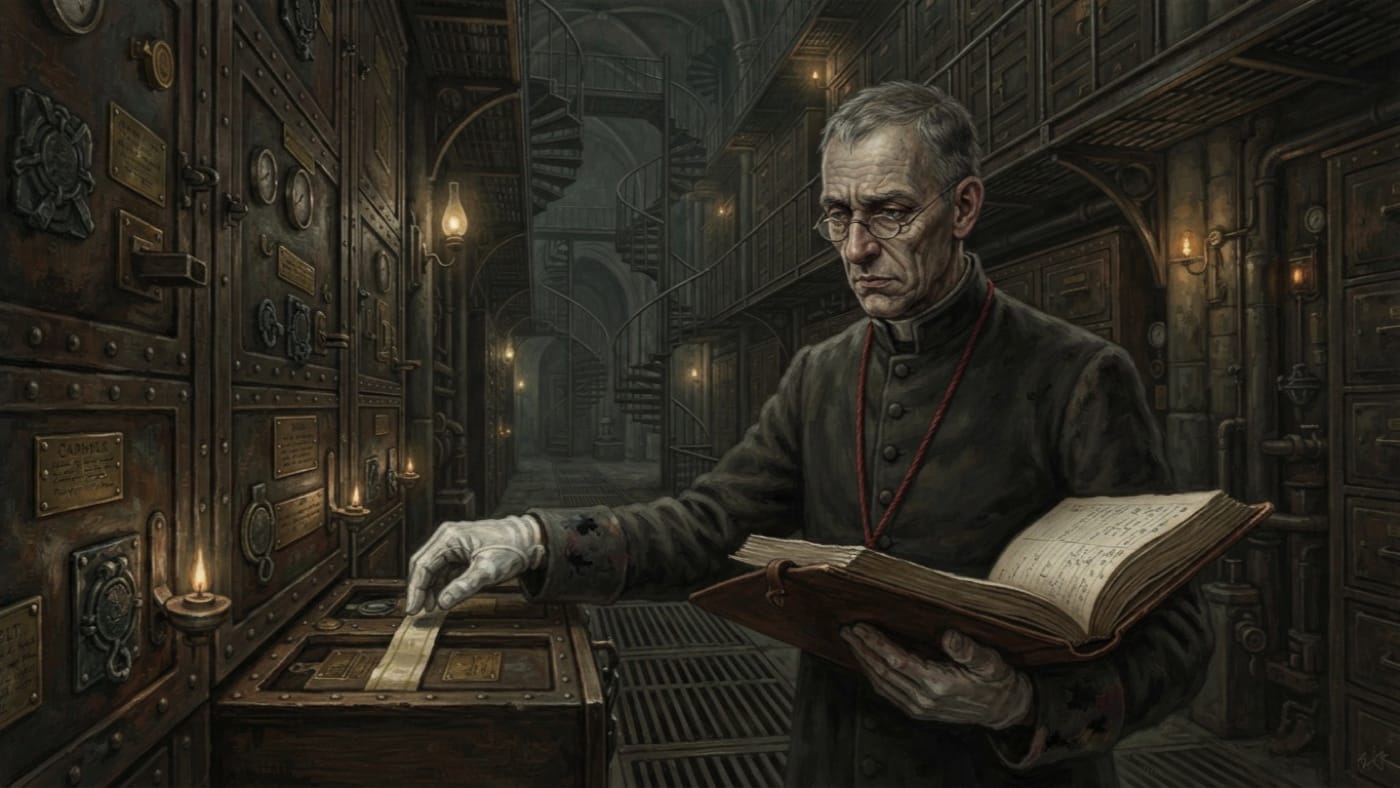
Somewhere beneath the Close of Strasbourg Cathedral, every morning, a man in white gloves bends over a strip of quarantine wax and compares it with the impression drawn in a ledger. The wax is intact. He writes that it is intact and initials the line, and the initial is the whole of his liturgy. The object behind the wax has been kept for one more day. That is the only miracle his rank is licensed to perform.
He is a Vault-Silence Curator. His title is the most honest in the Bureau of Relics, because it names both of his duties and claims holiness for neither.
The Curator is a Relic Authenticator who has outlived the lamp. He has been Lamp Hand, Examiner and notary. He has bent tapers, weighed bone and pressed seals. The profession's own lore places his grade among the elite specialists, at the far end of the promotion path. The Codex entry on his profession calls it the senior rank. He wears the scarlet stamp-cord that permits senior Authenticators to make real, and he seldom uses it. His work begins where authentication ends, whether it ended in a verdict or failed to reach one.
He serves in the Vault of Sacred Custody, beneath the Archon-Custodian, whose chair he does not occupy. The Custodian keeps the keys and the silence, and the Curators enforce that silence by standing order. They stand to him as a bailiff stands to a judge, and the bailiffs, as is customary, work the worse hours.
The Curator keeps what the Church can neither show nor lose. His typical charge is an object whose sanctity is attested and whose provenance is sound, but whose public existence would contradict another object, equally attested and equally sound. Such things are not frauds. Frauds go to the lime. These go to him.
#On Disputed Holdings
The Reliquary Schisms of A.S. 140–160 (1850–1870 CE) gave the rank its present authority. When the rank was founded is not recorded in any register I am cleared to read. I have looked, and I resent it.
The Schisms were a crisis of competence. Shrines in Cologne, Salzburg, Lyon and Bruges brought forth bones with valid chains, all of them valid at once. Saint Aldebrand acquired seventeen femurs, each one sealed and witnessed, and each with a crowd prepared to kill for it. Bishops died over tibias. The Bureau of Medicine counted bones and was told that its arithmetic was irrelevant to sanctity.
The Fourteenth Doctrinal Congress of A.S. 147 settled the matter by declining to settle it: all femurs are authentic if notarized. The Femur Principle came out under the Edict of Authentication. It preserved every relic and every shrine a relic had enriched, and it said nothing at all about storage.
A principle can be enthroned in a sentence. A surplus femur still has to be put somewhere. In the reduction years up to A.S. 160, the Bureau fell from hundreds of authentications a year to its present eleven, and disputed holdings left circulation by four roads: vault, kiln, mortar or silence. Vault and silence fell to the Curators. The Schisms gave them authority over disputed holdings, and they have not given it back.
They do not hold it alone. The Bureau of Records came out of the same years as co-custodian of provenance chains. A Curator keeps the femur. Records keeps the paper that says whose femur it is, along with a copy of the Curator's own paper, which Records calls collegial thoroughness.
#On Keeping the Cabinets
Grade, custody and silence are three separate instruments, and the Bureau confuses them at its peril. An Authenticator's verdict assigns one of four grades: Ward-safe, Votive, Contaminant or Fraud. The four took their present form in A.S. 165, and there is no fifth. Vault silence is a disposition, meaning a decision about where an object lives and who may speak of it. A disputed holding may carry any of the four grades or, in the instructive case, none at all.
The instructive case is the seal-press of Notary-Saint Caldre. It was submitted for authentication in A.S. 138 and refused, because the Bureau cannot authenticate its own instruments. It has lain ungraded under the Custodian's keys ever since, warm in every season, and the watch may touch it once but never twice. It has been pending for sixty-three years. The Curators keep a pending object exactly as they keep a condemned one, with wax, lead, witness and entry. Their whole art fits in that one cabinet: custody without a verdict, kept up indefinitely by men who are not permitted to want one.
The methods are inherited. The Curators invented no new tools. They carried the Authenticator's tools down into the Vault and never put them down. Seals are checked against registry impressions. Provenance books are kept current, every opening, transfer and inspection is entered, and Records receives its copy. Objects are handled in white gloves, under witness, and stored in lead-lined containers closed with quarantine wax. Every response is written down: weight, warmth, smell and sound. Quarantine follows grade, and the Contaminant stock never shares a corridor with the rotation stock bound for the Line.
Earlier procedural guidelines permitted Response Testing to be conducted by a single Authenticator without witnesses.
Withdrawn after the incident at the Authentication Hall of Bastion-Sibiu in A.S. 174. The rule governs testing. No Curator I have met will open a cabinet alone either, and none will tell me whether that is regulation or memory.
The intake manual is precise about sound. Silent objects are entered as "silence, observed." Audible objects are entered as "phenomena, observed," and phenomena louder than conversation require evacuation. It is a sensible rule, and it is the one every Curator was trained on.
The cabinets knock. Under the Custodian's standing order, the night reports from the quarantine section enter the knocking as silence. Both instructions remain in force. The manual governs intake. The standing order governs what the Vault is permitted to have heard. A Curator who logs by the second rule while remembering the first is doing exactly what the Bureau asks of him: keeping two true documents that cannot both be true. The femurs taught him how.
#On the Hands That Keep Them
The tremor is the rank's livery. It is common among Vault-Silence Curators, common enough that a junior clerk can pick out a Curator in a refectory by watching who holds his cup with both hands. Some Curators never acquire it. The Bureau keeps no list of which ones.
The Bureau of Medicine attributes the tremor to "cumulative sanctified exposure." The diagnosis names its cause the way a tombstone names a man. The Authenticators attribute it to the sound the quarantine cabinets make at night, the sound recorded as silence. Neither explanation has been verified. Both are on file, and Medicine's has the better letterhead.
I will not choose between them. The Bureau has not chosen, and inside the Vault the Bureau outranks me. I observe only where the tremor arrives. It comes to men whose labour is to keep a thing, and keep it, and keep it again, without settled knowledge of what it is and without leave to discuss it with anyone who lacks the clearance cord. An Examiner's hands shake before the stamp falls. A Curator's hands shake over objects no stamp has ever settled.
The rest of the body bears the profession's ordinary marks, carried longer. Glove-rash rings the wrist where the cuff meets latex and wax. Decades at the blessing lamp leave burn scars, white and glossy, across the knuckles. The ink in the cuffs defeats every laundress in the Close. One habit outlasts all the others, and that is documentation as reflex. Curators annotate. They initial doors they have merely walked past. They enter the cold in the margins of their seal-checks. The joke in the Close is that a retired Curator logs his own supper ("bread, observed") and sees nothing comic in it, because to him the unlogged object is the dangerous one.
#On the Present Charge
As of this survey, in A.S. 201 (1911 CE), the disputed holdings are still held. The femurs of the Schisms sit numbered on shelves no pilgrim will ever see, and the Archon-Custodian's quiet is still enforced. Overhead, the circulating stock does its work: Ward-safe bone in the trench niches, Votive fragments in parish shrines, rotation crates leaving under escort for the Line. The Church sees the relics that work. The Curators keep the ones that argue.
Since A.S. 182 the pressure has come from the south. The Counter-Relic Examiners confiscate hostile pieces on the Line and send them to Strasbourg, and each one becomes some Curator's cabinet the day it arrives. The Examiners test in the field and move on. The Curators do the keeping, which has no end date and carries no field allowance.
The Bureau of Doctrine holds that authentication confers sanctity. The Curators hold the objects that behave as they please regardless: warm while ungraded, loud while entered as silent, holy twice over in the paperwork of two rival shrines. Doctrine's position is sound. Nobody has consulted the cabinets.