
#On the Crisis of Surplus
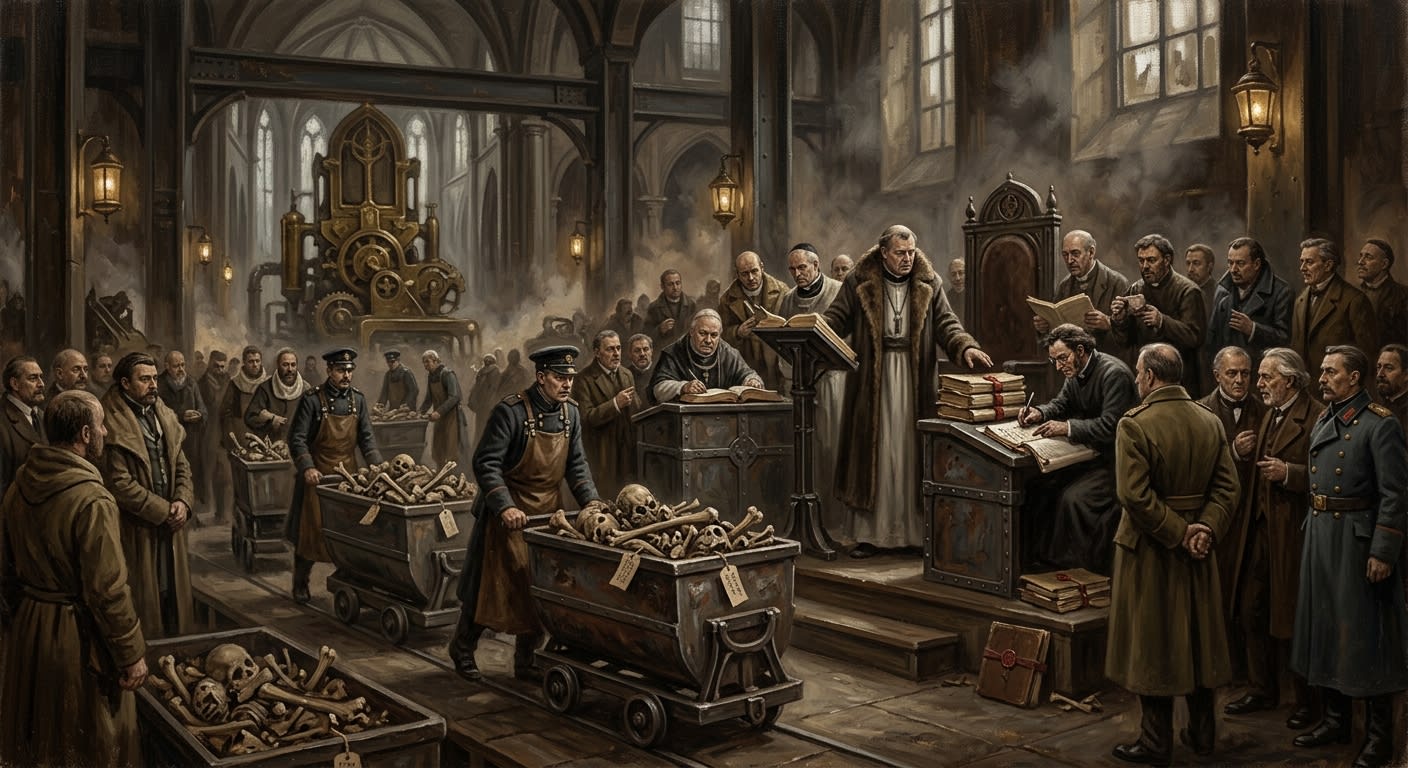
The Reliquary Schisms of A.S. 140–160 were the twenty-year period in which the Bureau of Relics discovered, to its horror and subsequent enrichment, that saints possess as many bones as paperwork permits. The crisis began as triumph. After the Atheist Wars and the long salvage of the Great Retreat, the Cellar Saints brought forth what they had hidden from Rationalist fire: femurs in linen, finger-bones in candle boxes, teeth sealed behind altar stones, vertebrae packed in salt, skull fragments labelled in hands so devoutly careful that even the ink looked sanctified.
The Bureau authenticated them. Of course it did. The seals matched. The custody chains held. The witnesses had died properly, which is the one thing witnesses can do without later contradiction. By A.S. 140, Relics had become the most confident office in Strasbourg: hundreds of relics stamped each year, shrines refreshed, pilgrim roads fattened, bastion niches stocked, and every parish priest from Cologne to Lyon newly convinced that Heaven favoured his chapel in particular.
Then Saint Aldebrand acquired his third femur.
#On the Anatomy Objection
The first dispute could have been contained by incompetence. One false seal, one careless Examiner, one bribed shrine, one animal bone under incense, and the Bureau would have enjoyed the bracing pleasure of punishment. The problem was virtue. Each claim was well made. Each relic had provenance. Each shrine produced witness rolls, transfer slips, cellaring attestations, wax impressions, pilgrimage testimonies, and the pious local fury that makes crowds gather with stones while insisting they are only present for clarity.
Cologne produced femurs. Salzburg produced tibias. Lyon produced finger-bones in liturgical excess. Bruges produced a shoulder blade that responded to the Candle Proof with such violent enthusiasm that the taper bent sideways and scorched the Examiner’s glove. The Bureau of Medicine submitted its first memorandum in A.S. 141: human skeletons possess fixed numbers of major bones. Relics returned the memorandum under the notation irrelevant to sanctity.
Earlier parish histories state that the Schisms began when “heretics forged saint-bones to embarrass the Synod.”
Corrected: the bones were, in the central cases, authenticated by Synodal process. Heresy would have been tidier. Bureau success caused the wound.
The anatomy objection spread because it was vulgar, obvious, and hard to kill. A peasant can count to two. A bishop can count to seventeen while explaining why two is spiritually incomplete. The Bureau chose bishops. The peasants noticed.
#On the Bloodshed of Provenance
A relic is not a bone once it enters dispute. It becomes jurisdiction. The chapel that owns it owns pilgrims. The diocese that owns pilgrims owns tolls. The prelate who owns tolls owns renovation, guards, influence, marriage dispensations, indulgence schedules, and enough money to discover fresh theological courage. So when two shrines claimed the same saint’s thigh, the quarrel was never about thigh. Thigh was the polite noun.
Duels began in basilica naves. Reliquary advocates fought with citation knives and, after citation failed, ordinary knives. Bishops were slain over tibias: two in Salzburg, one in Bruges, one in circumstances Records filed as ambiguous because the killer had excellent penmanship and poor doctrine. Processions met at crossroads and refused to yield, each carrying an authenticated object under canopy, each chanting its own custody chain. More than once, the rival bones glowed.
The Pilgrimage roads convulsed. Shrine-Assessors raised fees to offset “verification atmosphere.” Tithes imposed duplicate-flow surcharges. Purity detained sermonists who suggested that Saint Aldebrand had been anatomically generous. Doctrine issued eight pastoral clarifications in three years, each one sharper, shorter, and more frightened than the last.
DOCTRINE FIELD ABSTRACT — A.S. 143 — COLOGNE Public exposure of seventeen Aldebrand femurs produced simultaneous kneeling, laughter, vomiting, and three unauthorised hymns. Crowd question recorded: “Which one is him?” Response by attending Prelate: ███████████████████████ Subsequent casualties: sealed under Pilgrimage Stabilisation Order.
#On the Congress and the Femur Principle
The Fourteenth Doctrinal Congress convened in A.S. 147 because silence had become expensive. The Bureau of Relics arrived with registers. Medicine arrived with skeleton charts. Engineering arrived with a memorandum on load-bearing capacity, having somehow persuaded itself that bone arithmetic might become architecture if given sufficient ink. Records arrived with copies of every custody chain and the expression of an executioner choosing a clean apron.
The solution was Synodal in the highest sense: the contradiction was not resolved. It was enthroned.
All femurs are authentic if notarized.
The principle was obscene, efficient, and built to last. It preserved every existing relic, protected every shrine already enriched by authentication, spared the Bureau the task of confessing failure, and made anatomy subordinate to seal. Saint Aldebrand’s seventeen femurs remained authentic. The question of how many femurs Aldebrand possessed was transferred from Medicine to Doctrine, where impossible quantities have always found more hospitable air.
#On the Twenty-Year Reduction
The Edict ended the shouting. It did not restore innocence. From A.S. 147 to A.S. 160, the Bureau spent itself in revision: registry audits, custody-chain purges, double-wax comparisons, shrine inspections, and the quiet replacement of overconfident Examiners with men whose hands shook usefully before stamping. Authentication slowed. Then slowed again. By the end of the Schisms, the Bureau that had once processed hundreds of relics per year authenticated eleven.
Eleven became discipline. Eleven became penitence disguised as prudence. Eleven became the official annual rhythm by which Relics still operates in A.S. 201: eleven bones, eleven chains, eleven seals, eleven additions to the Vault of Sacred Custody. The Bureau cured haste by cutting off its own legs and declaring the sitting posture holy.
A.S. 160 closure notices state that “public confidence in relic authentication has been fully restored.”
Revised: public exhaustion achieved operational equivalence with confidence. The distinction does not affect collections.
The Schisms also created new professional habits. Relic Authenticators learned to fear clean provenance, because the cleanest chain may be the best forgery or the most dangerous truth. Vault-Silence Curators (Unregistered) gained authority over disputed holdings. The Bureau of Records obtained co-custodianship of provenance chains, a humiliation Relics has never forgiven and Records has never stopped enjoying in private.
#On the Permanent Uses of Contradiction
The Femur Principle escaped its chapel. Such principles always do. Bureau men from unrelated departments began quoting it whenever arithmetic offended policy. Tithes used it to reconcile duplicate obligations. Bells used it to approve contradictory tolling schedules. Records used it in lineage disputes where two men possessed the same grandfather by document. Doctrine used it in sermons with the smugness of a thief wearing the bishop’s ring.
The faithful adjusted with the speed of hungry creatures. Pilgrims knelt before the nearest authenticated bone and left anatomy to scholars, who are paid poorly because they ask poor questions. Soldiers at the Line cared only that the finger-bone glowed before attack. Shrine keepers cared that the donation chest filled. Relics cared that its seal remained sovereign.
The Schisms did not prove the Bureau false. They proved something worse and more useful: the Bureau could survive being visibly false, provided the falsehood was stamped before witnesses.