

The release file lifts the generation hold, so I've finished reading sources and am writing the article now.
#On the Survey of A.S. 201
"Keep the name quiet." — Notary's prayer, as entered in the Silent's dossier
This survey is compiled in A.S. 201, 1911 CE, from the registers and Codex entries now in force. It records how the phrase vault silence is used at present. That year gives no date for the feast, the saint, the Annex or any rule described below. The calendar has not yet assigned the feast a day. I have checked. The calendar has the decency to say so.
The observance, as the Silent's dossier and the Hagiography review both describe it, takes place in the Black Seal Annex beneath the Records house in Strasbourg. It consists of three acts. The clerks wash their hands. They count the seals. They keep one hour of vault silence. No sermon, procession or offering is attested, nor anything else a pilgrim could attend. Pilgrims are not admitted, so the question does not arise.
Everything else that clerks, chapel lecturers and frightened Registry Runners attach to the words belongs somewhere else in this survey. The phrase has wandered into three buildings and two Bureaus, and each building says it owns the original.
#On the Annex and Its Saint
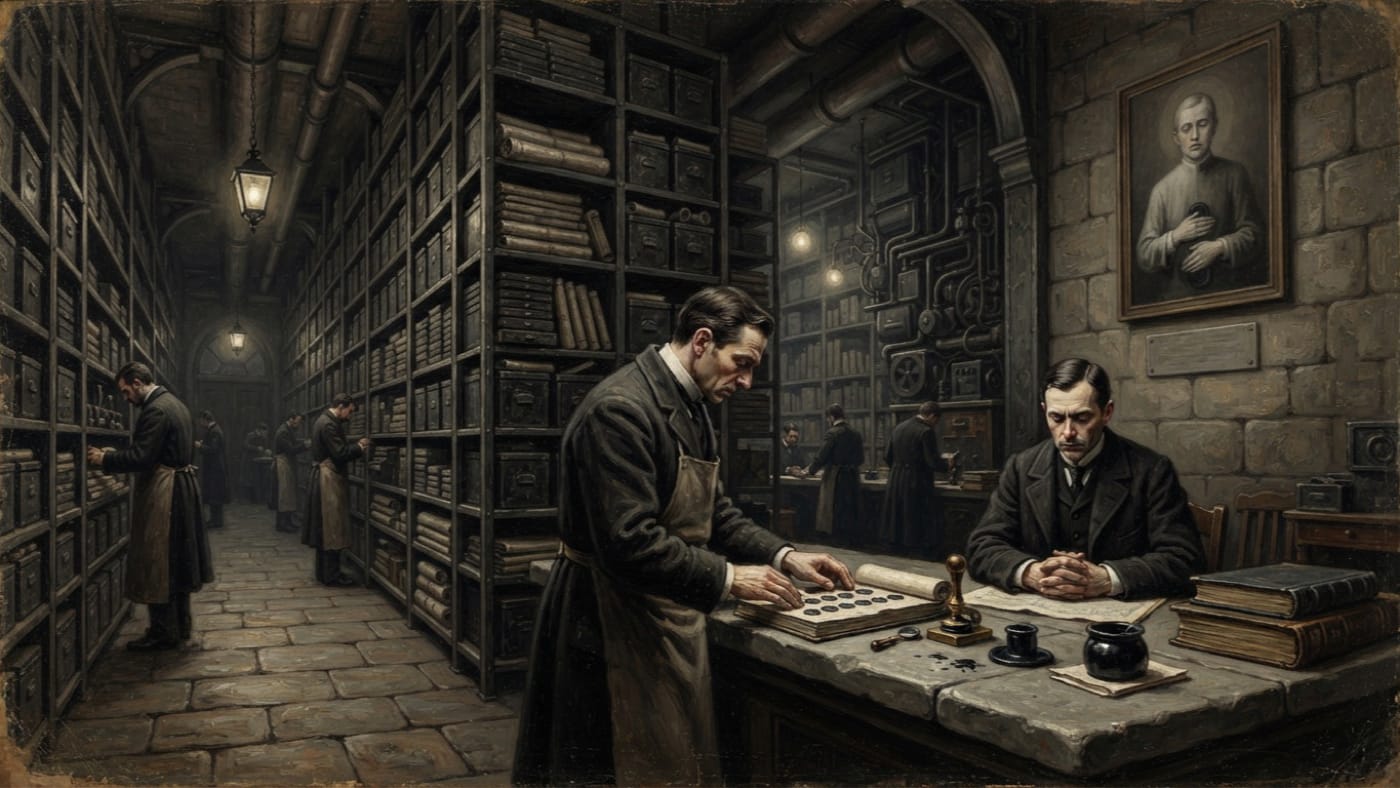
The Annex is the central archive and training vault of the Erasure Notaries. The Office of Nullity works there under Standing Order 22-N, at stone stamp tables beside trays of warmed black wax. The writ, the anchor slips and the sealed absence file of every struck citizen are kept on its shelves. When a man is made absent above ground, his reasons go down to the Annex and stay there.
Saint Vellum the Silent hangs on the inner wall. His icon shows a pale clerk with a closed mouth and washed hands, holding a black seal where a martyr would hold a palm. The Notaries call him patron, and so do the Strike Scribes, Nullity Clerks and Lineage Severers. The Bureau of Records sanctions the invocation by usage, and nothing more is on file. He has no authorised vita. No relic of his has been authenticated; by the dossier's account the Bureau of Relics has twice declined even to examine a purported finger bone. No completed canonisation exists.
Records credits him with "purging the city of invisible demons." The city is unnamed. The purge is legend, and so is the man. The dossier reads those demons as documentary contradictions: dead soldiers drawing bread in three towns, widows married twice through a copyist's error. That reading is mine. I wrote it, and Hagiography has confined it to me, properly. The Church keeps real demons on its books, and one clerk's patron does not get to file them all as clerical error.
The Silent's annual observance, being useful devotion tolerated by Records, constitutes "the purest form of canonisation available in a bureaucracy."
Withdrawn as a statement of status. The phrase in the Nullity entry was a figure of speech. Hagiography's file holds a sanctioned usage and a feast, and holds no canonisation. A figure of speech does not outrank a file.
Nor is the Silent any of his namesakes. Vellum-of-the-Quiet-Hand keeps the bone-stampers, Vellum of the Valve the resonance plumbers, and Vellum of the Narrow Line the manifest litigants. Mother Vellum-of-the-Reed keeps the ferry crossings, and Hagiography is non-cognisant of her, which is a different condition from the Silent's sanctioned usage and a much lonelier one. A memorandum once proposed folding several of these cults into one clerical ancestor, and the proposal was rejected for operational use. Conflation now requires written permission from both Hagiography and Records. Neither has issued any. The Silent's hour belongs to the Silent and to nobody else.
#On the Hour and the Session
Clerks run two practices together, and this survey keeps them apart. One is the feast hour. The other is the working discipline of the strike session.
The feast hour happens once in the cult's year, in the Annex. Washing, counting, one hour. The Annex entry says the silence is so complete that Registry Runners swear the lamps burn quieter. The dossier has the Runners swearing that the shelves hold their breath. Both are sworn impressions from children who carry rolls for a living and walk without letting their shoes speak. I enter them as testimony. They prove the Runners were frightened. Whether the lamps are frightened is not established.
The strike session is the ordinary working day, and its discipline is the one the trade actually learns. Hagiography sets it out as something that can be taught in a morning: wash, dry completely, count the seals, tap the black stamp twice on stone, and speak no word after the first seal. In the dossier's account, during the session questions are pointed at instead of asked, names are only mouthed, and errors are marked with a tap. The Annex adds rules nobody wrote down, among them a strip of blank vellum in the sleeve and no strike while the vault door stands open.
That rule binds Notaries at a strike, by the account of their own trade's sources. Nobody has shown that it binds anyone else. The sources prescribe no penalty, and I am not going to invent one. The Annex's own instructors seem content to let fear do the work.
The two practices meet at the hands. A Notary who skips the drying smears the strike. A smeared strike leaves a ghost right, and a ghost right brings an appeals advocate down the stairs to a named clerk's table. The feast hour makes no promise to prevent this. It only lets every clerk in the vault hear what the work sounds like when nobody speaks. Senior Notaries deny the shelves hold their breath. The dossier records that they refuse to work if the hour is shortened.
#On Silence as a Verdict
In the Bureau of Relics the same phrase means something else.
The Custodial Chain entry lists the dispositions open to an examiner after the bone has been weighed and the story tested: display, transport, quarantine, or "the condition the vault-curators call silence." The chain records hands. It says who held the object, from whom, under what seal. It cannot say whose thigh the bone came from or whether it is safe to stand beside. Those findings belong to other pages, and Records keeps duplicates of all of them.
The Edict of Authentication, sealed by the Fourteenth Doctrinal Congress in A.S. 147 during the Reliquary Schisms, sets out its categories in my own earlier prose. Primary, secondary and tertiary authentication follow from the Femur Principle. A quarantine authentication was provided for objects "too responsive to display and too profitable to destroy." The Archon-Custodian entry describes a sealed form of the same Edict, permitting surplus disputes to be retired into vault, kiln, mortar or silence. By A.S. 160 that had become routine, along with the eleven-a-year rhythm.
Rejected objects entered Fraud, Contaminant, or Vault Silence, depending on whose nephew had donated them.
Corrected as to vocabulary, though not as to nephews. Fraud and Contaminant are object grades. Vault silence is a disposition: where an object lives and who may speak of it. Since the taxonomy of A.S. 165 the grades have been four, Ward-safe, Votive, Contaminant and Fraud, and there is no fifth. A holding may also stay ungraded. The Edict's quarantine authentication is a third instrument again, and it is not the same thing as silence.
Grade, authentication category and disposition stay separate in this survey, because the registers keep them separate and the clerks do not. A Contaminant may sit in vault silence. So may a Votive fragment whose sound provenance contradicts another shrine's. So may Caldre's seal-press, ungraded since A.S. 138 and warm in every season. The Authenticators have a saying for it, "vault silence is still a verdict," and they keep it from the auditors. The saying is a joke about disposition. It does not make a fifth grade.
#On the Other Vault
The Vault of Sacred Custody lies beneath the Close of Strasbourg Cathedral, seventeen steps below the Reception Hall. It is a Bureau of Relics site under a classified Archon-Custodian, a different building from the Black Seal Annex, under a different Bureau, with no saint of its own on the wall. The two cellars share a city and a word. Neither has ever sent the other a feast invitation.
Vault-Silence Curators enforce the Custodian's quiet there under a standing order. When the rank was founded is unrecorded. The Schisms gave it authority over disputed holdings. A Curator checks quarantine wax against the ledger impression, keeps the provenance books current, and sends Records its copy.
The intake manual says otherwise. It enters silent objects as "silence, observed" and audible ones as "phenomena, observed," and phenomena louder than conversation require evacuation. Both instructions remain in force. The cabinets in the quarantine section knock, and the night reports enter the knocking as silence. Here the rule and the record disagree, and the Bureau keeps both on file. The documents do not show that the standing order makes the cabinets quiet. They show only that it decides what the Vault is permitted to have heard.
#On the Present Disposition
As surveyed in A.S. 201, 1911 CE, the phrase stands as follows. In the Annex there is a feast hour with no date, kept for a saint with no Life, in a vault that admits no pilgrim. At the stamp table there is a working discipline that binds Notaries during a strike and pretends to bind nobody else. In the registers of Relics, silence is a disposition, kept separate from the four grades and from the Edict's quarantine authentication, whatever my own earlier sentence said. Under the Cathedral Close there is a standing order that turns knocking into silence by entry, alongside a manual that would have called it phenomena.
No one rite connects them. Clerks who claim one will be asked for a citation.