

#On What Is Remembered
The Vespers Dispatch is the Church's name for one evening at Montreval in A.S. 25 / 1735 CE. That evening, during Vespers in the fortress chapel, news of the Betrayal of Aachen reached Cardinal-Marshal Severin of Avignon. The name is careless, because it suggests a single document. At least two kinds of paper passed through that chapel. The courier's report came in and the orders went out. Between them stood a psalm and a commander who declined to be hurried.
Schoolrooms keep the middle of the evening and lose both ends. I file the whole of it. A gesture without its paperwork is a holy card, and the Ledger does not trade in holy cards.
The year is certain, and so is the occasion. I have not been permitted to read any record of the day, the month, the hour the courier dismounted or the number of days he spent on the road, and I have been permitted to read a great deal. By its own account Aachen fell on a Tuesday evening. That Tuesday belongs to Aachen. It did not ride south with the courier.
#On the Chapel and the Command
By A.S. 25, Montreval had been ruined once and repaired by people who expected to be ruined again. It sat in the southern passes between Avignon's ecclesiastical rear and the roads north toward Lyon and the Rhine. Severin held it as the field seat of the southern faithful front under the old Church. The three siege winters against Lucien Artois and his clockwork artillery, A.S. 15 to 18, lay behind it, and they had left their accounts in stone and in custom: cracked bells, patched glass, garrisons sorted into prayer companies by parish, and bread issued by the half measure.
Those winters were over. I have heard sermons that keep Artois's guns firing straight through A.S. 25 for atmosphere. Nothing in the record has him bombarding the chapel that evening, and I will not lend him the ammunition.
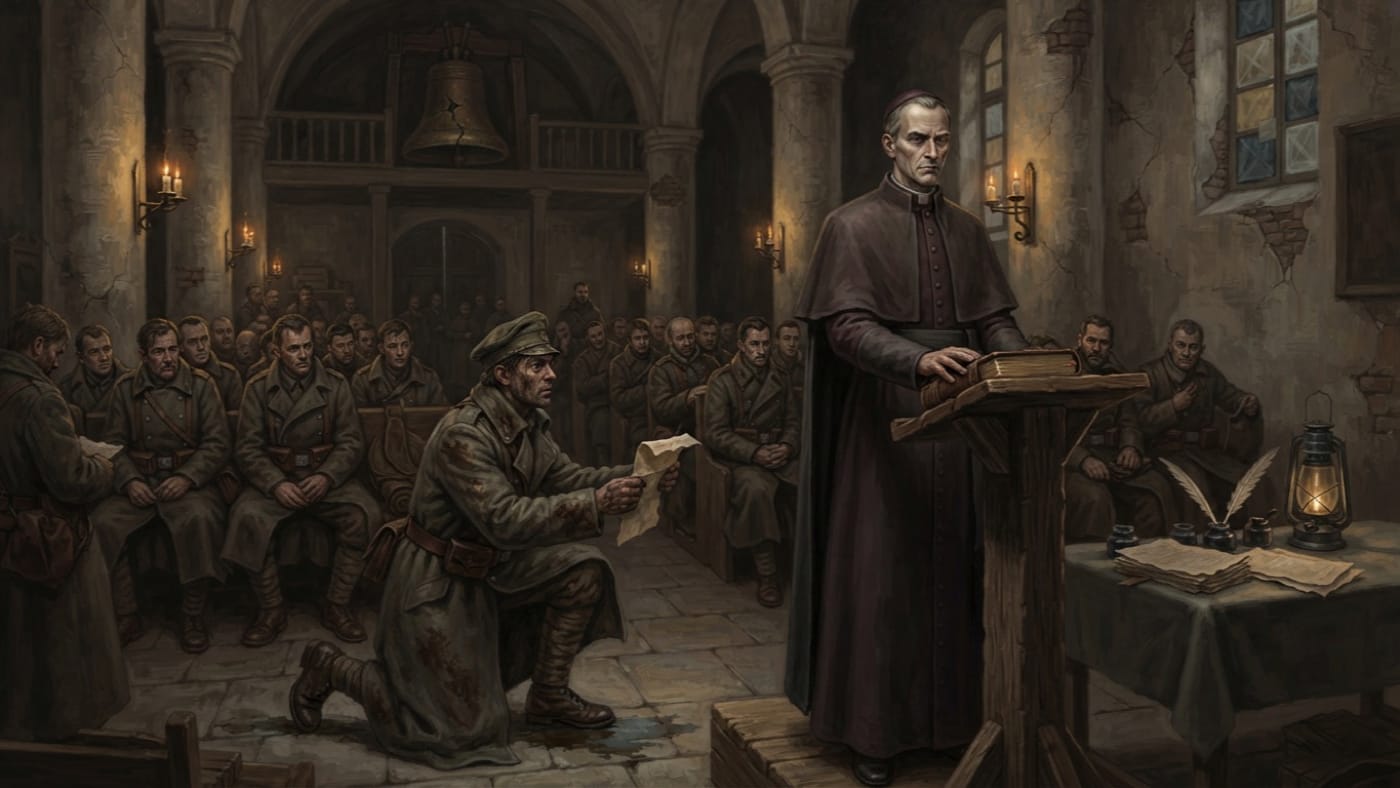
The witnesses describe the chapel itself in a plain inventory. It had patched windows and a cracked bell above. Officers stood in the aisle and a damp congregation filled the nave. Damp is all the record says. Nobody wrote down whether it came from rain, snow, hunger-sweat or the ordinary wetness of soldiers, and a weather report invented two centuries late is still a forgery.
Officers attended Vespers because in Severin's command the office and the order of the day shared a room. He preached from parapets, hung bells in the gun galleries and drilled his garrison to Hold. Pray. Reload. A commander who prays with his staff knows where his staff is. In wartime that is piety in its most practical vestment.
#On the Psalm and the Paper
The courier entered while the Miserere was being sung. His boots left black water on the floor. His name, rank, point of departure, route and fate are lost. The Church kept the stain he made and mislaid the man, which is an old habit of the Church.
The dispatch reported what Aachen had become. Lord-Protector Guillaume had opened the citadel to Rationalist columns in exchange for promised dominion over the Lowlands. Aachen was a junction more than a fortress. It held the roads, the supply lines and the courier relays that kept the faithful armies linked. With Aachen gone, the northern faithful front was cut and the Rhine garrisons were severed from relief. Montreval had spent years guarding its approaches on the understanding that a north lay at the far end of them. The paper in Severin's hand cancelled the north.
He read it. He finished the psalm.
That is the whole of the sequence. I set down no verses, because the Codex is not a psalter, and I give no duration, because nobody measured one. The Miserere asks for mercy. Nobody recorded its setting, its mode, the condition of the choir or the steadiness of the Cardinal-Marshal's voice, and I do not intend to improve on that silence with acoustics.
No council of war broke in, and no officer shouted. Whatever Severin thought while the verses ran on, he took it into his second coffin.
#On Ink, Couriers and Two Bridges
When the psalm ended, the commander resumed. Severin asked for fresh ink. He summoned the quartermasters, doubled every western courier route and ordered two western bridges burned.
The dossier says the garrison had defended those spans for nine months. Other accounts say only that it had defended them for months. I give the nine on the dossier's authority and no further.
The reasoning needs no secret folio. A bridge is an approach while friendly country lies beyond it. Once Aachen fell, the country beyond Montreval's western crossings could no longer be trusted, and every approach became an invitation. The doubled courier routes answer the same problem from the other side. A front that has just lost its principal relay junction spends riders to keep its remaining lines open. Severin paid in riders for what Guillaume had sold for wine.
The record leaves a good deal out, and I will not fill the gaps. The bridges are not named. Nobody recorded the demolition method, the engineers, the replacement itineraries, the hour the fires were set or the cost in lives. The two spans of A.S. 25 are not the Pont des Tanneurs. That bridge burned ten years earlier at the hands of the Sisters of the Martyrdom, and it has its own women, its own witnesses and its own quarrel over names. Grafting those dead onto this order would make a tidier sermon and a dishonest file.
One human fact survives. Men who had lost brothers defending those bridges carried oil to destroy them, and some cursed the Cardinal-Marshal as they poured. I consider it the most reliable line in the whole episode. Nobody invents resentment for a hagiography.
#On the Three Copies
The evening was composed in the chapel. In the archive it falls apart.
The Bureau of Records holds three copies of the order Severin gave after the psalm, and they disagree. In the first he says burn the bridges. In the second he says cut the roads. The third is water-damaged and preserves only bless the—, followed by a brown stain that Records classifies as either wine or arterial residue. Records has declined to choose between wine and blood. I commend the abstention, which is the only theological modesty that office has ever shown.
None of the three is authoritative. My dossier prints a fuller wording under the heading FIELD ORDER MONTREVAL-25-C, and it correctly labels that wording as attributed. It is not a master text. Nobody may use it to complete the damaged copy, and it does not count as a fourth witness. When the dossier calls all three copies canonical, it means only that the Church kept the contradiction instead of burning two-thirds of it. A variant does not stop being a variant because it was preserved.
The question of custody needs care. These were the field orders of an old-Church commander in wartime. The formal Synod did not exist until the Concordat of Strasbourg in A.S. 90, and the Records office that now holds the copies took its present form decades after the war. No Bureau officer stood in that aisle. Severin wrote the orders, and our clerks filed them generations later.
The incoming report must be kept apart from all this. The courier's dispatch concerned Aachen, while the three copies concern bridges. A provincial chaplain once preached the stain on the third copy as a lost verse of the Miserere and was corrected in the usual manner. The psalm came down to us whole and the logistics came down in pieces.
#On Later Readings
The Bureau of Doctrine keeps two readings of the completed psalm on file. One calls it supreme composure and the other catastrophic denial, and the Bureau calls both qualities useful in a field commander. They are interpretations only. Neither one opens Severin's skull, and the Bureau has not yet licensed any reading that does.
My own reading is narrower. A commander who stops a psalm halfway lets the courier set the order of service. Severin made the courier wait, and he did it on the last ground that was entirely his.
The episode did not win the Atheist Wars. The Rationalists took them at the Treaty of Regensburg in A.S. 30, whatever was sung at Montreval. Severin's recorded legacy is that he kept the southern faithful front from dissolving after Aachen and held the Avignon corridors long enough for clergy, relics and archives to escape. I credit that to his whole conduct of the war. Two bridges and an inkwell cannot carry the credit alone, however economical the story would be.
Sister-Quartermaster Eliane's deposition, sealed in A.S. 42, belongs in its own folder. Whichever burning her testimony concerns, it neither dates this evening nor identifies these bridges.
Several Avignon calendars list Severin as Saint Severin the Unbroken.
Unauthorized. The title is devotional excess, tolerated locally and refused centrally. Severin is retained as Exemplary Defender, Second Class. The evening may be called the Vespers Dispatch. The man may not be invoked as a saint without licence.
His second coffin bears his name, his titles and the date of the Vespers Dispatch. It carries no psalm, no order and no stain. Of all the evening's custodians, only the stonecutter kept to what he knew.