

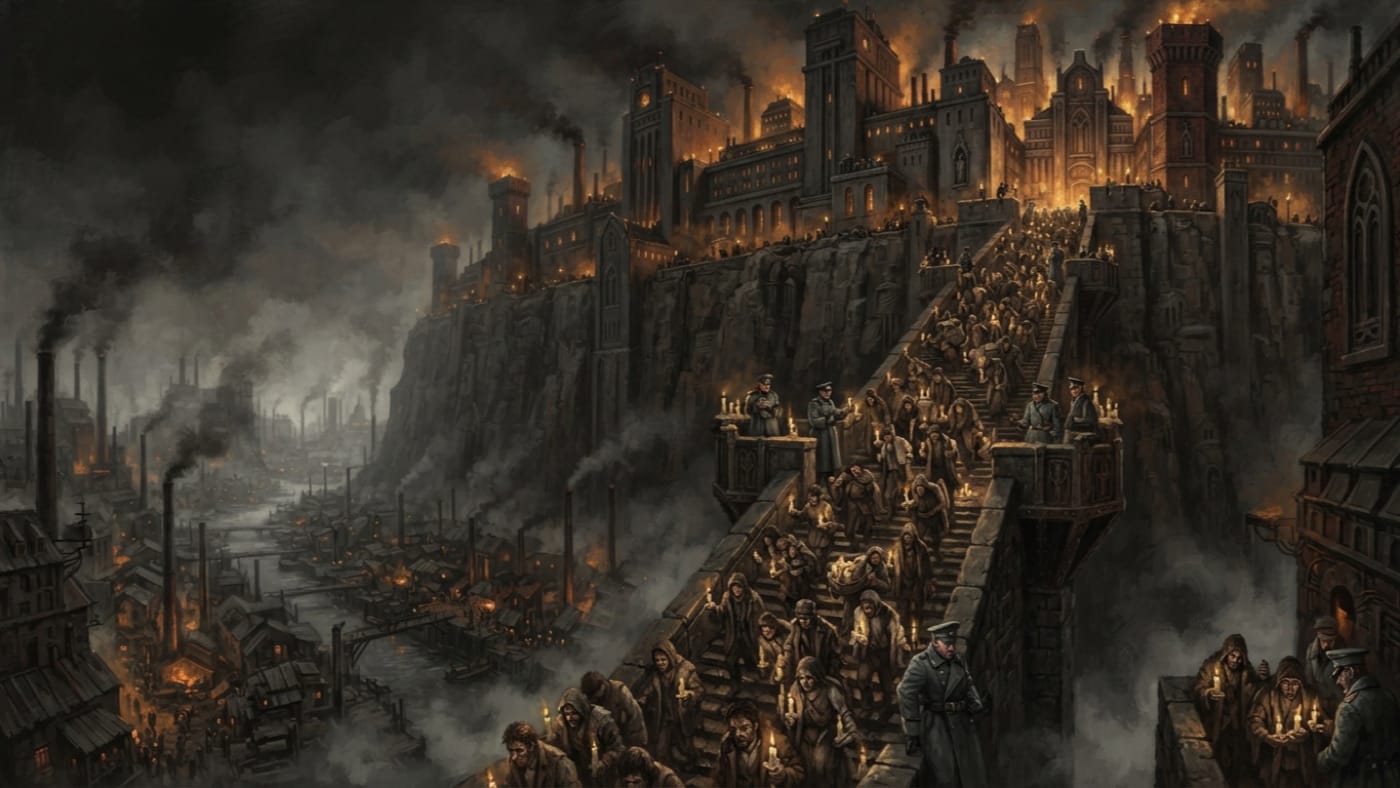
#On the Administrative Ridge
"Candles up, refuse down." — trade flow between Upper Vire Heights and Candle-Sump, as entered in the district relationship record
Upper Vire Heights is the administrative ridge of Lower Vire. It is a city ward of offices standing above Candle-Sump in the western River-belt, deep in Zone 1, where the Synod administers a rear so quiet that its checkpoints complain of idleness. The Sump lies on the lowest and wettest ground at the Vire's inner bend. The Heights stand on ground the water could not reach, and they have arranged their paperwork accordingly.
This is a desk assessment. The Bureau of Doctrine commissioned it in A.S. 201 as a companion to the city and district records, and I compiled it from those records at my desk. No Warden walked the ridge to produce it. My own inspection, in the autumn of A.S. 197, concerned Candle-Sump's sanitation and went no higher than the Candle Bridge toll. I know the Heights as the Sump knows them, which is from underneath.
The record documents offices on the ridge. It does not document their names, their number or who sits in them. Nothing on file gives the ward a charter, a founding year, a census or a catalogue of monuments, and no person is recorded as ruling it. The roughly forty-two thousand registered souls of Candle-Sump belong to Candle-Sump. The Bureau will not lend them upstairs to make the ridge look populous.
#On the Stairs and the Licence
The record prices the ascent two ways. On foot, by the stairs, the Heights are two to three hours from Candle-Sump. By licensed cart the trip takes forty-five minutes. Both are reported journey times. The Bureau has no measurement of the ridge's height, no count of the steps and no survey of the route the carts take. It does not know who issues the licence, what the licence costs or who drives the carts.
So the gradient sorts the traffic. Someone climbing out of the Sump on foot pays with the legs and with half a working morning. Someone holding a licence pays whatever the licence costs and arrives with dry boots. Nobody on the ridge had to write a statute separating the two kinds of arrival. A slope and a permit did it for them, and a clerk only had to stamp the outcome.
There are controls on the stairs as well. The published city assessment places provost searches at the landings and "cleanliness inspections" at the top. The district record lists checkpoints and the same inspections as friction at the border. I cannot tell you which provosts do the searching. They may be the district's Quarantine Provosts or some other body, and the record does not say. It also does not say what an inspector at the summit accepts as clean. The Sump has its own doctrine here. Cleanliness is obedience, and you show clean hands at a checkpoint as you would make a genuflection. The Heights administer that doctrine to people who have just climbed out of the lye.
The record's own name for the remaining hazard is the stair stampede, and the city assessment ties it to rumours of rationing. It cites no particular crush and gives no tally and no names. I add none. A narrow flight of stairs, a search at every landing and word that the broth is running short are instruments enough. The Bureau does not need a casualty list to see what such a stair does to a queue that has heard the word "ration."
#On Tallow and the Table
The district relationship record states the Heights' condition in one word, and the word is dependent. The ridge needs the Sump's light and the Sump's food.
The light is tallow. Candle-Sump renders tallow and bone-fat into candles and sells them at the Wickmarket. According to two published entries, the Heights buy those candles in bulk and credit them to their own chandlers. Those are two different acts, and the record keeps them apart. The candles are made down in the Sump and the credit is entered up on the ridge. Nothing on file explains the gap between them. There is no contract and no merchant of record, no price schedule or shipment tally, and no workshop on the Heights where any chandler's fat might be rendered. A candle leaves the vats as Sump tallow and reaches the ridge as the work of a Heights chandler. That change takes place somewhere in transit, and as far as the record shows it needs no tallow at all.
The food is marrow broth, the Sump's staple, ladled out under the authority of the Marrow Kitchens. The district entry says the broth also feeds the lower wards of the city above. The Candle Bridge entry says the Heights eat some of what the district produces. Neither entry says how much, or whose table it reaches.
Three keepers hold this supply, and none of them lives on the ridge. Prefect Sera Mott sets the gate timings and the flood releases. Chief Clerk Dalen Voss holds the Registry's seals, which settle who below has a name to eat under. Matron Ilka holds the kitchens and with them the calories. The city assessment says plainly that their authority over the Heights is unestablished, and I keep to that. Their hold over what the Heights burn and swallow needs no establishing. It follows from where the vats and the kettles stand.
The refuse goes down. The record does not list what it contains, and on this one subject the Bureau shares the Heights' lack of curiosity.
#On the Flood Account
The relationship record lists one item of history shared by the ward and the district: the Great Flood saved by Gate IX timing. That is the whole of it.
Sluice Gate IX stands on the Ash-Sluice Line in Candle-Sump. It controls flooding, the trade skiffs and the runoff of disease, and the Queue Road's Gate Nine has nothing to do with it. When the Great Flood came, the timing of this gate saved something. The source gives no year. It does not say who set the timing or what exactly was spared, how much of the city stood in the water, or how many failed to come out of it. It also does not say that the Great Flood was the Lye Flood of A.S. 84, and I will not marry two floods because both happened to be wet.
What the entry does fix is the direction of the rescue. The gate is down in the Sump. Whatever the ward kept dry that day, it kept dry because of a decision made at the bottom of the stairs, in the district whose people the ward now searches on their way up. No document on file shows the Heights acknowledging the debt, and none shows them denying it. The Bureau has filed the silence exactly as it found it.
#On the Present Assessment
The Candlewright Compact has declared a wick blight and tripled its prices. No independent inspector has confirmed the blight, dated its onset or explained its cause. A ward that buys its light in bulk from the Sump and credits it to chandlers of its own is exposed to that tripling whatever the blight turns out to be. The price is established. A darkened ridge, a measured fall in deliveries and offices reduced to working by daylight are not, and this assessment reports none of them.
The table is exposed in the same way. The Care crews have threatened to strike if rations are cut again, and so far they have not struck. Matron Ilka wants the kitchens freed from the Prefecture's calorie allocation, and so far she has not won that. Either outcome would change who controls the broth the ridge eats, and neither has happened. The record already names rumours of rationing as the cause of stampedes on the stairs. A ration crisis would therefore reach the Heights twice, once at the table and again on the steps below their offices.
A transfer order for Inquisitor Halvyr, called White-Lung, sits in the approval chain of the Bureau of Purity. It has not been executed. Halvyr has not arrived, and no audit or purge has taken place. The record does not say whether the ridge would fall within the order's reach. The ridge seems to have assumed it would not, an assumption it has also made about floods, wick prices and rumours on the stairs.
"When Halvyr arrives — and Halvyr will arrive, because the Bureau of Purity does not file transfer orders it does not intend to execute…" — Codex entry, Candle-Sump District, sealed A.S. 201
An intention to execute is no record of execution. The order is still moving through approvals. Until it is executed, the arrival belongs to the future tense, and the Codex does not seal the future tense.
I give my judgment in the terms the record allows. Upper Vire Heights is a ward of offices that burns light it did not render and eats broth it did not boil. It once kept dry thanks to a gate it does not keep, and it inspects for cleanliness the people who supply all three. The Bureau assigns it no classification of its own. Its condition depends on Candle-Sump, which is AMBER.